惯性聚合 高效追踪和阅读你感兴趣的博客、新闻、科技资讯
阅读原文 在惯性聚合中打开

推荐订阅源

量子位
cs.AI updates on arXiv.org
F
Fortinet All Blogs
博客园 - 聂微东
奇客Solidot–传递最新科技情报
奇客Solidot–传递最新科技情报
Hugging Face - Blog
Hugging Face - Blog
V
Visual Studio Blog
小众软件
小众软件
有赞技术团队
有赞技术团队
雷峰网
雷峰网
钛媒体:引领未来商业与生活新知
钛媒体:引领未来商业与生活新知
AWS News Blog
AWS News Blog
C
Cisco Blogs
美团技术团队
T
Threat Research - Cisco Blogs
C
CERT Recently Published Vulnerability Notes
人人都是产品经理
人人都是产品经理
宝玉的分享
宝玉的分享
Threat Intelligence Blog | Flashpoint
酷 壳 – CoolShell
酷 壳 – CoolShell
Stack Overflow Blog
Stack Overflow Blog
W
WeLiveSecurity
D
DataBreaches.Net
博客园 - 司徒正美
Blog — PlanetScale
Blog — PlanetScale
IT之家
IT之家
云风的 BLOG
云风的 BLOG
Cyber Security Advisories - MS-ISAC
Simon Willison's Weblog
Google DeepMind News
T
The Blog of Author Tim Ferriss
Know Your Adversary
Know Your Adversary
NISL@THU
NISL@THU
OSCHINA 社区最新新闻
OSCHINA 社区最新新闻
The Cloudflare Blog
Vercel News
Vercel News
月光博客
月光博客
T
Tailwind CSS Blog
H
Help Net Security
aimingoo的专栏
aimingoo的专栏
P
Proofpoint News Feed
Application and Cybersecurity Blog
Spread Privacy
Spread Privacy
cs.CL updates on arXiv.org
Cisco Talos Blog
Cisco Talos Blog
Microsoft Security Blog
V
V2EX
WordPress大学
WordPress大学
Cyberwarzone
Cyberwarzone
Recent Announcements

PostHog's RSS Feed

Training our own AI models - PostHog From 270GB RAM to 5GB: Moving local flag evaluation from Django to Rust The best analytics stack for vibe-coded apps The do's and don'ts of minimum viable product marketing - PostHog The best MCP servers for startups, by workflow 4,063 errors closed without a human opening PostHog – here's what we learned - PostHog PostHog Code and the self-driving product - PostHog Why attacking your competitors online is dumb - PostHog The best real-time analytics platforms for developers, compared DuckDB vs ClickHouse: Why we use both at PostHog - PostHog PostHog's next chapter - PostHog Making Claude Cowork actually useful - PostHog PostHog vs Matomo in-depth tool comparison You're doing lifecycle emails wrong Untangling Tokio and Rayon in production: From 2s latency spikes to 94ms flat The best HIPAA-compliant A/B testing tools - PostHog A beginner's guide to testing AI agents - PostHog I hate the standup bot (so I built an agent to do it for me) - PostHog The best CDPs for developers, compared The best error tracking tools for developers, compared The best feature flag software for developers, compared 7 best session replay tools for mobile apps 7 best free open source business intelligence tools right now 7 best free and open source LLM observability tools PostHog vs LogRocket in-depth tool comparison The most popular PostHog alternatives, compared Open source (and self-hosted) session replay tools - PostHog The 9 best GA4 alternatives for apps and websites - PostHog PostHog vs Google Analytics 4 in-depth tool comparison How we built automatic clustering for LLM traces - PostHog The 7 best HIPAA-compliant analytics tools 8 best open source analytics tools you can self-host - PostHog The best product analytics tools for startups, compared PostHog vs FullStory in-depth tool comparison The best in-app survey tools for product teams, compared The 7 best mobile app analytics tools PostHog vs Hotjar in-depth tool comparison The 8 best free and open-source feature flag services - PostHog The 5 best free and open-source A/B testing tools - PostHog The best mobile app A/B testing tools, compared What is a feature flag? Feature Flags vs Remote Config vs A/B Testing PostHog is now available in Vercel’s v0 The best Heap alternatives & competitors, compared PostHog vs Heap in-depth tool comparison PostHog vs Pendo in-depth tool comparison PostHog × Vercel: feature flags, minus the plumbing Your logs' final destination is in GA. You always end up here anyway Behind the scenes of a PostHog hackathon - PostHog The most popular Mixpanel alternatives & competitors, compared PostHog vs Mixpanel in-depth tool comparison The 9 best GDPR-compliant analytics tools How we use Logs at PostHog The best web analytics tools for developers, compared Stop AI slop: Run evals with LLM-as-a-Judge - PostHog You product data just got a job: Workflows is now out App onboarding: How to fix drop-off points Meet Logs (beta) – logs with all the tools you’re already using Why small teams crush tiger teams How we built user behavior analysis with multi-modal LLMs (in 5 not-so-easy steps) - PostHog The best Contentsquare alternatives & competitors, compared 8 learnings from 1 year of agents – PostHog AI - PostHog Why we killed our AI product assistant Workflows graduate to beta! Product data, meet automation The best Rollbar alternatives & competitors, compared Workflows are now in Alpha and I already broke mine - PostHog I've consistently underestimated how important communication is as a CEO - PostHog How we made feature flags even faster and more reliable The best session replay tools for developers, compared What I learned attending my first ever hackathon - PostHog Did you know AI is answering our community questions? - PostHog How not to be boring - PostHog We built an internal tool to generate changelog images for social media - PostHog What we built at our windswept Mykonos hackathon - PostHog How we built our onboarding email flow (with actual performance data) - PostHog We're building a better PostHog community by closing our public Slack - PostHog Introducing Notebooks for PostHog - PostHog Why we've launched PostHog user surveys - PostHog How we made feature flags faster and more reliable - PostHog In-depth: ClickHouse vs Redshift - PostHog Introducing HouseWatch: An open-source toolkit for ClickHouse - PostHog Introducing HogQL: Direct SQL access for PostHog - PostHog What we built at our sun-kissed Aruba hackathon - PostHog In-depth: ClickHouse vs BigQuery - PostHog In-depth: ClickHouse vs Elasticsearch - PostHog HogMail #22: Why do companies over-hire?" - PostHog Our simpler goal: Help engineers to be better at product - PostHog In-depth: ClickHouse vs Snowflake - PostHog HogMail #21: Avoiding the "Product Death Cycle" - PostHog Sunsetting Kubernetes support for PostHog - PostHog Why 'Product Engineer' is the most fun role I've had in tech - PostHog HogMail #20: Why do startups fail? - PostHog The best Google Optimize alternatives for apps and websites - PostHog Array 1.43.0: Massive performance improvements! - PostHog In-depth: ClickHouse vs Druid - PostHog HogMail #19: Which meetings should you kill? - PostHog CEO diary: The things I learned in 2022 - PostHog The essential tools used by product engineers - PostHog HogMail #18: What can SaaS learn from the New York Times? - PostHog What is a product engineer? - Product Engineer Handbook - PostHog Array 1.42.0: Get beta features via our roadmap! - PostHog
The state of plugins on PostHog - PostHog
Yakko Majuri · 2021-11-16 · via PostHog's RSS Feed

Update (May 2022): Plugins are now known as apps!

The plugin server has become an integral part of PostHog, as it is responsible for event ingestion. However, it isn’t called “ingestion server” because it was originally designed to run plugins. So, how are those going?

I used a combination of PostHog, Metabase, Python scripts, and Google Sheets to compile, analyze, and display the data you see here to answer that question as transparently as possible.
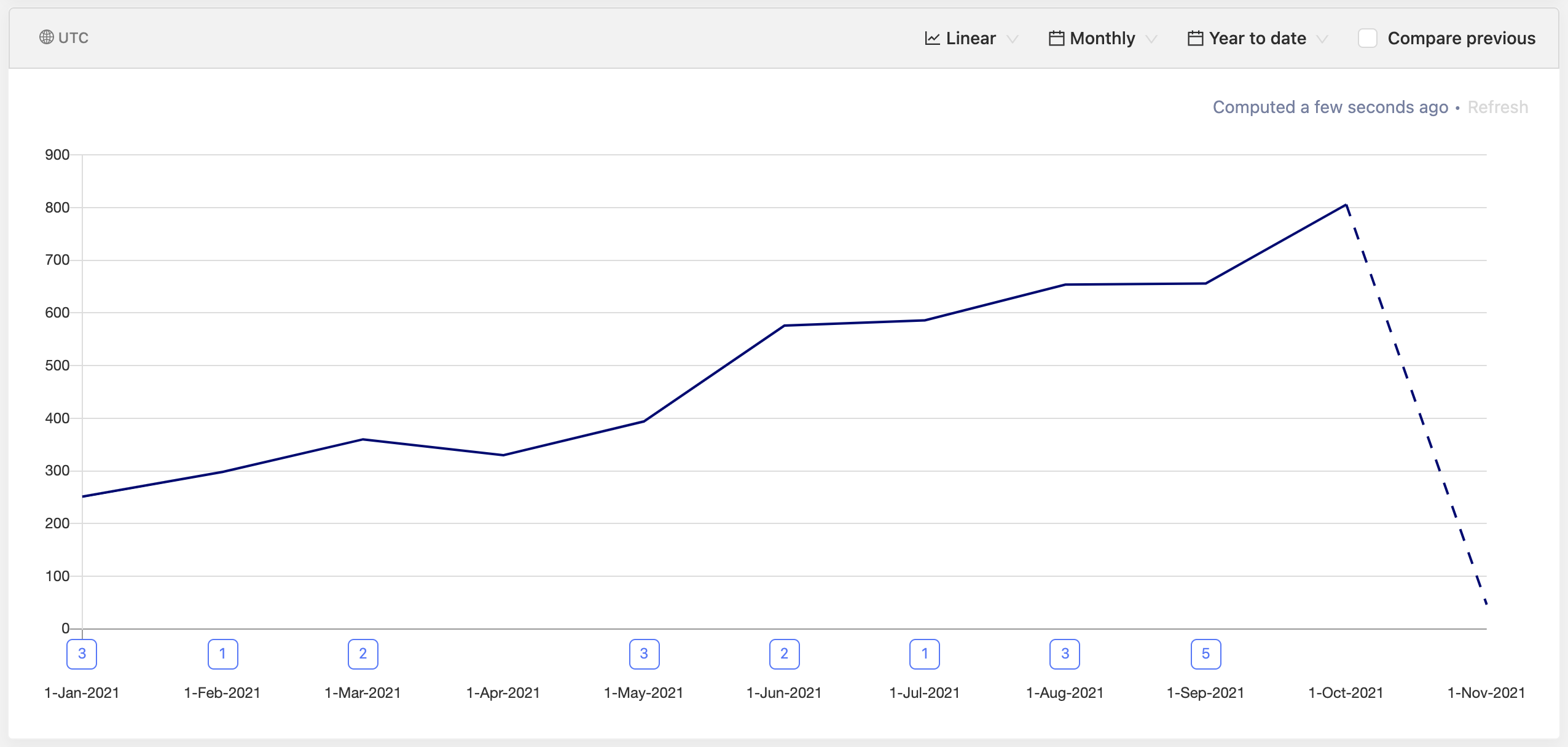
  • Most teams using PostHog use plugins (if GeoIP is included)
  • Relatively few Cloud teams use plugins (if GeoIP is excluded)
  • Self-hosted users are way more likely to use plugins than Cloud users
  • Export plugins are key for our larger customers (particularly self-hosted ones)
  • Simple plugins covering basic functionality that PostHog lacks are quite popular
  • The plugins ecosystem still needs a lot of work

Above: Pageviews for the Plugin Library (weekly).

Fun fact: the average length for the top six most popular plugins on PostHog is only 57 lines of code. Some, such as the Timestamp Parser, are only 16 lines long! The other thing they have in common is that they cover basic functionality which we haven’t built natively into PostHog yet.

This is a deliberate decision. It’s true that we could spend engineering time to build these features, such as filtering nested properties, but plugins enable us to quickly solve the same challenge without the resource overhead. Then, once we fully understand the challenge, we can create a better solution — some plugins are literally the duct tape version of full-fledged features we’re building at the moment.

Plugins also enable us to build useful functionality in a matter of hours. The Twitter Followers plugin hits an API and creates an event once a day. It would never make sense to build this natively, but it took just 30 minutes to make it as a plugin which is used by 30+ teams.

Despite feeling like a core part of the product, PostHog’s geolocation capabilities are actually handled by a plugin. This is a widely used feature, and the plugin is enabled for everyone by default, meaning it has thousands of users, both on self-hosted instances and Cloud.

As a result, it has been removed from all the graphs and tables you’ll be seeing in this document, so we can focus on plugins which users have deliberately enabled.
Plugins on PostHog Cloud

Above: Plugin usage on PostHog Cloud.

PostHog Cloud users have a selection of whitelisted plugins that they can install from our plugin library. Arbitrary plugins are not allowed, so if users want to install their own plugins, they must first submit a PR to our Plugin repo for review.

Out of the more than 4,000 teams we have on PostHog Cloud, 50.3% use plugins (including GeoIP).

However, only 4% of teams use a plugin that is not GeoIP. This is quite low. That said, many plugins weren't available to everyone on cloud until recently, so this is likely to be under-reporting the reality of how many teams would use them.

The most popular plugin on Cloud (excluding GeoIP) is the Timestamp Parser, which turns timestamp data into date properties. This helps developers answer questions such as ‘Why did our traffic spike on Tuesday?’ or ‘Do we get more purchases at the weekend or not?

Plugins on self-hosted PostHog deployments

Above: Plugin usage on self-hosted deployments.

Gathering and parsing data on self-hosted users is a bit harder, but we can pull some data from status reports going back two months from teams who did not opt out. This comes with the caveat that we are looking at distinct IDs, meaning some organizations may be counted twice.

Of the 1,500+ organizations in the dataset, 75.6% use plugins, and 23.5% use a plugin other than GeoIP. Both are much better ratios than Cloud.

This analysis shows the power of community plugins, as the most popular plugin is the User Agent plugin which was created by a community contributor. Thank you, Weyert!

Note: This plugin doesn’t show for PostHog Cloud stats because, as I found out while writing this, it wasn’t whitelisted for other organizations. We’ve since corrected this.

Finally, the most important point about self-hosted plugins is that they’re far more powerful than on Cloud. When you run your own instance, you can add whatever plugins you like to it. As such, we see some teams creating and running their own massively complicated plugin across multiple projects.

One user, for example, created a plugin to migrate more than 15 million events from Heap to PostHog. Others, such as MentionMe, have successfully used plugins we’ve made but haven’t released yet by installing them directly from GitHub!

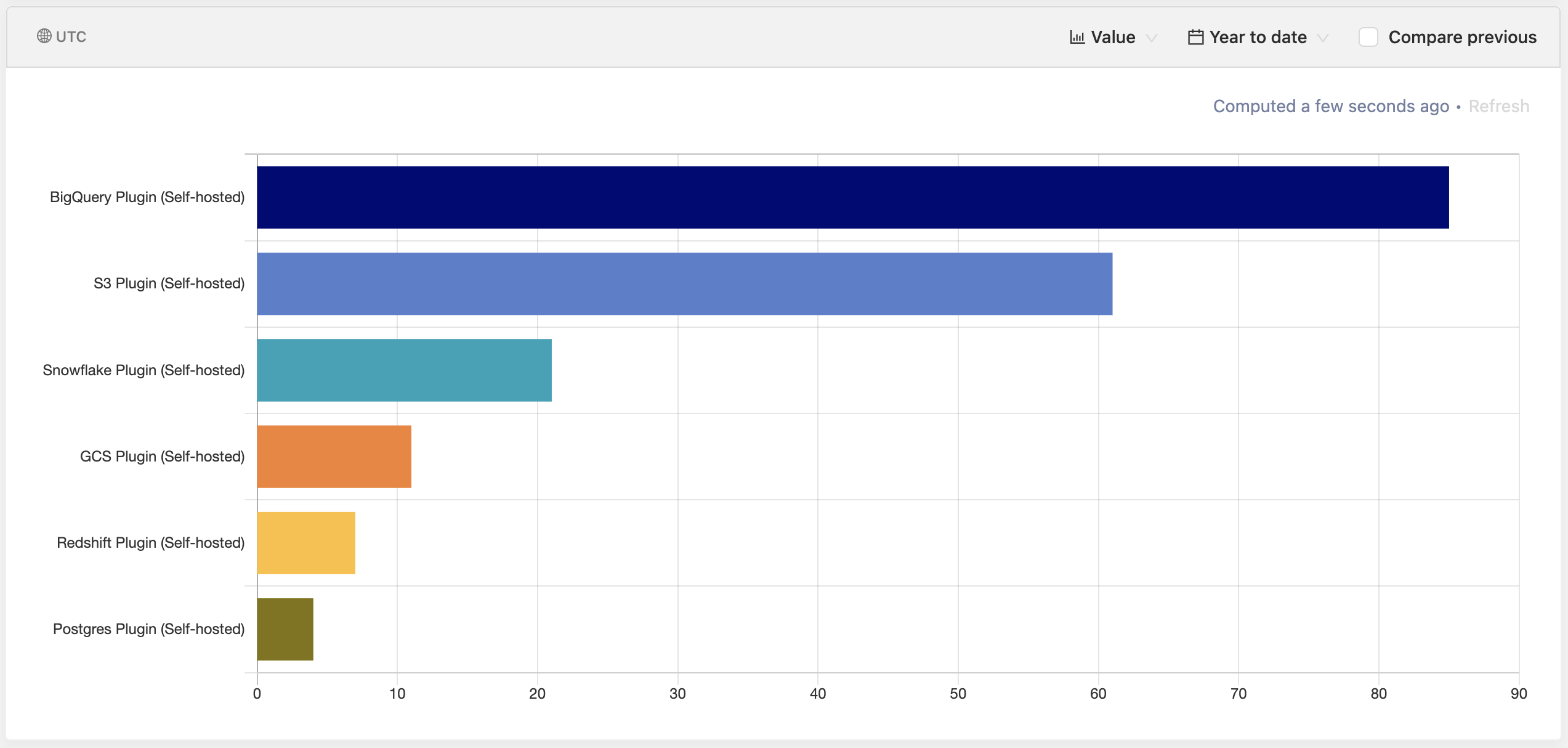
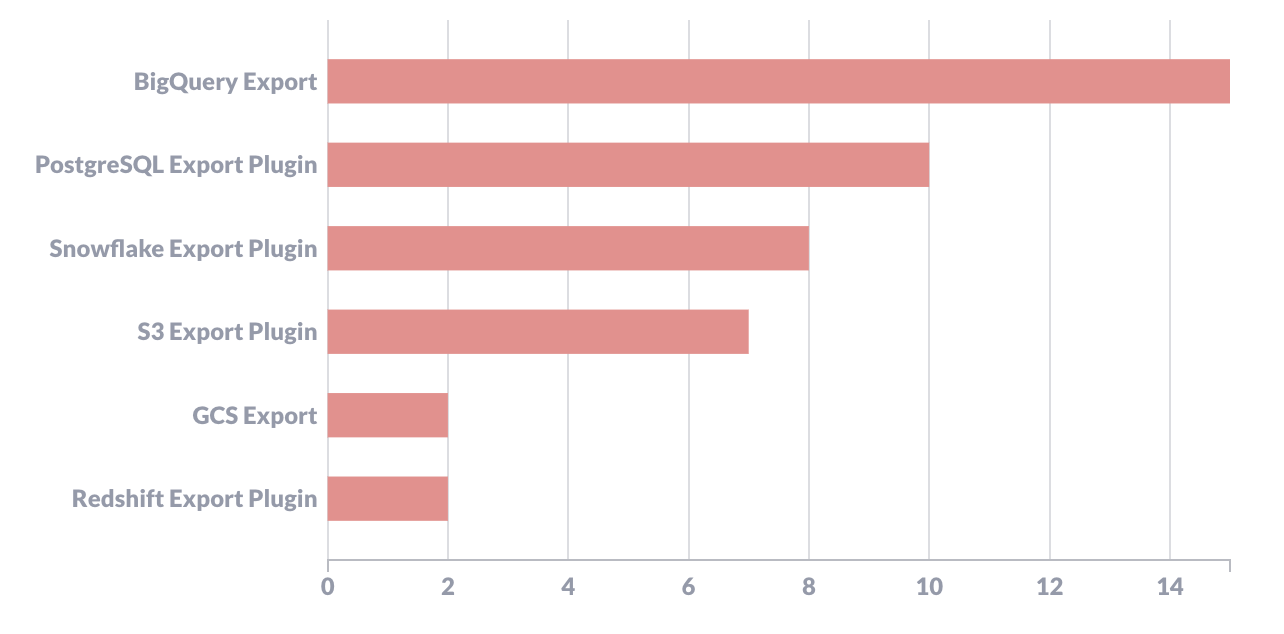
Export plugins are arguably our most important type of plugin, as they are specifically useful for Enterprise customers and form a core part of PostHog’s offering by enabling users to export PostHog info to a data warehouse.

BigQuery is by far the most popular export destination, across both self-hosted and Cloud deployments.
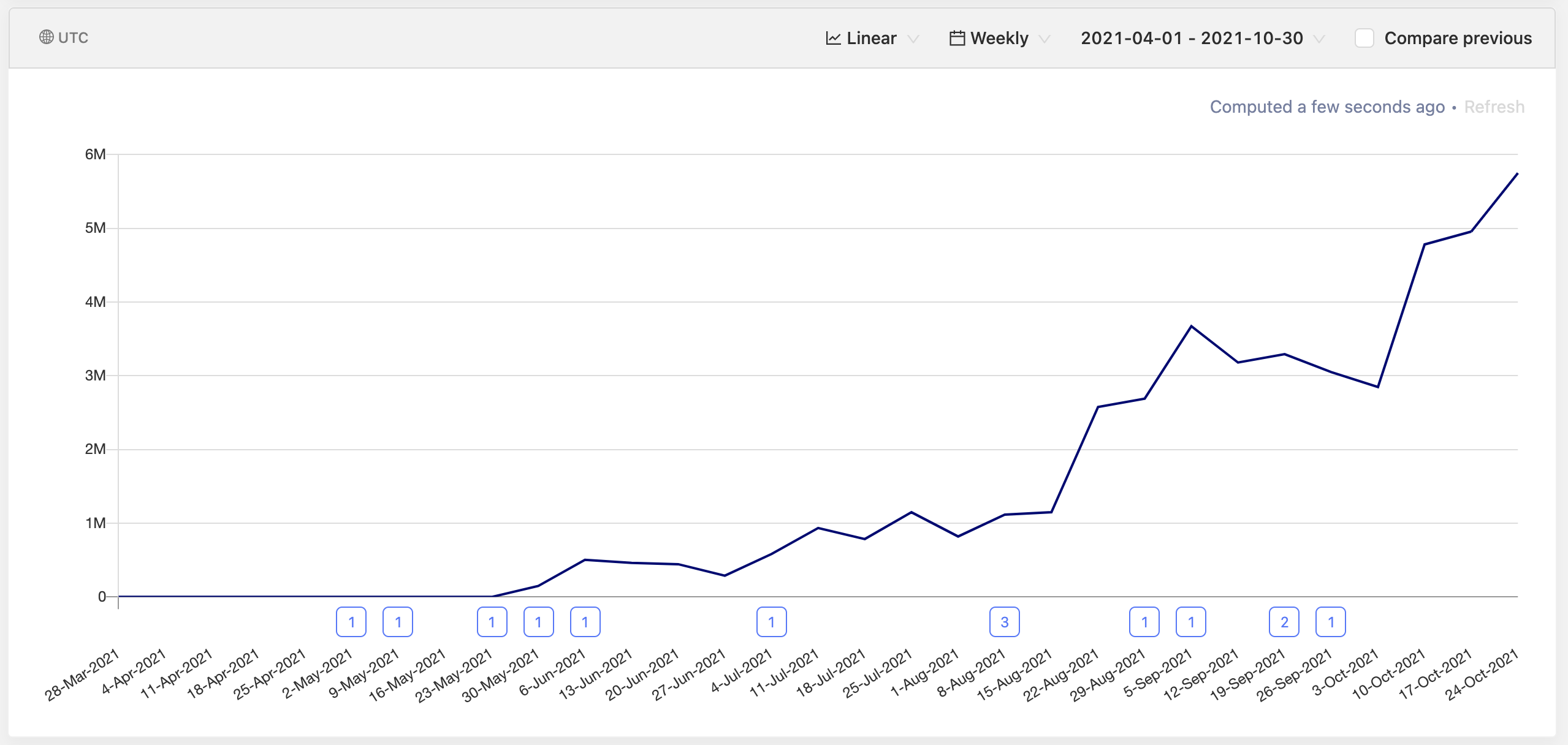
Above: Time spent running plugins on PostHog Cloud (weekly).

One of the most striking data points we have about plugins is that installations per week have been mostly flat and the correlation with user sign-ups is constant. This means we’re not doing a good job of getting more users to try out plugins (at least on Cloud) even though we are doing a good job of getting people to try PostHog.

Part of the reason for that could be that plugins still need a lot of polishing. We’ve had multiple reports in our community Slack that the release tracker plugin is broken, for example, and both the developer tooling and the user-facing plugin library are somewhat underwhelming to use.

Yet, it can be hard to prioritize fixing these issues. Almost by definition any work to improve the extensibility of PostHog will never be a short-term priority because the product has to come before the efforts to extend it.

In the short term I’m currently focusing on fixing known bugs as part of my current sprint, but the only real way to prioritize extensibility is to look at it from a long-term perspective and I hope we can invest ongoing engineering efforts into PostHog in the future.

Want to know more about what we're up to? Subscribe to our new newsletter, which we send once every two weeks!