惯性聚合 高效追踪和阅读你感兴趣的博客、新闻、科技资讯
阅读原文 在惯性聚合中打开

推荐订阅源

TaoSecurity Blog
TaoSecurity Blog
L
LINUX DO - 最新话题
Help Net Security
Help Net Security
N
News | PayPal Newsroom
www.infosecurity-magazine.com
cs.AI updates on arXiv.org
The Last Watchdog
The Last Watchdog
S
Security @ Cisco Blogs
W
WeLiveSecurity
C
CXSECURITY Database RSS Feed - CXSecurity.com
Webroot Blog
Webroot Blog
T
Troy Hunt's Blog
V
Vulnerabilities – Threatpost
Google Online Security Blog
N
News and Events Feed by Topic
T
Threat Research - Cisco Blogs
Security Archives - TechRepublic
钛媒体:引领未来商业与生活新知
钛媒体:引领未来商业与生活新知
T
Tor Project blog
freeCodeCamp Programming Tutorials: Python, JavaScript, Git & More
D
Darknet – Hacking Tools, Hacker News & Cyber Security
PCI Perspectives
PCI Perspectives
Google DeepMind News
T
Tailwind CSS Blog
让小产品的独立变现更简单 - ezindie.com
Apple Machine Learning Research
IT之家
IT之家
S
SegmentFault 最新的问题
J
Java Code Geeks
P
Privacy & Cybersecurity Law Blog
Threat Intelligence Blog | Flashpoint
博客园 - 【当耐特】
博客园_首页
H
Hacker News: Front Page
T
Threatpost
Jina AI
Jina AI
博客园 - Franky
月光博客
月光博客
L
LINUX DO - 热门话题
The Cloudflare Blog
H
Heimdal Security Blog
博客园 - 司徒正美
酷 壳 – CoolShell
酷 壳 – CoolShell
Cloudbric
Cloudbric
雷峰网
雷峰网
Hugging Face - Blog
Hugging Face - Blog
S
Secure Thoughts
T
Tenable Blog
I
Intezer
OSCHINA 社区最新新闻
OSCHINA 社区最新新闻

PostHog's RSS Feed

Training our own AI models - PostHog From 270GB RAM to 5GB: Moving local flag evaluation from Django to Rust The best analytics stack for vibe-coded apps The do's and don'ts of minimum viable product marketing - PostHog The best MCP servers for startups, by workflow 4,063 errors closed without a human opening PostHog – here's what we learned - PostHog PostHog Code and the self-driving product - PostHog Why attacking your competitors online is dumb - PostHog The best real-time analytics platforms for developers, compared DuckDB vs ClickHouse: Why we use both at PostHog - PostHog PostHog's next chapter - PostHog Making Claude Cowork actually useful - PostHog PostHog vs Matomo in-depth tool comparison You're doing lifecycle emails wrong Untangling Tokio and Rayon in production: From 2s latency spikes to 94ms flat The best HIPAA-compliant A/B testing tools - PostHog A beginner's guide to testing AI agents - PostHog I hate the standup bot (so I built an agent to do it for me) - PostHog The best CDPs for developers, compared The best error tracking tools for developers, compared The best feature flag software for developers, compared 7 best session replay tools for mobile apps 7 best free open source business intelligence tools right now 7 best free and open source LLM observability tools PostHog vs LogRocket in-depth tool comparison The most popular PostHog alternatives, compared Open source (and self-hosted) session replay tools - PostHog The 9 best GA4 alternatives for apps and websites - PostHog PostHog vs Google Analytics 4 in-depth tool comparison How we built automatic clustering for LLM traces - PostHog The 7 best HIPAA-compliant analytics tools 8 best open source analytics tools you can self-host - PostHog The best product analytics tools for startups, compared PostHog vs FullStory in-depth tool comparison The best in-app survey tools for product teams, compared The 7 best mobile app analytics tools PostHog vs Hotjar in-depth tool comparison The 8 best free and open-source feature flag services - PostHog The 5 best free and open-source A/B testing tools - PostHog The best mobile app A/B testing tools, compared What is a feature flag? Feature Flags vs Remote Config vs A/B Testing PostHog is now available in Vercel’s v0 The best Heap alternatives & competitors, compared PostHog vs Heap in-depth tool comparison PostHog vs Pendo in-depth tool comparison PostHog × Vercel: feature flags, minus the plumbing Your logs' final destination is in GA. You always end up here anyway Behind the scenes of a PostHog hackathon - PostHog The most popular Mixpanel alternatives & competitors, compared PostHog vs Mixpanel in-depth tool comparison The 9 best GDPR-compliant analytics tools How we use Logs at PostHog The best web analytics tools for developers, compared Stop AI slop: Run evals with LLM-as-a-Judge - PostHog You product data just got a job: Workflows is now out App onboarding: How to fix drop-off points Meet Logs (beta) – logs with all the tools you’re already using Why small teams crush tiger teams How we built user behavior analysis with multi-modal LLMs (in 5 not-so-easy steps) - PostHog The best Contentsquare alternatives & competitors, compared 8 learnings from 1 year of agents – PostHog AI - PostHog Why we killed our AI product assistant Workflows graduate to beta! Product data, meet automation The best Rollbar alternatives & competitors, compared Workflows are now in Alpha and I already broke mine - PostHog I've consistently underestimated how important communication is as a CEO - PostHog How we made feature flags even faster and more reliable The best session replay tools for developers, compared What I learned attending my first ever hackathon - PostHog Did you know AI is answering our community questions? - PostHog How not to be boring - PostHog We built an internal tool to generate changelog images for social media - PostHog What we built at our windswept Mykonos hackathon - PostHog How we built our onboarding email flow (with actual performance data) - PostHog We're building a better PostHog community by closing our public Slack - PostHog Introducing Notebooks for PostHog - PostHog Why we've launched PostHog user surveys - PostHog How we made feature flags faster and more reliable - PostHog In-depth: ClickHouse vs Redshift - PostHog Introducing HouseWatch: An open-source toolkit for ClickHouse - PostHog Introducing HogQL: Direct SQL access for PostHog - PostHog What we built at our sun-kissed Aruba hackathon - PostHog In-depth: ClickHouse vs BigQuery - PostHog In-depth: ClickHouse vs Elasticsearch - PostHog HogMail #22: Why do companies over-hire?" - PostHog Our simpler goal: Help engineers to be better at product - PostHog In-depth: ClickHouse vs Snowflake - PostHog HogMail #21: Avoiding the "Product Death Cycle" - PostHog Sunsetting Kubernetes support for PostHog - PostHog Why 'Product Engineer' is the most fun role I've had in tech - PostHog HogMail #20: Why do startups fail? - PostHog The best Google Optimize alternatives for apps and websites - PostHog Array 1.43.0: Massive performance improvements! - PostHog In-depth: ClickHouse vs Druid - PostHog HogMail #19: Which meetings should you kill? - PostHog CEO diary: The things I learned in 2022 - PostHog The essential tools used by product engineers - PostHog HogMail #18: What can SaaS learn from the New York Times? - PostHog What is a product engineer? - Product Engineer Handbook - PostHog Array 1.42.0: Get beta features via our roadmap! - PostHog
Speeding up PostHog builds with Depot - PostHog
Kyle Galbrai · 2022-08-05 · via PostHog's RSS Feed

PostHog recently swapped out Docker for Depot in their container image builds within GitHub Actions. The results are outstanding, taking the average build time from 16 minutes to 3 minutes. Building the PostHog images via depot build instead of docker build is over five times faster, so PostHog invited us — the founders of Depot — to share more about how Depot works and will benefit the PostHog community.

Depot is a managed container build service which runs both Intel and Arm builder machines so you can build native container images for both architectures. Each instance runs BuildKit, the modern engine that backs docker build with four CPUs, 8GB of RAM, and a persistent 50GB NVMe cache disk. Depot fully manages the lifecycle of project builder instances; today, Depot launches builder machines in AWS and Fly.io.

The depot build CLI implements the same options as docker build for easy adoption. By offloading the build to a remote Depot builder, the build can make use of the centralized persistent cache, so build steps that are unchanged can be instantly reused. Remote builds also are not limited by local resource constraints like CPU, RAM, or network.

One of the most common use-cases for Depot is accelerating Docker image builds in CI providers like GitHub Actions. We often see a 2-3x speedup when using Depot, compared to the standard docker/build-push-action action.

Builds in GitHub Actions can be slow for a few primary reasons:

  1. Not making use of the layer cache to skip unnecessary steps.
  2. Using the layer cache requires saving and loading the cache before and after the build, which can be slow as cache sizes increase.
  3. Resources like total cache size and available CPUs are constrained in the Actions environment.

Assuming that a build uses cache-from and cache-to to cache layers, the biggest bottlenecks afterwards are the last two reasons. Saving and loading the cache to tarballs is slow, and the time taken to restore the cache can often outweigh the potential speedups of having the cache at all. And GitHub Actions only provides two CPUs today for the build to use.

Depot and PostHog

At Depot, we use PostHog to track our core product metrics; builds started and completed per week, build time in minutes, what versions of our depot CLI are running in the wild, etc. It's quite the universal tool, and we would recommend it to just about anyone.

We also maintain several benchmarks of popular open-source projects, including PostHog, to help us gauge the performance of Depot. The benchmarks compare the speed of container builds on GitHub Actions with and without Depot, for each new commit to the upstream project. We generally see a 2-3x speedup with Depot.

PostHog was one of the projects we selected to benchmark, and we observed average build times of only three minutes with Depot's remote builders. At the time, PostHog's own build workflows took around 16 minutes for the same build.

So, we reached out to Tim at PostHog to show him the benchmark results and suggest that we use Depot for PostHog. Tim suggested we open a pull request implementing the switch.

Switching PostHog builds from Docker to Depot

We created a new PostHog Depot organization and opened a pull request to begin building the PostHog Docker image with Depot. There's some interesting details in the pull request discussion, but the basic implementation was:

  1. Install the Depot CLI with the depot/setup-action.

  2. Replace docker/build-push-action with depot/build-push-action, which implements the same inputs but uses depot build for the build:

At the time, we supported authentication via a personal access token, provided in a DEPOT_TOKEN environment variable. However we discovered a workflow problem that needed to be solved; workflows triggered by a pull_request event from a forked repository don't have access to repository secrets, as they are considered untrusted.

Initially we thought that we could use GitHub's OIDC tokens instead. This would allow our depot/build-push-action to exchange a temporary token provided by GitHub for a temporary Depot token, and then use that token to authenticate with Depot. We implemented this authentication mechanism then discovered that, unfortunately, GitHub will not issue OIDC tokens for pull_request events from forked repositories (only pull requests from within the same repository).

In the end, we opted to use Depot for all builds for push events but continue using docker for pull_request events. This isn't the most performant option, but it appears to be what's possible today with GitHub's limitations.

However, we could still use OIDC token authentication for all the push builds and avoid the static DEPOT_TOKEN environment variable entirely. Securely authenticating the build request with an OIDC token required adding the repository as a trust relationship in the Depot project, then adjusting the workflow permissions to allow retrieving the token:

The depot/build-push-action action handles exchanging the temporary token provided by GitHub for a temporary Depot token and providing that token to the build.

Before switching to Depot, builds using docker build took over 16 minutes to complete:
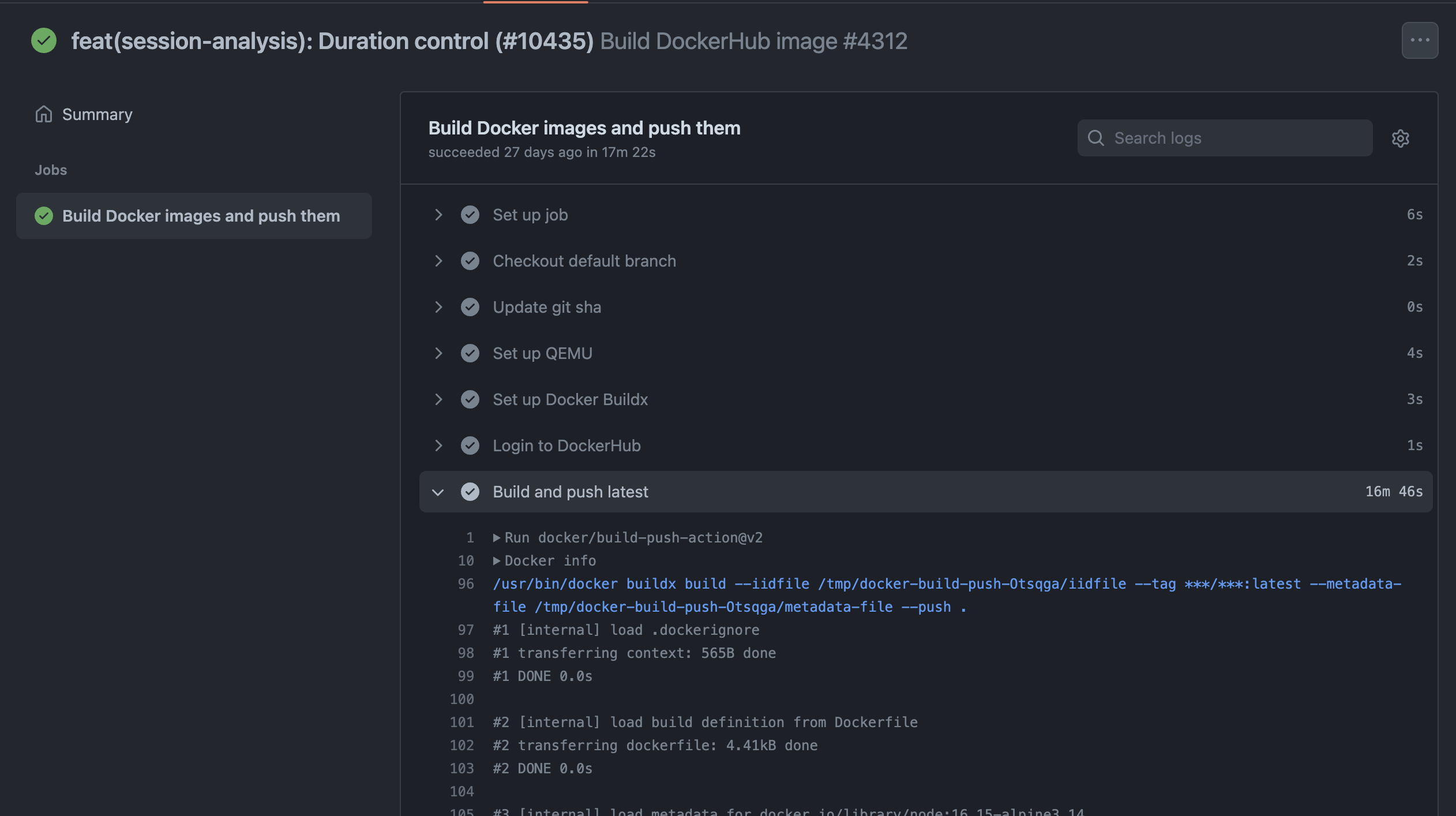
GitHub Actions Docker Build

After switching to depot build, those same builds took only three minutes on average:
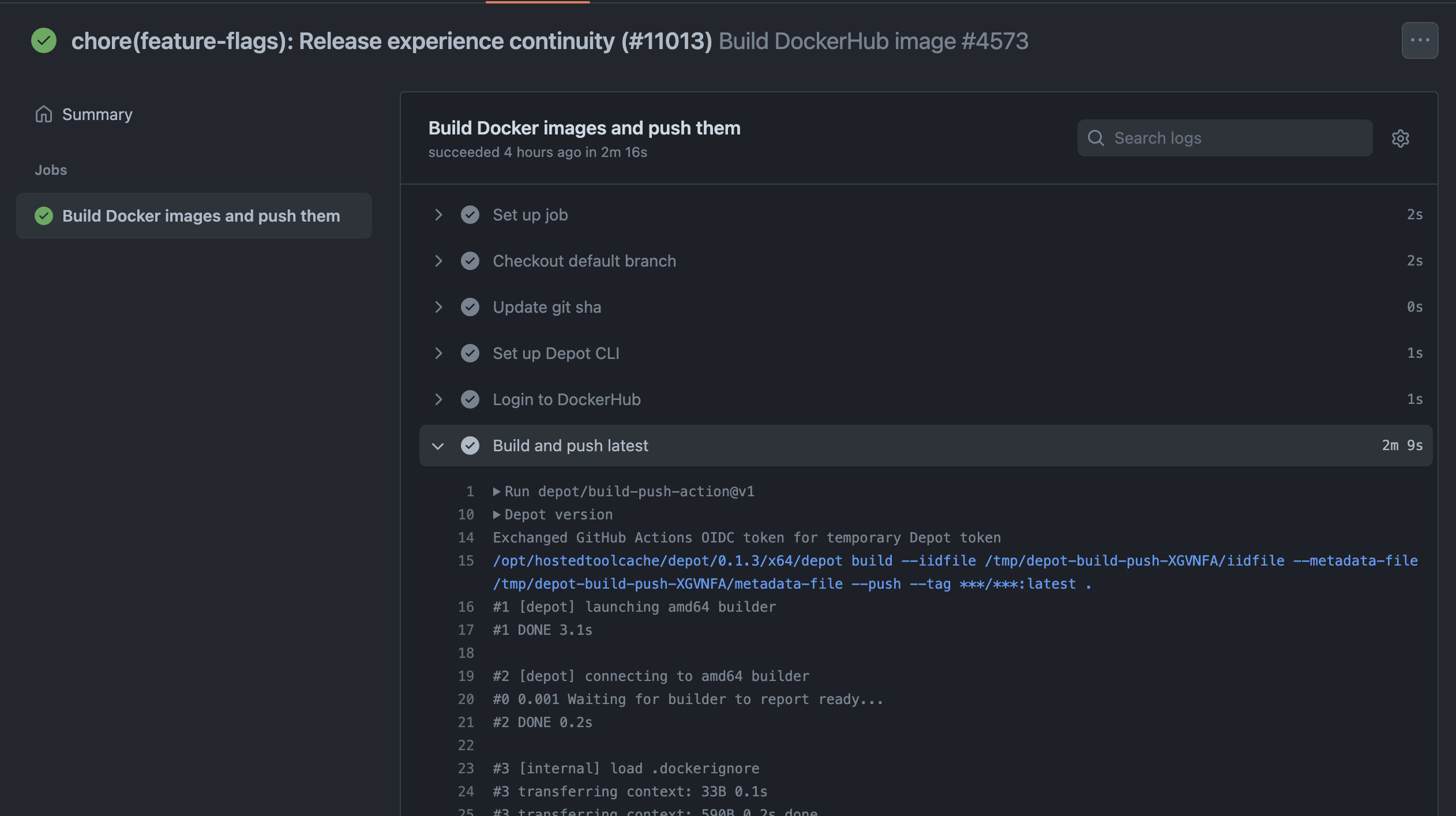
GitHub Actions Depot Build

A 5x speed up with very little change to the existing workflow, just one line if we don't include the OIDC improvement.

The improvement here is deceptively huge. A 16-minute build that is run 20 times a day can account for over 5 hours of build time, slowing down progress. Faster builds mean less time waiting, fewer interruptions, and faster feedback and deploys. By switching to Depot, PostHog can get more done, iterate faster and fix bugs without interruptions.

Subscribe to our newsletter

Product for Engineers

Read by 100,000+ founders and builders

We'll share your email with Substack