



There's a future version of you who isn't boxed into one job function. Someone who has an idea in the morning and the means to ship it the same afternoon.
Farfetched? Hardly. That version of you isn't waiting for 2030 – they exist today. They're in build mode, and they're not looking back.
Build mode is the version of you that ships a lot more. You could call it everyone being an engineer now, but I'd put it more precisely: product engineers, product managers, and product marketers can finally play in each other's sandboxes.
Look at who's actually building with PostHog's AI products. In the last 30 days, people:
That's people building things. And a growing share of them would never call themselves engineers.
In other words: build mode isn't really about more output. It's about making everyone who builds, markets, sells, or supports a product more capable.
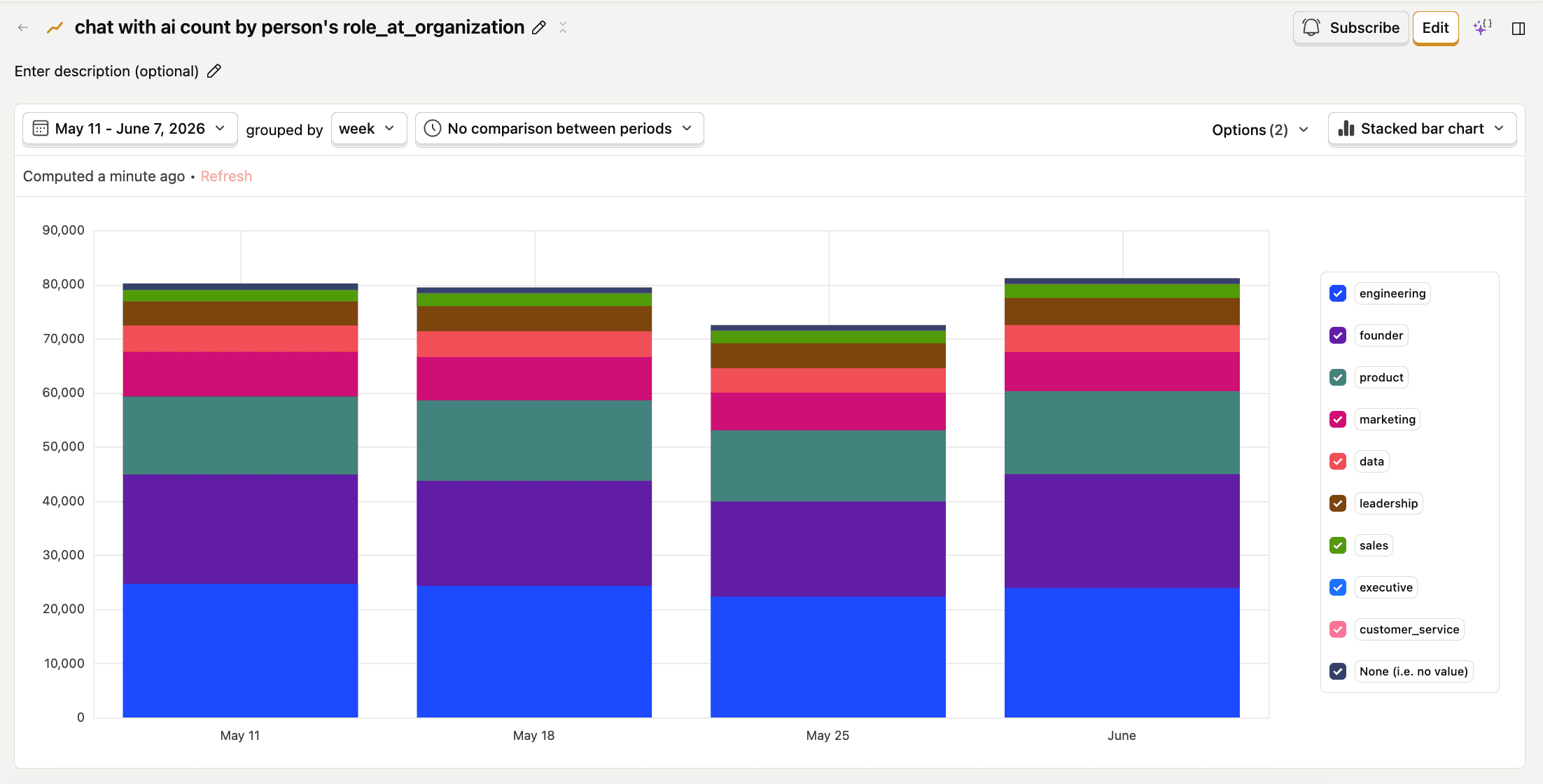
Who's actually chatting with PostHog AI – plenty of them don't sit in engineering.
Reading this won't change your job title, so what does build mode mean for you? Here are some concrete things you can do today with @PostHog in Slack, PostHog AI, the MCP, and PostHog Code:
In case you haven't met it: PostHog has a Slack app. Mention @PostHog in any channel and it can answer any question about your users or product usage.
Tag it with "fix this" or "build that" and it can code too. It spins up a sandbox, makes a plan, edits files, runs your checks, and opens a draft PR – answering your review comments right there in the thread. (Here's how to set it up.)
In the first week it was available, usage split roughly into a quarter engineers, a quarter founders, and the rest marketing, product, support, and sales. People in every one of those roles have shipped real PRs.
A colleague swears users love the new onboarding flow. You swear they hate it. Instead of booking a meeting about it, tag in @PostHog. Ask "How does 7-day retention compare for users who went through the new onboarding versus the old one?" It drops the data. Debate over.
And because it's a Slack thread, it's multiplayer. Your PM jumps in to ask about mobile, someone from support adds a segment, and the bot keeps refining the answer as the conversation goes.
You can also make it recurring. Subscriptions pipe scheduled insights straight into a Slack channel. When something catches their eye, Ian and Nat from the editorial team @PostHog in that same thread to dig in.
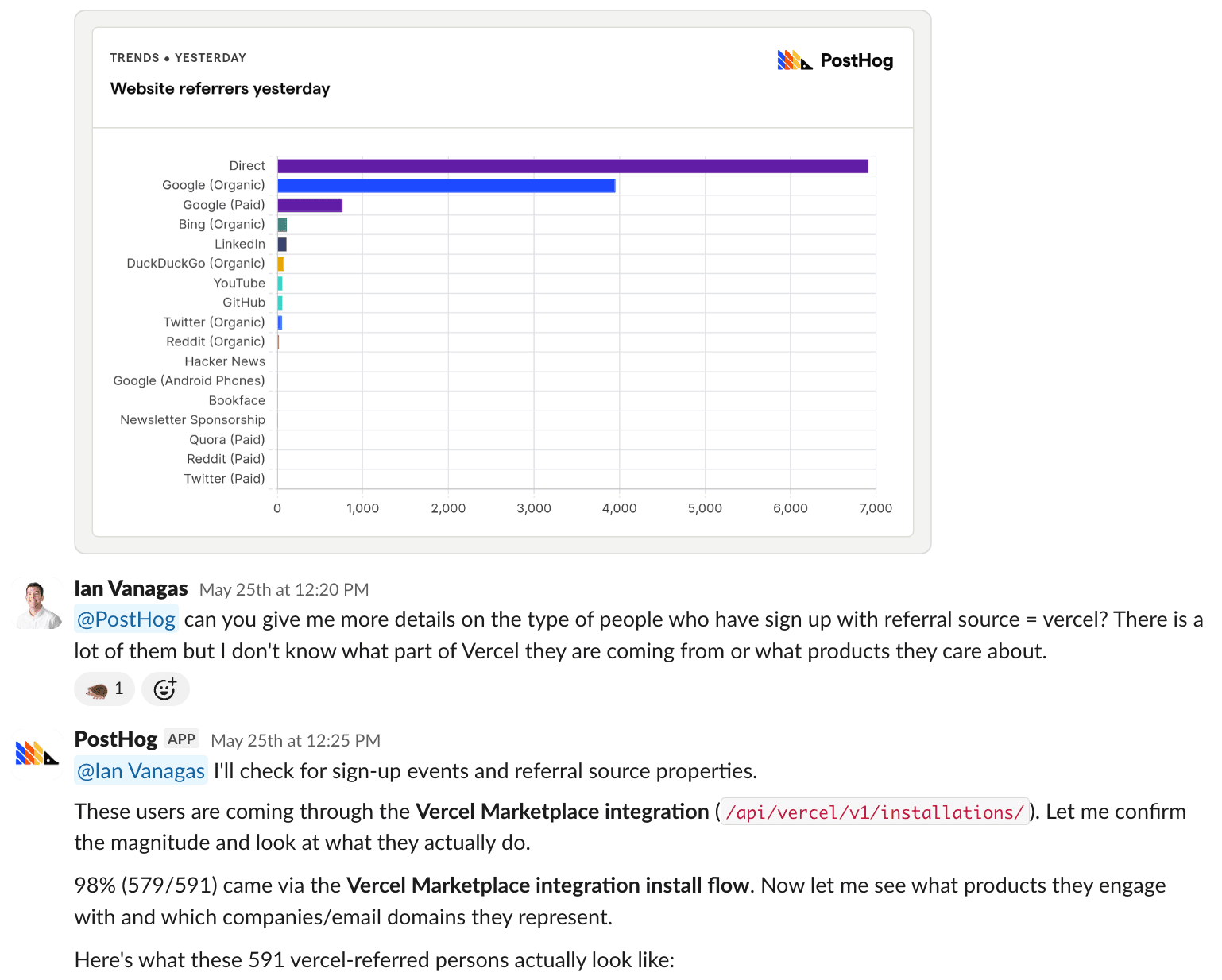
Every answer just raises three more questions. Mercifully, the bot doesn't tire of them.
Case studies, alpha testers, champions to rally inside an account – they all start with finding your best users, which usually means digging through usage data nobody has time for. Ask @PostHog: "Find my 10 most engaged users who've invited a teammate, and summarize their recent session recordings." You get a shortlist back in the thread, with enough context to actually reach out.
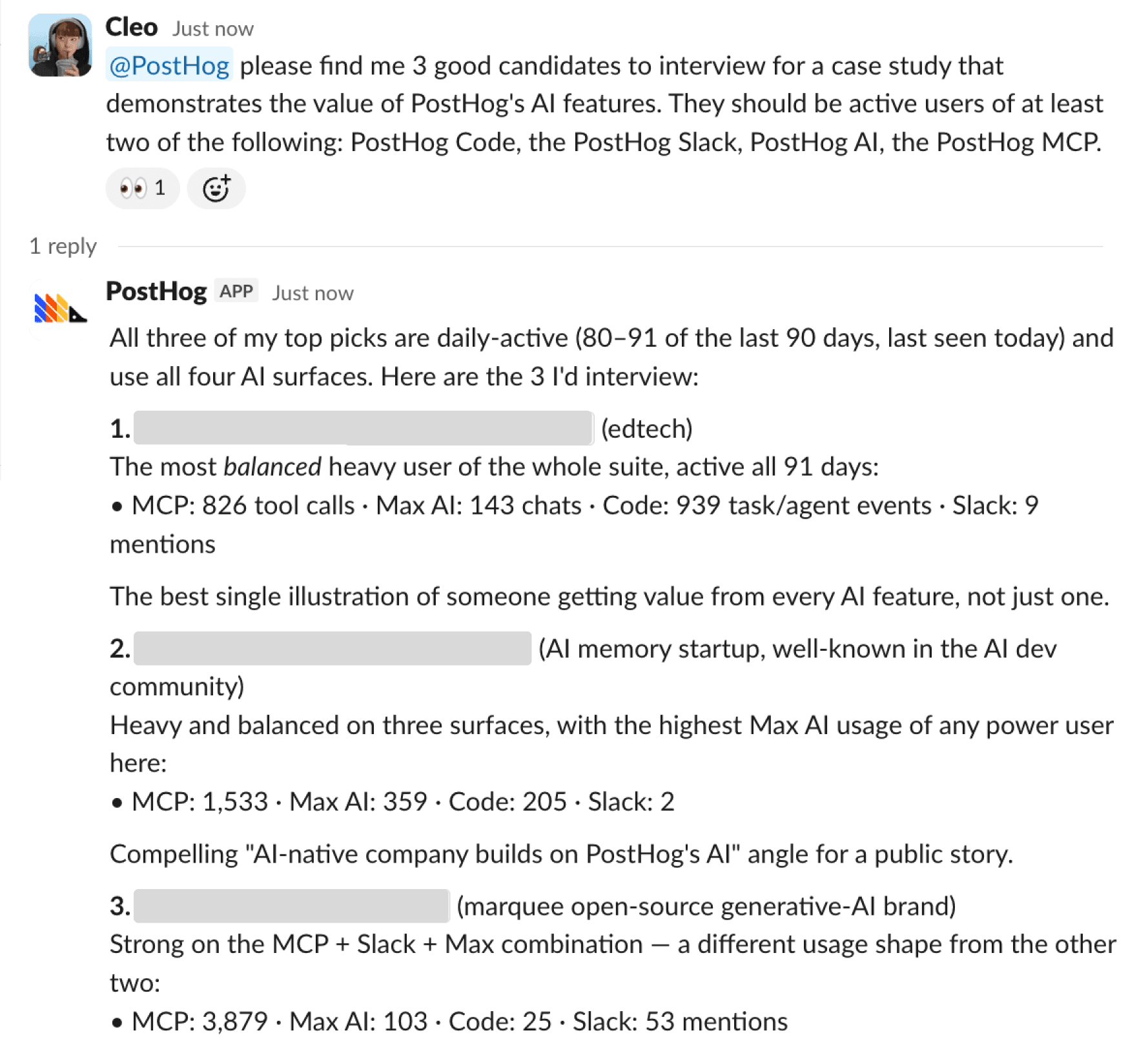
I didn't have to ask sales or CS for a list – the context already lives in PostHog.
Good content decisions come from understanding what actually converts, not just what gets traffic. Because PostHog connects your web analytics to product data, you can ask PostHog AI "which articles bring in signups that activate within 7 days?" and see the whole picture at once.
You might find one post quietly driving your best users. Then you go write more like it. Schedule it as a recurring AI summary and it lands in Slack each week without you asking.
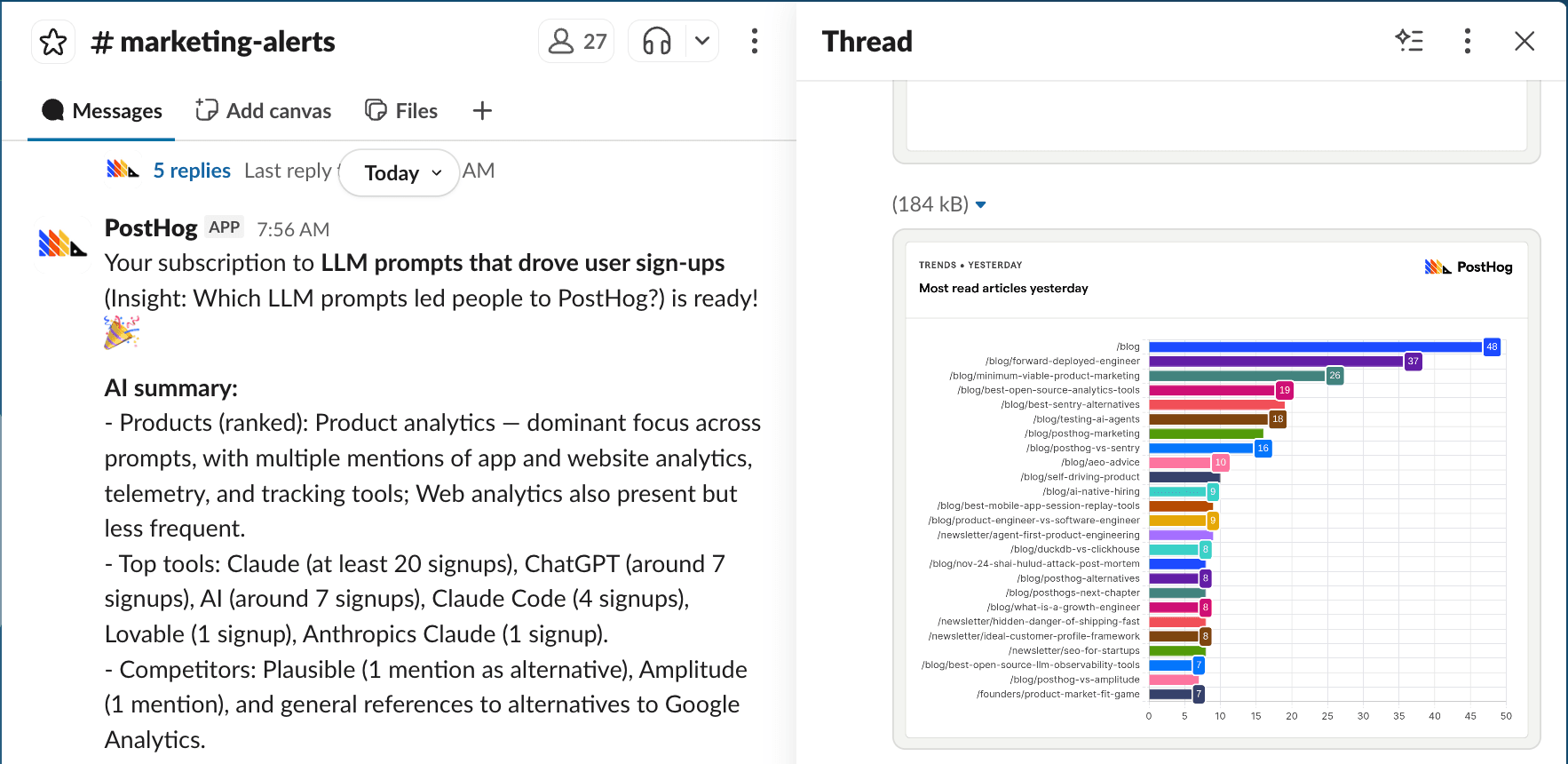
The content that's actually converting, surfaced automatically.
Yes, a marketer can open a pull request against the real product – not just a marketing page, the actual app. It's not as reckless as it sounds, because @PostHog only ever opens a draft PR and runs your checks, and an engineer can review it before anything ships.
So when I spot a bug (or an opportunity), I just describe it to @PostHog, and the bot opens the PR. That's how Joe and I – two marketers – have shipped real changes to a genuinely complex codebase.
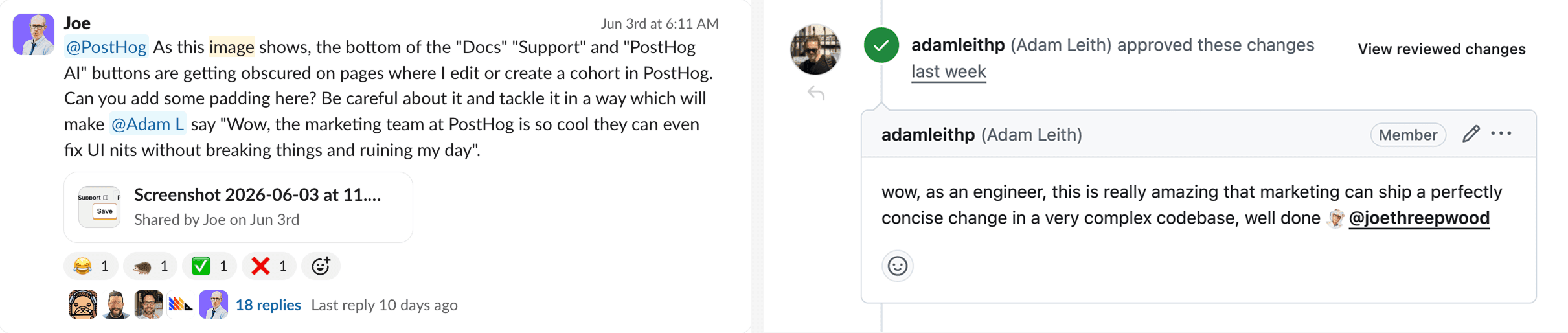
A marketer ships to the main app, and an engineer signs off. This is build mode working as intended.
PostHog AI is a surprisingly good writing assistant, because it's wired straight into your product data. Describe what you're working on – or drop the draft in the chat – and ask it to pull the relevant numbers in. It'll surface angles and metrics worth including (guess what I did for this post).
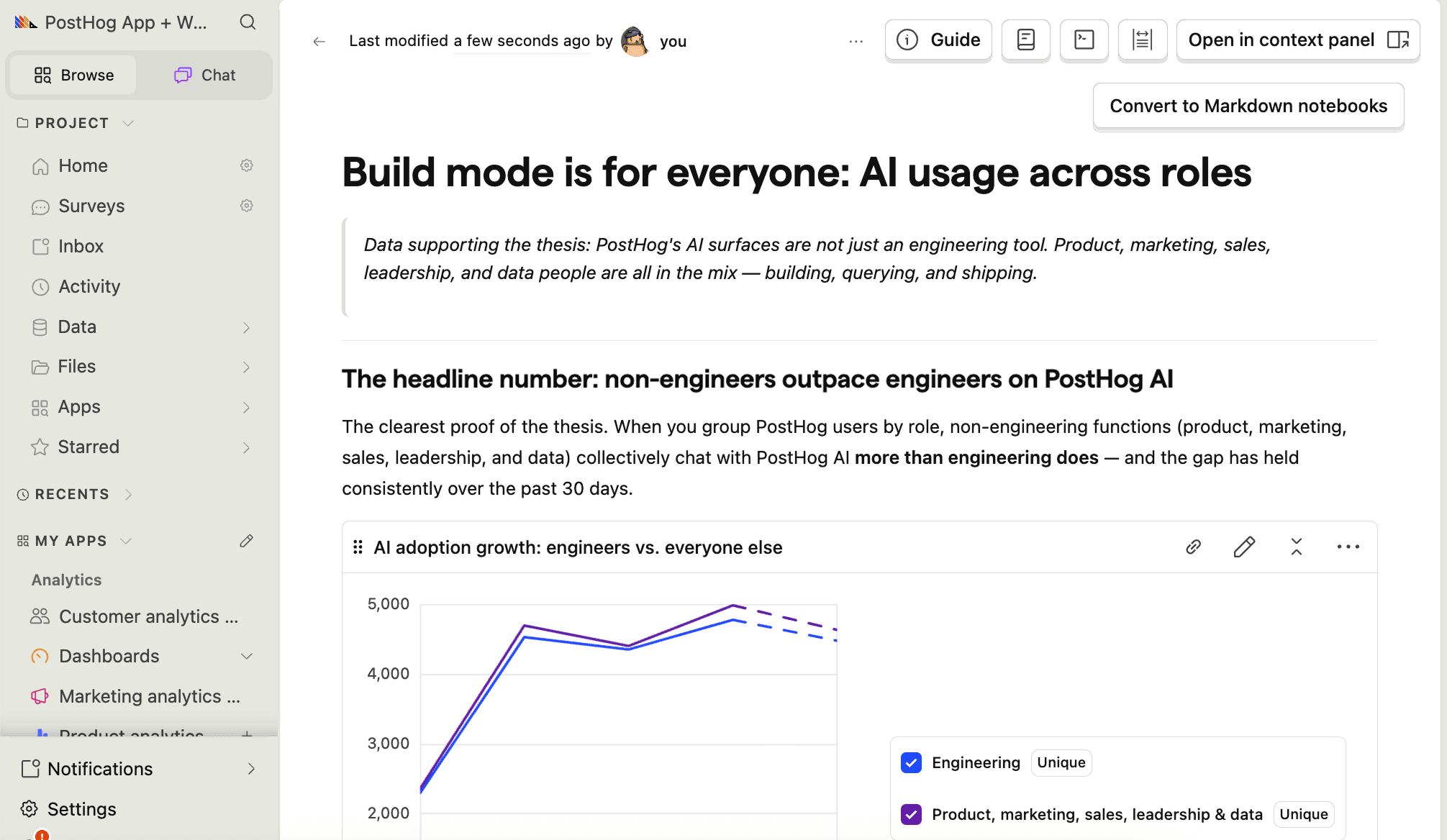
Never ship a number you can't stand behind. Ask PostHog AI to check it against real data first.
Say you're launching a feature and aren't sure who to target. Tell PostHog AI: "we're launching [feature] – here's what it does. Suggest a few user segments we could target, and explain why."
It comes back with segment ideas and the cohorts to match – power users who'd love it, or accounts at churn risk it might win back – each ready to email or sync straight to your ad platform. Do it in the web app, or from your editor through the MCP.
It works the other way too. Ask "what events are we already tracking in the checkout flow?" and your agent reads the schema live, then adds the missing checkout_step_completed call and opens the PR. Shipping a real change becomes part of the same conversation as asking about your data – the heart of agent-first product engineering.
If you already use something like Claude Cowork or Codex to prep for the week, add the PostHog MCP to the mix – now your agent can pull live product data alongside your calendar and meeting notes.
Set it on a schedule. Every Monday: "summarize last week's activation, day-7 retention, and top onboarding drop-off versus the week before." You walk into the week already knowing the numbers. The highest-leverage AI work usually isn't a task you'd do faster, it's one you'd never get around to at all.
Whether you're a PM or a PMM coordinating a launch, the first question is always: what are we actually measuring, and are we even tracking it? Ask PostHog AI "what events are we tracking in the onboarding flow?" and it reads your live schema. Then you can spot the gaps before you build anything.
Once you know what's there, tell it: "Build me a dashboard showing where new users drop off, and how activation rates compare by signup source." It assembles the insights, and you go a few turns back and forth until it's filled with the metrics you care about.
The same dashboard tells you when something goes wrong after launch. "Anything weird in the last two hours versus yesterday?" – and you'll know whether to relax or roll back. And when the dashboard reveals an opportunity worth testing, that's when you bring in PostHog Code or the MCP to build the experiment properly – no-code experiment tools can't compete with an agent that already knows your product.
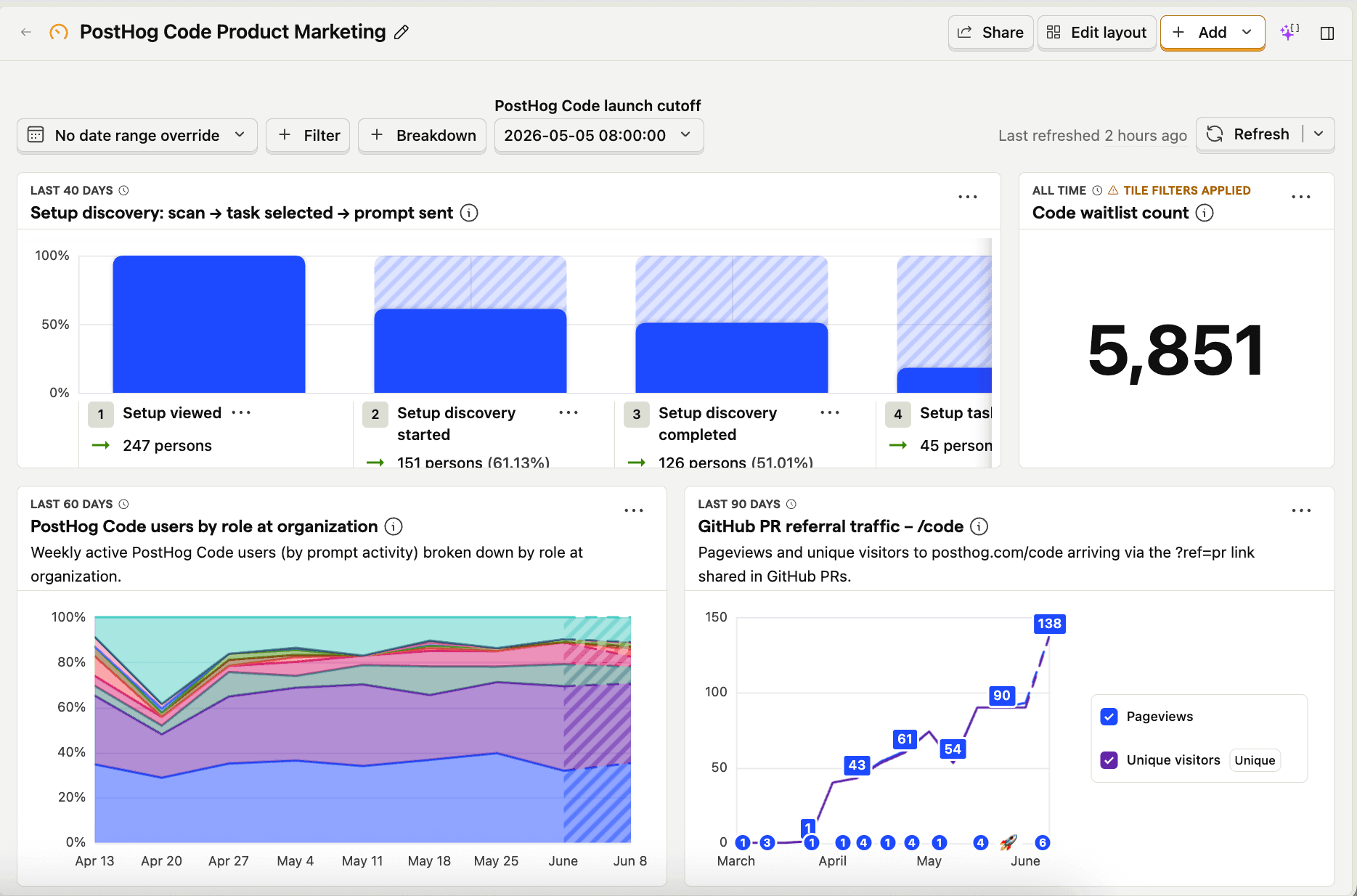
A glimpse at my real launch dashboard – I didn't build a single insight by hand.
Build mode isn't a solo act. Some of the best work happening at PostHog is in public Slack channels: a thread starts with an idea and ends with shipped code.
And that know-how compounds. The old way to pass on how you do something was to write a standard operating procedure – a document that tells you how to do the thing but can't do it itself. A skill can: it's your judgment written down in a form an agent can actually run, so the next person doesn't start from scratch.
If your company is cautiously adopting AI, this is the cleanest way to let people work outside their lane – the agent runs on your colleagues' codified judgment, not a blank prompt. We keep ours in a few places: the skills store, the .claude folder in our website repo, and the company handbook.
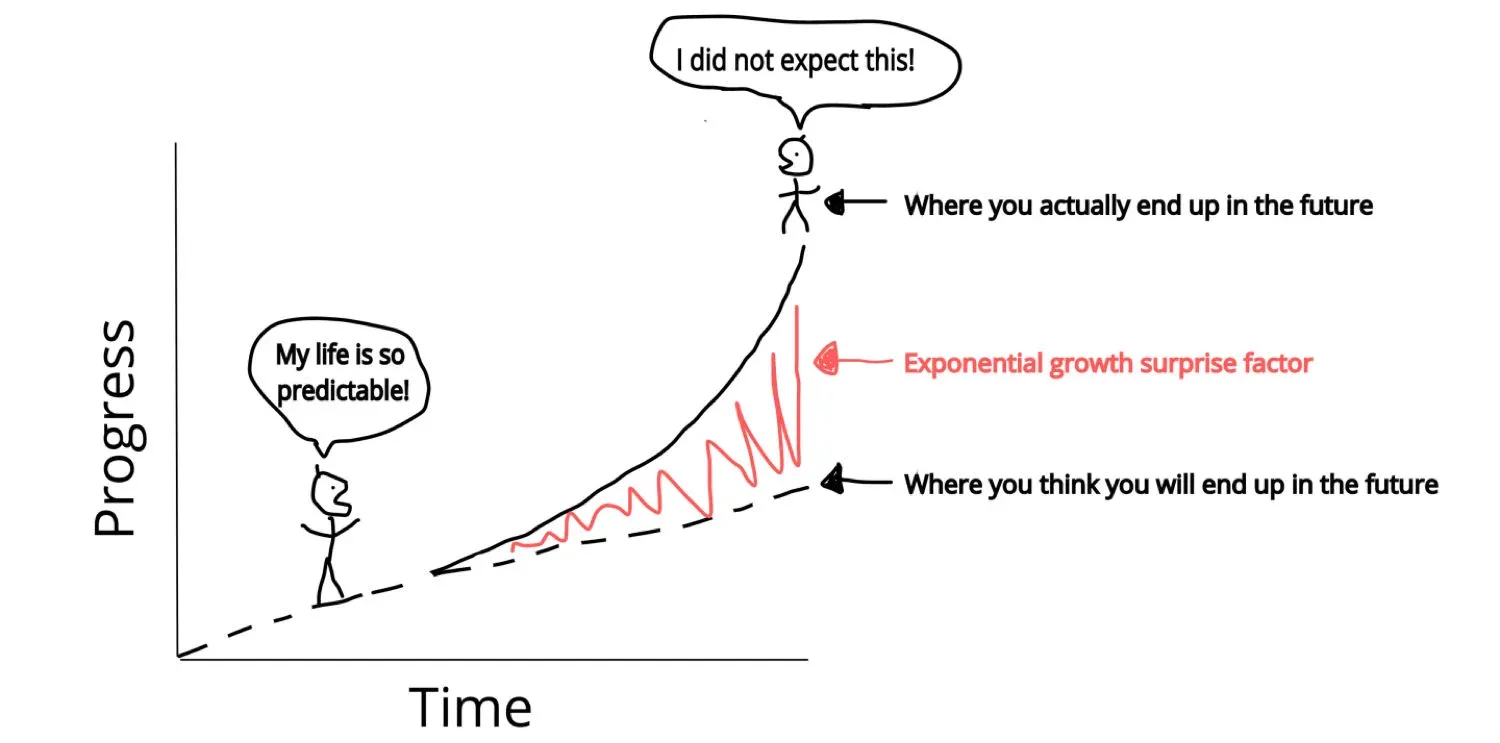
We're wired to expect progress in straight lines, but build mode is exponential.
Build mode hands you the ability to always be launching, which means you now have to decide what to build. Good news: AI doesn't care what's on your resume.
At a previous company, I was cross-functional but still firmly inside a lane (marketing). I wasn't allowed near the source code, and even if I had been, I wouldn't have known where to start. The version of me powered by AI is a completely different shape, and I see it happening all around me. Engineers are designing. Product managers are shipping code instead of writing PRDs. Everyone gets to be a product person.
This is the thing people actually wanted from AI: the ability to imagine something and then have it exist. It's a genie lamp except you are, in fact, allowed to wish for more wishes.
此内容由惯性聚合(RSS阅读器)自动聚合整理,仅供阅读参考。 原文来自 — 版权归原作者所有。