惯性聚合 高效追踪和阅读你感兴趣的博客、新闻、科技资讯
阅读原文 在惯性聚合中打开

推荐订阅源

N
Netflix TechBlog - Medium
罗磊的独立博客
H
Help Net Security
I
Intezer
G
Google Developers Blog
CTFtime.org: upcoming CTF events
T
Troy Hunt's Blog
让小产品的独立变现更简单 - ezindie.com
U
Unit 42
cs.AI updates on arXiv.org
freeCodeCamp Programming Tutorials: Python, JavaScript, Git & More
钛媒体:引领未来商业与生活新知
钛媒体:引领未来商业与生活新知
N
News and Events Feed by Topic
J
Java Code Geeks
S
Security Affairs
T
The Blog of Author Tim Ferriss
Recent Commits to openclaw:main
cs.CV updates on arXiv.org
D
Docker
The GitHub Blog
The GitHub Blog
F
Full Disclosure
N
News and Events Feed by Topic
Webroot Blog
Webroot Blog
S
Security @ Cisco Blogs
腾讯CDC
人人都是产品经理
人人都是产品经理
M
MIT News - Artificial intelligence
Blog — PlanetScale
Blog — PlanetScale
T
Threatpost
D
DataBreaches.Net
Recent Announcements
博客园 - 三生石上(FineUI控件)
MongoDB | Blog
MongoDB | Blog
博客园 - 【当耐特】
L
LINUX DO - 最新话题
Google Online Security Blog
S
Schneier on Security
S
Securelist
奇客Solidot–传递最新科技情报
奇客Solidot–传递最新科技情报
Help Net Security
Help Net Security
P
Proofpoint News Feed
Project Zero
Project Zero
S
SegmentFault 最新的问题
H
Hackread – Cybersecurity News, Data Breaches, AI and More
MyScale Blog
MyScale Blog
Google DeepMind News
宝玉的分享
宝玉的分享
Y
Y Combinator Blog
C
CXSECURITY Database RSS Feed - CXSecurity.com
博客园 - 叶小钗

PostHog's RSS Feed

Training our own AI models - PostHog From 270GB RAM to 5GB: Moving local flag evaluation from Django to Rust The best analytics stack for vibe-coded apps The do's and don'ts of minimum viable product marketing - PostHog The best MCP servers for startups, by workflow 4,063 errors closed without a human opening PostHog – here's what we learned - PostHog PostHog Code and the self-driving product - PostHog Why attacking your competitors online is dumb - PostHog The best real-time analytics platforms for developers, compared DuckDB vs ClickHouse: Why we use both at PostHog - PostHog PostHog's next chapter - PostHog Making Claude Cowork actually useful - PostHog PostHog vs Matomo in-depth tool comparison You're doing lifecycle emails wrong Untangling Tokio and Rayon in production: From 2s latency spikes to 94ms flat The best HIPAA-compliant A/B testing tools - PostHog A beginner's guide to testing AI agents - PostHog I hate the standup bot (so I built an agent to do it for me) - PostHog The best CDPs for developers, compared The best error tracking tools for developers, compared The best feature flag software for developers, compared 7 best session replay tools for mobile apps 7 best free open source business intelligence tools right now 7 best free and open source LLM observability tools PostHog vs LogRocket in-depth tool comparison The most popular PostHog alternatives, compared Open source (and self-hosted) session replay tools - PostHog The 9 best GA4 alternatives for apps and websites - PostHog PostHog vs Google Analytics 4 in-depth tool comparison How we built automatic clustering for LLM traces - PostHog The 7 best HIPAA-compliant analytics tools 8 best open source analytics tools you can self-host - PostHog The best product analytics tools for startups, compared PostHog vs FullStory in-depth tool comparison The best in-app survey tools for product teams, compared The 7 best mobile app analytics tools PostHog vs Hotjar in-depth tool comparison The 8 best free and open-source feature flag services - PostHog The 5 best free and open-source A/B testing tools - PostHog The best mobile app A/B testing tools, compared What is a feature flag? Feature Flags vs Remote Config vs A/B Testing PostHog is now available in Vercel’s v0 The best Heap alternatives & competitors, compared PostHog vs Heap in-depth tool comparison PostHog vs Pendo in-depth tool comparison PostHog × Vercel: feature flags, minus the plumbing Your logs' final destination is in GA. You always end up here anyway Behind the scenes of a PostHog hackathon - PostHog The most popular Mixpanel alternatives & competitors, compared PostHog vs Mixpanel in-depth tool comparison The 9 best GDPR-compliant analytics tools How we use Logs at PostHog The best web analytics tools for developers, compared Stop AI slop: Run evals with LLM-as-a-Judge - PostHog You product data just got a job: Workflows is now out App onboarding: How to fix drop-off points Meet Logs (beta) – logs with all the tools you’re already using Why small teams crush tiger teams How we built user behavior analysis with multi-modal LLMs (in 5 not-so-easy steps) - PostHog The best Contentsquare alternatives & competitors, compared 8 learnings from 1 year of agents – PostHog AI - PostHog Why we killed our AI product assistant Workflows graduate to beta! Product data, meet automation The best Rollbar alternatives & competitors, compared Workflows are now in Alpha and I already broke mine - PostHog I've consistently underestimated how important communication is as a CEO - PostHog How we made feature flags even faster and more reliable The best session replay tools for developers, compared What I learned attending my first ever hackathon - PostHog Did you know AI is answering our community questions? - PostHog How not to be boring - PostHog We built an internal tool to generate changelog images for social media - PostHog What we built at our windswept Mykonos hackathon - PostHog How we built our onboarding email flow (with actual performance data) - PostHog We're building a better PostHog community by closing our public Slack - PostHog Introducing Notebooks for PostHog - PostHog Why we've launched PostHog user surveys - PostHog How we made feature flags faster and more reliable - PostHog In-depth: ClickHouse vs Redshift - PostHog Introducing HouseWatch: An open-source toolkit for ClickHouse - PostHog Introducing HogQL: Direct SQL access for PostHog - PostHog What we built at our sun-kissed Aruba hackathon - PostHog In-depth: ClickHouse vs BigQuery - PostHog In-depth: ClickHouse vs Elasticsearch - PostHog HogMail #22: Why do companies over-hire?" - PostHog Our simpler goal: Help engineers to be better at product - PostHog In-depth: ClickHouse vs Snowflake - PostHog HogMail #21: Avoiding the "Product Death Cycle" - PostHog Sunsetting Kubernetes support for PostHog - PostHog Why 'Product Engineer' is the most fun role I've had in tech - PostHog HogMail #20: Why do startups fail? - PostHog The best Google Optimize alternatives for apps and websites - PostHog Array 1.43.0: Massive performance improvements! - PostHog In-depth: ClickHouse vs Druid - PostHog HogMail #19: Which meetings should you kill? - PostHog CEO diary: The things I learned in 2022 - PostHog The essential tools used by product engineers - PostHog HogMail #18: What can SaaS learn from the New York Times? - PostHog What is a product engineer? - Product Engineer Handbook - PostHog Array 1.42.0: Get beta features via our roadmap! - PostHog
Why we ditched ‘talk to sales’ for transparent pricing - PostHog
Simon Fisher · 2022-06-01 · via PostHog's RSS Feed

"I wonder how much this SaaS product costs to..."

"Contact sales!"

😤

Contact. Sales.

Two words that embody everything we hate about modern SaaS products. And, when you see them, you know it's just the start of the sales dance.

Even if you're deemed worthy enough for a sales rep to call you, it's likely you still won't find out the price until you've answered a lot of questions.

And maybe seen a demo.

And perhaps your own hands-on evaluation.

And introduced your boss' boss.

And consulted the legal department.

And "hey, would you like to join our webinar?"

It's all a colossal waste of time and energy that's better spent focusing on what matters: building better products.

That's why, at PostHog, we've adopted transparent pricing and self-service for every paid plan, even PostHog Enterprise.

Simon Fisher leads customer success at PostHog. He's made a career out of helping companies automate stuff, including seven years at IBM and five years at Chef Software. He lives in Sheffield in the North of England with his wife, three young boys, a black labrador, and a killer Lego collection. Seriously, it's sweet.

For those new to PostHog, it's an all-in-one product analytics suite that replaces siloed tools for product analytics, Session Recording, Feature Flags, and Experimentation. It's open source and you can host it yourself, giving you complete control over your data – we have a Cloud version too if that's your thing.

As an open-source business, we put great value in transparency. We make our processes, policies, team structure – even how we pay people – available for anyone to read in our company handbook, and the vast majority of our comms is visible for anyone to read on our GitHub repo.

This philosophy extends to transparent pricing and our self-serve model.

We believe transparent pricing is fundamentally better for both us and our customers. No one should ever feel like they're paying over the odds because they didn't haggle hard enough, or have to go through a lengthy process just to get a simple estimate.

Self-service, meanwhile, makes it easy for customers to get up and running as quickly as possible. Got a problem to solve? We'll get out of your way and let you do that, and make it easy to upgrade to a higher tier when you actually need it.

That's why we made our core paid plans totally self-serve and free up to 1 million events per month, with the "per event" price decreasing as usage increases, as you can see below.
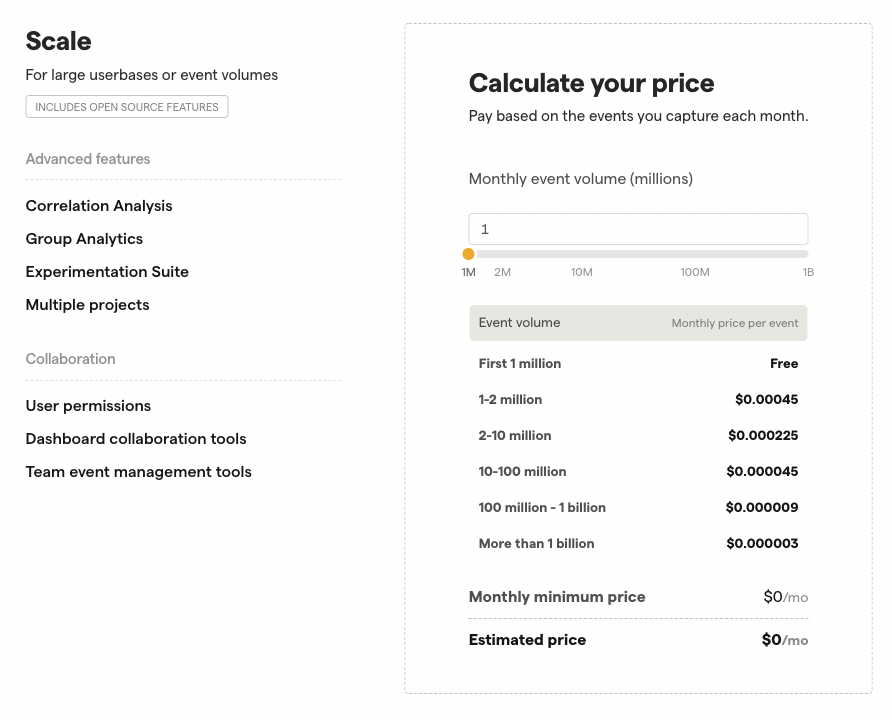
PostHog pricing calc

This model has worked incredibly well for us.

In the last six months, we've seen 20% month over month growth on our paid plans – an 8.9x increase per year.
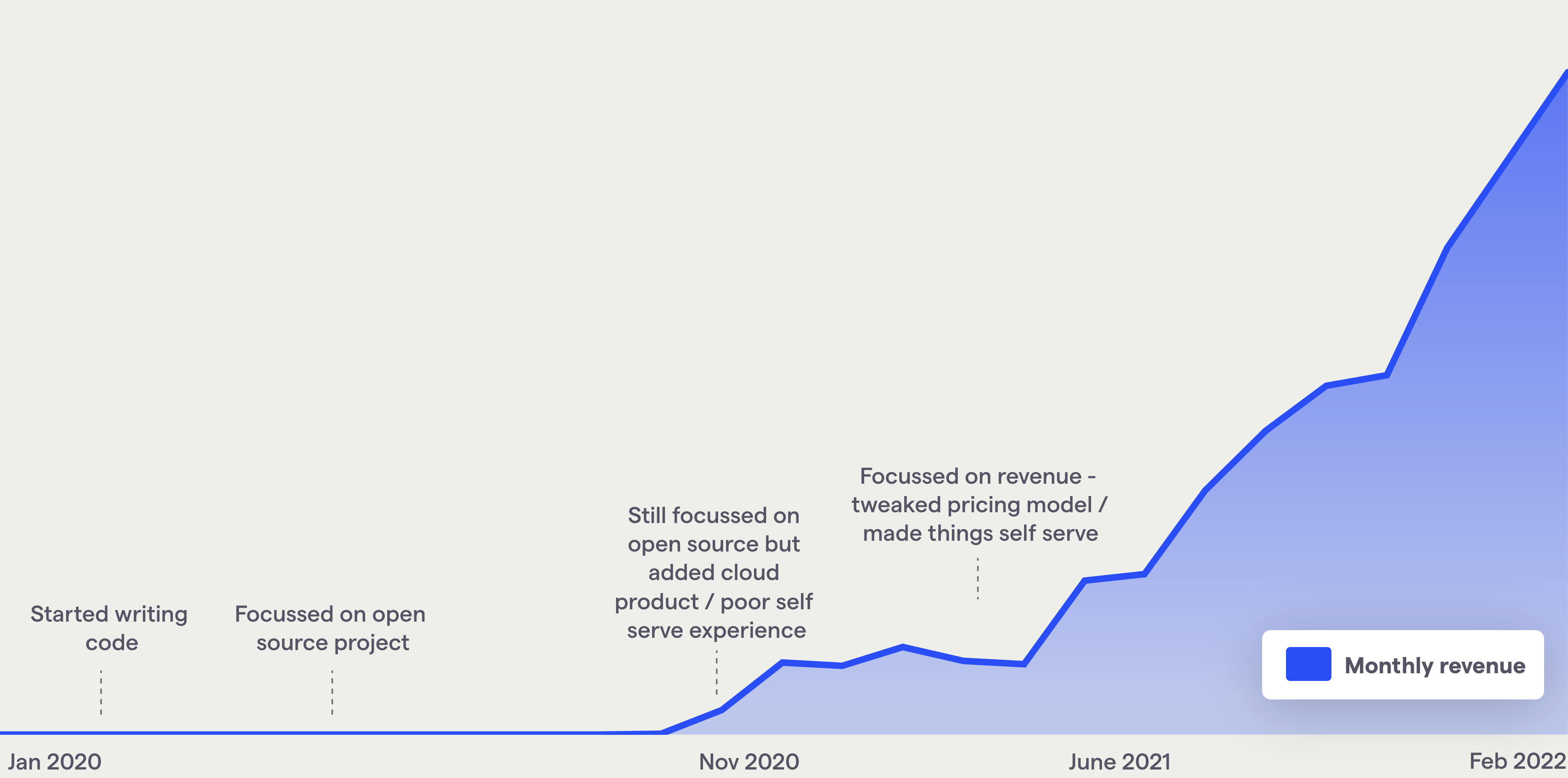
PostHog's revenue going sharply up and to the right

We achieved this without cold emailing companies, or chasing specific customers. We just make it super easy for companies to try us and pay us, and proactively help new and potential customers get what they need from PostHog.

It's a winning combination more SaaS companies should adopt.

The last frontier for us was our Enterprise plans. While some companies practice partial transparency, we wanted 100% transparency across the board. This took a while to achieve, but we're glad we did.

Our plans are split by whether you want to self-host PostHog, or have it hosted and managed by us.

There are three options for self-hosting PostHog:

  • Open-Source: Contains all of the base analytics features but is limited to one project
  • Scale: Contains advanced features such as experiments and group analytics, and has unlimited projects
  • Enterprise: Comes with SAML-based SSO, project permissions and a whole lot of help from us

For PostHog Cloud, there are just two options:

  • Cloud: Mirrors the features of PostHog Scale, hosted by us
  • Cloud Enterprise: Mirrors the features of PostHog Enterprise, hosted by us

PostHog Scale and Cloud have had transparent pricing for a while and, unsurprisingly, we found companies interested in PostHog Enterprise would calculate the price using the Scale or Cloud pricing calculators.

This makes sense in isolation, but our enterprise plans cost more because you get more, particularly on self-hosted where we offer a lot of support to ensure things run smoothly.

We adapted our existing pricing models to be roughly 2x Scale pricing for self-hosted Enterprise, and 1.3x Cloud pricing for Cloud Enterprise to reflect the additional benefits you gain from these editions.

We didn't want to mandate lengthy annual commitments, so all of our products can be subscribed to on a monthly basis and canceled at any time.

That said, most larger organizations fall into a traditional annual buying process, and we incentivize them with bigger discounts for the upfront commitment.

People expect self-hosted deployments to be cheaper than PostHog Cloud as they incur the additional infrastructure costs.

While it's true that running PostHog Cloud requires a minimum level of spend from us, self-hosting costs more than Cloud for a few important reasons:

  1. Developing and supporting a self-hosted platform is more complex than a traditional SaaS offering (and we offer both)

  2. We are willing to invest a significant amount of our time in ensuring our large, self-hosted deployments are tuned effectively so customers have the best PostHog experience possible.

This is a message we'll continue to refine, but ultimately we feel tolerance for the expense PostHog Enterprise is directly connected to how important self-hosting is to a customer.

It's still good value compared to other enterprise SaaS tools, especially considering the breadth of features we offer, and if the price isn't right then Cloud Enterprise might be a better option for those customers.

Things move fast at PostHog. When I started writing this blog post, our Enterprise plans had transparent pricing but still required you to contact us to get started. Not anymore.

You can now sign up for an Enterprise license yourself in a fully automated manner, so all our plans are now transparently-priced and self-serve.

If having SAML integration, project permissions and a whole lot of set up and ongoing help from us is for you, you can sign up for your Enterprise license key in just a few clicks.

Our final hurdle is to make it so Scale and Cloud users can upgrade to Enterprise themselves without our intervention. It's coming soon.

If all this talk of self-serving and automation isn't for you then don't worry – you can still always contact sales. We love hearing from our customers, but it's your choice when you do.

Subscribe to our newsletter

Product for Engineers

Read by 100,000+ founders and builders

We'll share your email with Substack