


惯性聚合 高效追踪和阅读你感兴趣的博客、新闻、科技资讯
阅读原文 在惯性聚合中打开

推荐订阅源

Jina AI
Jina AI
V
Vulnerabilities – Threatpost
Security Latest
Security Latest
AI
AI
奇客Solidot–传递最新科技情报
奇客Solidot–传递最新科技情报
量子位
H
Help Net Security
Attack and Defense Labs
The GitHub Blog
The GitHub Blog
L
LINUX DO - 最新话题
A
Arctic Wolf
博客园_首页
S
Securelist
S
Secure Thoughts
Google DeepMind News
让小产品的独立变现更简单 - ezindie.com
T
Tailwind CSS Blog
Apple Machine Learning Research
酷 壳 – CoolShell
酷 壳 – CoolShell
Stack Overflow Blog
Stack Overflow Blog
N
Netflix TechBlog - Medium
Cyberwarzone
Cyberwarzone
小众软件
小众软件
T
Threatpost
Exploit-DB.com RSS Feed
Blog — PlanetScale
Blog — PlanetScale
N
News and Events Feed by Topic
NISL@THU
NISL@THU
Forbes - Security
Forbes - Security
博客园 - 聂微东
F
Fortinet All Blogs
Simon Willison's Weblog
H
Heimdal Security Blog
罗磊的独立博客
S
Security @ Cisco Blogs
B
Blog
T
Troy Hunt's Blog
Engineering at Meta
Engineering at Meta
cs.CL updates on arXiv.org
The Hacker News
The Hacker News
The Last Watchdog
The Last Watchdog
Hacker News - Newest:
Hacker News - Newest: "LLM"
I
Intezer
T
Threat Research - Cisco Blogs
C
Cybersecurity and Infrastructure Security Agency CISA
The Cloudflare Blog
S
Schneier on Security
月光博客
月光博客
L
LINUX DO - 热门话题
cs.CV updates on arXiv.org

PostHog's RSS Feed

Training our own AI models - PostHog From 270GB RAM to 5GB: Moving local flag evaluation from Django to Rust The best analytics stack for vibe-coded apps The do's and don'ts of minimum viable product marketing - PostHog The best MCP servers for startups, by workflow 4,063 errors closed without a human opening PostHog – here's what we learned - PostHog PostHog Code and the self-driving product - PostHog Why attacking your competitors online is dumb - PostHog The best real-time analytics platforms for developers, compared DuckDB vs ClickHouse: Why we use both at PostHog - PostHog PostHog's next chapter - PostHog Making Claude Cowork actually useful - PostHog PostHog vs Matomo in-depth tool comparison You're doing lifecycle emails wrong Untangling Tokio and Rayon in production: From 2s latency spikes to 94ms flat The best HIPAA-compliant A/B testing tools - PostHog A beginner's guide to testing AI agents - PostHog I hate the standup bot (so I built an agent to do it for me) - PostHog The best CDPs for developers, compared The best error tracking tools for developers, compared The best feature flag software for developers, compared 7 best session replay tools for mobile apps 7 best free open source business intelligence tools right now 7 best free and open source LLM observability tools PostHog vs LogRocket in-depth tool comparison The most popular PostHog alternatives, compared Open source (and self-hosted) session replay tools - PostHog The 9 best GA4 alternatives for apps and websites - PostHog PostHog vs Google Analytics 4 in-depth tool comparison How we built automatic clustering for LLM traces - PostHog The 7 best HIPAA-compliant analytics tools 8 best open source analytics tools you can self-host - PostHog The best product analytics tools for startups, compared PostHog vs FullStory in-depth tool comparison The best in-app survey tools for product teams, compared The 7 best mobile app analytics tools PostHog vs Hotjar in-depth tool comparison The 8 best free and open-source feature flag services - PostHog The 5 best free and open-source A/B testing tools - PostHog The best mobile app A/B testing tools, compared What is a feature flag? Feature Flags vs Remote Config vs A/B Testing PostHog is now available in Vercel’s v0 The best Heap alternatives & competitors, compared PostHog vs Heap in-depth tool comparison PostHog vs Pendo in-depth tool comparison PostHog × Vercel: feature flags, minus the plumbing Your logs' final destination is in GA. You always end up here anyway Behind the scenes of a PostHog hackathon - PostHog The most popular Mixpanel alternatives & competitors, compared PostHog vs Mixpanel in-depth tool comparison The 9 best GDPR-compliant analytics tools How we use Logs at PostHog The best web analytics tools for developers, compared Stop AI slop: Run evals with LLM-as-a-Judge - PostHog You product data just got a job: Workflows is now out App onboarding: How to fix drop-off points Meet Logs (beta) – logs with all the tools you’re already using Why small teams crush tiger teams How we built user behavior analysis with multi-modal LLMs (in 5 not-so-easy steps) - PostHog The best Contentsquare alternatives & competitors, compared 8 learnings from 1 year of agents – PostHog AI - PostHog Why we killed our AI product assistant Workflows graduate to beta! Product data, meet automation The best Rollbar alternatives & competitors, compared Workflows are now in Alpha and I already broke mine - PostHog I've consistently underestimated how important communication is as a CEO - PostHog How we made feature flags even faster and more reliable The best session replay tools for developers, compared What I learned attending my first ever hackathon - PostHog Did you know AI is answering our community questions? - PostHog How not to be boring - PostHog We built an internal tool to generate changelog images for social media - PostHog What we built at our windswept Mykonos hackathon - PostHog How we built our onboarding email flow (with actual performance data) - PostHog We're building a better PostHog community by closing our public Slack - PostHog Introducing Notebooks for PostHog - PostHog Why we've launched PostHog user surveys - PostHog How we made feature flags faster and more reliable - PostHog In-depth: ClickHouse vs Redshift - PostHog Introducing HouseWatch: An open-source toolkit for ClickHouse - PostHog Introducing HogQL: Direct SQL access for PostHog - PostHog What we built at our sun-kissed Aruba hackathon - PostHog In-depth: ClickHouse vs BigQuery - PostHog In-depth: ClickHouse vs Elasticsearch - PostHog HogMail #22: Why do companies over-hire?" - PostHog Our simpler goal: Help engineers to be better at product - PostHog In-depth: ClickHouse vs Snowflake - PostHog HogMail #21: Avoiding the "Product Death Cycle" - PostHog Sunsetting Kubernetes support for PostHog - PostHog Why 'Product Engineer' is the most fun role I've had in tech - PostHog HogMail #20: Why do startups fail? - PostHog The best Google Optimize alternatives for apps and websites - PostHog Array 1.43.0: Massive performance improvements! - PostHog In-depth: ClickHouse vs Druid - PostHog HogMail #19: Which meetings should you kill? - PostHog CEO diary: The things I learned in 2022 - PostHog The essential tools used by product engineers - PostHog HogMail #18: What can SaaS learn from the New York Times? - PostHog What is a product engineer? - Product Engineer Handbook - PostHog Array 1.42.0: Get beta features via our roadmap! - PostHog
I didn't understand the OS I built with AI until the MCP gave it analytics - PostHog
Joe Martin · 2026-08-05 · via PostHog's RSS Feed

For my birthday this year I got a Pimoroni Presto — a little developer gadget with a 240×240 touchscreen and not much else. I also got an environment sensor which can track CO2, temperature, and humidity. I wanted to build something for it.

The thing is, I'm not an engineer. I'm a marketer. Until I joined PostHog I couldn't code at all. I've made effort to learn and slowly got myself to the point where I could ship product features, but it wasn't until DeskHog came along that I saw how AI could supercharge my progress.

My goal was a desk dashboard that worked at any level of attention. Something I could glance at between meetings and read idly, but that also had deeper things to poke at while I waited for someone to join a call or had lunch.

I call it Joe-OS, because naming things is the one part of this I'm actually qualified for.

The Presto runs MicroPython. The top two-thirds of the screen is a carousel of panels; the bottom third permanently shows temperature and CO2 from the sensor, with little sparklines of the last half hour. You move between panels by tapping the corners of the screen.

The panels are deliberately a mix of useful and useless:
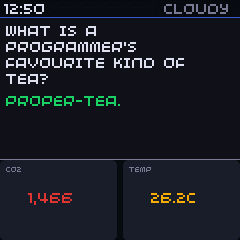
  • Three news readers that stream the latest RSS headlines from The Guardian, BBC News, and Rock, Paper, Shotgun.
  • Oblique Strategies — Brian Eno's deck of creative prompts, plus a few dozen I wrote myself to build it out more.
  • A rotating daily joke, a random fractal, and a Sky panel showing the current moon phase, sunrise, and sunset.

joke panel

The most ambitious part of Joe-OS was Vigil

It's a tiny medieval roguelike text adventure about a knight keeping watch over a dying realm. Every turn something happens — a ghoul rises, a house burns, a bandit approaches — and you respond by choosing an Honorable or a Craven option. Sometimes you get a third choice based on your inventory or companions, each of which has their own simple personality.

It runs across five acts and 400+ hand-written events, with a two-and-a-half minute cooldown between choices during which the world breathes by giving you a slow trickle of flavour events.

When your knight finally dies, you choose their last words, and those words shape the knight who takes up the watch next. It is not a game you rush. It's something you keep half an eye on while you wait for meetings to start over the course of weeks.
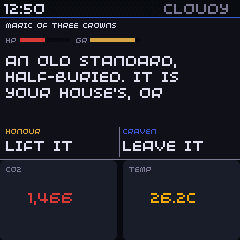
vigil panel

The whole thing was built in plain English, in conversation with Claude. I'd describe what I wanted — a new panel, a layout tweak, a bug to chase — and it would write the MicroPython, flash it to the device over USB, and read the logs back when something broke. For the bigger pieces, like expanding Vigil, I'd put it in plan mode first, but for everything small, I just said the thing and watched it land a few seconds later.

Initially my prompts were not precise. Most were vibes — "make the moon panel a bit nicer and more in keeping with the aesthetic." Some were just "the clock is five minutes slow," with a photo of the screen attached. The rhythm never changed: ask, flash, see what it actually did, report back.

This was a necessary pattern because, while AI helped me ship this thing, I didn't always understand the thing I shipped and the AI is only as good as what you can tell it. "It's broken" isn't as powerful as "It hangs at the weather fetch, here's the boot log for you to debug"..

The bottleneck in non-technical building isn't building anymore — it's diagnosis. And diagnosis is just data you haven't collected yet.

So the more of my code an AI writes, the more I need something telling me — and it — what's actually happening. That's the opposite of what you'd assume. You'd think tools like Claude make analytics less necessary. For people like me, they make it more.

Setting up PostHog

Which is why the last thing I added was PostHog.

There are a lot of ways to install PostHog, but I did this with one sentence: "Add PostHog to track usage, games played, and errors."

Claude wrote a small capture client that batches events in memory and ships them over WiFi without ever blocking the screen, then wired it through the whole OS. I pasted in a project key. That was the entirety of the install experience.

The more interesting part happened next, through the PostHog MCP. With it, I never had to open the PostHog UI. I just asked, and Claude found my new project, confirmed events were arriving, built two pinned dashboards, and filled them with fifteen insights – all from plain English.

AI collapsed the gap between having an idea and shipping it. The MCP collapsed the gap between shipping it and understanding it — which, for someone like me, is the harder of the two.
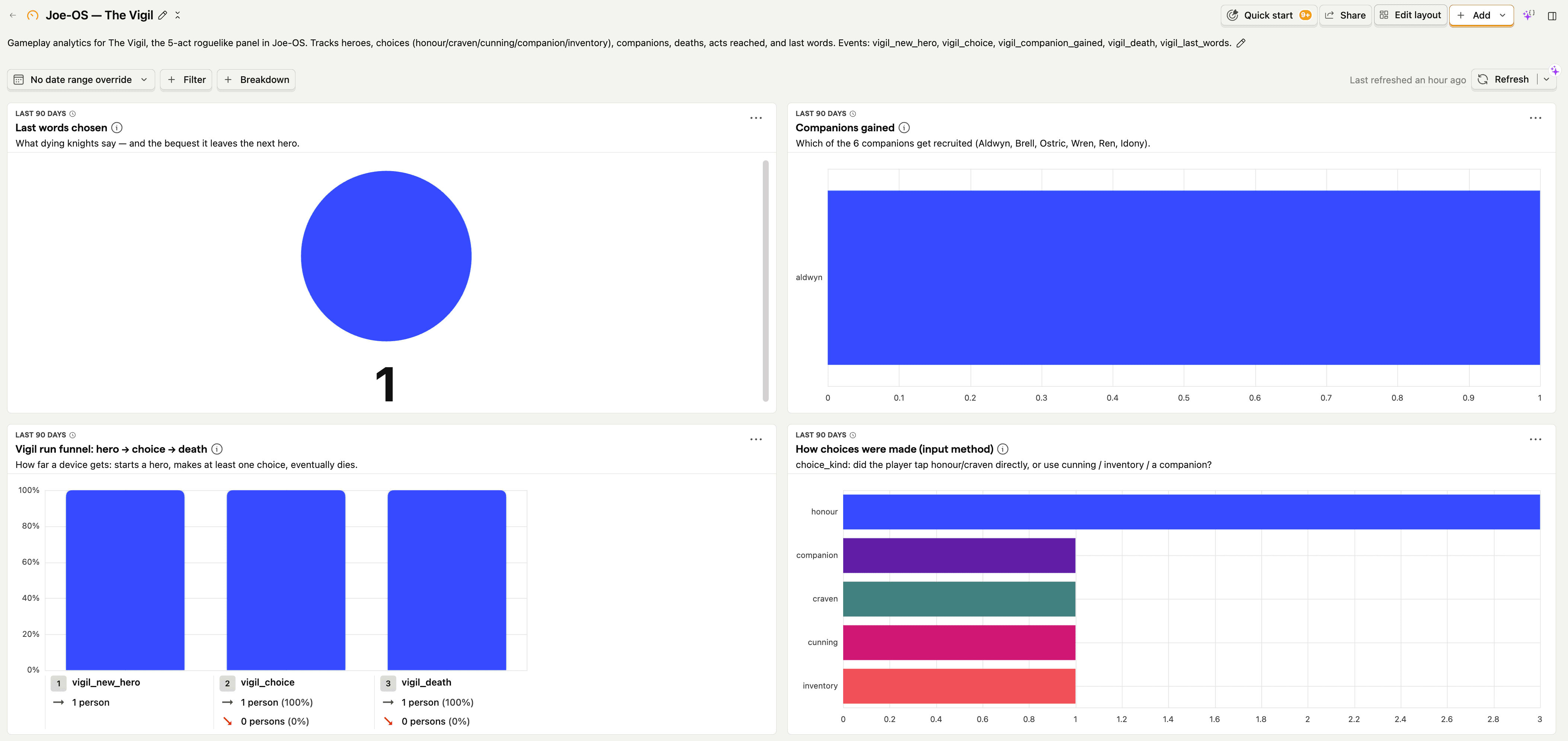
Vigil dashboard

The device now reports boots, which panels I actually visit and for how long, every honour-or-craven choice my knights make, which companions I recruit, where they die, and a temperature and CO2 reading every five minutes. One dashboard tracks device health — errors grouped by where they fired, CO2 plotted against the same thresholds the OS uses to colour its own display. Another dashboard tracks interactions in Vigil.

Shipping isn't maintaining

I'm not going to pretend I'm an engineer now. I do enough of that on LinkedIn. But the gap between "I have an idea" and "it's running on hardware on my desk" has collapsed, and it'll keep collapsing for people like me.

Analytics added via PostHog are part of how that happens. The dashboards and tracking I've implemented can function as just a curiosity — a scoreboard by which I can track my lifetime progress in Vigil and the temperature in my home office. But they also provide so much more as a way for me to enrich my prompts, gather insights, and build more features.

A few things that are already changing because of what I can now see in the data include re-ordering the panels and tweaking the UI. I knew this intuitively, but the data in PostHog showed I opened Vigil more often than anything else. So, I asked Claude to create a shortcut. Now, I can tap the clock from any panel and it'll take me straight back to my knights' dreary adventure.

Further updates are coming too. Right now, the numbers in Vigil's dashboard suggest I choose the Honorable option far more often than not – which suggests the moral tension I was hoping for isn't landing. When I get time I plan to rewrite many of the story beats, remove the Honor and Craven labels, and make the positions randomize. That way there won't always be an obviously good choice to lean on.

In other words, while the way I build is changing thanks to AI tools like Claude, product analytics remains an important part of the process and helps me decide what I'll build. The instrumentation is what lets me, and the AI I build with, keep something alive that neither of us could have written alone.

Also, my desk now tells me when the CO2 in the room is too high, which explains an enormous amount about my sleepy afternoons.