






Picture this: your company's social media team excitedly informs you that stonks are up this month. You can see the screenshots. They're green. Holy smokes. We are killing it. Social media has been solved.
There is a non-zero chance they are taking you for a total sucker.
Don't fret. What they're saying may still be true. Success metrics may be up. However, basing your judgment of social media success on numbers is not helping your business. In a lot of cases, it's doing the opposite.
You see, the problem with social media metrics is that they're all bad. To show you how bad, let's go through them one by one.
I may upset some social media professionals by lumping these in the same category. These all have slightly different definitions: impressions counts repeat views, reach is unique accounts, views usually require a unit of time spent looking at content.
They all ostensibly track the same thing: how "viral" a post is.
The main problem with these metrics is that, for a single piece of content, they're no better at determining how "good" a piece of content is than eyeballing "how it's doing".
Does it have more likes and shares than usual? Are people commenting in earnest? These are things you can see and make quick content strategy pivots with much more easily than digging into impression numbers.
At the very least, likes, comments, and shares will tell you how people are interacting with your content, not just how many screens someone might have seen it on before swiping past, uninterested.
And when you track an account's impressions/reach/views in aggregate, you're removing all context around what individual pieces did well.
Unless you're completely changing the sort of content you're posting from week to week or month to month, you're gonna have a data set that doesn't give you any context for how you should change what you're doing.
Engagements are the best of the bad metrics.
Why is it still dumb to track? Because it's not telling you how people engage with your content.
Are they super pissed? Are they loving it? Are they just tagging their friend? Is that because they like the post, or because they're trying to dunk on you and say mean things about your product?
Engagements as a metric tells you none of that. One post that had your company getting absolutely killed can make it seem as if your metrics are up in a positive way. I can't think of another metric in any business case where what looks good can actually be completely detrimental.
Now this is some BS.
I once worked for a company for whom followers was a KPI. Let me just say: it is really nice for brands and creator types to have large followings. It's a great signal to prospective buyers of whatever you're selling.
At the same time, it's the most fudgeable performance metric possible. I can cynically create a giveaway whose call to action is to follow and like, and boom, I've got a whack more followers. And guess what we did at that company? Exactly that! KPI hit!
Heck, I can just buy 'em outright if I wanted to.
Following should be built gradually, not at any particular speed. It should be a byproduct of your content being engaging and people choosing to follow you to see more of it.
"But Liam," you say, "surely engagement rate is worth looking at. It's the best way to measure if people are actually looking at what we're putting out!"
No it's not. Because engagement rate is engagements divided by reach (or followers; the fact that there is not one standard way to measure this is indication enough that it's not reliable), one of those metrics being juiced throws everything off.
Have a post that's got a ton of impressions, but not much engagement? You still reached a ton of people. That can still be an objective success. Yet, your engagement rate will dip.
What about one that's got a whack of engagements but hasn't reached many people? Sure, it's great that who did see it's interacting, but there's probably a reason the algo hasn't pushed it out to more people. Your engagement rate will be good, but your brand awareness won't be.
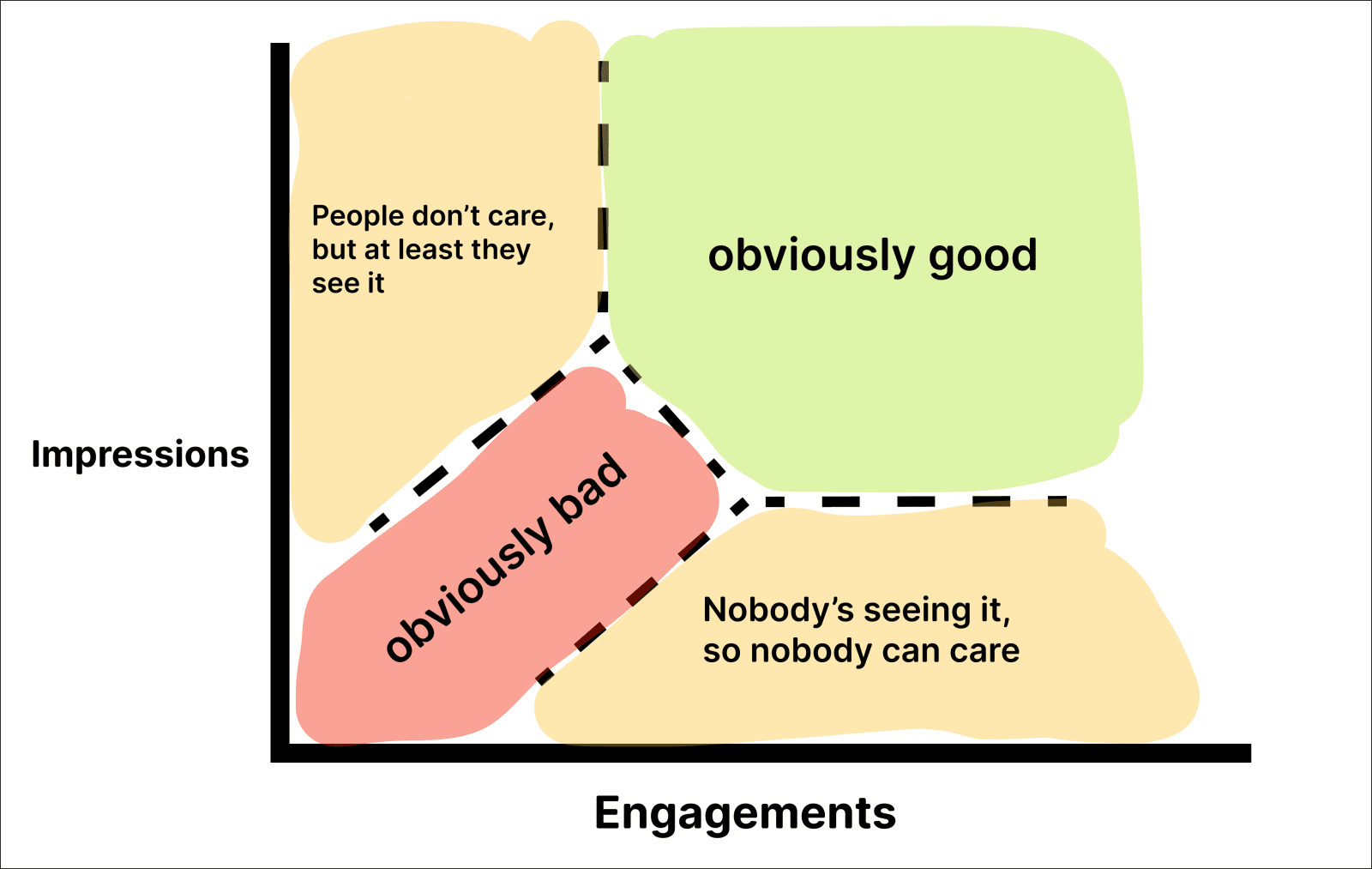
Goodhart's law states that when a measure becomes a target, it ceases to be a good measure. Social media's rife with this: you can game the system to hit any one of the above metrics, but it doesn't mean your brand's reaching the right people.
Focus on consistently creating content that appeals to your ideal customer profile (ICP).
I'm PostHog's new social media person. PostHog compensates me obscenely to post stupid shit like the meme below because it's appealing to our ICP: engineers at early-stage startups.

These folks are meme-literate and have short attention spans because they're smart, high-functioning people busy with more important things.
What we post has to cut through the stuff on their feeds that they watch on their mental breaks: cat, thirst trap, and fight videos.
I don't own a cat, I'm ugly, and I can't fight. Damn, are we ever at a disadvantage!
So, we lean into hedgehogs with many jobs, medieval tales, and content that we think would be entertaining or funny. And memes. As long as they're not corny.
This ✨ represents our brand voice ✨.
Your brand's success on social media is not conditional on having a similarly irreverent, fun tone. What it does depend on is consistency.
To get better at this, look at brands that are...
Both of those qualifiers are important: you cannot learn anything applicable from Nike, Apple, or Red Bull's marketing. These are brands with so much built-up credit that almost anything they post would do well. Even when it's written by AI. Allegedly.
Every time one of those brands is mentioned internally within a company that's got a marketing budget, an MBA student gets their wings. They're flying over to bill you $300 an hour. You brought this on yourself.
Brands with massive following, while sometimes having been successful for their content strategy, are often big because of their wider branding efforts over years or decades, not just what they post.
Your brand's social media is, more likely than not, highly dependent on external factors. Consider them always, and use the following two objectives as your new north star.
Your audience needs to know what they can expect to see from your account. It can be as simple as someone giving hot takes into a lav mic, or as complex as long written editorial pieces broken up into slides in an Instagram carousel.
Familiarity and a clear set of expectations are what make someone follow an account if they are not familiar with a brand. They find the content and think "I wanna see more of that", and boom, you've got yourself a new follower. It's no more complicated than this.
It's easy to be a blocker: being overly-protective of brand when not necessary, prioritizing personal opinion and taste above all, or even just not delegating tasks efficiently across their team.
Social media should draw from across your entire organization. Everyone should feel the work they're doing is represented by it, not that it's on an island.
One of the things I've tried to do (and am still trying to do better) during my first couple months at PostHog is figure out where content exists that isn't getting pushed externally.
We're proud of the changelog and want that info out there every week to show how much we ship? Let's figure out a way to do that.
Talent wants to write a blog about how what they look for has changed as a result of AI? Put it out there.
A PMM has an idea for a meme that goes completely over your head? Trust their judgment and stick 'er out (I am not hip enough to have read or seen Watchmen).
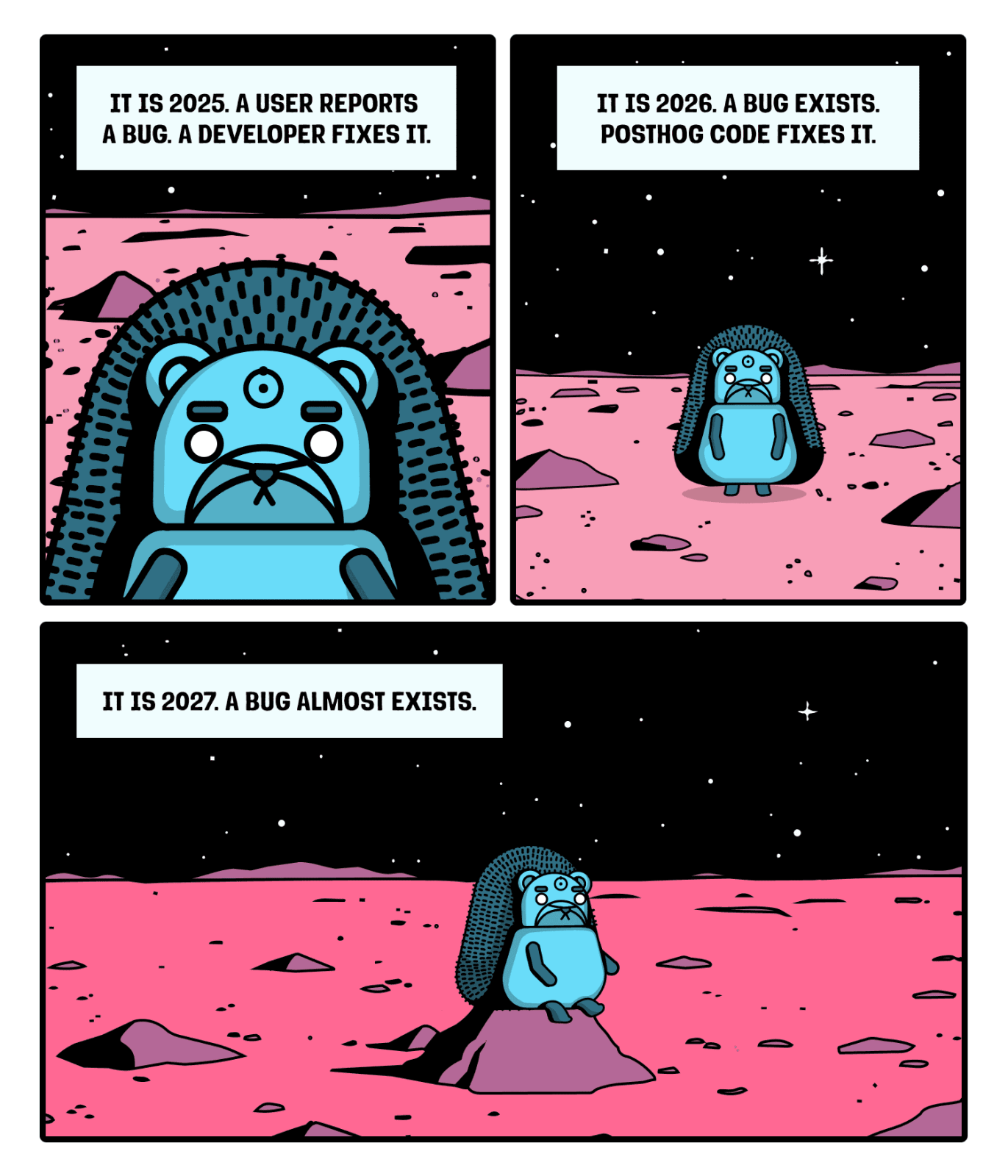
Can it be difficult to do this? Yes. But that's what best-in-class looks like.
It's also important that your company's employees feel empowered to share their own content. It might look different or slightly less buttoned-up than what would come out of a company account, but on LinkedIn, it's more than twice as likely to be seen and 5x as likely to be engaged with.
Internally, we have a Slack channel called #shitposters-unite, where if someone's looking for a little encouragement or inspiration to post, they can get it on demand.
It's inadvertently a fantastic team-building tool for us: posting can be intimidating, especially because nobody wants to be part of a LinkedIn slop fest, so getting feedback and getting spurred on by other team members becomes something that benefits both PostHog employees and PostHog the company.
Your goal shouldn't be impressions, engagements, followers, or any other quantitative social media metric. It should be consistent brand representation that gets attention from your ICP.
此内容由惯性聚合(RSS阅读器)自动聚合整理,仅供阅读参考。 原文来自 — 版权归原作者所有。