
惯性聚合 高效追踪和阅读你感兴趣的博客、新闻、科技资讯
阅读原文 在惯性聚合中打开

推荐订阅源

B
Blog RSS Feed
C
CERT Recently Published Vulnerability Notes
P
Proofpoint News Feed
Y
Y Combinator Blog
T
The Blog of Author Tim Ferriss
云风的 BLOG
云风的 BLOG
H
Help Net Security
Recorded Future
Recorded Future
The Register - Security
F
Full Disclosure
N
Netflix TechBlog - Medium
Cyber Security Advisories - MS-ISAC
酷 壳 – CoolShell
酷 壳 – CoolShell
H
Hackread – Cybersecurity News, Data Breaches, AI and More
爱范儿
爱范儿
Security Archives - TechRepublic
Simon Willison's Weblog
Cisco Talos Blog
Cisco Talos Blog
I
InfoQ
T
Tenable Blog
T
Tor Project blog
人人都是产品经理
人人都是产品经理
D
DataBreaches.Net
NISL@THU
NISL@THU
Google DeepMind News
博客园 - 叶小钗
B
Blog
V
V2EX
Jina AI
Jina AI
L
LangChain Blog
月光博客
月光博客
W
WeLiveSecurity
U
Unit 42
AWS News Blog
AWS News Blog
C
Cyber Attacks, Cyber Crime and Cyber Security
博客园 - 聂微东
V
Visual Studio Blog
A
Arctic Wolf
T
Tailwind CSS Blog
The Cloudflare Blog
SecWiki News
SecWiki News
S
SegmentFault 最新的问题
Hacker News - Newest:
Hacker News - Newest: "LLM"
宝玉的分享
宝玉的分享
MyScale Blog
MyScale Blog
cs.CL updates on arXiv.org
S
Securelist
www.infosecurity-magazine.com
腾讯CDC
雷峰网
雷峰网

PostHog's RSS Feed

Training our own AI models - PostHog From 270GB RAM to 5GB: Moving local flag evaluation from Django to Rust The best analytics stack for vibe-coded apps The do's and don'ts of minimum viable product marketing - PostHog The best MCP servers for startups, by workflow 4,063 errors closed without a human opening PostHog – here's what we learned - PostHog PostHog Code and the self-driving product - PostHog Why attacking your competitors online is dumb - PostHog The best real-time analytics platforms for developers, compared DuckDB vs ClickHouse: Why we use both at PostHog - PostHog PostHog's next chapter - PostHog Making Claude Cowork actually useful - PostHog PostHog vs Matomo in-depth tool comparison You're doing lifecycle emails wrong Untangling Tokio and Rayon in production: From 2s latency spikes to 94ms flat The best HIPAA-compliant A/B testing tools - PostHog A beginner's guide to testing AI agents - PostHog I hate the standup bot (so I built an agent to do it for me) - PostHog The best CDPs for developers, compared The best error tracking tools for developers, compared The best feature flag software for developers, compared 7 best session replay tools for mobile apps 7 best free open source business intelligence tools right now 7 best free and open source LLM observability tools PostHog vs LogRocket in-depth tool comparison The most popular PostHog alternatives, compared Open source (and self-hosted) session replay tools - PostHog The 9 best GA4 alternatives for apps and websites - PostHog PostHog vs Google Analytics 4 in-depth tool comparison How we built automatic clustering for LLM traces - PostHog The 7 best HIPAA-compliant analytics tools 8 best open source analytics tools you can self-host - PostHog The best product analytics tools for startups, compared PostHog vs FullStory in-depth tool comparison The best in-app survey tools for product teams, compared The 7 best mobile app analytics tools PostHog vs Hotjar in-depth tool comparison The 8 best free and open-source feature flag services - PostHog The 5 best free and open-source A/B testing tools - PostHog The best mobile app A/B testing tools, compared What is a feature flag? Feature Flags vs Remote Config vs A/B Testing PostHog is now available in Vercel’s v0 The best Heap alternatives & competitors, compared PostHog vs Heap in-depth tool comparison PostHog vs Pendo in-depth tool comparison PostHog × Vercel: feature flags, minus the plumbing Your logs' final destination is in GA. You always end up here anyway Behind the scenes of a PostHog hackathon - PostHog The most popular Mixpanel alternatives & competitors, compared PostHog vs Mixpanel in-depth tool comparison The 9 best GDPR-compliant analytics tools How we use Logs at PostHog The best web analytics tools for developers, compared Stop AI slop: Run evals with LLM-as-a-Judge - PostHog You product data just got a job: Workflows is now out App onboarding: How to fix drop-off points Meet Logs (beta) – logs with all the tools you’re already using Why small teams crush tiger teams How we built user behavior analysis with multi-modal LLMs (in 5 not-so-easy steps) - PostHog The best Contentsquare alternatives & competitors, compared 8 learnings from 1 year of agents – PostHog AI - PostHog Why we killed our AI product assistant Workflows graduate to beta! Product data, meet automation The best Rollbar alternatives & competitors, compared Workflows are now in Alpha and I already broke mine - PostHog I've consistently underestimated how important communication is as a CEO - PostHog How we made feature flags even faster and more reliable The best session replay tools for developers, compared What I learned attending my first ever hackathon - PostHog Did you know AI is answering our community questions? - PostHog How not to be boring - PostHog We built an internal tool to generate changelog images for social media - PostHog What we built at our windswept Mykonos hackathon - PostHog How we built our onboarding email flow (with actual performance data) - PostHog We're building a better PostHog community by closing our public Slack - PostHog Introducing Notebooks for PostHog - PostHog Why we've launched PostHog user surveys - PostHog How we made feature flags faster and more reliable - PostHog In-depth: ClickHouse vs Redshift - PostHog Introducing HouseWatch: An open-source toolkit for ClickHouse - PostHog Introducing HogQL: Direct SQL access for PostHog - PostHog What we built at our sun-kissed Aruba hackathon - PostHog In-depth: ClickHouse vs BigQuery - PostHog In-depth: ClickHouse vs Elasticsearch - PostHog HogMail #22: Why do companies over-hire?" - PostHog Our simpler goal: Help engineers to be better at product - PostHog In-depth: ClickHouse vs Snowflake - PostHog HogMail #21: Avoiding the "Product Death Cycle" - PostHog Sunsetting Kubernetes support for PostHog - PostHog Why 'Product Engineer' is the most fun role I've had in tech - PostHog HogMail #20: Why do startups fail? - PostHog The best Google Optimize alternatives for apps and websites - PostHog Array 1.43.0: Massive performance improvements! - PostHog In-depth: ClickHouse vs Druid - PostHog HogMail #19: Which meetings should you kill? - PostHog CEO diary: The things I learned in 2022 - PostHog The essential tools used by product engineers - PostHog HogMail #18: What can SaaS learn from the New York Times? - PostHog What is a product engineer? - Product Engineer Handbook - PostHog Array 1.42.0: Get beta features via our roadmap! - PostHog
We put PostHog in Slack and now everyone's an engineer - PostHog
Cleo Lant · 2026-06-02 · via PostHog's RSS Feed

Today, we're releasing the PostHog Slack app into beta.

We built it for those times when a colleague flags an annoying UI quirk, or a customer mentions a bug. The issues that normally end up on a backlog, untouched and ignored.

With the PostHog Slack app, you @PostHog to "fix this" or "build that". It spins up a sandbox, makes a plan, edits files, runs checks, opens a draft PR, and answers review comments in the thread.

The bot uses your product data as context and follows your repo's rules. It even reacts with emojis while it works, which makes it feel less like a coding tool and more like chatting with a clever teammate.

Try it yourself → setup docs

@PostHog in the #papercuts channel

Paul D'Ambra was the first to fall in love with @PostHog. Among other important blitzscale duties, he owns the #papercuts Slack channel, where anyone can post the small bugs and nits they hit in the app. He'd been fixing them with PostHog Code like a good engineer. Now he mentions @PostHog in nearly every thread.
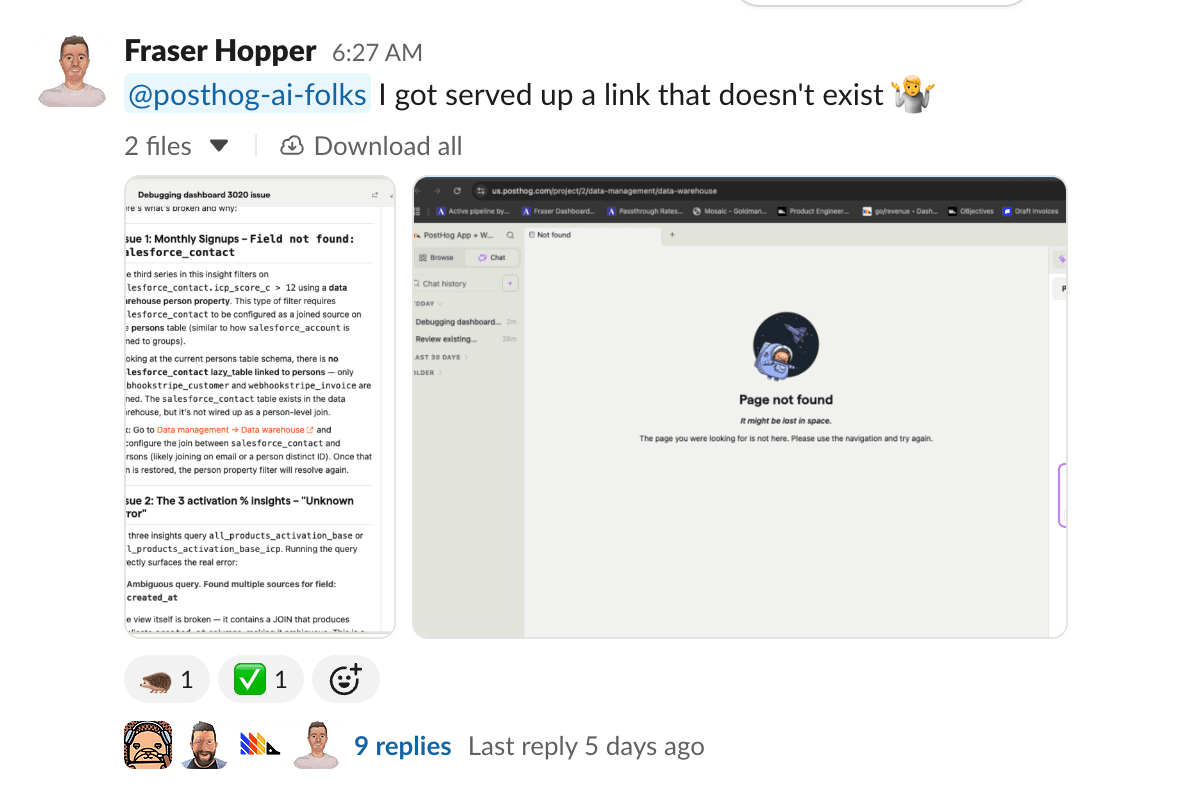

Paul mentions @PostHog in #papercuts

Paul D'Ambra prompts @PostHog

It's awesome when a prolific engineer gets even more productive, but what makes @PostHog really magical is that it empowers every role. Sales, marketing, customer support – anyone can tag the bot with a bug, a papercut, or a feature idea.

Here's a few examples of @PostHog usage across the org chart:

The one where it built a new feature for the web app

Will Wearing (technical account manager) asked @PostHog to add support to copy and paste for markdown into PostHog notebooks with proper rendering. The bot wrote the code, added 20 test cases, and auto-closed a related stale GitHub issue.

Will Wearing prompts @PostHog

PostHog/posthog is a massive production repo that most people in a sales role would never feel empowered to touch. Will's PR got merged in less than 24 hours, and the only hiccup was a flaky test (nothing wrong with the code, just CI being CI).

Clearing CI is as much of a job as the code generation itself, and the bot sticks with a PR through red checks and reruns until it's mergeable.

The one where it prepared for a user interview

It's not just code generation. You can tag @PostHog with a data question and it runs the same agent loop as PostHog AI. The only difference is that answers turn up where you're already working (i.e. wasting time searching for the perfect reaction emoji).

Cory Slater (product manager) asked @PostHog to pull context on a Session Replay user he was interviewing that afternoon. The bot came back with a full brief: account value, product usage, how long she'd been a customer.

Then it went further. In addition to detecting zero MCP activity, it noticed she works across two PostHog projects with replicated feature flag configs. The bot flagged it as odd and suggested Cory ask about that in the interview. Clever robot.
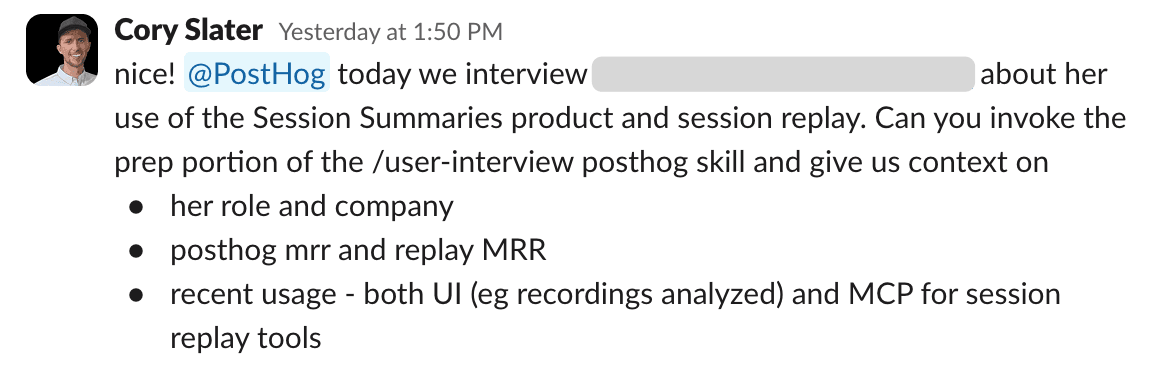
Cory Slater prompts @PostHog

The one where it updated the company handbook

Lizzie (product marketer), asked in #team-marketing what URL format to use when linking to the PostHog app in emails. She got an answer in the thread – then asked @PostHog to write it into the company handbook. She didn't specify which repo, but the bot figured it out.
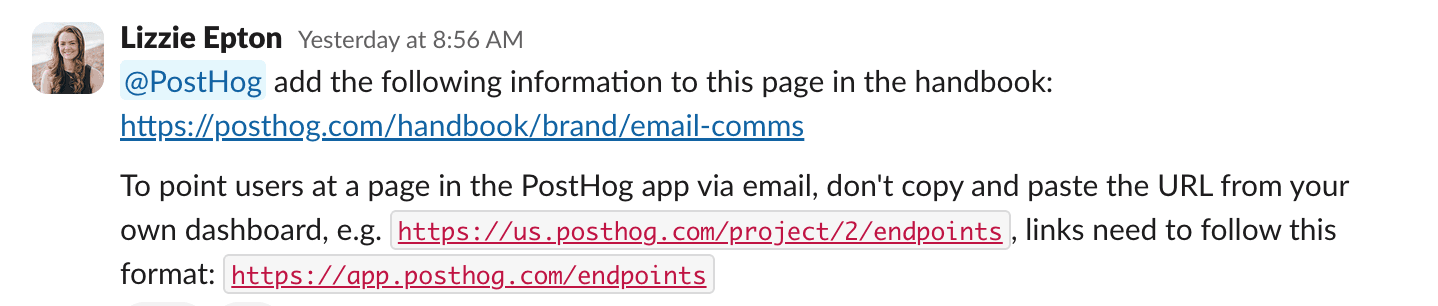
Lizzie prompts @PostHog

The one where it did the logs legwork

Lucas Ricoy (product engineer) asked @PostHog to check whether a recent PR, which aimed to tag WebStats queries by strategy for better performance visibility, actually worked. The logs API was returning stale data (which threw off the bot), but once Lucas confirmed the cutover had happened, the bot not only confirmed the new ones were appearing, but also that one query – stats_table_path_bounce_query – was showing up as a bottleneck.

Lucas Ricoy prompts @PostHog

The one where it added feet pics to the website

Then there's Richard (product engineer). He broke his foot at the recent company offsite, posted his x-ray, and asked @PostHog to add it to the secret company feet pics folder. The bot grabbed the image link, labeled it broken bone (real).jpg, and passed 19 CI checks. The resulting PR was merged a lot quicker than Richard's anticipated 4-6 week recovery period.

Richard prompts @PostHog

What you can @PostHog to do

Over the past two weeks, we've merged 116 contributions from @PostHog into production across AI Observability, Session Replay, Error Tracking, Feature Flags, Workflows, billing, MCP, and the Data Warehouse. No corner of the codebase is off-limits (except our secrets).

The work it's taken off our hands sorts into roughly these categories – and yours probably looks similar:

  • Content and docs – Navigation changes, removing stale content, adding new pages, copy updates, fixing 404s. Admin chores fit for a robot.
  • Code maintenance – Removing released feature flag guards, updating naming conventions, bumping versions, resolving merge conflicts, dead click tracking.
  • Bugs and CI fixesErrors, display issues, flaky tests, merge conflicts. Anything you tell an agent to "debug".
  • UI polish – Layout tweaks, swapping icons, adding keyboard shortcuts, task renaming, in-app banners and notifications. The nice-to-haves you never seem to get to.
  • AI infrastructure – Updating the MCP server, adding skills and prompts for AI observability, writing evals, tool schema improvements, LLM gateway routing logic (e.g. Bedrock fallback).
  • Net new features – UX additions, new screens and capabilities, setup scripts, scaffolding whole new products.

You'd expect engineers to hate this. A bot opening hundreds of PRs for them to review, non-technical people shipping AI-generated code to production – that sounds like a mess!

It's not, and here's why: the PostHog Slack app understands your codebase and your product data. It doesn't merge its own work. It follows a rigorous review process, and runs a flurry of tests (which most engineers would rather not do).

If CI fails, it fixes the failure. If you add a review comment, it addresses the comment. It pokes you when the PR sits idle until the merge is clean or it runs out of ideas.

The code generation that lands from one sentence prompts are surprisingly good. So good that even Cory Watilo, our resident webmaster, is pleased to @PostHog.
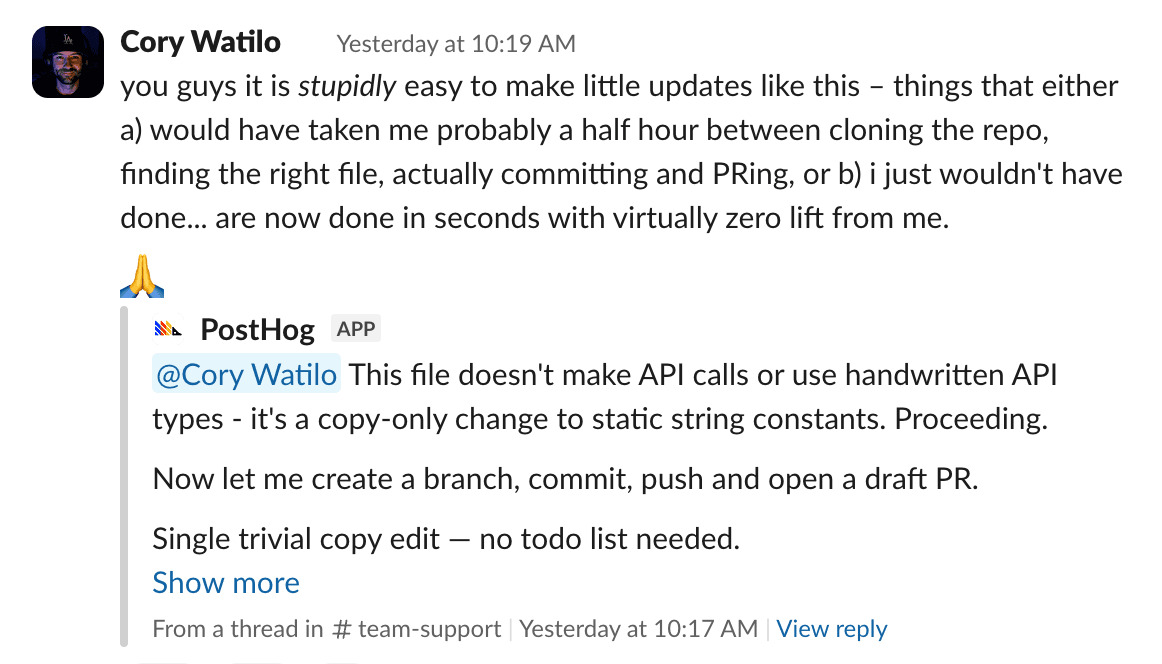
Cory Watilo reacts to @PostHog

Generating PRs with @PostHog in Slack is so easy it feels illegal, and it's a glimpse at what the self-driving product means in practice.

Despite being a coding agent, it won't answer every @mention with a PR. Every @PostHog mention runs through a two-stage classifier before any work happens:

  1. Task classifier – Does this request need repo access, or is it analytics/data/config?
  2. Repo router – If it does require code generation, which GitHub repo does it go to?

Both classifiers use Claude Haiku (tiny, fast, cheap) and we track latency and cost with AI Observability.

This simple routing is why Paul's prompt "@PostHog can you generate a team photo of team blitzscale as the Spice Girls" – was correctly classified as non-actionable work.
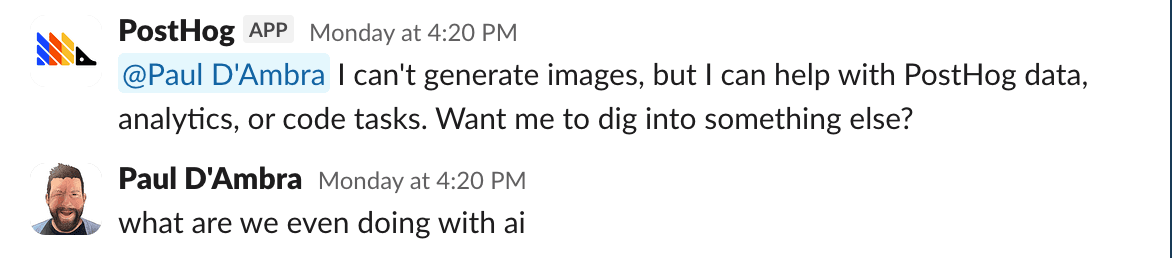
Paul's Spice Girls prompt

Paul was disappointed, but the bot knew what it was doing.

The PostHog Slack app is in beta – we skipped alpha by dogfooding it to the extreme.

It's free to install, and free to uninstall when you realize this means you can ship production code from your phone (which, frankly, might be too much power for anyone).

Connect Slack

Is it free to use?

The agent that runs behind @PostHog mentions consumes PostHog AI credits for the LLM work it does. This includes tokens used when planning a task, editing files, reasoning about your data. For credit mechanics, the free monthly tier, billing limits, and the live pricing calculator, see PostHog AI pricing.

Why use this over Cursor, Claude Code, or Codex?

Other tools only write code. PostHog is connected to your product data, so you can start from a problem – tag @PostHog with a message like "conversion dropped on signup". It finds the cause in your analytics and replays, explores solutions, and opens a PR to propose a fix. No hopping between a dashboard, a replay tab, and your editor.

Is it a better coding model?

No. It runs the same frontier models everyone else does. The difference is context – an agent that can read your funnels, replays, and errors is working from evidence, not guessing at what matters.

Is it an analytics agent or coding agent?

Both, in one thread. Explore data and build in the same conversation.

Does it just open a PR and walk away?

No. It sticks with the PR through failing checks and reruns until it's mergeable – we call that babysitting. On a big repo, getting through CI is often more work than the code.

Will it touch our whole codebase?

It only touches repos you connect, and every change goes through a PR you review. Nothing merges without a human saying yes.

Do I need to be an engineer to use it?

Not at all! It's a Slack message. Our sales and marketing teams regularly use it make fixes to our main app. Describe the problem or idea, and the agent takes it from there.

Won't it try to code every message?

It classifies each @mention first – code task or data question, and which repo. Data questions get answered, not turned into PRs.