




惯性聚合 高效追踪和阅读你感兴趣的博客、新闻、科技资讯
阅读原文 在惯性聚合中打开

推荐订阅源

freeCodeCamp Programming Tutorials: Python, JavaScript, Git & More
GbyAI
GbyAI
OSCHINA 社区最新新闻
OSCHINA 社区最新新闻
博客园 - 三生石上(FineUI控件)
美团技术团队
Last Week in AI
Last Week in AI
WordPress大学
WordPress大学
L
LangChain Blog
雷峰网
雷峰网
让小产品的独立变现更简单 - ezindie.com
博客园 - 叶小钗
Engineering at Meta
Engineering at Meta
腾讯CDC
Recent Announcements
The Register - Security
有赞技术团队
有赞技术团队
Blog — PlanetScale
Blog — PlanetScale
博客园 - Franky
博客园 - 司徒正美
The Cloudflare Blog
Google DeepMind News
T
Tailwind CSS Blog
C
Check Point Blog
小众软件
小众软件
V
Visual Studio Blog
V
V2EX
F
Full Disclosure
J
Java Code Geeks
MongoDB | Blog
MongoDB | Blog
罗磊的独立博客
人人都是产品经理
人人都是产品经理
量子位
Apple Machine Learning Research
F
Fortinet All Blogs
Microsoft Security Blog
奇客Solidot–传递最新科技情报
奇客Solidot–传递最新科技情报
博客园 - 【当耐特】
博客园_首页
Y
Y Combinator Blog
N
Netflix TechBlog - Medium
酷 壳 – CoolShell
酷 壳 – CoolShell
Stack Overflow Blog
Stack Overflow Blog
Recorded Future
Recorded Future
G
Google Developers Blog
Vercel News
Vercel News
大猫的无限游戏
大猫的无限游戏
Microsoft Azure Blog
U
Unit 42
爱范儿
爱范儿
Jina AI
Jina AI

Inside Nutrient

A guide to the invisible work behind documents Introducing Nutrient Documents for Salesforce: Native document generation and signing Document AI vs. traditional OCR: Choosing between OCR, AI, and hybrid pipelines PDF SDK compliance and security evaluation checklist for enterprise teams (2026) Invariant Corp replaces paper processes with Nutrient Workflow and scales without limits What is process mapping? A complete guide Nutrient vs. Conga Composer for Salesforce document generation (2026) Document routing: How to automate document distribution The CTO’s AI playbook: Why accountability architecture beats orchestration Compliance workflow automation: Why built-in compliance is table stakes Workflow diagrams: Examples, symbols, and how to build one that actually runs Digital forms: Replace paper forms with automated workflows Approval workflow software: How to automate approvals Why document-centric automation is different The CEO’s AI playbook: Why decision architecture beats model selection Nutrient SDK product updates for Q1 2026 PDF redaction verification: How to prove sensitive data is permanently removed What is a VPAT? The complete guide to accessibility conformance reports What is PDF/UA? The accessible PDF standard explained Salesforce eSignatures: Generate, sign, and track documents in one flow Online document viewer: Options, tradeoffs, and how to embed one Document viewer for web apps: React, Vue, Angular (2026) Best document viewers in 2026: A buyer’s guide How to edit a PDF in Python: Add text, images, and annotations Nutrient advances Workflow platform with agentic AI for enterprise-grade speed and consistency in document-heavy operations How to create a Salesforce quote template from opportunity data The business case for accessibility: Five ways it drives enterprise value Python PDF library comparison (2026): 7 libraries for developers Why your AI agent hallucinates PDF table data PDF.js limitations: When to upgrade to a commercial PDF SDK How Subject scaled 5× with Nutrient’s PDF SDK without rebuilding its document layer I replaced our sales training with an AI coach that runs in Slack — here’s what broke Redirecting to: https://securitybuzz.com/cybersecurity-news/why-enterprise-permissions-are-ais-most-dangerous-inheritance/ Nutrient .NET SDK vs. iText Core: Complete comparison for .NET developers DocuVieware: Support’s most frequently asked setup questions Introducing Nutrient Workflow How to convert PDF to Word in C# (.NET) When email and spreadsheets stop working: Work order approval workflows for field teams on the move Compliance with confidence: Why document-centric automation is the foundation of your mission Nutrient expands AI Assistant, automating multistep document workflows inside any application What is document generation? A developer’s guide to PDF generation Document Converter data flow and how real-time watermarks skip the queue PDF/UA compliance guide: Requirements, standards, and best practices Computers still can’t understand you How Athena Intelligence built AI agents for regulated enterprises with Nutrient’s document infrastructure How to convert HTML to PDF (2026): 4 methods from browser print to SDK How to build a document extraction pipeline with Nutrient Vision API OCR vs. intelligent document processing: Choosing the right document extraction engine Beyond OCR: How document intelligence eliminates manual processing in regulated industries Nutrient vs. IronPDF: Complete comparison for .NET developers Nutrient vs. Aspose.PDF: Complete comparison for .NET developers Redirecting to: https://fortune.com/2026/02/19/openclaw-who-is-peter-steinberger-openai-sam-altman-anthropic-moltbook/ Lufthansa Systems uses Nutrient to deliver reliable, scalable PDF rendering for pilots worldwide Nutrient vs. Syncfusion: Complete comparison for .NET developers React’s useTransition: The hook you’re probably using wrong First City Monument Bank streamlines banking processes with Nutrient Workflow Redirecting to: https://www.sdcexec.com/warehousing/automation/article/22957364/nutrient-workflow-automation-the-missing-link-in-supply-chain-efficiency The complete guide to digital signatures: PAdES, CAdES, and XAdES explained Nutrient Python SDK: Production-grade document processing for Python Introducing agentic document editing for web applications with AI Assistant Nutrient vs. QuestPDF: Complete comparison for .NET developers How we fixed the GdPicture license expiration (and what to do if you’re affected) Red team security testing with agentic AI The future of healthcare document automation Best healthcare workflow software compared Nutrient SDK product updates for Q4 2025 How Harvey scaled legal document workflows 50 percent MoM without rebuilding infrastructure HIPAA-compliant document management in hospitals How we optimized rendering performance while handling thousands of annotations in React — Part 2 Automated PII removal with Nutrient API Redirecting to: https://www.devopsdigest.com/2026-low-code-no-code-predictions Redirecting to: https://www.kmworld.com/Articles/Editorial/ViewPoints/Leaders-predict-AI-to-continue-permeating-all-aspects-of-KM-in-2026-172594.aspx What are deep agents and how do they solve complex problems? Whipping up document magic: Your easy-bake recipe for Vue and Nutrient Web SDK 🧁 What I’ve learned about product iteration planning while building SDKs Passwordless document signing: Three-layer security guide New zip folder functionality streamlines file management in Document Automation Server The keyboard shortcuts playbook: Taking control of keyboard events in Nutrient Web SDK From experienced engineer to AI beginner: My unexpected journey AI-assisted manual testing: Handling Safari’s PDF rendering and UI quirks How to keep a 20-year-old SDK up to date How we optimized rendering performance while handling thousands of annotations in React — Part 1 Nutrient announces new executive hires to accelerate next phase of growth High performance UI using web workers Automate document conversion at scale with Python and Nutrient DCS From curiosity to PLG (and AI): My journey to understanding product-led growth Prost to progress: One year as Nutrient Pigeon usage at Nutrient: Bridging native SDKs to Flutter Modernizing CI build servers: How to migrate from Chef to Ansible Unix man pages: AI-friendly documentation since 1971 Consistent hashing for even load distribution Best AI redaction APIs: Complete comparison guide for 2025 Why AI document redaction matters for modern security From coding to coordinating: How AI transformed my workflow What is intelligent document processing (IDP)? A complete guide Enterprise PDF SDKs: Best PSPDFKit (now Nutrient) alternatives Nutrient SDK product updates for Q3 2025 GdPicture support best practices Redacting sensitive data with Nutrient AI redaction API How AI is transforming the customer experience at Nutrient: From instant answers to intelligent support
Should your internal processes be more transparent?
Mike Raia · 2024-02-21 · via Inside Nutrient

Internal processes can become more efficient and more transparent by using a process automation tool to both** display and manage all the tasks involved in a process.**

enforce process compliance

Corporate transparency has been a hot topic for a while now(opens in a new tab), with some companies completely embracing the idea of sharing all things all the time and others simply trying to find ways to be more open internally and externally. On the internal front, some companies believe there is tremendous value in breaking down office walls (figuratively and literally) to make sure that everyone in the organization is “part of the conversation.” This could mean salaries are no longer secret(opens in a new tab) or that email is replaced with a public stream of questions and answers like SalesForce’s Chatter(opens in a new tab) or Trello’s(opens in a new tab) team boards (Note: we use and love Trello).

Internal process transparency

One area some companies are looking to be more transparent is around internal processes. By sharing “how things work” when it comes to internal processes, employees have a better understanding of what’s happening now, who’s handling it and what’s next. When you submit a request for a new hire, for instance, you’d probably like to know how the process is going to work so you can properly set expectations.

Process transparency can be done a few ways. Traditionally, process maps or flowcharts are created that show a process from beginning to end as well as all the decision points along the way. Swimlanes can be used to indicate who is responsible for each part of the process as well.

Static flow charts are good for providing a full overview of an entire process and sometimes just the act of generating them can help a company identify bottlenecks and weaknesses in their processes. We recommend everyone who isn’t doing this should start. Whether or not you’ll be seeking out a workflow automation tool (in which case you’ll be saving yourself sometime later), this is an extremely helpful activity.

Since process mapping is built into our workflow automation software, we can take the idea of process transparency a few steps further.
YouTube video player

How workflow automation helps improve transparency

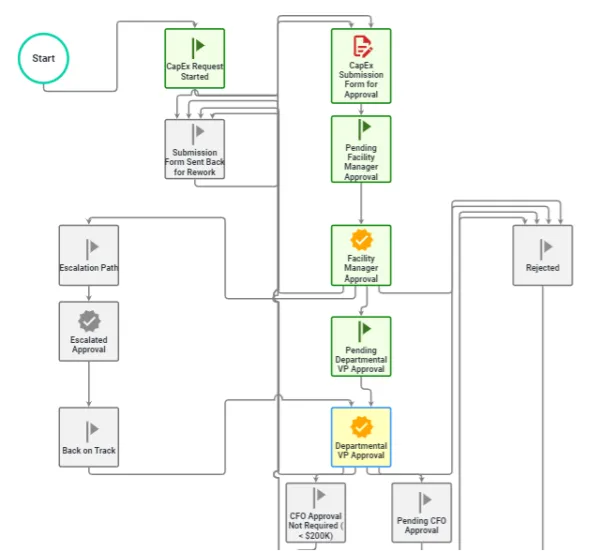
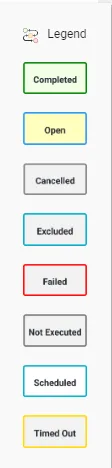
In fact one of the more powerful but overlooked features in Nutrient Workflow is the ability to not only show users what a process looks like but where they are in the process once it starts. For instance, in the process below, which is the process for a capital expenditure request, I can see, via the colored boxes and the legend, which parts of the process have completed and where we are in the process right now. If I hover over the highlighted box, it gives me detail about that step, including who’s involved, time, date, etc. I’m not confused about what’s happening now and I can see what’s happening next.
The advantages of transparency are numerous (building trust, getting new ideas, empowerment, etc.) but that’s not to say it’s for all organizations and all departments/business units within an organization. In some cases, transparency is simply not legally possible. That’s why we offer the ability to either display or hide this view for users. It’s up to the workflow administrators to configure.