

惯性聚合 高效追踪和阅读你感兴趣的博客、新闻、科技资讯
阅读原文 在惯性聚合中打开

推荐订阅源

云风的 BLOG
云风的 BLOG
The GitHub Blog
The GitHub Blog
A
About on SuperTechFans
P
Proofpoint News Feed
G
Google Developers Blog
Stack Overflow Blog
Stack Overflow Blog
IT之家
IT之家
Microsoft Security Blog
F
Fortinet All Blogs
人人都是产品经理
人人都是产品经理
博客园 - 叶小钗
C
Check Point Blog
Microsoft Azure Blog
aimingoo的专栏
aimingoo的专栏
月光博客
月光博客
美团技术团队
D
Docker
博客园 - Franky
Y
Y Combinator Blog
大猫的无限游戏
大猫的无限游戏
Cyber Security Advisories - MS-ISAC
博客园 - 【当耐特】
罗磊的独立博客
奇客Solidot–传递最新科技情报
奇客Solidot–传递最新科技情报

Inside Nutrient

A guide to the invisible work behind documents Introducing Nutrient Documents for Salesforce: Native document generation and signing Document AI vs. traditional OCR: Choosing between OCR, AI, and hybrid pipelines PDF SDK compliance and security evaluation checklist for enterprise teams (2026) Invariant Corp replaces paper processes with Nutrient Workflow and scales without limits What is process mapping? A complete guide Nutrient vs. Conga Composer for Salesforce document generation (2026) Document routing: How to automate document distribution The CTO’s AI playbook: Why accountability architecture beats orchestration Compliance workflow automation: Why built-in compliance is table stakes Workflow diagrams: Examples, symbols, and how to build one that actually runs Digital forms: Replace paper forms with automated workflows Approval workflow software: How to automate approvals Why document-centric automation is different The CEO’s AI playbook: Why decision architecture beats model selection Nutrient SDK product updates for Q1 2026 PDF redaction verification: How to prove sensitive data is permanently removed What is a VPAT? The complete guide to accessibility conformance reports What is PDF/UA? The accessible PDF standard explained Salesforce eSignatures: Generate, sign, and track documents in one flow Online document viewer: Options, tradeoffs, and how to embed one Document viewer for web apps: React, Vue, Angular (2026) Best document viewers in 2026: A buyer’s guide How to edit a PDF in Python: Add text, images, and annotations Nutrient advances Workflow platform with agentic AI for enterprise-grade speed and consistency in document-heavy operations How to create a Salesforce quote template from opportunity data The business case for accessibility: Five ways it drives enterprise value Python PDF library comparison (2026): 7 libraries for developers Why your AI agent hallucinates PDF table data PDF.js limitations: When to upgrade to a commercial PDF SDK
The difference between digital and electronic signatures
Toni Buffa · 2025-04-30 · via Inside Nutrient

Table of contents

    The difference between digital and electronic signatures

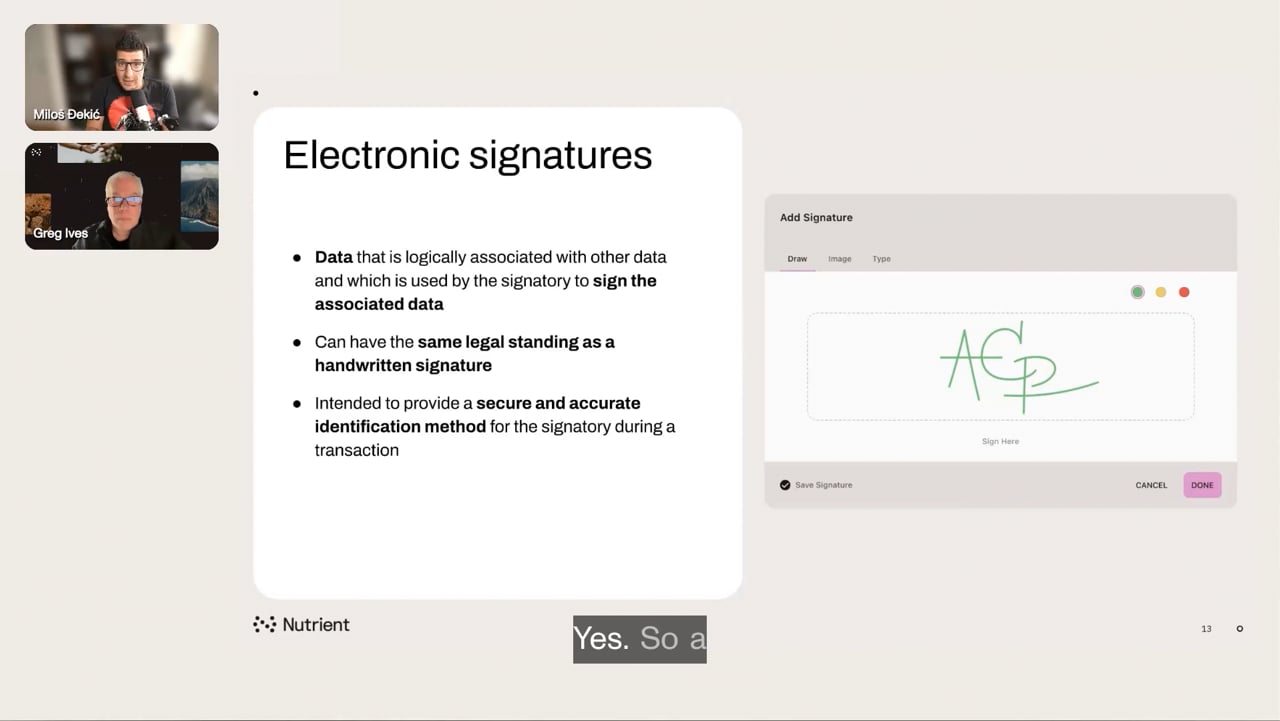
    In a recent webinar, our two key speakers, Greg Ives and Miloš Đekić, covered the distinction between digital signatures and electronic signatures.
    Enhancing Security and Trust with Cryptographic Signatures

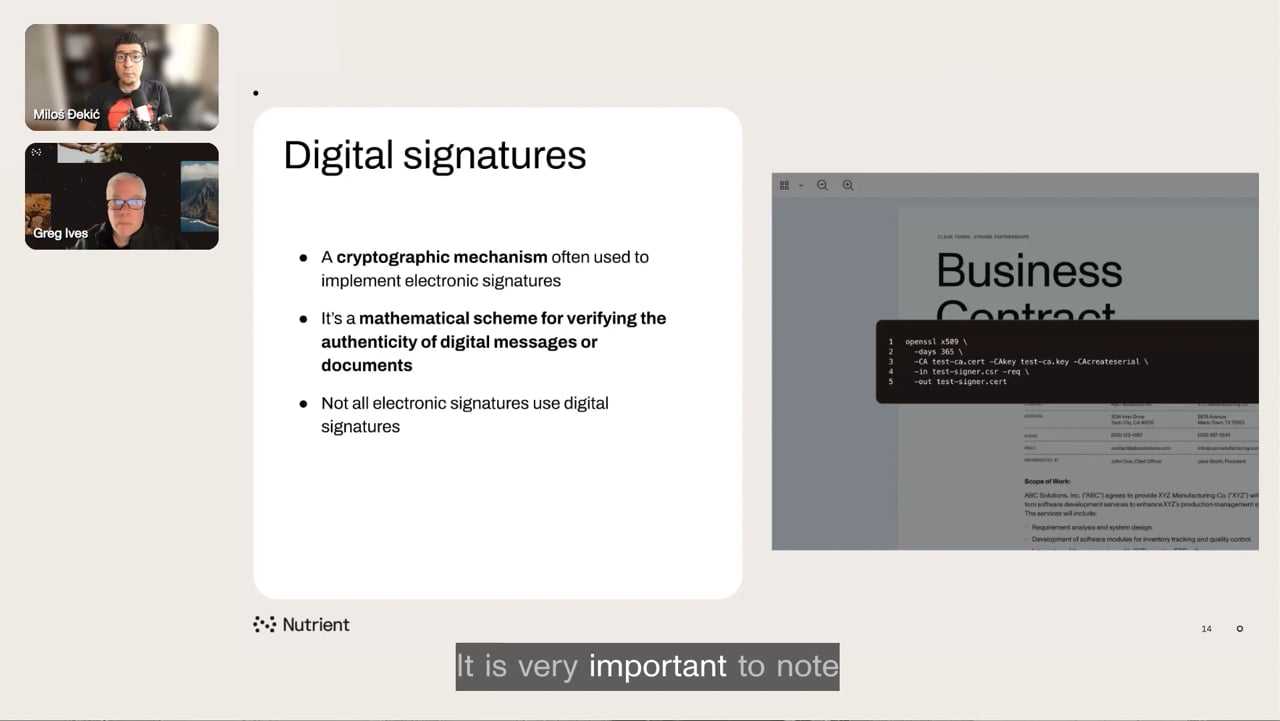
    Simply put, an electronic signature is data utilized for signing digital documents. A digital signature adds additional data to an electronic signature created by using a cryptographic mechanism, which is a mathematical scheme for verifying the authenticity of digital messages or documents. This provides a heightened level of assurance and confirmation of identity in electronically signed documents. It’s very important to note that not all electronic signatures will contain digital signatures.

    The intricacies of digital signatures
    Enhancing security through digital signatures

    Here, the focus shifts toward the intricacies of digital signatures, where a key player is the role of trusted entities. These entities can guarantee the integrity of the signed documents or the identity of the signing parties by providing digital certificates and methods for creating and validating digital signatures.

    A significant point that surfaced throughout the presentation was the variable legal definitions for signing across different geographical areas. Đekić covered the differing regulations and definitions concerning electronic signatures in several countries, primarily Canada, the U.S., and the EU.

    Categories of electronic signatures
    Understanding and Enhancing Signatures in EU

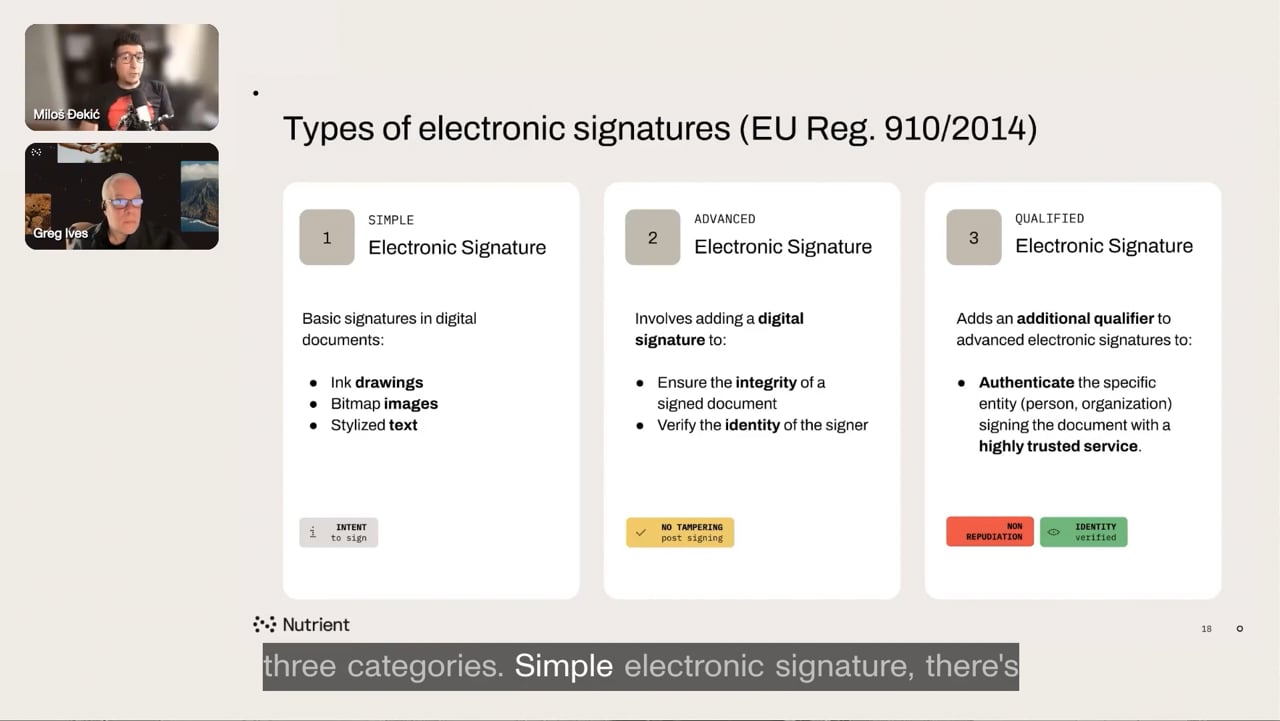
    In the EU, for example, the law recognizes three categories of electronic signatures:

    1. Simple electronic signatures
    2. Advanced electronic signatures
    3. Qualified electronic signatures

    Each category provides varying levels of security and identity verification, with an emphasis on the signer’s intent — a crucial factor in a court of law.

    As technology evolves, digital signatures are set to expand beyond the document space, potentially venturing into areas like code versioning and document versioning. This evolution points toward an anticipated future with technical standards for verifying a document’s origin, further underscoring the importance of digital signatures in ensuring authenticity and integrity.

    In conclusion, the session emphasized the nuances between electronic and digital signatures and the impact of technological advancement on the future of digital signing. For more information about signatures and signing, refer to our other blog posts on the topic, or check out our signature guides.

    Want to watch the full webinar? Check it out below.
    Electronic vs digital signatures- everything you need to know

    Explore related topics

    Try for free Ready to get started?

    Related SDK articles

    Explore more