


TL;DR
At a glance
AI brings speed and new insight to document workflows — from editing and comparison, to redaction and data extraction. But its adoption is slowed by real business fears:
This paper shows how deploying Nutrient’s AI services on Azure Government or AWS Bedrock on GovCloud addresses those concerns head-on. Both platforms provide sovereign-grade environments with strict isolation, compliance certifications, and explicit contractual safeguards that ensure customer data is never used to train public foundation models.
Key takeaways
By leveraging these safeguards, organizations can confidently deploy Nutrient’s AI document assistants and workflows in even the most sensitive environments. The conversation shifts from risk avoidance to secure innovation.
Trust begins with a clear view of the risks. For enterprises processing contracts, financial reports, medical records, or discovery materials, AI doesn’t just extend existing concerns — it introduces new ones across privacy, security, compliance, and intellectual property. These risks are real, not hypothetical, and they explain why many organizations hesitate to deploy AI in sensitive document workflows.
AI systems thrive on large datasets, and this reliance magnifies long-standing challenges. Sensitive documents often include PII, PHI, or proprietary data such as trade secrets and financial results. A single vulnerability can lead to regulatory penalties, lawsuits, and reputational harm.
One fear is unauthorized repurposing of personal data — for example, when resumes or medical records collected for a specific purpose are reused to train models without consent. Such practices collide with laws like GDPR and undermine public trust. Even when direct misuse is avoided, advanced models can infer sensitive attributes (political leanings, health conditions) from seemingly harmless data.
The attack surface for large language models (LLMs) continues to expand. Prompt injection attacks can induce models to bypass safeguards, expose confidential information, or forward sensitive documents, as documented by GDPRLocal(opens in a new tab) and IBM(opens in a new tab). Because LLMs themselves contain vast amounts of embedded data, they become valuable targets for exfiltration, according to Frost Brown Todd LLP(opens in a new tab) and IBM(opens in a new tab). And the machine learning stack is sprawling: Popular frameworks rely on hundreds of thousands of lines of code and hundreds of dependencies, each a potential entry point(opens in a new tab).
A particularly dangerous vulnerability is data leakage:
Both scenarios can trigger GDPR or HIPAA violations and lead to multimillion-dollar liabilities.
Finally, compliance challenges are mounting. GDPR’s “right to be forgotten” is especially problematic: Once personal data is baked into a model, deleting it without full retraining is nearly impossible. Requests for deletion are rising sharply — up 43 percent year over year — leaving companies stuck between legal requirements and technical limitations(opens in a new tab). GDPR also mandates Data Protection Impact Assessments (DPIAs), but opaque model behavior makes it difficult to produce assessments regulators will accept.
Even when data is secure, the quality and transparency of AI outputs remain pressing concerns. Half of professionals cite(opens in a new tab) lack of demonstrable accuracy as a barrier to AI adoption. The issue is not poor grammar or style — it’s hallucinations: confident, polished answers that are factually wrong. In document-heavy fields like law, finance, or medicine, a fabricated clause or figure can do real damage.
Bias compounds the problem. If training data is skewed, models can produce discriminatory results — in hiring, lending, or legal contexts — exposing organizations to ethical and legal challenges.
Then there’s explainability. Many advanced models function as black boxes, making it nearly impossible to trace why a given output occurred. Regulators in finance and healthcare often demand clear, auditable reasoning, but most LLMs cannot provide it(opens in a new tab). Without transparency, accountability and governance suffer.
The rise of shadow AI makes this worse: Employees adopt unsanctioned public tools out of convenience, pasting sensitive company data into systems outside IT’s control. A sanctioned, secure internal solution isn’t just about enabling new capabilities — it’s about shutting down uncontrolled risk.
The provenance of training data is one of AI’s most contentious issues. Many leading models have been built by scraping content from the internet without permission or compensation(opens in a new tab), and courts are now testing whether this constitutes copyright infringement. One recent ruling found that training on copyrighted legal materials was not “fair use,”(opens in a new tab) since the use was commercial and non-transformative, and it directly harmed the original market.
For businesses, the downstream risk is clear: If you rely on AI tools trained on questionable data, you may face copyright liability, even if your own use is legitimate.
Confidentiality adds another layer. Employees and professionals are bound by NDAs and client agreements, but the simple act of pasting a contract clause or financial detail into a public AI tool may constitute a breach. If that information leaks — or worse, shows up in another user’s response — the fallout could include lawsuits, lost clients, and reputational harm.
For organizations like Nutrient’s clients, this underscores why sovereign AI platforms matter: Data must remain private, never be reused for training, and always be protected within compliant, isolated environments.

For organizations handling highly regulated or mission-critical documents, infrastructure choice isn’t just about performance — it’s about trust. Microsoft Azure Government isn’t a repackaged version of commercial Azure, but a sovereign cloud environment designed specifically for the stringent needs of the U.S. government and its partners. Its architecture — physical, logical, operational, and technological — directly addresses the AI risks outlined in the previous section.
The strength of Azure Government begins with isolation.
Together, the controls of technology, process, and people interlock to form a holistic perimeter of defense.
Azure Government inherits Azure’s defense-in-depth model, enhanced with controls for sovereign environments.
Encryption at rest and in transit is now expected. Azure pushes further by securing data while in memory using the following methods and tools.
For Nutrient’s AI workflows, this means processes such as redaction or extraction can execute inside confidential VMs or containers. Sensitive documents remain encrypted end-to-end — even during model inference — eliminating one of the most persistent cloud vulnerabilities.
One of the most persistent fears is that customer data will be used to train public models. Microsoft addresses this with explicit contractual and architectural separation:
Abuse monitoring does exist(opens in a new tab): Algorithms may flag potential misuse, and in rare cases, authorized reviewers examine samples. However, these samples are stored separately and are never used for training, and access is tightly logged. In Azure Government, monitoring is further restricted(opens in a new tab), giving customers more direct responsibility for safe use.
Azure Government pairs technical controls with extensive certifications:
No other commercial cloud offers this breadth of government-grade certifications.
Azure Government secures the infrastructure; Nutrient secures its workloads.
This model isn’t a burden but a form of empowerment: Nutrient can tailor its security posture while relying on Microsoft’s sovereign foundation. Together, they create a defensible architecture for AI-driven document intelligence.

Amazon Web Services (AWS) delivers generative AI through a combination of AWS GovCloud (US) — an isolated cloud environment for regulated workloads — and Amazon Bedrock, a managed service for foundation models. Together, they provide the controls, policies, and compliance credentials required by U.S. government agencies and highly regulated industries.
Like Azure Government, AWS GovCloud (US) is designed from the ground up for sovereignty.
This model combines the familiarity of AWS with the heightened oversight required by government standards.
Bedrock extends beyond infrastructure security with application-layer safeguards — an essential response to the risks unique to generative AI.
bedrock:GuardrailIdentifier condition key, organizations can enforce mandatory guardrails(opens in a new tab) for every inference call, centralizing governance.For Nutrient’s AI document redaction, comparison, and data extraction tools, guardrails provide an automated layer of real-time safety and compliance.
AWS eliminates exposure to the public internet through VPC endpoints and Private Link(opens in a new tab).
This design ensures end-to-end protection for document processing, from upload through inference and model customization.
AWS reinforces its position with clear contractual and technical guarantees(opens in a new tab):
This creates a one-way data street: Customer data can be used for inference, but it never flows back to enrich shared or public models.
AWS GovCloud services, including Amazon Bedrock, are backed by rigorous third-party audits:
A list of approved models is outlined below.
| Model provider | Model name | FedRAMP High | DoD IL4/5 |
|---|---|---|---|
| Amazon | Titan models | Authorized | Authorized |
| Anthropic | Claude 3.5 Sonnet v1 | Authorized | Authorized |
| Anthropic | Claude 3 Haiku | Authorized | Authorized |
| Meta | Llama 3 8B | Authorized | Authorized |
| Meta | Llama 3 70B | Authorized | Authorized |
For Nutrient clients, this table is tangible evidence: AI workloads can be mapped to specific models with the compliance credentials required for their sector.
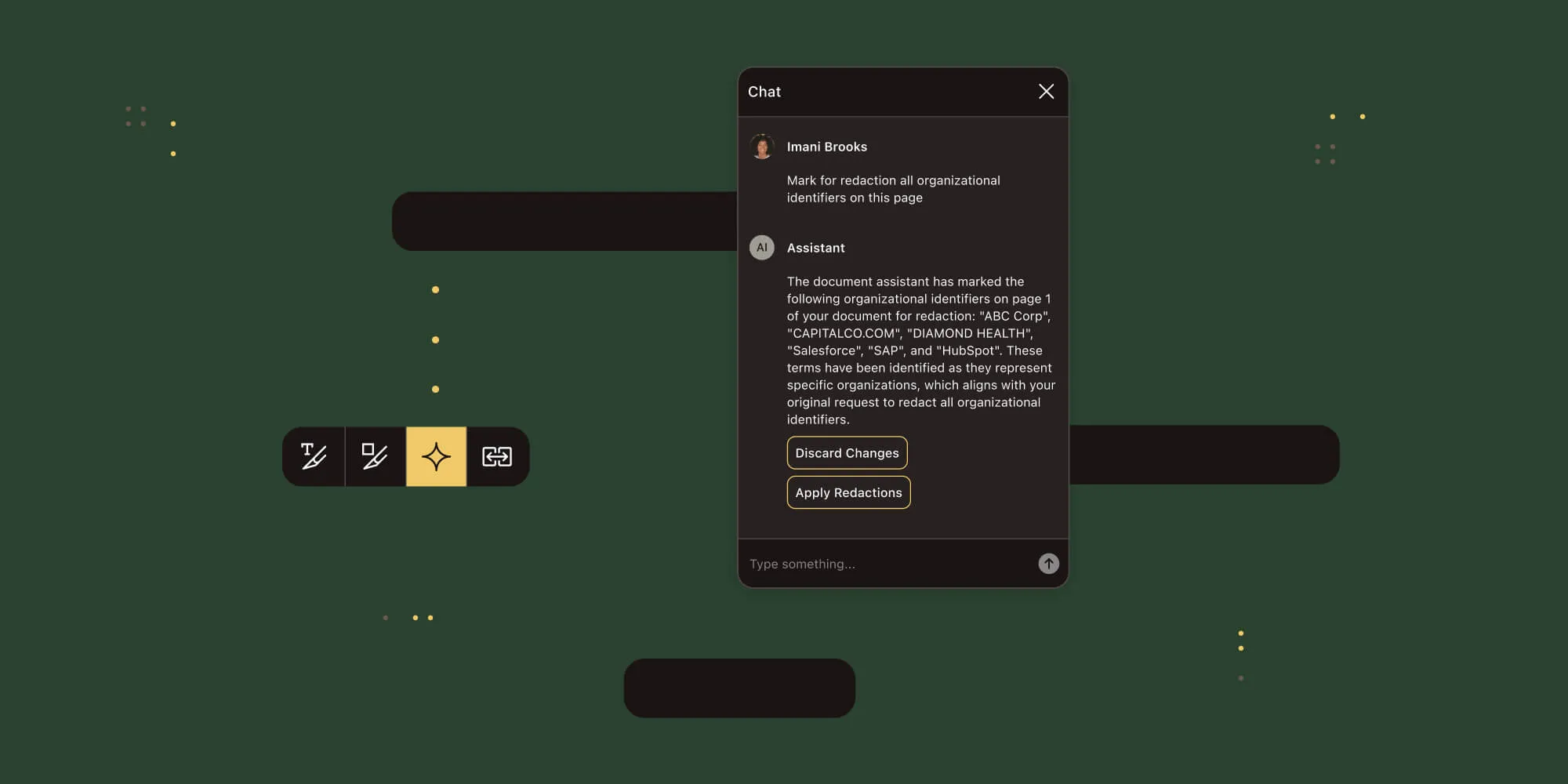
Azure Government and AWS Bedrock on GovCloud are only as valuable as the protections they deliver in real workflows. This section turns platform capabilities into concrete safeguards for Nutrient’s AI assistants, comparison, redaction, and data-extraction features — and shows how to evidence those safeguards to your users.
Nutrient delivers several AI-powered document capabilities — assistance, extraction, redaction, and comparison — each with a different mix of operational value and risk exposure. To make these features defensible in regulated environments, security must be mapped to the point where the risk arises, not just applied generically at the cloud perimeter. This section details how Azure Government and AWS Bedrock on GovCloud controls align with each capability, showing how risks such as data leakage, prompt injection, or missed redactions are addressed in practice.
These features often mix public and confidential content.
Risk
Mitigation
High-stakes handling of sensitive fields (PII/PHI).
Risk
Mitigation
Legal/financial diffs where tiny discrepancies matter.
Risk
Mitigation
| Client fear/AI risk | Mitigation via Azure Government | Mitigation via AWS Bedrock on GovCloud |
|---|---|---|
| Confidential data will be used to train public AI models. | Explicit, contractual zero-training for Azure OpenAI; fine-tuned models remain private. | Explicit no-training policy; fine-tuning creates a private copy of the base model. |
| Prompt injection will leak sensitive information. | Azure AI Content Safety filters; processing inside confidential Computing prevents host-level exfiltration. | Guardrails with denied topics/word filters; IAM enforces mandatory guardrails per call. |
| Hallucinations will produce inaccurate outputs. | Ground Azure OpenAI with customer data via Azure AI Search for higher factuality. | Contextual grounding checks ensure answers tie to provided sources. |
| PII or sensitive data will be exposed. | Confidential VMs encrypt data in use; CMK keeps decryption under client control. | Sensitive information filtering automatically blocks or masks PII in real time. |
| We’ll violate GDPR, HIPAA, or CJIS. | FedRAMP High, DoD IL5/6, HIPAA BAA; contractual CJIS commitments. | FedRAMP High; HIPAA eligible; specific Bedrock models authorized at DoD IL4/5. |
| Cloud admins can access our data. | Confidential computing blocks access outside the enclave — even for privileged admins; U.S.-screened personnel only. | GovCloud run by screened U.S. citizens; architectural isolation from model providers and Bedrock team. |
There isn’t a single “most secure” choice; there’s better fit per threat model and operational reality. The emphasis differs:
| Feature/control | Azure Government details | AWS GovCloud (U.S.) details |
|---|---|---|
| Isolation model | Sovereign cloud: physically/logically separate instance of Azure | Isolated regions within the AWS ecosystem |
| Data center locations | U.S. regions include DoD and secret regions | U.S. regions (US-East, US-West) |
| Personnel screening | Operated by screened U.S. citizens | Operated by screened U.S. citizens on U.S. soil |
| Access eligibility | U.S. government entities and vetted partners | U.S. agencies and vetted organizations in regulated industries |
| Key compliance | FedRAMP High, DoD IL2/4/5/6, CJIS (contractual), ITAR, HIPAA BAA | FedRAMP High, DoD IL2/4/5, CJIS, ITAR, HIPAA eligible |
| Data-in-use protection | Confidential computing (TEEs) encrypts memory during processing | Standard AWS controls; no direct general-purpose TEE equivalent |
| AI content safety | Azure AI Content Safety integration | Bedrock Guardrails (content, PII, topics) |
Assurances land when they’re verifiable. Under the shared-responsibility model, Nutrient should turn configuration into evidence.
Shifting from “trust us” to “verify our security” reduces friction in procurement, accelerates approvals, and builds durable partnerships.
Generative AI can transform document-heavy work — editing, comparison, redaction, and extraction — with real gains in speed and accuracy. The hesitation you hear from boards and CISOs is rational: privacy breaches, opaque decision-making, and regulatory exposure are non-trivial. This paper shows those risks are manageable with the right architecture and governance.
Moving from consumer-grade tools to sovereign-grade platforms — Azure Government and AWS Bedrock on GovCloud — changes the equation. Physical and logical isolation, screened U.S. personnel, FedRAMP High and DoD authorizations, and contractual no-training policies establish a trustworthy baseline. From there, Azure Confidential Computing secures data even in use, while Bedrock Guardrails governs content and PII at the application layer in real time.
Layer in Nutrient’s NIST AI RMF-aligned program — clear governance, mapped risks, measured performance, and managed responses — and you move past reassurances to proof. The outcome: Clients get the benefits of AI without compromising what matters most — their data, their reputation, and the trust of their customers.
Secure AI won’t be won by raw model horsepower alone. It’ll be won by verifiable security and operational discipline. That’s the path Nutrient offers — powered by sovereign clouds, grounded in governance, and built for regulated work.
此内容由惯性聚合(RSS阅读器)自动聚合整理,仅供阅读参考。 原文来自 — 版权归原作者所有。