







We’re excited to announce that PSPDFKit now supports visionOS in an early public preview build. While Apple’s visionOS SDK is still in beta, we wanted to take this opportunity and put out a first build to prepare you for what to expect and what’s still to come for working with PDFs in an immersive virtual workspace.
We’ve been intrigued by Apple Vision Pro since its announcement, and we started work on getting PSPDFKit to run on this new platform as soon as the visionOS SDK dropped, so as to see how our user interface (UI) can be adapted in a way that feels right at home on Vision Pro.
We’ve heard from several of our customers who are interested in building their apps for this new platform. So now you can give PSPDFKit on visionOS a first try.
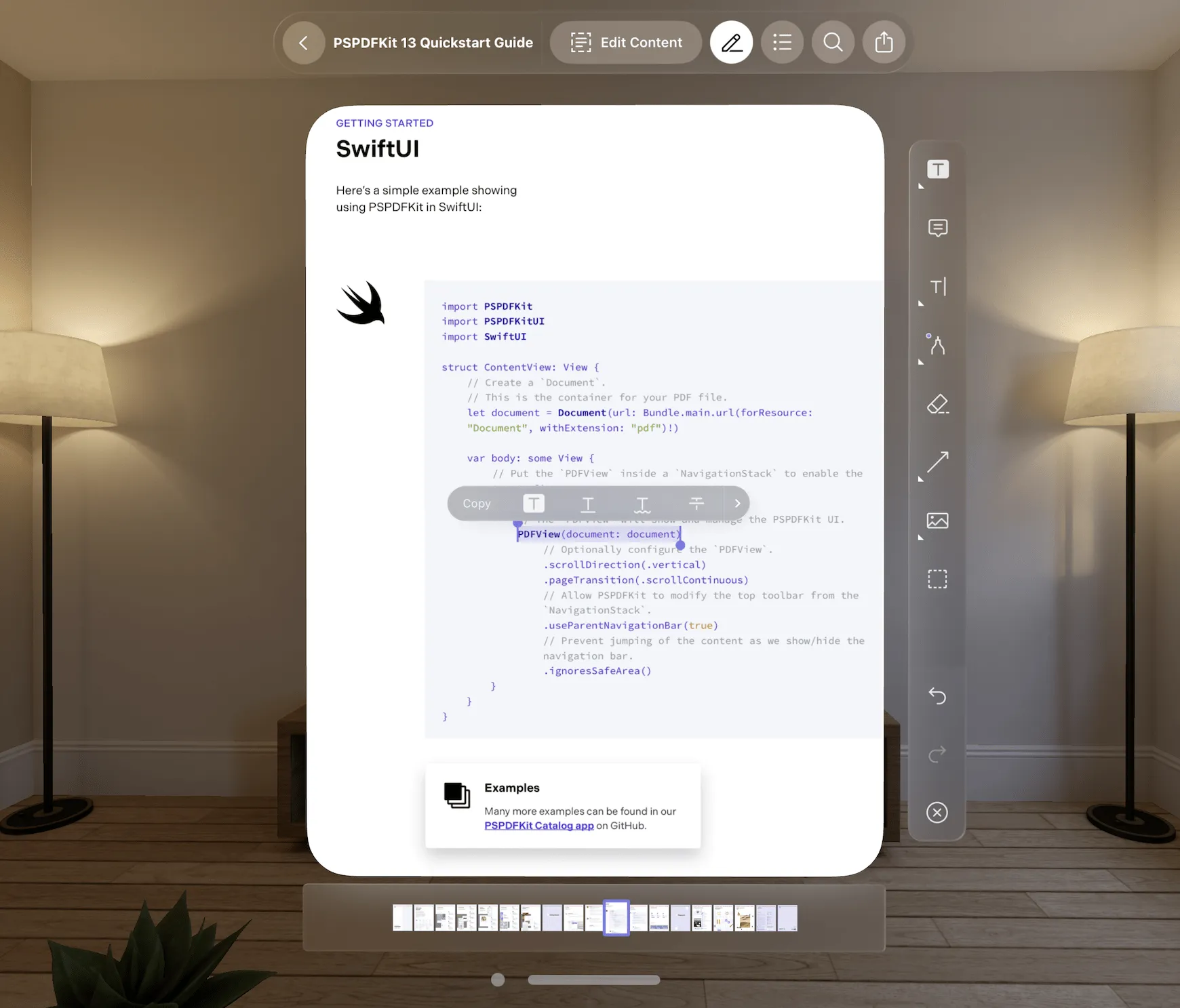
While PSPDFKit for visionOS is in a preview phase, there will still be issues and bugs, and not all APIs are currently supported. The main purpose of this public preview release is to give you a first impression of PSPDFKit on visionOS and to avoid any build errors when creating apps for visionOS while including PSPDFKit.
PSPDFKit for visionOS is now available as a nightly public preview build you can download and integrate into your project. The frameworks we provide contain iOS, Catalyst, and visionOS support bundled in XCFrameworks, which means we can ship support for each of those platforms combined.
To try PSPDFKit for visionOS, you’ll need to download the latest preview build and manually integrate the frameworks.
Use this direct download link(opens in a new tab) or get the nightly from the PSPDFKit Portal(opens in a new tab) for the latest build of PSPDFKit for iOS with support for visionOS, and follow our manual integration guide to see how to add PSPDFKit to your project.
There will be a new build with the latest changes available every night, so make sure to update the build in your project from time to time. Since this product is still in a very early stage in its development lifecycle, builds don’t undergo the same quality control process as stable releases, and as such, they aren’t meant to be used for apps in production — including for iOS and Mac Catalyst. This also means that there might be breaking API changes without further notice during the preview lifecycle.
Note that we’ll only be able to add visionOS support in regular release builds of PSPDFKit after Apple releases a stable (i.e. non-beta) Xcode version that supports the visionOS SDK. It isn’t possible to submit apps to the App Store from beta versions of Xcode, which prevents us from shipping visionOS support in our regular releases at this time.
Since visionOS is a new platform, you’ll need a new license key for PSPDFKit for visionOS if you already have an existing iOS or Catalyst license. Please contact our Sales team if you’d like to add PSPDFKit for visionOS to your existing license or purchase a new license. It’s also possible to use PSPDFKit in trial mode when not providing a license key.
PSPDFKit’s UI mostly adapts well to this new platform by using system components. However, there’s more polish needed to get the right look and feel across the UI.
We’re currently busy designing and building new UI components and adapting existing ones from PSPDFKit for iOS to work well on visionOS.
We’ve already moved some toolbars — like the navigation bar, annotation toolbar, and thumbnail bar — into ornaments (floating panels to the sides of windows) to provide better focus on page content. These ornaments will be customizable to a certain extent as well, so they can fit better into your app.
One other area we’re focusing on is making sure UI elements have a hover state, since this is essential on Vision Pro for easy navigation using your eyes.
If you’re interested in PSPDFKit for visionOS, you can sign up for notifications on updates regarding the product. We’d also encourage you to contact us to help shape the direction of this product. Please share how you plan on using PSPDFKit on visionOS, feedback regarding the public preview build, or which features you’d be interested in by reaching out to our Support team. We’d be delighted to receive your feedback and can’t wait to see what you build with PSPDFKit for visionOS!
此内容由惯性聚合(RSS阅读器)自动聚合整理,仅供阅读参考。 原文来自 — 版权归原作者所有。