
惯性聚合 高效追踪和阅读你感兴趣的博客、新闻、科技资讯
阅读原文 在惯性聚合中打开

推荐订阅源

cs.AI updates on arXiv.org
Threat Intelligence Blog | Flashpoint
A
Arctic Wolf
Apple Machine Learning Research
人人都是产品经理
人人都是产品经理
Spread Privacy
Spread Privacy
IT之家
IT之家
F
Fortinet All Blogs
GbyAI
GbyAI
T
Threat Research - Cisco Blogs
月光博客
月光博客
WordPress大学
WordPress大学
V
Vulnerabilities – Threatpost
G
GRAHAM CLULEY
酷 壳 – CoolShell
酷 壳 – CoolShell
MyScale Blog
MyScale Blog
小众软件
小众软件
AI
AI
云风的 BLOG
云风的 BLOG
Jina AI
Jina AI
博客园 - 【当耐特】
T
Tailwind CSS Blog
Recorded Future
Recorded Future
Simon Willison's Weblog
I
Intezer
Schneier on Security
Engineering at Meta
Engineering at Meta
OSCHINA 社区最新新闻
OSCHINA 社区最新新闻
V
V2EX
T
The Exploit Database - CXSecurity.com
大猫的无限游戏
大猫的无限游戏
PCI Perspectives
PCI Perspectives
K
Kaspersky official blog
U
Unit 42
奇客Solidot–传递最新科技情报
奇客Solidot–传递最新科技情报
Webroot Blog
Webroot Blog
钛媒体:引领未来商业与生活新知
钛媒体:引领未来商业与生活新知
A
About on SuperTechFans
Stack Overflow Blog
Stack Overflow Blog
N
News and Events Feed by Topic
MongoDB | Blog
MongoDB | Blog
C
CERT Recently Published Vulnerability Notes
Security Latest
Security Latest
爱范儿
爱范儿
L
LangChain Blog
V
Visual Studio Blog
W
WeLiveSecurity
Exploit-DB.com RSS Feed
C
Cisco Blogs
H
Hackread – Cybersecurity News, Data Breaches, AI and More

Inside Nutrient

A guide to the invisible work behind documents Introducing Nutrient Documents for Salesforce: Native document generation and signing Document AI vs. traditional OCR: Choosing between OCR, AI, and hybrid pipelines PDF SDK compliance and security evaluation checklist for enterprise teams (2026) Invariant Corp replaces paper processes with Nutrient Workflow and scales without limits What is process mapping? A complete guide Nutrient vs. Conga Composer for Salesforce document generation (2026) Document routing: How to automate document distribution The CTO’s AI playbook: Why accountability architecture beats orchestration Compliance workflow automation: Why built-in compliance is table stakes Workflow diagrams: Examples, symbols, and how to build one that actually runs Digital forms: Replace paper forms with automated workflows Approval workflow software: How to automate approvals Why document-centric automation is different The CEO’s AI playbook: Why decision architecture beats model selection Nutrient SDK product updates for Q1 2026 PDF redaction verification: How to prove sensitive data is permanently removed What is a VPAT? The complete guide to accessibility conformance reports What is PDF/UA? The accessible PDF standard explained Salesforce eSignatures: Generate, sign, and track documents in one flow Online document viewer: Options, tradeoffs, and how to embed one Document viewer for web apps: React, Vue, Angular (2026) Best document viewers in 2026: A buyer’s guide How to edit a PDF in Python: Add text, images, and annotations Nutrient advances Workflow platform with agentic AI for enterprise-grade speed and consistency in document-heavy operations How to create a Salesforce quote template from opportunity data The business case for accessibility: Five ways it drives enterprise value Python PDF library comparison (2026): 7 libraries for developers Why your AI agent hallucinates PDF table data PDF.js limitations: When to upgrade to a commercial PDF SDK How Subject scaled 5× with Nutrient’s PDF SDK without rebuilding its document layer I replaced our sales training with an AI coach that runs in Slack — here’s what broke Redirecting to: https://securitybuzz.com/cybersecurity-news/why-enterprise-permissions-are-ais-most-dangerous-inheritance/ Nutrient .NET SDK vs. iText Core: Complete comparison for .NET developers DocuVieware: Support’s most frequently asked setup questions Introducing Nutrient Workflow How to convert PDF to Word in C# (.NET) When email and spreadsheets stop working: Work order approval workflows for field teams on the move Compliance with confidence: Why document-centric automation is the foundation of your mission Nutrient expands AI Assistant, automating multistep document workflows inside any application What is document generation? A developer’s guide to PDF generation Document Converter data flow and how real-time watermarks skip the queue PDF/UA compliance guide: Requirements, standards, and best practices Computers still can’t understand you How Athena Intelligence built AI agents for regulated enterprises with Nutrient’s document infrastructure How to convert HTML to PDF (2026): 4 methods from browser print to SDK How to build a document extraction pipeline with Nutrient Vision API OCR vs. intelligent document processing: Choosing the right document extraction engine Beyond OCR: How document intelligence eliminates manual processing in regulated industries Nutrient vs. IronPDF: Complete comparison for .NET developers Nutrient vs. Aspose.PDF: Complete comparison for .NET developers Redirecting to: https://fortune.com/2026/02/19/openclaw-who-is-peter-steinberger-openai-sam-altman-anthropic-moltbook/ Lufthansa Systems uses Nutrient to deliver reliable, scalable PDF rendering for pilots worldwide Nutrient vs. Syncfusion: Complete comparison for .NET developers React’s useTransition: The hook you’re probably using wrong First City Monument Bank streamlines banking processes with Nutrient Workflow Redirecting to: https://www.sdcexec.com/warehousing/automation/article/22957364/nutrient-workflow-automation-the-missing-link-in-supply-chain-efficiency The complete guide to digital signatures: PAdES, CAdES, and XAdES explained Nutrient Python SDK: Production-grade document processing for Python Introducing agentic document editing for web applications with AI Assistant Nutrient vs. QuestPDF: Complete comparison for .NET developers How we fixed the GdPicture license expiration (and what to do if you’re affected) Red team security testing with agentic AI The future of healthcare document automation Best healthcare workflow software compared Nutrient SDK product updates for Q4 2025 How Harvey scaled legal document workflows 50 percent MoM without rebuilding infrastructure HIPAA-compliant document management in hospitals How we optimized rendering performance while handling thousands of annotations in React — Part 2 Automated PII removal with Nutrient API Redirecting to: https://www.devopsdigest.com/2026-low-code-no-code-predictions Redirecting to: https://www.kmworld.com/Articles/Editorial/ViewPoints/Leaders-predict-AI-to-continue-permeating-all-aspects-of-KM-in-2026-172594.aspx What are deep agents and how do they solve complex problems? Whipping up document magic: Your easy-bake recipe for Vue and Nutrient Web SDK 🧁 What I’ve learned about product iteration planning while building SDKs Passwordless document signing: Three-layer security guide New zip folder functionality streamlines file management in Document Automation Server The keyboard shortcuts playbook: Taking control of keyboard events in Nutrient Web SDK From experienced engineer to AI beginner: My unexpected journey AI-assisted manual testing: Handling Safari’s PDF rendering and UI quirks How to keep a 20-year-old SDK up to date How we optimized rendering performance while handling thousands of annotations in React — Part 1 Nutrient announces new executive hires to accelerate next phase of growth High performance UI using web workers Automate document conversion at scale with Python and Nutrient DCS From curiosity to PLG (and AI): My journey to understanding product-led growth Prost to progress: One year as Nutrient Pigeon usage at Nutrient: Bridging native SDKs to Flutter Modernizing CI build servers: How to migrate from Chef to Ansible Unix man pages: AI-friendly documentation since 1971 Consistent hashing for even load distribution Best AI redaction APIs: Complete comparison guide for 2025 Why AI document redaction matters for modern security From coding to coordinating: How AI transformed my workflow What is intelligent document processing (IDP)? A complete guide Enterprise PDF SDKs: Best PSPDFKit (now Nutrient) alternatives Nutrient SDK product updates for Q3 2025 GdPicture support best practices Redacting sensitive data with Nutrient AI redaction API How AI is transforming the customer experience at Nutrient: From instant answers to intelligent support
Automate invoices with Aquaforest PDF Connector
Marija Trpkovic · 2024-05-20 · via Inside Nutrient

In today’s business landscape, the efficient processing of invoices is crucial for maintaining financial accuracy and ensuring timely payments. However, dealing with large PDF files containing multiple invoices can be a time-consuming and error-prone task. This user guide demonstrates how to leverage the Aquaforest PDF Connector for Power Automate — specifically the Split PDF by barcode action — to automate the separation of invoices based on barcode values.

Challenges

Manual processing of invoices within large PDF files poses several challenges:

  • Time-consuming — Separating and organizing individual invoices manually is time-consuming, especially when dealing with a high volume of documents.
  • Error-prone — Manual separation increases the risk of errors in categorizing and assigning invoices to the correct processing workflows.
  • Lack of efficiency — Traditional methods hinder the efficiency of accounts payable processes, leading to delays in payment cycles.

Split PDF by barcode action

The Aquaforest PDF Connector for Power Automate introduces a powerful action that enables splitting PDFs by barcode, and it’s designed to address the challenges associated with invoice processing. This action utilizes barcode values embedded in PDF files to automate the splitting of the PDF into individual invoices. Moreover, it allows the generation of customized file names for the split files based on the extracted barcode values.

How to split PDFs by barcode using Power Automate

Follow the step-by-step instructions below to implement the Split PDF by barcode action.

Step 1 — Configure the PDF Connector

Add the Aquaforest PDF Connector to your Power Automate workflow. First, choose the type of the flow and the trigger.

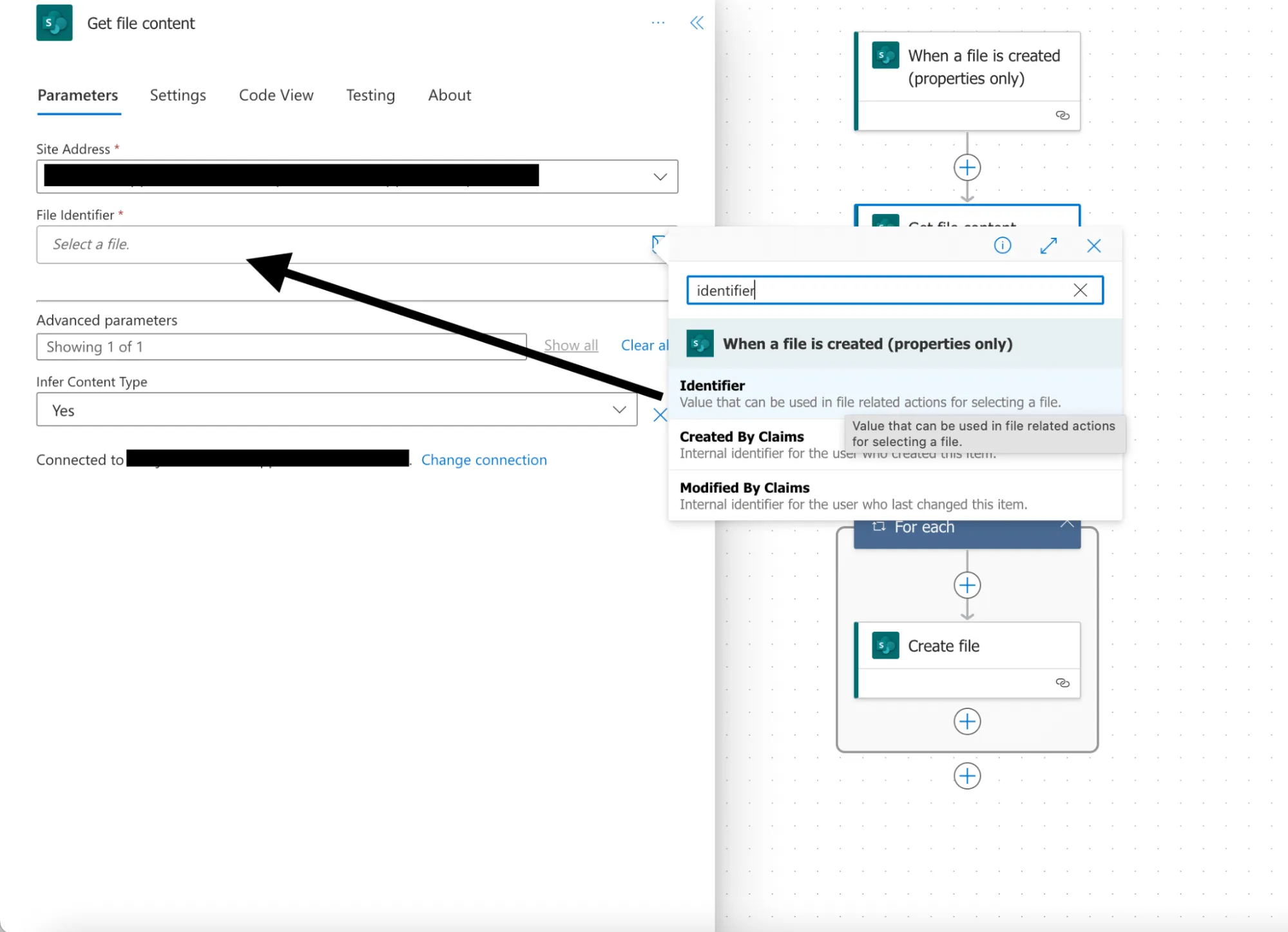
For this example, choose the Automated cloud flow and set the When a file is created (properties only) trigger. This trigger is activated when an item is created or modified in a library. As it returns only the properties stored in the library columns, you need to add a Get file content step and use the Identifier property returned by this action to get to the contents of the file.
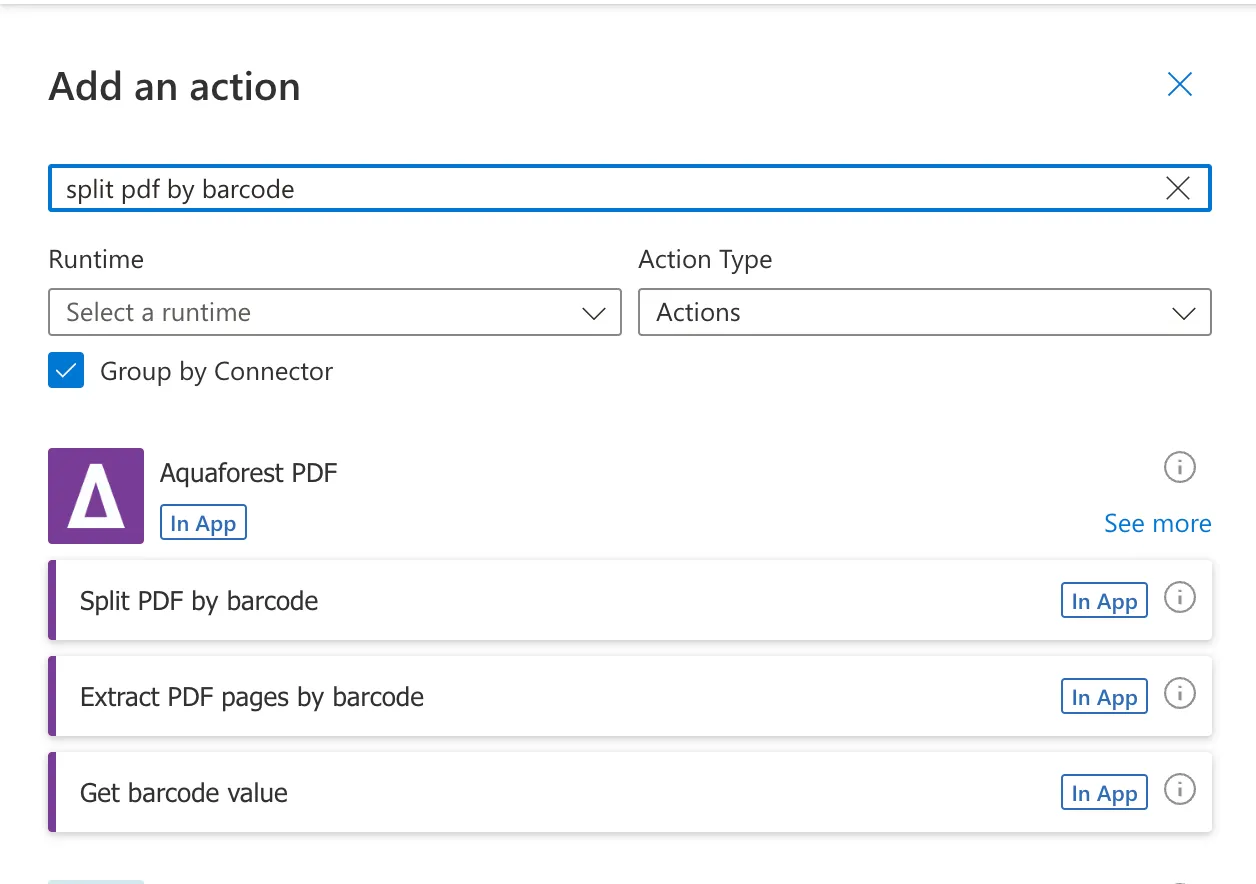
Click the + button to add a new action, and in the search bar, type split pdf by barcode.
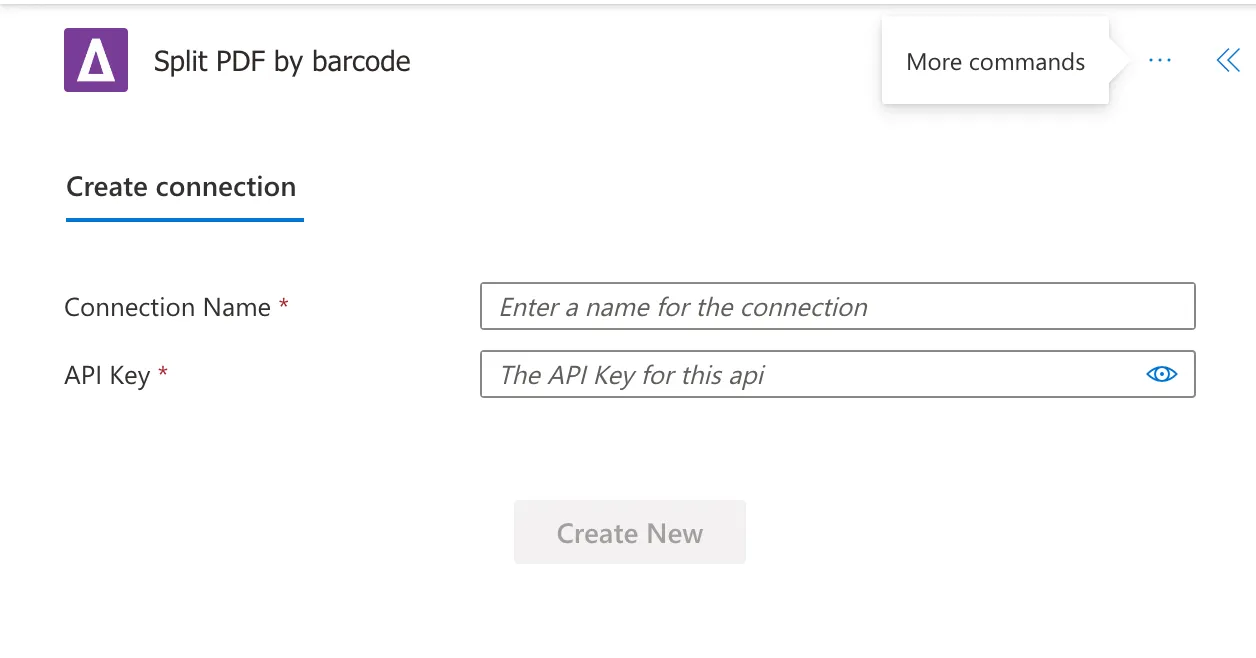
In the next step, fill in the Connection Name and API Key fields. Give your connection a name, and use the primary key that was generated when you signed up for PDF Connector.
Step 2 — Provide input parameters

When you activate the connector and add an action, the next step is to fill in the required fields. Enter the source file name, file content (Base64 string), and file name template.

  • File Content — The content of the source file. Click the thunder sign and type Get file content. Then click Add.
  • File Name Template — Template for the output text result if a barcode match is found. You can leave it as it is and %VALUE1% will be replaced by the barcode values found dynamically.
  • File Name — Click the thunder sign and choose File name with extension.

Step 3 — Configure optional parameters

Fill in the following fields, if they’re relevant:

  • Pages With No Match — Define the behavior for pages with no barcode value in the split section output.
  • No Barcode Match Template — Template for the text to be returned if a barcode match isn’t found.
  • Output File Options — Choose the location of the page with the barcode in the output files from the split operation.

Step 4 — Create file action

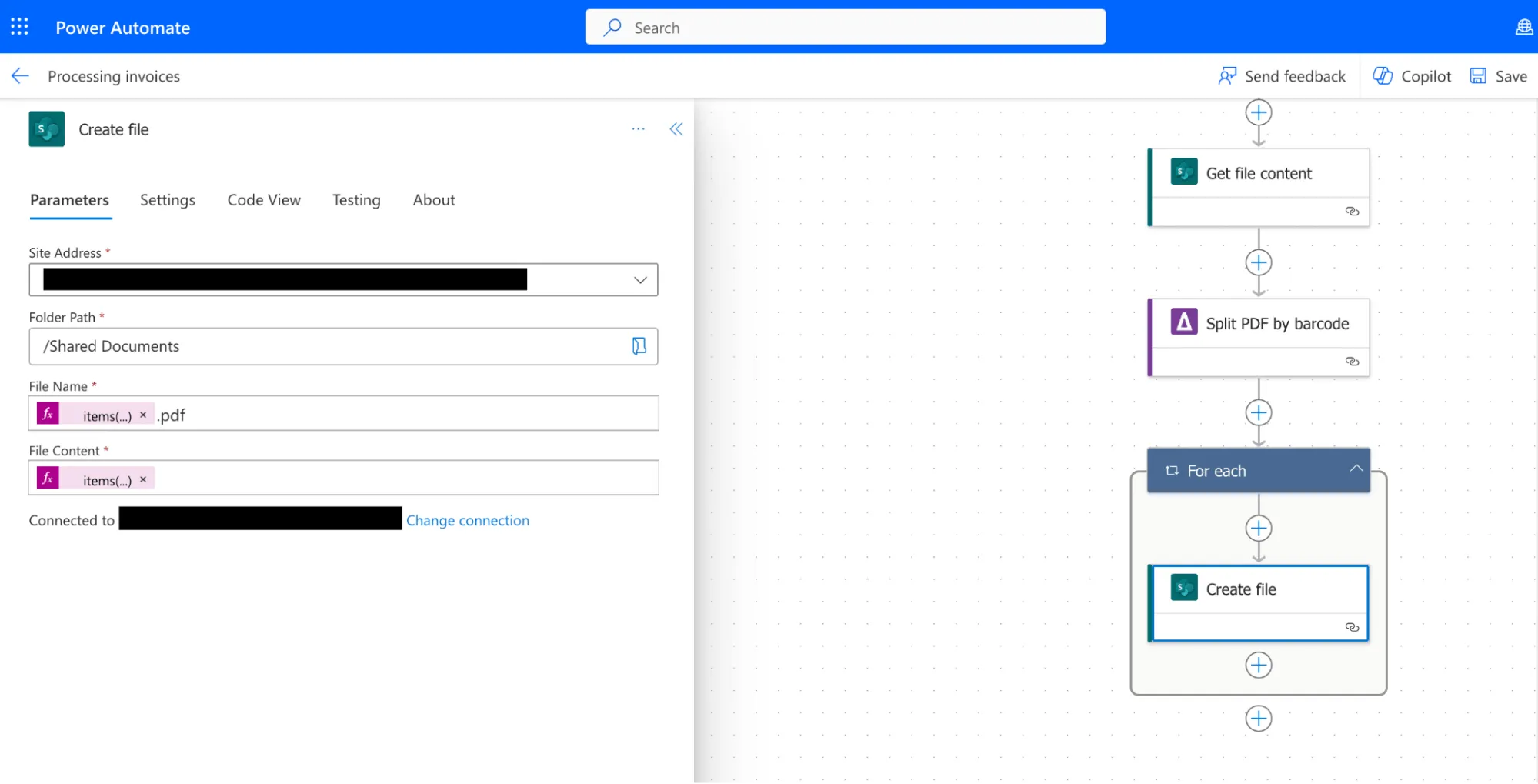
Add the create file action and configure following the details below:

  • Site Address — The URL of your SharePoint site.
  • Folder Path — The location of your SharePoint library where the input file is stored.
  • File Name — Choose Split Output Files (file name) and add .pdf. The output file name contains the barcode file in it.
  • File Content — Click the thunder sign to open dynamic content. Click See More to show all the output parameters, and then click Split Output Files (file content) and confirm by clicking the Add button.

Split Output Files is the array of split files with their corresponding file names.

You can also check other output parameters:
  • Page Range — The page range containing the page numbers of the split operation.
  • Is Successful — A Boolean value specifying if the operation was successful or not.
  • License Info — Information about your API subscription key, which tells you the license type, how many calls you’ve made, and how many calls are remaining.
  • Error Message — Contains the error message returned by the operation, if any exist.

Step 5 — Execute the action

Click Save and run the Power Automate workflow to execute the Split PDF by barcode action.

Step 6 — Review the output

Check the output for accurately separated invoices with customized file names based on barcode values.

Conclusion

By incorporating the Split PDF by barcode action into your Power Automate workflows, you can significantly enhance the efficiency and accuracy of invoice processing. This post provides a comprehensive walkthrough of the action, empowering users to streamline accounts payable processes and reduce manual effort.