惯性聚合 高效追踪和阅读你感兴趣的博客、新闻、科技资讯
阅读原文 在惯性聚合中打开

推荐订阅源

博客园_首页
GbyAI
GbyAI
OSCHINA 社区最新新闻
OSCHINA 社区最新新闻
Apple Machine Learning Research
大猫的无限游戏
大猫的无限游戏
阮一峰的网络日志
阮一峰的网络日志
Last Week in AI
Last Week in AI
V
Visual Studio Blog
酷 壳 – CoolShell
酷 壳 – CoolShell
The Cloudflare Blog
博客园 - 【当耐特】
博客园 - 叶小钗
量子位
博客园 - 聂微东
S
SegmentFault 最新的问题
美团技术团队
Hugging Face - Blog
Hugging Face - Blog
钛媒体:引领未来商业与生活新知
钛媒体:引领未来商业与生活新知
月光博客
月光博客
宝玉的分享
宝玉的分享
小众软件
小众软件
罗磊的独立博客
有赞技术团队
有赞技术团队
Stack Overflow Blog
Stack Overflow Blog

Inside Nutrient

A guide to the invisible work behind documents Introducing Nutrient Documents for Salesforce: Native document generation and signing Document AI vs. traditional OCR: Choosing between OCR, AI, and hybrid pipelines PDF SDK compliance and security evaluation checklist for enterprise teams (2026) Invariant Corp replaces paper processes with Nutrient Workflow and scales without limits What is process mapping? A complete guide Nutrient vs. Conga Composer for Salesforce document generation (2026) Document routing: How to automate document distribution The CTO’s AI playbook: Why accountability architecture beats orchestration Compliance workflow automation: Why built-in compliance is table stakes Workflow diagrams: Examples, symbols, and how to build one that actually runs Digital forms: Replace paper forms with automated workflows Approval workflow software: How to automate approvals Why document-centric automation is different The CEO’s AI playbook: Why decision architecture beats model selection Nutrient SDK product updates for Q1 2026 PDF redaction verification: How to prove sensitive data is permanently removed What is a VPAT? The complete guide to accessibility conformance reports What is PDF/UA? The accessible PDF standard explained Salesforce eSignatures: Generate, sign, and track documents in one flow Online document viewer: Options, tradeoffs, and how to embed one Document viewer for web apps: React, Vue, Angular (2026) Best document viewers in 2026: A buyer’s guide How to edit a PDF in Python: Add text, images, and annotations Nutrient advances Workflow platform with agentic AI for enterprise-grade speed and consistency in document-heavy operations How to create a Salesforce quote template from opportunity data The business case for accessibility: Five ways it drives enterprise value Python PDF library comparison (2026): 7 libraries for developers Why your AI agent hallucinates PDF table data PDF.js limitations: When to upgrade to a commercial PDF SDK
Streamline logistics package tracking efficiently
Marija Trpkovic · 2024-05-14 · via Inside Nutrient

In the dynamic world of logistics and transportation, precision and efficiency in package tracking and shipment processing are paramount. The Aquaforest PDF Connector for Power Automateintroduces the “Get Barcode Value” action, providing a robust solution to streamline these operations. This user guide delves into a compelling use case, offering a step-by-step guide for logistics professionals aiming to enhance package tracking processes.

Meet Alex, a logistics coordinator responsible for managing the tracking and processing of incoming and outgoing shipments. Alex faces the challenge of handling a high volume of packages daily, each with its unique barcode for tracking. The manual process of extracting barcode values and updating the tracking system is time-consuming and prone to errors.

Challenges

  • Manual Tracking: Manually extracting barcode values from shipping labels is time-consuming.
  • Data Entry Errors: The manual process increases the risk of errors in updating the tracking system.
  • Delayed Processing: The inefficiencies in barcode extraction and data entry lead to delays in shipment processing.

Benefits

  • Efficiency Gains: Automating barcode extraction accelerates the tracking process.
  • Error Reduction: Automated extraction minimizes the risk of data entry errors.
  • Real-time Updates: Swift and accurate updates to the tracking system for timely processing.

How to Get Barcode Value Using Power Automate

Alex sets up a Power Automate workflow triggered by the arrival of a new shipment. As packages are received, the “Get Barcode Value” action is invoked to extract barcode data.

Step 1: Configure Aquaforest PDF Connector.

Add the Aquaforest PDF Connector to your Power Automate workflow. First you choose the type of the flow and the trigger.

Choose to create “Automated cloud flow” and set a trigger “When a file is created or modified (properties only)”. Then add the action “Get file content”. In the “File Identifier” field, add dynamic content “Identifier”.

Click on the + button to add a new action, and in the search bar type “Get barcode value” action.
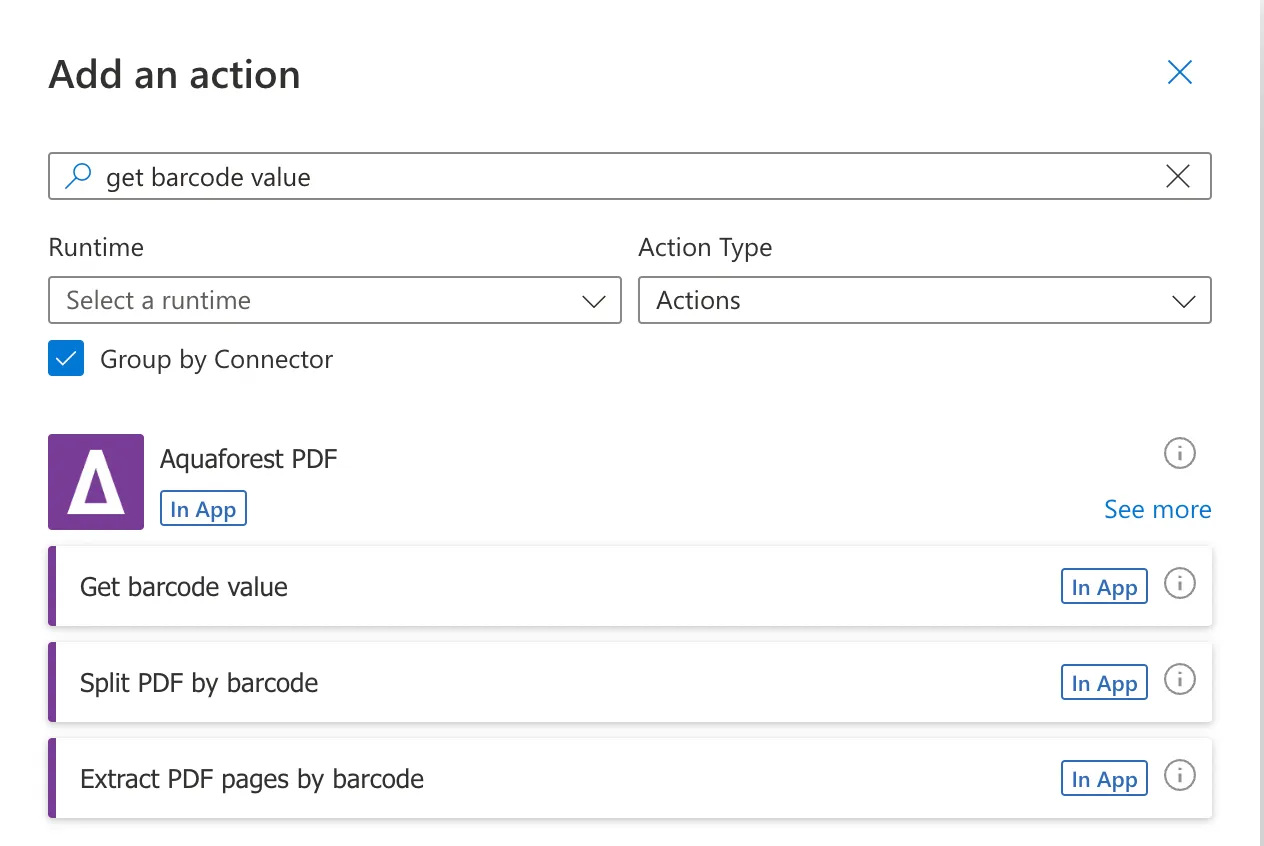
As a next step, you will be asked for a Connection Name and an API Key. Give your connection a name and use the primary key generated upon signing up for PDF Connector. If you need assistance, read the getting started guide, particularly Generate API key section.
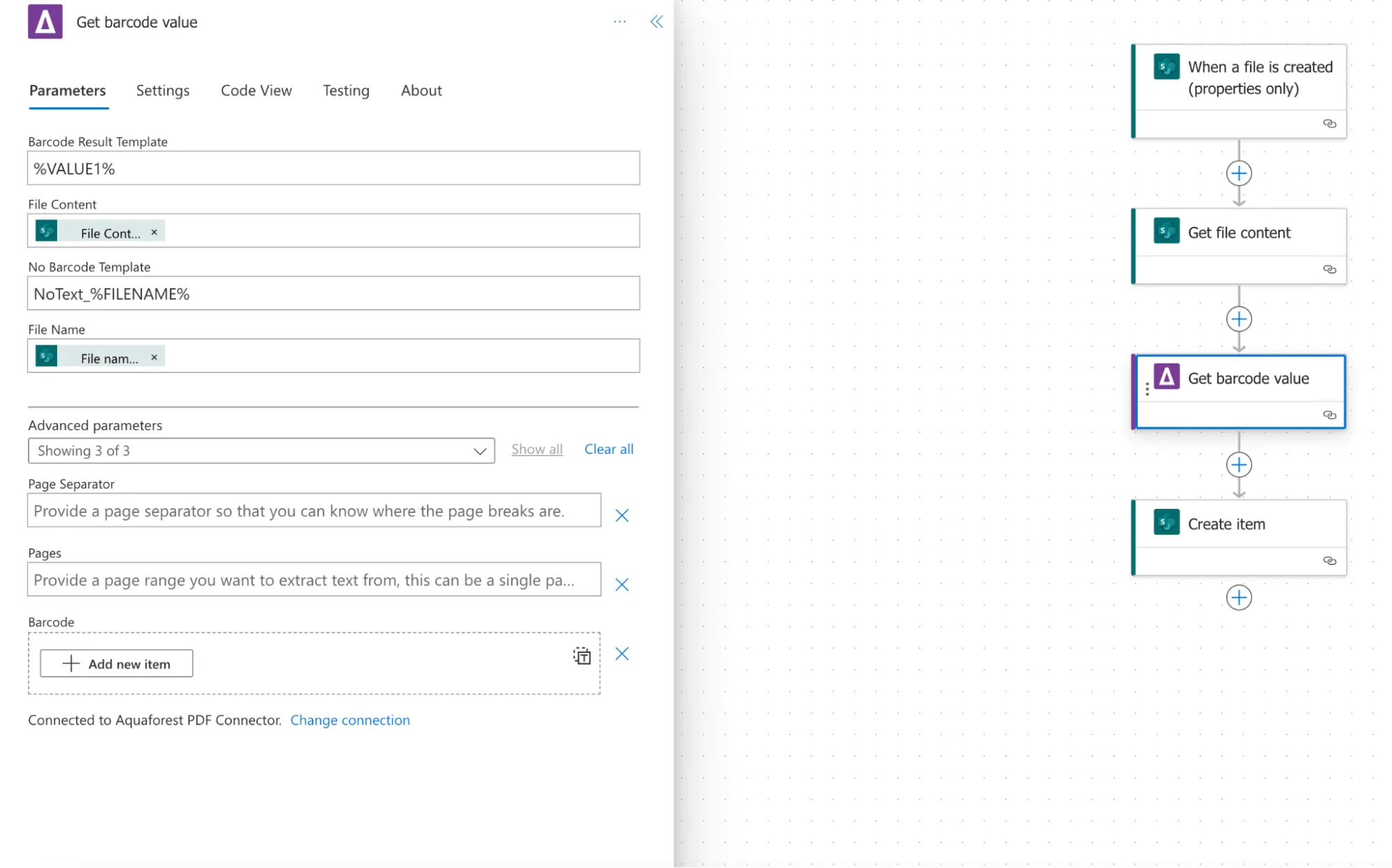
Step 2: Input Parameters.

When you activate the connector and add an action, the next step would be to fill in the required fields. Enter the source file name, file content, and define barcode result template.

  • Barcode Result Template: Define the output text template for found barcodes.
  • File Content: Add “File content” from Dynamic list.
  • File Name: Add “File name with extension” from Dynamic list.
  • No Barcode Template: Set the output text template for cases where no barcode is found.

Step 3: Configure Optional Parameters.

  • Page Separator: Define a separator for page breaks.
  • Pages: Specify the page range for extracting barcode values.
  • Add a new barcode.

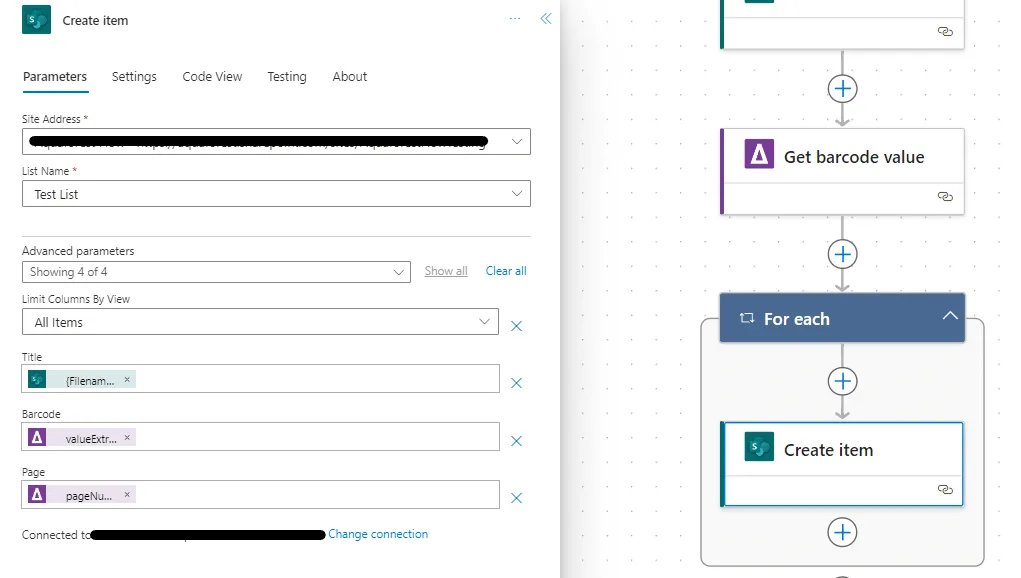
Step 4. Create item action.

Add the create item action and configure following the details below:

Site address: The URL of your SharePoint site.

Folder path: The location of your SharePoint library where the input file is stored.

List item: The name of the list that you want to get barcode value from.

You can also check other output parameters:

  • Barcode: The generated string from the extracted text applied to the file template.
  • Barcode Results: An array with pages and their corresponding extracted barcode values.
  • Page Number: The page where the barcode was found.
  • Page Barcode: The generated string from the extracted barcode value applied to the Barcode Result Template.
  • Zone Values: An array containing the barcode extracted from each zone.
  • Is Successful: A boolean value indicating the success of the operation.
  • License Info: Information about your API subscription key.
  • Error: If any, contains the error message returned by the operation.

Step 5: Execute the Action.

Click on the Save button and run the Power Automate workflow to trigger the “Get Barcode Value” action.

Step 6: Real-time Tracking Updates.

As the “Get Barcode Value” action executes, the tracking system of Alex’s logistics company is automatically updated with the extracted barcode values.

Conclusion

By incorporating the Aquaforest PDF Connector’s “Get Barcode Value” action into the logistics workflow, professionals like Alex can streamline package tracking, reduce manual effort, and ensure real-time updates in the shipment processing pipeline. Embrace automation to enhance efficiency and accuracy in logistics operations.