


惯性聚合 高效追踪和阅读你感兴趣的博客、新闻、科技资讯
阅读原文 在惯性聚合中打开

推荐订阅源

宝玉的分享
宝玉的分享
T
The Blog of Author Tim Ferriss
Y
Y Combinator Blog
Apple Machine Learning Research
Last Week in AI
Last Week in AI
Recorded Future
Recorded Future
博客园 - 司徒正美
V
Vulnerabilities – Threatpost
月光博客
月光博客
C
CXSECURITY Database RSS Feed - CXSecurity.com
D
Darknet – Hacking Tools, Hacker News & Cyber Security
CTFtime.org: upcoming CTF events
Microsoft Azure Blog
cs.AI updates on arXiv.org
W
WeLiveSecurity
Jina AI
Jina AI
Exploit-DB.com RSS Feed
Hacker News: Ask HN
Hacker News: Ask HN
S
Security Affairs
V
Visual Studio Blog
Schneier on Security
T
Tailwind CSS Blog
Martin Fowler
Martin Fowler
V2EX - 技术
V2EX - 技术
博客园 - Franky
S
Secure Thoughts
Blog — PlanetScale
Blog — PlanetScale
G
GRAHAM CLULEY
D
DataBreaches.Net
O
OpenAI News
Forbes - Security
Forbes - Security
云风的 BLOG
云风的 BLOG
Google Online Security Blog
博客园 - 三生石上(FineUI控件)
T
Tor Project blog
T
Tenable Blog
Latest news
Latest news
N
News and Events Feed by Topic
博客园_首页
Simon Willison's Weblog
C
Cybersecurity and Infrastructure Security Agency CISA
美团技术团队
T
The Exploit Database - CXSecurity.com
K
Kaspersky official blog
B
Blog
阮一峰的网络日志
阮一峰的网络日志
T
Threat Research - Cisco Blogs
SecWiki News
SecWiki News
PCI Perspectives
PCI Perspectives
GbyAI
GbyAI

Inside Nutrient

A guide to the invisible work behind documents Introducing Nutrient Documents for Salesforce: Native document generation and signing Document AI vs. traditional OCR: Choosing between OCR, AI, and hybrid pipelines PDF SDK compliance and security evaluation checklist for enterprise teams (2026) Invariant Corp replaces paper processes with Nutrient Workflow and scales without limits What is process mapping? A complete guide Nutrient vs. Conga Composer for Salesforce document generation (2026) Document routing: How to automate document distribution The CTO’s AI playbook: Why accountability architecture beats orchestration Compliance workflow automation: Why built-in compliance is table stakes Workflow diagrams: Examples, symbols, and how to build one that actually runs Digital forms: Replace paper forms with automated workflows Approval workflow software: How to automate approvals Why document-centric automation is different The CEO’s AI playbook: Why decision architecture beats model selection Nutrient SDK product updates for Q1 2026 PDF redaction verification: How to prove sensitive data is permanently removed What is a VPAT? The complete guide to accessibility conformance reports What is PDF/UA? The accessible PDF standard explained Salesforce eSignatures: Generate, sign, and track documents in one flow Online document viewer: Options, tradeoffs, and how to embed one Document viewer for web apps: React, Vue, Angular (2026) Best document viewers in 2026: A buyer’s guide How to edit a PDF in Python: Add text, images, and annotations Nutrient advances Workflow platform with agentic AI for enterprise-grade speed and consistency in document-heavy operations How to create a Salesforce quote template from opportunity data The business case for accessibility: Five ways it drives enterprise value Python PDF library comparison (2026): 7 libraries for developers Why your AI agent hallucinates PDF table data PDF.js limitations: When to upgrade to a commercial PDF SDK How Subject scaled 5× with Nutrient’s PDF SDK without rebuilding its document layer I replaced our sales training with an AI coach that runs in Slack — here’s what broke Redirecting to: https://securitybuzz.com/cybersecurity-news/why-enterprise-permissions-are-ais-most-dangerous-inheritance/ Nutrient .NET SDK vs. iText Core: Complete comparison for .NET developers DocuVieware: Support’s most frequently asked setup questions Introducing Nutrient Workflow How to convert PDF to Word in C# (.NET) When email and spreadsheets stop working: Work order approval workflows for field teams on the move Compliance with confidence: Why document-centric automation is the foundation of your mission Nutrient expands AI Assistant, automating multistep document workflows inside any application What is document generation? A developer’s guide to PDF generation Document Converter data flow and how real-time watermarks skip the queue PDF/UA compliance guide: Requirements, standards, and best practices Computers still can’t understand you How Athena Intelligence built AI agents for regulated enterprises with Nutrient’s document infrastructure How to convert HTML to PDF (2026): 4 methods from browser print to SDK How to build a document extraction pipeline with Nutrient Vision API OCR vs. intelligent document processing: Choosing the right document extraction engine Beyond OCR: How document intelligence eliminates manual processing in regulated industries Nutrient vs. IronPDF: Complete comparison for .NET developers Nutrient vs. Aspose.PDF: Complete comparison for .NET developers Redirecting to: https://fortune.com/2026/02/19/openclaw-who-is-peter-steinberger-openai-sam-altman-anthropic-moltbook/ Lufthansa Systems uses Nutrient to deliver reliable, scalable PDF rendering for pilots worldwide Nutrient vs. Syncfusion: Complete comparison for .NET developers React’s useTransition: The hook you’re probably using wrong First City Monument Bank streamlines banking processes with Nutrient Workflow Redirecting to: https://www.sdcexec.com/warehousing/automation/article/22957364/nutrient-workflow-automation-the-missing-link-in-supply-chain-efficiency The complete guide to digital signatures: PAdES, CAdES, and XAdES explained Nutrient Python SDK: Production-grade document processing for Python Introducing agentic document editing for web applications with AI Assistant Nutrient vs. QuestPDF: Complete comparison for .NET developers How we fixed the GdPicture license expiration (and what to do if you’re affected) Red team security testing with agentic AI The future of healthcare document automation Best healthcare workflow software compared Nutrient SDK product updates for Q4 2025 How Harvey scaled legal document workflows 50 percent MoM without rebuilding infrastructure HIPAA-compliant document management in hospitals How we optimized rendering performance while handling thousands of annotations in React — Part 2 Automated PII removal with Nutrient API Redirecting to: https://www.devopsdigest.com/2026-low-code-no-code-predictions Redirecting to: https://www.kmworld.com/Articles/Editorial/ViewPoints/Leaders-predict-AI-to-continue-permeating-all-aspects-of-KM-in-2026-172594.aspx What are deep agents and how do they solve complex problems? Whipping up document magic: Your easy-bake recipe for Vue and Nutrient Web SDK 🧁 What I’ve learned about product iteration planning while building SDKs Passwordless document signing: Three-layer security guide New zip folder functionality streamlines file management in Document Automation Server The keyboard shortcuts playbook: Taking control of keyboard events in Nutrient Web SDK From experienced engineer to AI beginner: My unexpected journey AI-assisted manual testing: Handling Safari’s PDF rendering and UI quirks How to keep a 20-year-old SDK up to date How we optimized rendering performance while handling thousands of annotations in React — Part 1 Nutrient announces new executive hires to accelerate next phase of growth High performance UI using web workers Automate document conversion at scale with Python and Nutrient DCS From curiosity to PLG (and AI): My journey to understanding product-led growth Prost to progress: One year as Nutrient Pigeon usage at Nutrient: Bridging native SDKs to Flutter Modernizing CI build servers: How to migrate from Chef to Ansible Unix man pages: AI-friendly documentation since 1971 Consistent hashing for even load distribution Best AI redaction APIs: Complete comparison guide for 2025 Why AI document redaction matters for modern security From coding to coordinating: How AI transformed my workflow What is intelligent document processing (IDP)? A complete guide Enterprise PDF SDKs: Best PSPDFKit (now Nutrient) alternatives Nutrient SDK product updates for Q3 2025 GdPicture support best practices Redacting sensitive data with Nutrient AI redaction API How AI is transforming the customer experience at Nutrient: From instant answers to intelligent support
How to measure PDFs: A step-by-step guide
Hulya Masharipov · 2025-05-21 · via Inside Nutrient

Table of contents

    How to measure PDFs: A step-by-step guide

    TL;DR

    Nutrient SDK lets you measure distance, area, and perimeter in PDFs accurately and at scale. Calibrate real-world units, customize precision, and integrate across web and mobile platforms.

    In fields like architecture, engineering, construction, and manufacturing, PDFs are the standard for sharing precise, annotated plans. But one thing that’s often missing from typical PDF viewers? The ability to take real measurements digitally.

    That’s where Nutrient SDK comes in. It enables developers to embed advanced measurement tools into their applications — across web, mobile, and cross-platform environments — so users can calculate distance, perimeter, and area directly on PDF files.

    PDFs are the standard format for sharing floor plans, CAD diagrams, maps, and engineering documentation. But not all PDF viewers support accurate measurement. A powerful PDF measuring tool can help you:

    • Accurately calculate distances between elements.
    • Measure complex perimeters or enclosed areas.
    • Calibrate PDFs to real-world scale for construction and design.
    • Work seamlessly across web and mobile platforms.

    Why choose Nutrient SDK for PDF measurements

    While several PDF tools offer basic measurement functionalities, Nutrient SDK stands out with its advanced features, high performance, and user-centric design. Unlike some competitors that may lack comprehensive measurement tools or require additional plugins, Nutrient provides an all-in-one solution for accurate and efficient PDF measurements.

    Key features of Nutrient SDK measurement tools

    • Distance measurement — Measure the distance between two or more points on a PDF.
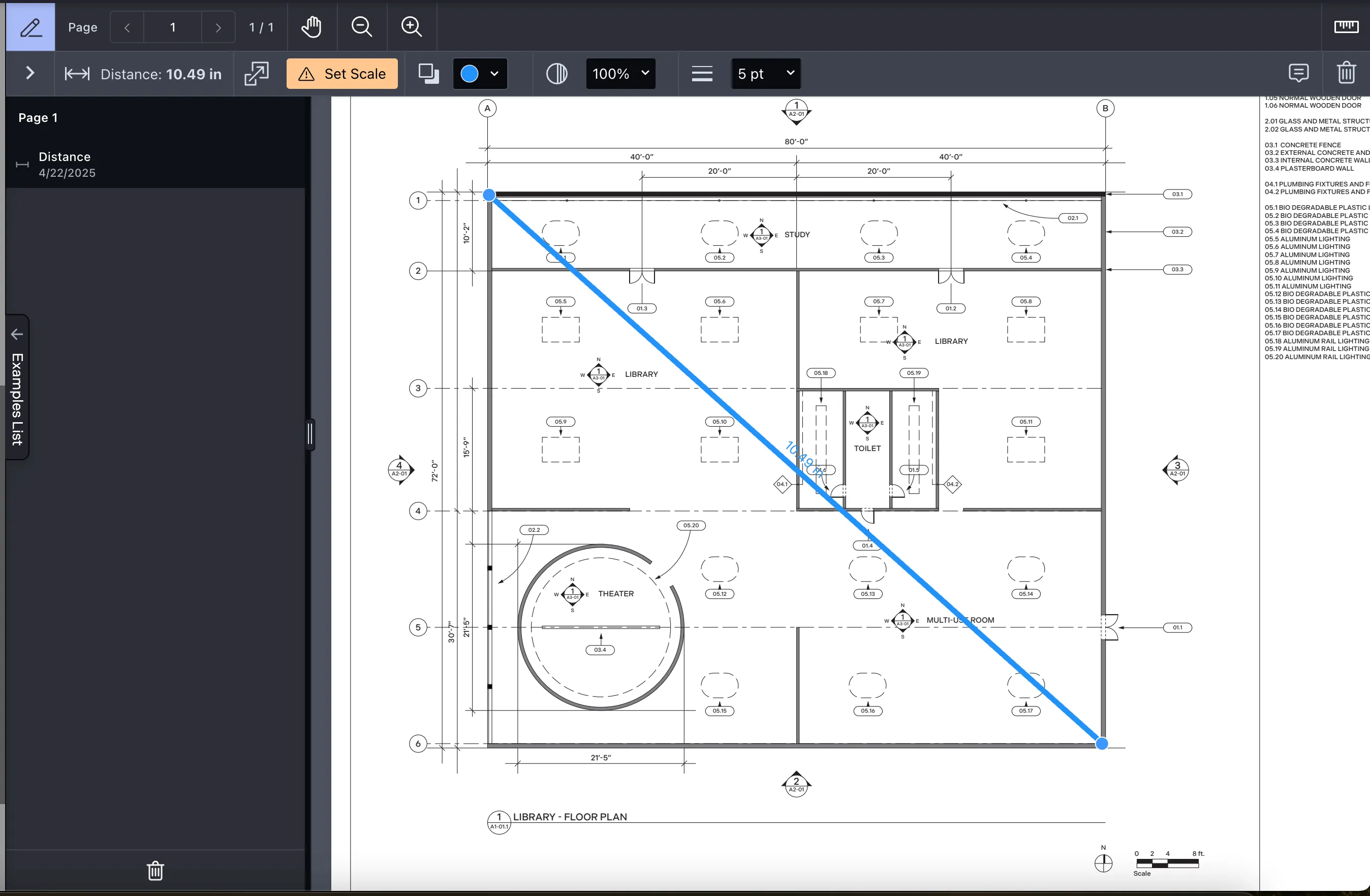
      Distance measurement

    • Area measurement — Calculate the area inside a custom-drawn polygon, rectangle, or ellipse. Perfect for estimating floor space, zoning areas, or cutout regions.

    • Ellipse area measurement — Used to calculate the area of rounded or circular regions, such as tanks, circular rooms, or mechanical parts.
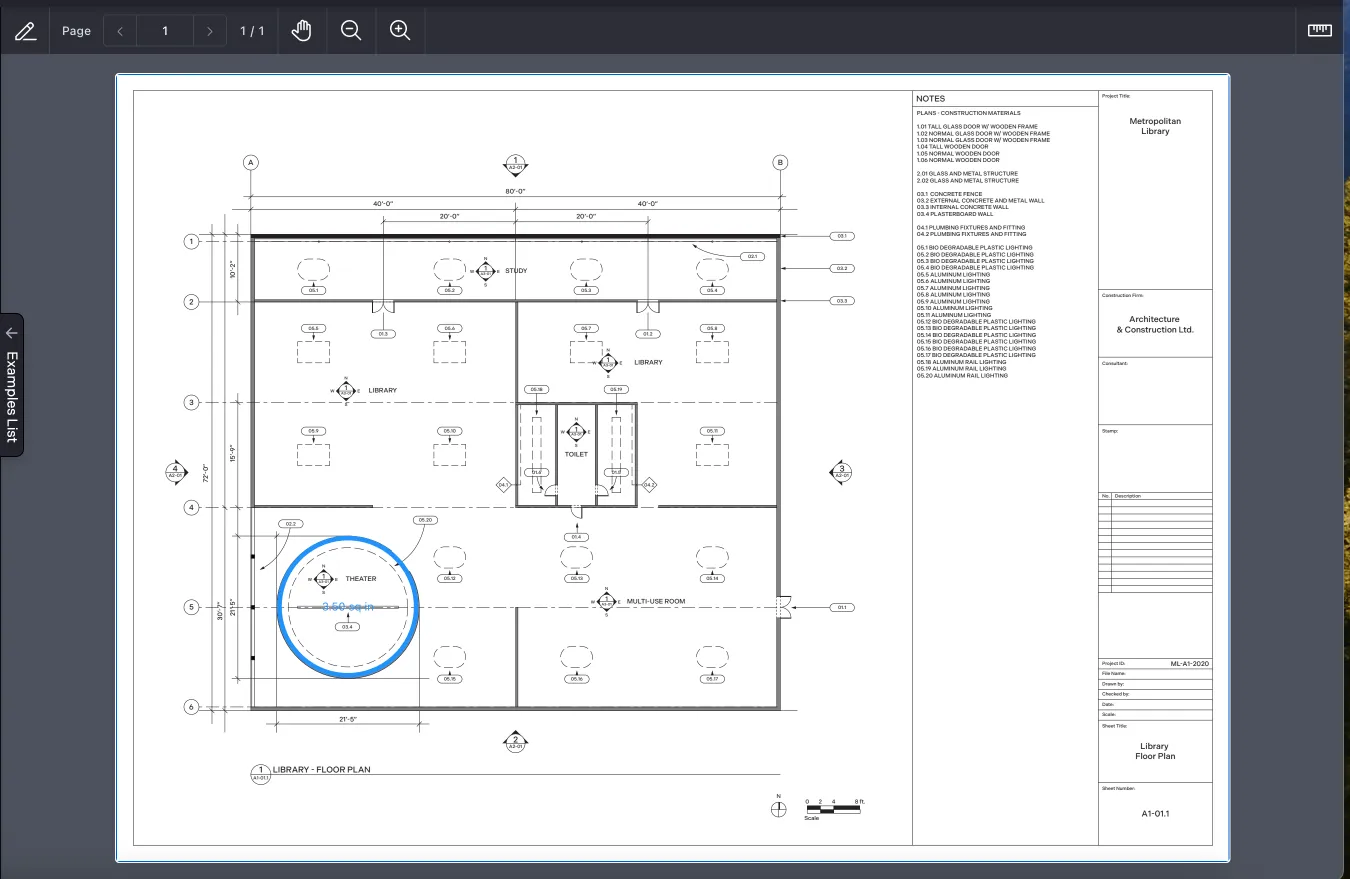
      Ellipse measurement

    • Rectangle area measurement — Ideal for rectangular or square-shaped areas, and great for quick floor space calculations, rooms, or standardized cutouts.
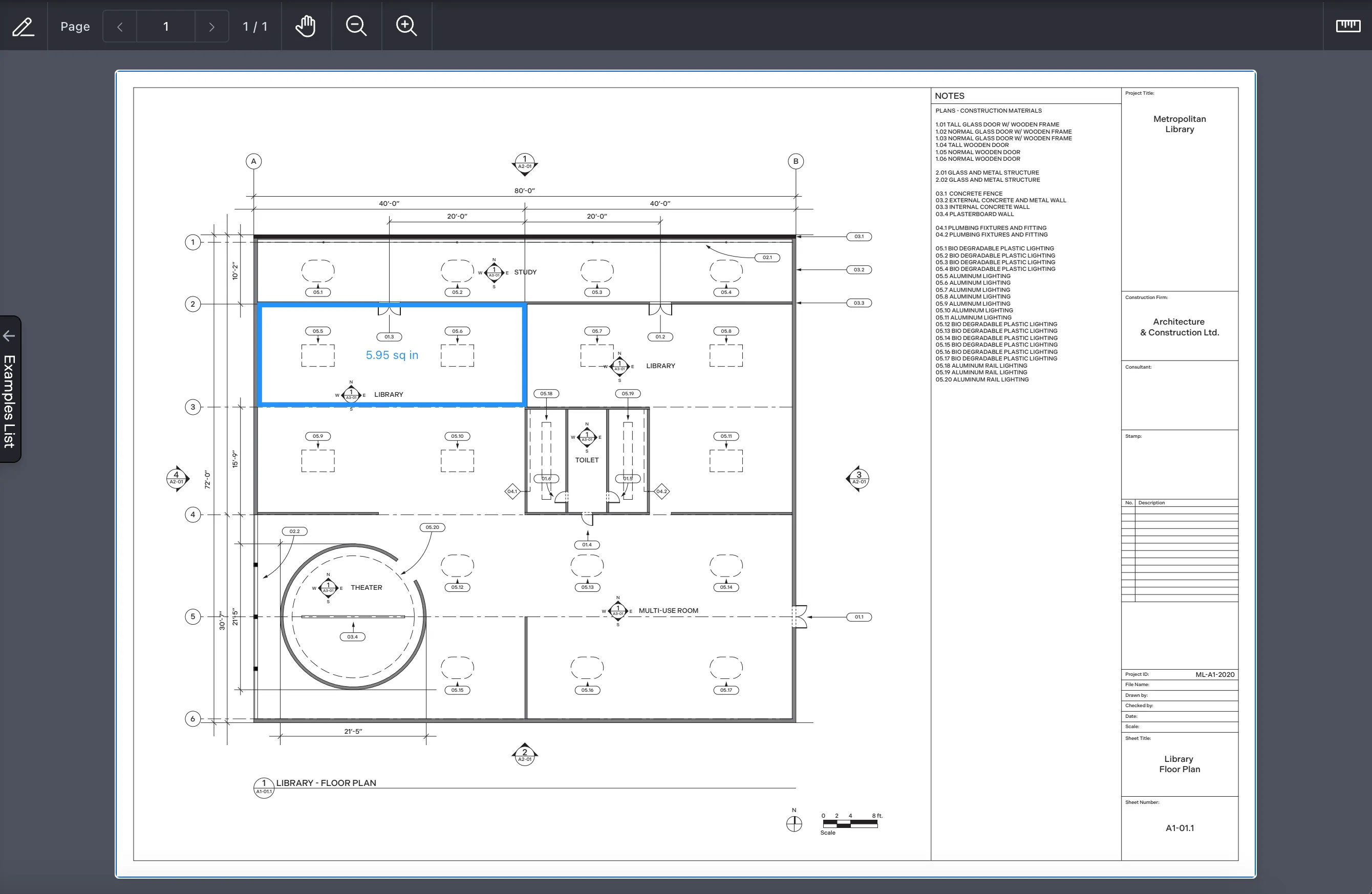
      Rectangle measurement

    • Polygon area measurement — For irregular or complex shapes, polygon tools let users draw any number of connected points to define a custom area.
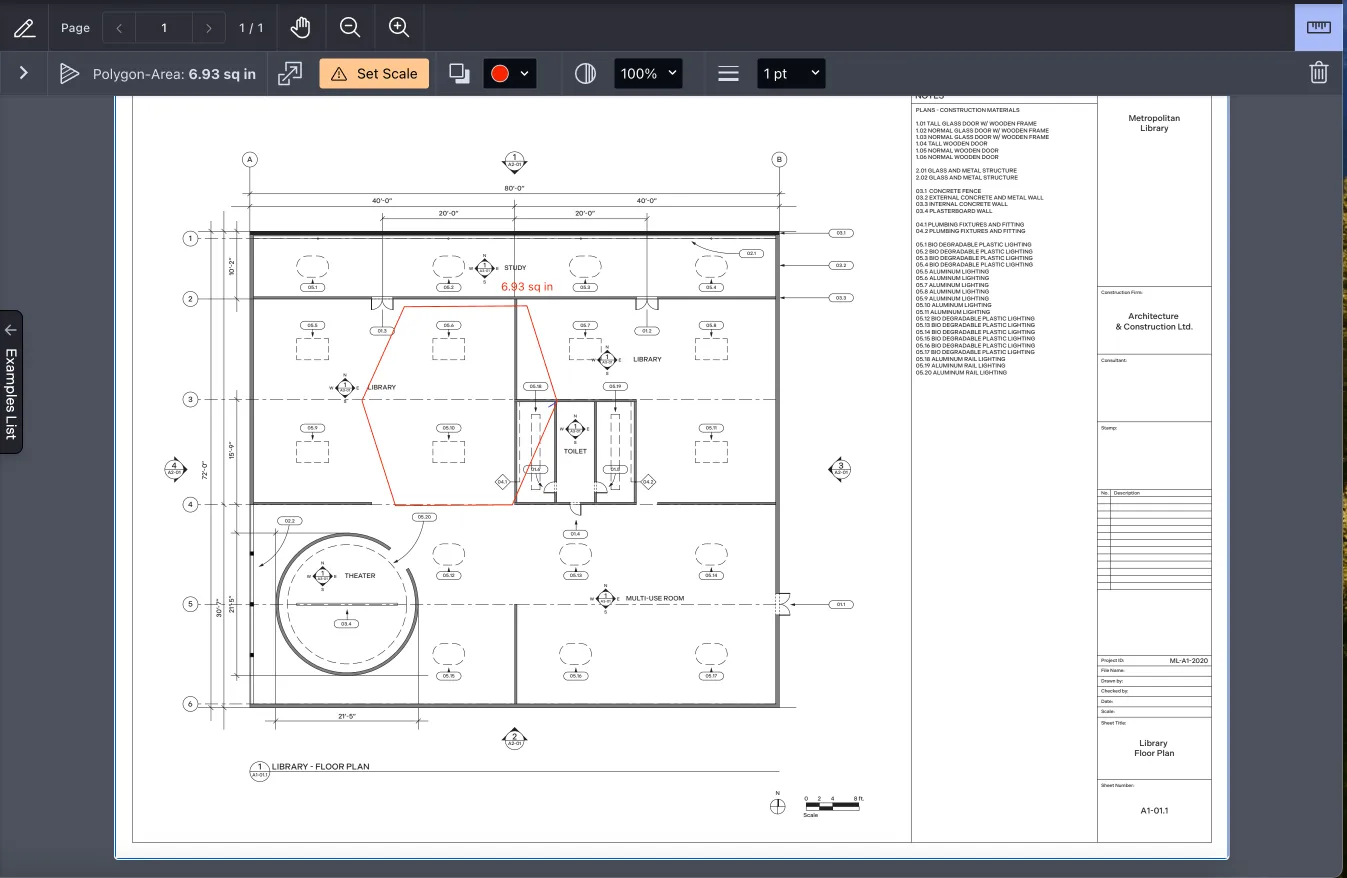
      Polygon measurement

    • Perimeter measurement — Determine the total length around a set of connected points, which is useful for calculating fences, piping routes, or outline distances.
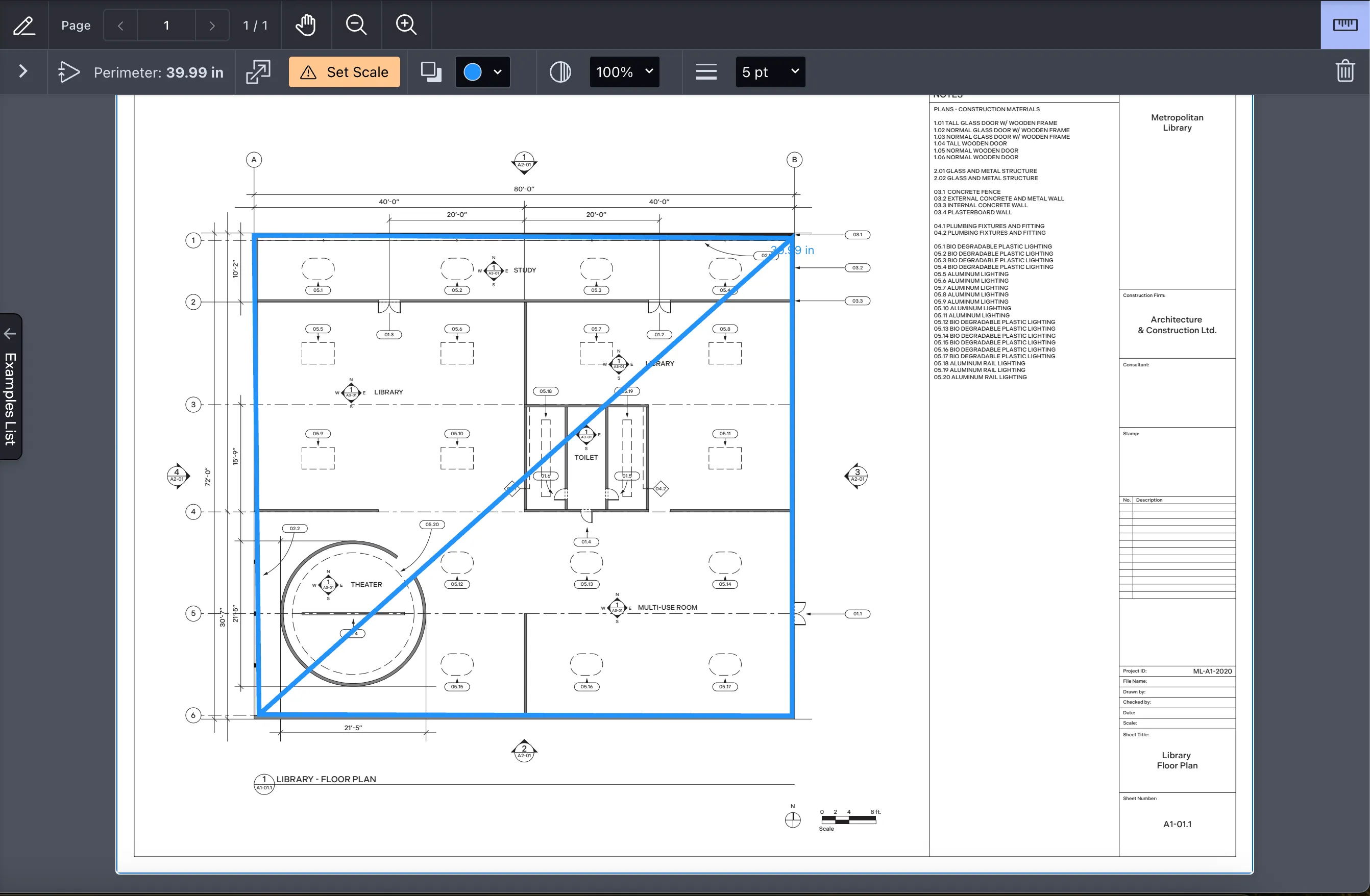
      Perimeter measurement

    • Scale calibration — Calibrate the page’s scale using a known reference distance so all future measurements reflect real-world values.

    • Snap to page — Enable snapping to ensure measurement lines align with document graphics, grid lines, or annotation edges.

    • Customization — Developers and users can:

      • Adjust units (e.g. meters, inches, feet)
      • Control decimal precision
      • Style measurement lines (color, thickness, opacity)
      • Save and switch between multiple measurement presets (e.g. site vs. interior scaling)

    For more details, refer to the Web measurement guide.

    Try measuring a PDF on Web

    Measuring PDF documents with Nutrient SDK

    Step 1 — Access the measurement tools

    Nutrient’s UI integrates seamlessly into your app’s toolbar, making it easy to begin measuring with just a few clicks or taps.

    • Web — Add measurement tools to your toolbar configuration. Learn how to configure in JavaScript.
    • Flutter — Touch and hold the annotation tools icon to reveal measurement options. Refer to the Flutter guide for details.
    • iOS, Android, MAUI, React Native — UI access points vary slightly by platform, but all follow a similar flow.

    Step 2 — Select the right tool

    Once the measurement toolbar is open, choose the tool that best fits your need:

    • Distance — Measure a straight line between two points.
    • Perimeter — Measure the total length around a set of connected points.
    • Area — Measure the space enclosed by a polygon, ellipse, or rectangle.

    Each tool offers snap-to-grid features, adjustable precision, and editable measurement annotations.

    Step 3 — Take measurements

    Using your cursor (or finger on mobile), draw directly on the PDF:

    • Distance tool — Click/tap once for the start point, and then again for the endpoint.
    • Perimeter tool — Add multiple connected points; the total length updates dynamically.
    • Area tool — Draw around the region; the calculated area appears onscreen.

    Configuring measurements for accuracy

    1. Set the scale
      Use a known reference distance in the PDF to calibrate. For example, if a line represents five meters, use that to set your page-to-real-world ratio.

    2. Adjust measurement precision
      You can customize the number of decimal places shown in measurement outputs.

    3. Enable snapping (on mobile)
      Improve accuracy by enabling snapping so measurements align precisely with lines or objects.

    Learn more: Measuring tools for PDFs: Distance, area, perimeter.

    Advanced measurement use cases

    For developers needing full control or automation:

    • Programmatically create and extract measurement annotations.
    • Integrate with project management systems to log measurements.
    • Automate validation of design dimensions across document versions.

    If you’re implementing programmatic measurement workflows, Nutrient’s team can help you with code samples and API-level customization. Reach out via the Nutrient support page(opens in a new tab).

    Nutrient SDK vs. competitors

    When comparing Nutrient SDK to other PDF tools, several advantages become evident:

    • Comprehensive measurement tools — Unlike some competitors that offer limited measurement capabilities, Nutrient provides tools for distance, perimeter, and area measurements.
    • Cross-platform support — Nutrient supports web, iOS, Android, Flutter, MAUI, and React Native, ensuring consistent functionality across devices.
    • User-friendly interface — The intuitive design allows users to access and utilize measurement tools effortlessly.
    • Advanced configuration options — Features like scale calibration, precision adjustment, and snapping enhance measurement accuracy and flexibility.

    Platform-specific guides

    Nutrient SDK supports measurement tools across all major platforms. Dive into the platform-specific documentation below:

    Conclusion

    Accurate measurements within PDFs are vital for professionals in various industries. Nutrient SDKs offer a robust, user-friendly, and cross-platform solution for all your PDF measurement needs. By integrating Nutrient into your workflows, you ensure precision, efficiency, and a seamless user experience.

    For more information or to get started, visit the Nutrient SDK Measurement Tools page.

    Need help implementing it?

    Reach out to our Support team(opens in a new tab) or book a demo to see how easy it is to integrate measurement tools with your workflow.

    FAQ

    Nutrient SDK lets you measure distances between two or more points, calculate perimeters around connected shapes, and measure areas using polygons, rectangles, or ellipses — directly in PDF documents.

    Yes. Nutrient SDK allows you to set a custom scale based on a known distance within the document. This ensures all future measurements reflect accurate real-world units like meters or feet.

    You can customize measurement units (e.g. millimeters, centimeters, meters, inches, feet) and set decimal precision to meet your project’s requirements.

    Absolutely. Nutrient SDK supports PDF measurement tools across all major platforms: Web, iOS, Android, Flutter, React Native, and MAUI.

    Yes. You can use the SDK’s APIs to create, extract, and manipulate measurement annotations programmatically — for automation, syncing with external systems, or reporting.

    Explore related topics

    Try for free Ready to get started?

    Related SDK articles

    Explore more