

惯性聚合 高效追踪和阅读你感兴趣的博客、新闻、科技资讯
阅读原文 在惯性聚合中打开

推荐订阅源

Microsoft Azure Blog
量子位
小众软件
小众软件
C
Cybersecurity and Infrastructure Security Agency CISA
Threat Intelligence Blog | Flashpoint
T
Tenable Blog
V
Vulnerabilities – Threatpost
Know Your Adversary
Know Your Adversary
T
Threat Research - Cisco Blogs
Latest news
Latest news
Spread Privacy
Spread Privacy
C
Cyber Attacks, Cyber Crime and Cyber Security
NISL@THU
NISL@THU
T
Tor Project blog
Hacker News: Ask HN
Hacker News: Ask HN
V2EX - 技术
V2EX - 技术
T
The Exploit Database - CXSecurity.com
博客园 - 三生石上(FineUI控件)
K
Kaspersky official blog
Cyberwarzone
Cyberwarzone
博客园 - 叶小钗
博客园 - 聂微东
Last Week in AI
Last Week in AI
爱范儿
爱范儿
腾讯CDC
博客园 - Franky
美团技术团队
J
Java Code Geeks
O
OpenAI News
L
Lohrmann on Cybersecurity
Simon Willison's Weblog
有赞技术团队
有赞技术团队
T
Threatpost
G
GRAHAM CLULEY
Hugging Face - Blog
Hugging Face - Blog
博客园 - 【当耐特】
宝玉的分享
宝玉的分享
I
Intezer
N
News and Events Feed by Topic
钛媒体:引领未来商业与生活新知
钛媒体:引领未来商业与生活新知
CTFtime.org: upcoming CTF events
OSCHINA 社区最新新闻
OSCHINA 社区最新新闻
T
The Blog of Author Tim Ferriss
S
Security @ Cisco Blogs
Forbes - Security
Forbes - Security
N
News | PayPal Newsroom
Stack Overflow Blog
Stack Overflow Blog
Scott Helme
Scott Helme
H
Hacker News: Front Page
Cloudbric
Cloudbric

Inside Nutrient

A guide to the invisible work behind documents Introducing Nutrient Documents for Salesforce: Native document generation and signing Document AI vs. traditional OCR: Choosing between OCR, AI, and hybrid pipelines PDF SDK compliance and security evaluation checklist for enterprise teams (2026) Invariant Corp replaces paper processes with Nutrient Workflow and scales without limits What is process mapping? A complete guide Nutrient vs. Conga Composer for Salesforce document generation (2026) Document routing: How to automate document distribution The CTO’s AI playbook: Why accountability architecture beats orchestration Compliance workflow automation: Why built-in compliance is table stakes Workflow diagrams: Examples, symbols, and how to build one that actually runs Digital forms: Replace paper forms with automated workflows Approval workflow software: How to automate approvals Why document-centric automation is different The CEO’s AI playbook: Why decision architecture beats model selection Nutrient SDK product updates for Q1 2026 PDF redaction verification: How to prove sensitive data is permanently removed What is a VPAT? The complete guide to accessibility conformance reports What is PDF/UA? The accessible PDF standard explained Salesforce eSignatures: Generate, sign, and track documents in one flow Online document viewer: Options, tradeoffs, and how to embed one Document viewer for web apps: React, Vue, Angular (2026) Best document viewers in 2026: A buyer’s guide How to edit a PDF in Python: Add text, images, and annotations Nutrient advances Workflow platform with agentic AI for enterprise-grade speed and consistency in document-heavy operations How to create a Salesforce quote template from opportunity data The business case for accessibility: Five ways it drives enterprise value Python PDF library comparison (2026): 7 libraries for developers Why your AI agent hallucinates PDF table data PDF.js limitations: When to upgrade to a commercial PDF SDK How Subject scaled 5× with Nutrient’s PDF SDK without rebuilding its document layer I replaced our sales training with an AI coach that runs in Slack — here’s what broke Redirecting to: https://securitybuzz.com/cybersecurity-news/why-enterprise-permissions-are-ais-most-dangerous-inheritance/ Nutrient .NET SDK vs. iText Core: Complete comparison for .NET developers DocuVieware: Support’s most frequently asked setup questions Introducing Nutrient Workflow How to convert PDF to Word in C# (.NET) When email and spreadsheets stop working: Work order approval workflows for field teams on the move Compliance with confidence: Why document-centric automation is the foundation of your mission Nutrient expands AI Assistant, automating multistep document workflows inside any application What is document generation? A developer’s guide to PDF generation Document Converter data flow and how real-time watermarks skip the queue PDF/UA compliance guide: Requirements, standards, and best practices Computers still can’t understand you How Athena Intelligence built AI agents for regulated enterprises with Nutrient’s document infrastructure How to convert HTML to PDF (2026): 4 methods from browser print to SDK How to build a document extraction pipeline with Nutrient Vision API OCR vs. intelligent document processing: Choosing the right document extraction engine Beyond OCR: How document intelligence eliminates manual processing in regulated industries Nutrient vs. IronPDF: Complete comparison for .NET developers Nutrient vs. Aspose.PDF: Complete comparison for .NET developers Redirecting to: https://fortune.com/2026/02/19/openclaw-who-is-peter-steinberger-openai-sam-altman-anthropic-moltbook/ Lufthansa Systems uses Nutrient to deliver reliable, scalable PDF rendering for pilots worldwide Nutrient vs. Syncfusion: Complete comparison for .NET developers React’s useTransition: The hook you’re probably using wrong First City Monument Bank streamlines banking processes with Nutrient Workflow Redirecting to: https://www.sdcexec.com/warehousing/automation/article/22957364/nutrient-workflow-automation-the-missing-link-in-supply-chain-efficiency The complete guide to digital signatures: PAdES, CAdES, and XAdES explained Nutrient Python SDK: Production-grade document processing for Python Introducing agentic document editing for web applications with AI Assistant Nutrient vs. QuestPDF: Complete comparison for .NET developers How we fixed the GdPicture license expiration (and what to do if you’re affected) Red team security testing with agentic AI The future of healthcare document automation Best healthcare workflow software compared Nutrient SDK product updates for Q4 2025 How Harvey scaled legal document workflows 50 percent MoM without rebuilding infrastructure HIPAA-compliant document management in hospitals How we optimized rendering performance while handling thousands of annotations in React — Part 2 Automated PII removal with Nutrient API Redirecting to: https://www.devopsdigest.com/2026-low-code-no-code-predictions Redirecting to: https://www.kmworld.com/Articles/Editorial/ViewPoints/Leaders-predict-AI-to-continue-permeating-all-aspects-of-KM-in-2026-172594.aspx What are deep agents and how do they solve complex problems? Whipping up document magic: Your easy-bake recipe for Vue and Nutrient Web SDK 🧁 What I’ve learned about product iteration planning while building SDKs Passwordless document signing: Three-layer security guide New zip folder functionality streamlines file management in Document Automation Server The keyboard shortcuts playbook: Taking control of keyboard events in Nutrient Web SDK From experienced engineer to AI beginner: My unexpected journey AI-assisted manual testing: Handling Safari’s PDF rendering and UI quirks How to keep a 20-year-old SDK up to date How we optimized rendering performance while handling thousands of annotations in React — Part 1 Nutrient announces new executive hires to accelerate next phase of growth High performance UI using web workers Automate document conversion at scale with Python and Nutrient DCS From curiosity to PLG (and AI): My journey to understanding product-led growth Prost to progress: One year as Nutrient Pigeon usage at Nutrient: Bridging native SDKs to Flutter Modernizing CI build servers: How to migrate from Chef to Ansible Unix man pages: AI-friendly documentation since 1971 Consistent hashing for even load distribution Best AI redaction APIs: Complete comparison guide for 2025 Why AI document redaction matters for modern security From coding to coordinating: How AI transformed my workflow What is intelligent document processing (IDP)? A complete guide Enterprise PDF SDKs: Best PSPDFKit (now Nutrient) alternatives Nutrient SDK product updates for Q3 2025 GdPicture support best practices Redacting sensitive data with Nutrient AI redaction API How AI is transforming the customer experience at Nutrient: From instant answers to intelligent support
A new version of Nutrient Document Automation Server is here
Marija Trpkovic · 2023-11-09 · via Inside Nutrient

Nutrient Document Automation Server version 6.0.231116 has just been released. It is one of Nutrient’s flagship products and has been a cornerstone of the large-volume optical character recognition (OCR) market for 15 years.

Nutrient Document Automation Server is a no-code/low-code solution that provides a set of steps that can be combined into jobs that can be scheduled or run manually. With an extensive range of step types, Document Automation Server jobs can handle a wide range of document workflows. The documents can originate from the file system, SharePoint on-premises or Online, Office 365, Azure, and email sources, and the processing results can be saved back to the mentioned destinations.

Five new steps have been added to Nutrient Document Automation Server in this release — all of which make use of GdPicture’s capabilities — including the new key-value pairs processing engine, which extracts important data from files in the form of key-value pairs. We also added a step that redacts or highlights PDF text based on a regex pattern or a terms list, as well as new PDF split steps for page ranges, bookmarks, or barcodes.
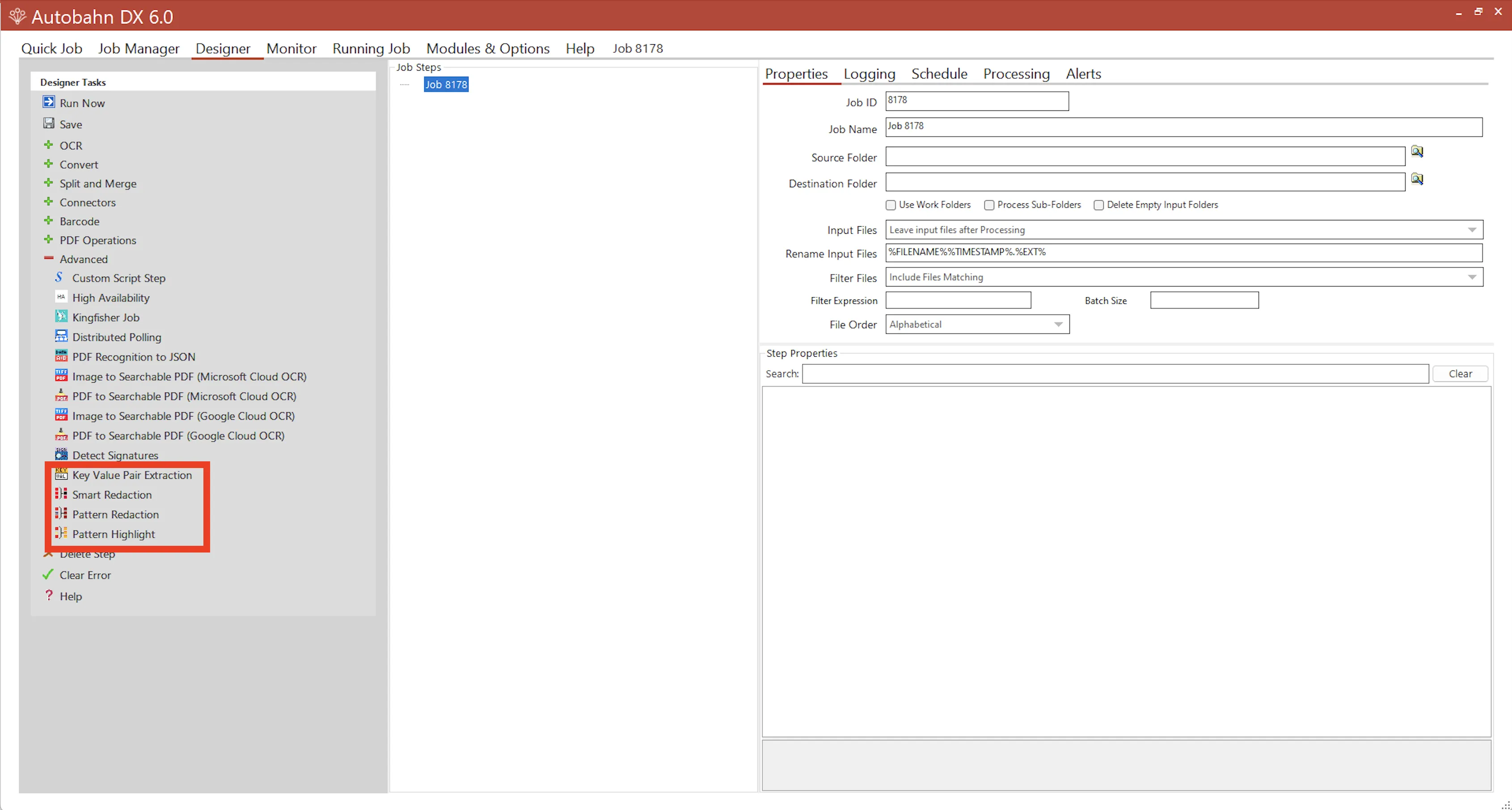
Document Automation Server Update

New available steps in Nutrient document automation server

The new steps, outlined below, are designed to give users greater control over data extraction, redaction, highlighting, and splitting of PDF files — all through a no-code, configurable interface. Whether you’re automating compliance workflows or extracting structured data from unstructured documents, these new steps make it easier than ever to build efficient, scalable automation jobs.

Extracts key-value pairs from PDFs, alongside information about their location, data type, etc. The step outputs the information in the choice of JSON, CSV, and XML output. The user can also specify expected keys, and the closest match for each expected key will be output in a separate file.

Pattern redaction

Redacts text in the input PDF based on a regex expression or terms listed in a text file. The user can also customize the color of the redaction zone.

Pattern highlight

Adds a highlight to text in the input PDF based on a regex expression or terms listed in a text file. The user can also customize the color and transparency of the highlight.

Split PDF (GdPicture)

Splits a PDF based on the criteria specified. The available options are to split by page ranges or bookmarks, or to split into single pages.

Split by barcode

Split a PDF based on the barcodes found. The output files can be named based on the value of each barcode found. After specifying the barcode types, page ranges and regular expressions can further specify the barcodes to split the document on.

Additional improvements in this version

New conversion types available — The Convert Any File To PDF (GdPicture) step previously wasn’t able to process JSON or XML files, as they weren’t supported. Now, they’re treated as text files when converted to PDF, so they’ll now process successfully.

Additional smart redaction options — Improvements to the GdPicture engine have increased the possibilities of the Smart Redaction step, adding two more redaction categories. You can now choose to redact both social security numbers and postal addresses from input PDFs.

Users can now control threads used in GdPicture OCR — The GdPicture OCR step is unique, in that it uses multiple concurrent threads to process multiple pages simultaneously, drastically increasing speed. However, it also uses more CPU to run these threads, so we added the option to limit the threads to not use all the CPU power.

How to upgrade to the latest version of Nutrient document automation server?

Nutrient Document Automation Server Version 6.0.231116 doesn’t require a new license key if you already have one of the version 6 keys. Otherwise, please contact Support to upgrade to the latest version. As our license keys are machine-bound, we’ll need the NetBIOS name of the server running Document Automation Server 6.0. If the server name remains unchanged, we’ll have it on record.

Upgrade process

Upgrading Nutrient Document Automation Server involves uninstalling your current installation, downloading version 6.0.2311.03 from our website, and installing the new version. This process should only take a few minutes.

When Nutrient Document Automation Server starts, it checks the version number of each of the step types and will make the required updates to any step. A status bar will show the progress of this process. This only happens the first time the job definition is checked by Nutrient Document Automation Server. Once completed, your previous job list will appear in the new version as it was previously.

Updating from older versions (before 5.0) may require either manual opening, editing, and saving of the job, or recreating the job from a new one.

On the install server, ADX 6.0.231116 will require .NET Framework 4.7.2 or higher. The Document Automation Server installer will check this requirement before installation.

Upgrading from previous versions

Two versions of Document Automation Server cannot be installed at the same time. To install a new version of Document Automation Server, the previous version must first be uninstalled. Before starting the uninstall, first, stop the Nutrient Document Automation Server service and close the UI. The …Autobahn DX/jobdef folder contains the definitions for all jobs. We advise saving this folder in a separate location before upgrading.

Previous jobs and license keys

Certain files will be left in the Nutrient Document Automation Server install location after the uninstallation. Both the jobdef folder containing the descriptions for all the previous jobs and the license key file will be preserved.

Job definitions

Job definitions are now automatically upgraded to the latest version of Nutrient Document Automation Server on opening the UI. This doesn’t require any action from the user. The jobs before upgrading will be saved in the …Autobahn DX/jobdef_copy folder. If you’re upgrading to the latest version from a version older than v5.0, we recommend recreating your jobs instead of relying on the job upgrade.

License key

The license key will remain from your previous version. For upgrades between minor releases, the license key should still be valid for the newly installed version. If you’re on a new major version (5.0, 5.5, 6.0), then the license key will no longer be valid. In this case, contact Support for a new license key.