


惯性聚合 高效追踪和阅读你感兴趣的博客、新闻、科技资讯
阅读原文 在惯性聚合中打开

推荐订阅源

P
Palo Alto Networks Blog
S
Security Affairs
T
Tor Project blog
T
Threatpost
Hacker News - Newest:
Hacker News - Newest: "LLM"
C
Cyber Attacks, Cyber Crime and Cyber Security
The Hacker News
The Hacker News
A
Arctic Wolf
K
Kaspersky official blog
O
OpenAI News
Spread Privacy
Spread Privacy
人人都是产品经理
人人都是产品经理
爱范儿
爱范儿
Simon Willison's Weblog
雷峰网
雷峰网
P
Privacy & Cybersecurity Law Blog
Know Your Adversary
Know Your Adversary
奇客Solidot–传递最新科技情报
奇客Solidot–传递最新科技情报
Last Week in AI
Last Week in AI
Martin Fowler
Martin Fowler
量子位
博客园_首页
Cyberwarzone
Cyberwarzone
博客园 - 三生石上(FineUI控件)
Exploit-DB.com RSS Feed
IT之家
IT之家
N
News and Events Feed by Topic
博客园 - 司徒正美
V2EX - 技术
V2EX - 技术
S
Schneier on Security
博客园 - 叶小钗
Attack and Defense Labs
AI
AI
Application and Cybersecurity Blog
博客园 - 【当耐特】
Jina AI
Jina AI
C
CXSECURITY Database RSS Feed - CXSecurity.com
C
Cybersecurity and Infrastructure Security Agency CISA
D
Darknet – Hacking Tools, Hacker News & Cyber Security
cs.CL updates on arXiv.org
freeCodeCamp Programming Tutorials: Python, JavaScript, Git & More
大猫的无限游戏
大猫的无限游戏
Cloudbric
Cloudbric
H
Hacker News: Front Page
The Last Watchdog
The Last Watchdog
V
V2EX
S
SegmentFault 最新的问题
V
Visual Studio Blog
PCI Perspectives
PCI Perspectives
Microsoft Security Blog

Resend RSS Feed

6 Tips for Accessible Emails Welcoming Manoel do Amaral, our new Brand Designer Welcoming Michael Vaz, our new Customer Success Engineer Six Steps to Improve Your Sender Reputation Welcoming Tatira Andrade, our new Executive Assistant Welcoming Pedro Ivo Hudson, our new Design Engineer Welcoming Diel Duarte, our new Open source Engineer Welcoming Areia Spinner, our new Recruiter Resend Forward: A Conference about Craft React Email 6.0 Custom Tracking Domains AI Email Editor Introducing Automations Welcoming Ahmed Tolba, our new SRE Engineer Welcoming Aneil Singh, our new Founding Account Executive Welcoming Lucas Motta, our new Software Engineer Welcoming Trey Knowles, our new Founding Account Executive Welcoming Anxhela Carciu, our new SRE Engineer Introducing DMARC Analyzer Welcoming Evan Thibodeau, our new Customer Success Engineer Welcoming Derich Pacheco, our new Software Engineer Welcoming Alec Ventura, our new Data Engineer Welcoming Felipe Freitag, our new Software Engineer Welcoming Mateusz Wos, our new Software Engineer Incident report for February 15, 2026 Email automation for OpenClaw How to Create a DevTools Agent Skill Introducing Email Skills Why You Should Embrace the Promotions Tab Slater Smith, our new Customer Success Engineer Do You Need a Warmup Service? Welcoming Zá Scalon, our new Brand Designer How Replit Built Effortless Email Sending Features 1,000,000 users Top 10 new features in 2025 Welcoming Danilo Campos, our new Design Engineer How Dub Uses Webhooks to Power Features Incident report for November 18, 2025 Resend Forward 5: Wrap Up One More (AI) Thing React Email 5.0 Unsubscribe Topics New Contacts Experience Introducing Templates Inbound Emails $3M to Make Email Safer Hacktoberfest 2025 Four Ways to Hurt Your Sender Reputation Resend MCP Hackathon Welcoming Christina Martinez, our new Developer Experience Engineer How to read a DMARC report Welcoming Erin Levine, our new Chief of Staff How to Validate Form Inputs Engineering an AI App Welcoming Lucas da Costa, our new Software Engineer Welcoming Lucas Vieira, our new Software Engineer Resend acquires Briefer How Raycast Modernized their Email Sending How to Get Email Consent DMARC Policy Modes Welcoming Gabriel Miranda, our new Software Engineer Rebranding Resend The 7 Best Email Verification APIs for Developers How DMARC Applies to Subdomains Welcoming Pedro Gomes, our new Software Engineer Do You Need a Dedicated IP? The 6 best notification infrastructure services The Fixer Why Your Emails are Going to Spam Engineering Idempotency Keys Microsoft’s bulk sending requirements for 2025 Welcoming Rehan van der Merwe, our new Devops Engineer 400,000 users and beyond Welcoming Cassio Zen, our new Software Engineer Resend acquires Mergent How to warm up a new domain Welcoming Carolina Josephik, our new Software Engineer Launch Week: Behind the Scenes Welcoming Isabella Aquino, our new Software Engineer Resend Forward 4: Wrap Up React Email 4.0 Multiplayer Editor Broadcast API Multiple Teams new.email Public Launch Welcoming Anna Ward, our new Postmaster How Gumroad Migrated 100M Emails to Resend Welcoming João Melo, our new Software Engineer Welcoming Jp Valery, our new Customer Success Engineer What is AX (Agent Experience) and how to improve it Welcoming Pauline Chin, our new Customer Success Engineer Introducing new.email How we use Friction Logs to improve the product Top 10 Email Deliverability Tips Welcoming Giovana Yahiro, our new Designer Engineer What BIMI's Changes Mean for Email Top 10 new features in 2024 Design Engineering an X Component Welcoming Alexandre Cisneiros, our new Software Engineer Resend raises $18M Series A
Engineering a Vercel Chat Adapter
João Melo · 2026-06-22 · via Resend RSS Feed

AI agents communicate through channels like Slack, chat apps, and SMS. Most of these channels are ephemeral. Messages disappear into feeds, threads get buried, and there's no real record of what happened.

Email is the one protocol that nearly everyone already uses, and conversations don't vanish. We built the official Resend adapter for Vercel Chat SDK to bring email into the Chat SDK ecosystem.

Along the way, we faced challenges and made decisions and tradeoffs. Let's talk about the development process behind @resend/chat-sdk-adapter.

About the adapter

Vercel's Chat SDK is an open-source, TypeScript SDK for building chat bots across Slack, Microsoft Teams, Google Chat, Discord, and more. Write your bot logic once and deploy everywhere.

The Resend adapter extends the SDK, bringing email capabilities to your chat apps.

The Resend adapter treats email as a bidirectional chat channel. Inbound emails arrive via Resend webhooks and trigger Chat SDK event handlers. Outbound messages get delivered as emails through the Resend API.

Practically, this means that you can send emails from your chat interface, build proactive outbound notifications, and more.

Threading without a database

Chat platforms give you thread IDs for free. A message arrives on Slack with a thread_ts. Discord has channel IDs.

Email doesn't work like that. There is no central thread ID, so threading is a client-side concern.

There are two headers that let mail clients reconstruct conversation threads: In-Reply-To and References. These require Message-IDs of prior emails to keep track of the thread. We needed to derive thread IDs from email headers alone. The format we chose looks like this:

resend:{sender-address}:{sha256-first-16-chars-of-root-message-id}

When a new email arrives, the ThreadResolver checks whether In-Reply-To or References point to a message we've already seen. If so, it's part of an existing thread. If not, we hash the Message-ID to create a new thread ID.

An in-memory Map is enough here. Email already carries its own history in the References header, so we don't need persistence. As long as the adapter process is running, it can track which messages belong to which threads.

Mapping between email and chat

The Chat SDK expects adapters to implement parseMessage (inbound) and postMessage (outbound). Both have specific shapes.

On the inbound side, the SDK wants a Message with an author that has userId, userName, and isMe values. For email, the identity fields are the sender's address. isMe is true if the sender matches the bot's fromAddress.

On the outbound side, postMessage accepts an AdapterPostableMessage. This is a union that can be a plain string, markdown, an AST, or a structured card. Each needs to become an email with HTML and plain text options. Strings and markdown are straightforward. Cards are not.

Rendering cards as email

The Chat SDK has a CardElement type for structured messages: cards with titles, sections, fields, buttons, images, dividers. We had to turn them into email HTML.
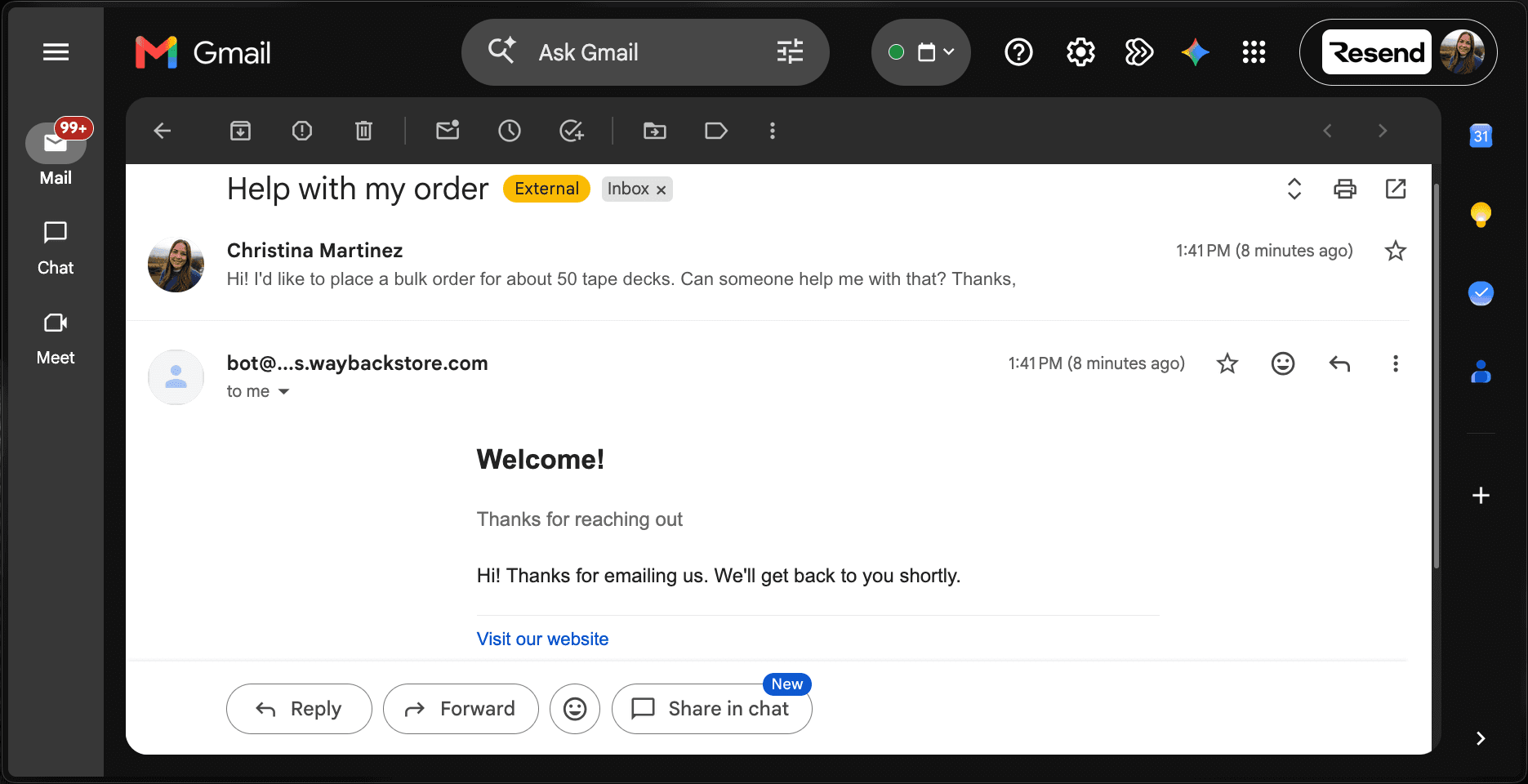
A card rendered in an email inbox

To accomplish this, we turned to our open source package, React Email.

Each CardElement type maps to a React Email component:

  • Text (with a content property) becomes <Text>
  • Field (with label and value) becomes a bolded label and a value
  • Link-button (with label and url) becomes <Button>
  • Image (with label and url) becomes <Img>
  • Divider becomes <Hr />

What I learned

The bulk of the work when building the Chat SDK adapter was translation. Each platform has its own version of threads, messages, authors, and some form of rich content. The work is figuring out how platforms represent those things differently and writing the conversion layer.

Email's representations are older and less convenient than all the other platforms. You have to reconstruct a thread from headers alone. No structured content format exists; you need to render archaic email HTML.

But email reaches everyone. There's no OAuth, no app installations, and no workspace invites. You simply send to an address and they receive it. It's the democratic protocol that the web was built on.

We're excited to see what you build with the Resend adapter. Check the docs for the full setup guide, or view the open source code.