
惯性聚合 高效追踪和阅读你感兴趣的博客、新闻、科技资讯
阅读原文 在惯性聚合中打开

推荐订阅源

爱范儿
爱范儿
Know Your Adversary
Know Your Adversary
Google DeepMind News
A
Arctic Wolf
P
Privacy & Cybersecurity Law Blog
云风的 BLOG
云风的 BLOG
Stack Overflow Blog
Stack Overflow Blog
V
Visual Studio Blog
Project Zero
Project Zero
L
LangChain Blog
N
News and Events Feed by Topic
博客园 - Franky
Last Week in AI
Last Week in AI
cs.AI updates on arXiv.org
T
The Blog of Author Tim Ferriss
宝玉的分享
宝玉的分享
Scott Helme
Scott Helme
T
The Exploit Database - CXSecurity.com
P
Proofpoint News Feed
Blog — PlanetScale
Blog — PlanetScale
www.infosecurity-magazine.com
W
WeLiveSecurity
月光博客
月光博客
博客园_首页
美团技术团队
CTFtime.org: upcoming CTF events
freeCodeCamp Programming Tutorials: Python, JavaScript, Git & More
腾讯CDC
Latest news
Latest news
WordPress大学
WordPress大学
cs.CV updates on arXiv.org
Spread Privacy
Spread Privacy
Attack and Defense Labs
量子位
L
LINUX DO - 热门话题
C
CERT Recently Published Vulnerability Notes
Webroot Blog
Webroot Blog
L
Lohrmann on Cybersecurity
aimingoo的专栏
aimingoo的专栏
T
Troy Hunt's Blog
Security Latest
Security Latest
小众软件
小众软件
Cloudbric
Cloudbric
Hacker News: Ask HN
Hacker News: Ask HN
S
Secure Thoughts
雷峰网
雷峰网
T
Threat Research - Cisco Blogs
H
Hacker News: Front Page
IT之家
IT之家
Simon Willison's Weblog

Inside Nutrient

A guide to the invisible work behind documents Introducing Nutrient Documents for Salesforce: Native document generation and signing Document AI vs. traditional OCR: Choosing between OCR, AI, and hybrid pipelines PDF SDK compliance and security evaluation checklist for enterprise teams (2026) Invariant Corp replaces paper processes with Nutrient Workflow and scales without limits What is process mapping? A complete guide Nutrient vs. Conga Composer for Salesforce document generation (2026) Document routing: How to automate document distribution The CTO’s AI playbook: Why accountability architecture beats orchestration Compliance workflow automation: Why built-in compliance is table stakes Workflow diagrams: Examples, symbols, and how to build one that actually runs Digital forms: Replace paper forms with automated workflows Approval workflow software: How to automate approvals Why document-centric automation is different The CEO’s AI playbook: Why decision architecture beats model selection Nutrient SDK product updates for Q1 2026 PDF redaction verification: How to prove sensitive data is permanently removed What is a VPAT? The complete guide to accessibility conformance reports What is PDF/UA? The accessible PDF standard explained Salesforce eSignatures: Generate, sign, and track documents in one flow Online document viewer: Options, tradeoffs, and how to embed one Document viewer for web apps: React, Vue, Angular (2026) Best document viewers in 2026: A buyer’s guide How to edit a PDF in Python: Add text, images, and annotations Nutrient advances Workflow platform with agentic AI for enterprise-grade speed and consistency in document-heavy operations How to create a Salesforce quote template from opportunity data The business case for accessibility: Five ways it drives enterprise value Python PDF library comparison (2026): 7 libraries for developers Why your AI agent hallucinates PDF table data PDF.js limitations: When to upgrade to a commercial PDF SDK How Subject scaled 5× with Nutrient’s PDF SDK without rebuilding its document layer I replaced our sales training with an AI coach that runs in Slack — here’s what broke Redirecting to: https://securitybuzz.com/cybersecurity-news/why-enterprise-permissions-are-ais-most-dangerous-inheritance/ Nutrient .NET SDK vs. iText Core: Complete comparison for .NET developers DocuVieware: Support’s most frequently asked setup questions Introducing Nutrient Workflow How to convert PDF to Word in C# (.NET) When email and spreadsheets stop working: Work order approval workflows for field teams on the move Compliance with confidence: Why document-centric automation is the foundation of your mission Nutrient expands AI Assistant, automating multistep document workflows inside any application What is document generation? A developer’s guide to PDF generation Document Converter data flow and how real-time watermarks skip the queue PDF/UA compliance guide: Requirements, standards, and best practices Computers still can’t understand you How Athena Intelligence built AI agents for regulated enterprises with Nutrient’s document infrastructure How to convert HTML to PDF (2026): 4 methods from browser print to SDK How to build a document extraction pipeline with Nutrient Vision API OCR vs. intelligent document processing: Choosing the right document extraction engine Beyond OCR: How document intelligence eliminates manual processing in regulated industries Nutrient vs. IronPDF: Complete comparison for .NET developers Nutrient vs. Aspose.PDF: Complete comparison for .NET developers Redirecting to: https://fortune.com/2026/02/19/openclaw-who-is-peter-steinberger-openai-sam-altman-anthropic-moltbook/ Lufthansa Systems uses Nutrient to deliver reliable, scalable PDF rendering for pilots worldwide Nutrient vs. Syncfusion: Complete comparison for .NET developers React’s useTransition: The hook you’re probably using wrong First City Monument Bank streamlines banking processes with Nutrient Workflow Redirecting to: https://www.sdcexec.com/warehousing/automation/article/22957364/nutrient-workflow-automation-the-missing-link-in-supply-chain-efficiency The complete guide to digital signatures: PAdES, CAdES, and XAdES explained Nutrient Python SDK: Production-grade document processing for Python Introducing agentic document editing for web applications with AI Assistant Nutrient vs. QuestPDF: Complete comparison for .NET developers How we fixed the GdPicture license expiration (and what to do if you’re affected) Red team security testing with agentic AI The future of healthcare document automation Best healthcare workflow software compared Nutrient SDK product updates for Q4 2025 How Harvey scaled legal document workflows 50 percent MoM without rebuilding infrastructure HIPAA-compliant document management in hospitals How we optimized rendering performance while handling thousands of annotations in React — Part 2 Automated PII removal with Nutrient API Redirecting to: https://www.devopsdigest.com/2026-low-code-no-code-predictions Redirecting to: https://www.kmworld.com/Articles/Editorial/ViewPoints/Leaders-predict-AI-to-continue-permeating-all-aspects-of-KM-in-2026-172594.aspx What are deep agents and how do they solve complex problems? Whipping up document magic: Your easy-bake recipe for Vue and Nutrient Web SDK 🧁 What I’ve learned about product iteration planning while building SDKs Passwordless document signing: Three-layer security guide New zip folder functionality streamlines file management in Document Automation Server The keyboard shortcuts playbook: Taking control of keyboard events in Nutrient Web SDK From experienced engineer to AI beginner: My unexpected journey AI-assisted manual testing: Handling Safari’s PDF rendering and UI quirks How to keep a 20-year-old SDK up to date How we optimized rendering performance while handling thousands of annotations in React — Part 1 Nutrient announces new executive hires to accelerate next phase of growth High performance UI using web workers Automate document conversion at scale with Python and Nutrient DCS From curiosity to PLG (and AI): My journey to understanding product-led growth Prost to progress: One year as Nutrient Pigeon usage at Nutrient: Bridging native SDKs to Flutter Modernizing CI build servers: How to migrate from Chef to Ansible Unix man pages: AI-friendly documentation since 1971 Consistent hashing for even load distribution Best AI redaction APIs: Complete comparison guide for 2025 Why AI document redaction matters for modern security From coding to coordinating: How AI transformed my workflow What is intelligent document processing (IDP)? A complete guide Enterprise PDF SDKs: Best PSPDFKit (now Nutrient) alternatives Nutrient SDK product updates for Q3 2025 GdPicture support best practices Redacting sensitive data with Nutrient AI redaction API How AI is transforming the customer experience at Nutrient: From instant answers to intelligent support
Apple Intelligence: A new era in privacy-first AI
Jonathan D. Rhyne · 2024-06-12 · via Inside Nutrient

I’m hearing a bunch of different takes on Apple’s introduction of Apple Intelligence(opens in a new tab), which is the company’s AI play at WWDC24(opens in a new tab).

Before the keynote, we spotted Sam Altman in the VIP waiting area and thought for sure the rumors of an OpenAI partnership were true. As I was sitting in the audience at Apple Park, I was blown away as Craig Federighi laid out Apple’s strategy. He passionately talked about what AI should be for Apple: a strategy focused on personal context but, more specifically, privacy.

Privacy is something Apple has been talking about for more than half a decade, specifically with iPhone, and it has been a differentiator in the company’s strategy compared to other large tech companies such as Meta, Google, and OpenAI.
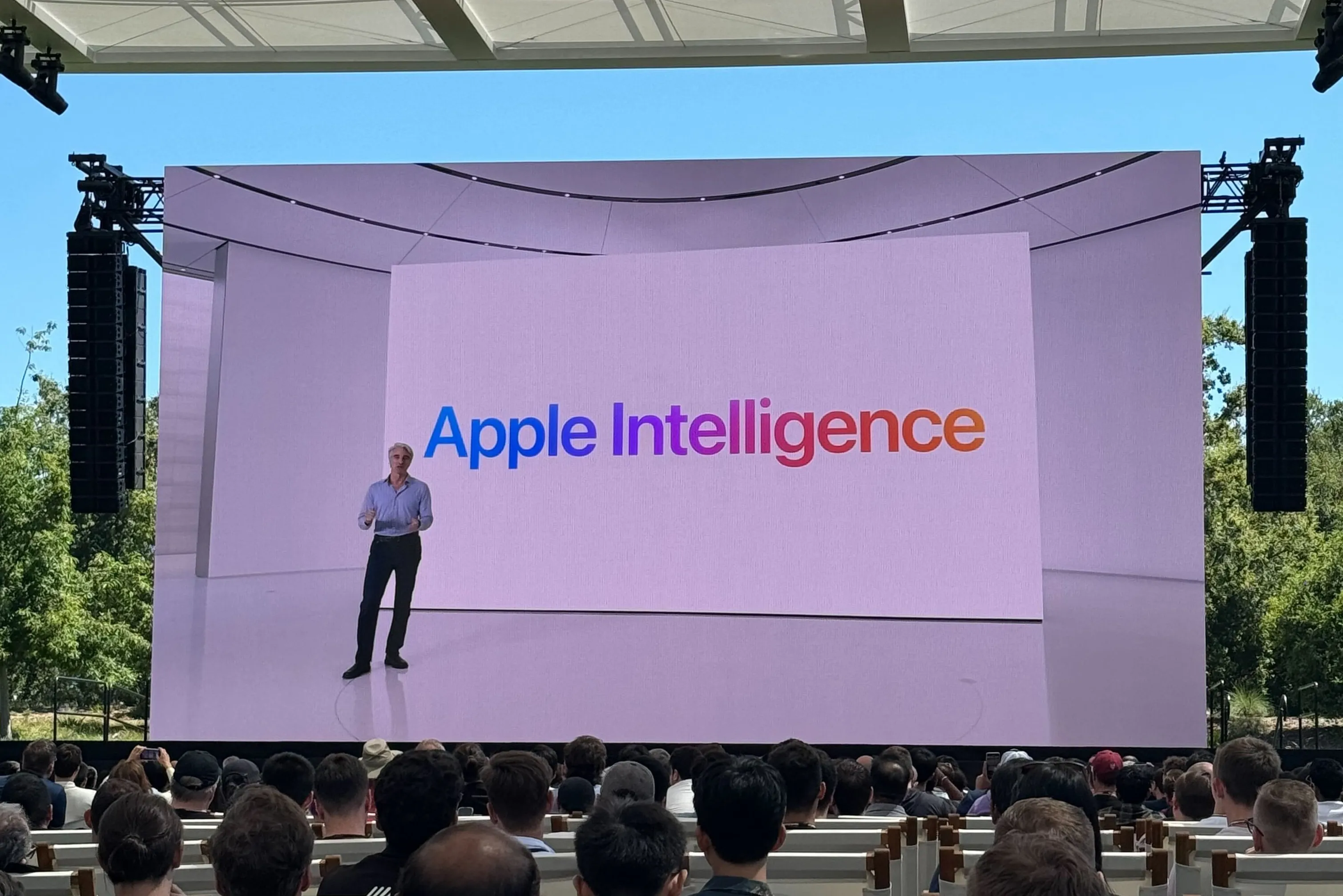
Apple Intelligence

Apple introduces Apple Intelligence (AI) based on privacy and personal context

We all know the famous statement from the documentary The Social Dilemma: “If you’re not paying for the product, then you are the product.” Statements like this seemed to be the stake in the ground that Apple had based its future on, and it seems to have worked so far.

What was interesting about the announcement was that Apple presented its own on-device models that cover what have become table stakes in the GenAI world — image generation, summarization, and rewriting. The company introduced innovative things like emoji generation(opens in a new tab), which I do think will be reason enough for people to upgrade to the latest iPhone. It’s clear that by only making generative AI features available on M1 or newer chips or phones with A17 Pro onward, Apple hopes this will be a reason to refresh buys of Apple devices.

But really, the innovation is that Apple is offering functionality similar to that of other AI companies, with access to your life’s data on your most personal device — yet done in a way that guarantees privacy.
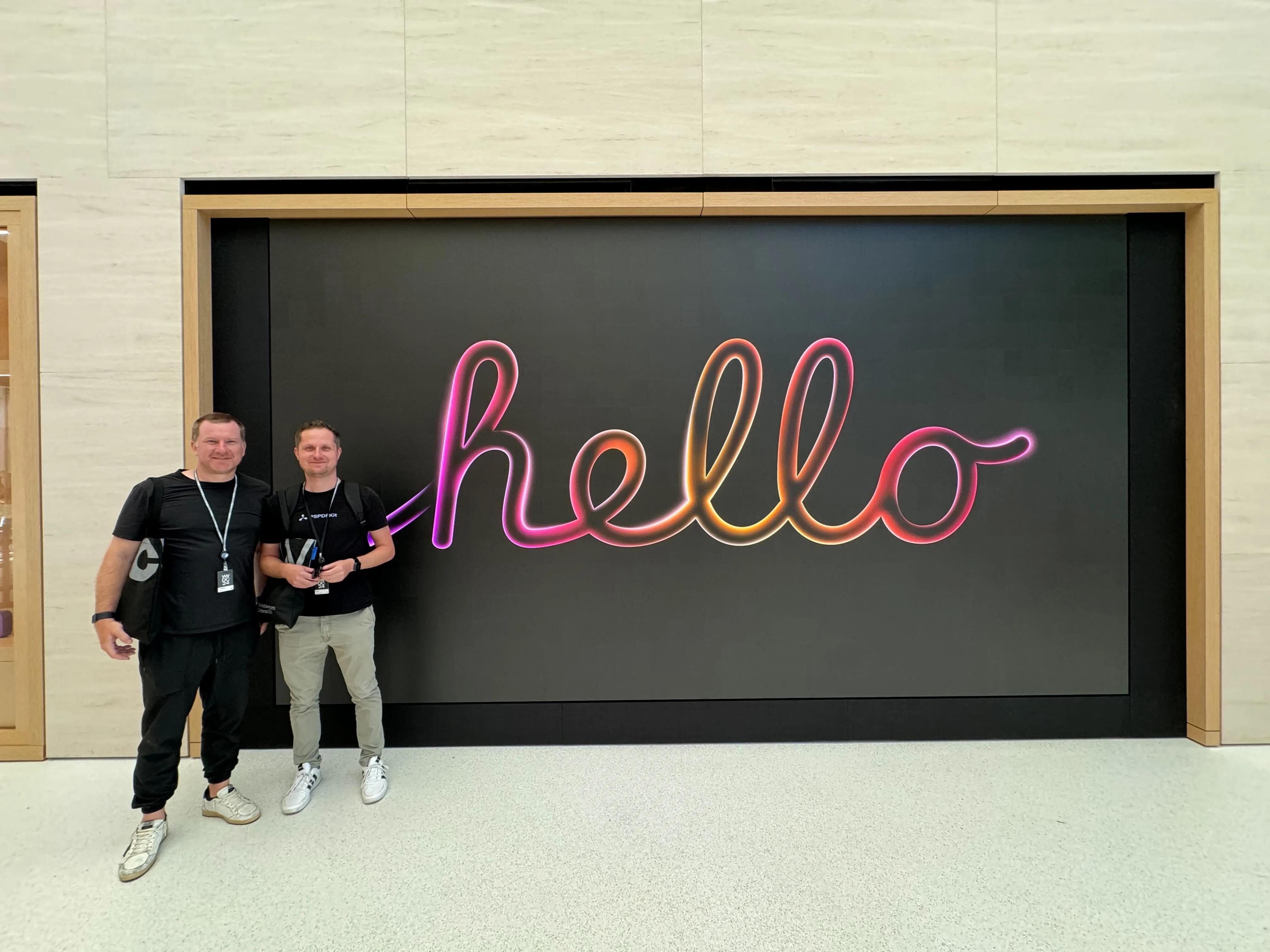
Matej and Jonathan at 1 Infinite Loop

Personal context from Apple ecosystem gives Apple Intelligence differentiation

Personal context is a key differentiator because it leverages Apple’s massive ecosystem. One of the most annoying things with current GenAI tools is having to prompt all the information you want it to contextualize when giving you an answer.

Effective now, Apple Intelligence will already have access to that information and therefore, in theory, be able to give you a better answer than other tools. Privacy solves the feeling that you’re being watched, collected, and used as training data for the AI overlords. These are two huge improvements over current offerings, so long as the results are actually still useful.

Why Apple is partnering with OpenAI

So why announce the partnership with OpenAI? While Apple has made it clear it’ll be anonymizing data to make sure OpenAI can’t track its users, OpenAI clearly isn’t giving access to third-party auditors to validate what it’s actually doing with the data, like Apple promised is the case with Private Cloud Compute(opens in a new tab).

This is a situation similar to when Apple had Google Maps on early iPhones. The company knows that ChatGPT is the cutting-edge market leader for generative AI, and it wants to offer that option to its users.

I also think it’s an admission that Apple is still in the early building of its own AI models, and I wouldn’t be surprised to see Apple remove ChatGPT completely or demote it to any other third-party AI tool integration.

Either way, it’s great to see Apple enter the AI space, and I hope the company continues to build out on the foundations of privacy and personal context.