


惯性聚合 高效追踪和阅读你感兴趣的博客、新闻、科技资讯
阅读原文 在惯性聚合中打开

推荐订阅源

B
Blog RSS Feed
Spread Privacy
Spread Privacy
T
Threatpost
C
Cisco Blogs
P
Palo Alto Networks Blog
AI
AI
Cyberwarzone
Cyberwarzone
NISL@THU
NISL@THU
P
Privacy & Cybersecurity Law Blog
G
GRAHAM CLULEY
Simon Willison's Weblog
T
Tor Project blog
Latest news
Latest news
AWS News Blog
AWS News Blog
D
Docker
S
SegmentFault 最新的问题
博客园 - 聂微东
WordPress大学
WordPress大学
Vercel News
Vercel News
S
Securelist
爱范儿
爱范儿
J
Java Code Geeks
Know Your Adversary
Know Your Adversary
S
Schneier on Security
Hugging Face - Blog
Hugging Face - Blog
F
Fortinet All Blogs
Last Week in AI
Last Week in AI
D
DataBreaches.Net
宝玉的分享
宝玉的分享
D
Darknet – Hacking Tools, Hacker News & Cyber Security
MongoDB | Blog
MongoDB | Blog
Engineering at Meta
Engineering at Meta
K
Kaspersky official blog
美团技术团队
博客园 - 叶小钗
阮一峰的网络日志
阮一峰的网络日志
量子位
博客园_首页
Attack and Defense Labs
S
Secure Thoughts
Google Online Security Blog
Application and Cybersecurity Blog
Threat Intelligence Blog | Flashpoint
腾讯CDC
T
Threat Research - Cisco Blogs
雷峰网
雷峰网
有赞技术团队
有赞技术团队
www.infosecurity-magazine.com
P
Privacy International News Feed
S
Security Affairs

Let's Encrypt

The difficulty of making sure your website is broken Simplifying Certificate Renewals for Millions of Domains with ACME Renewal Information (ARI) Six-Day and IP Address Certificates Available in Certbot Shorter Certificate Lifetimes and Rate Limits DNS-PERSIST-01: A New Model for DNS-based Challenge Validation On the Importance of "Hello" and "Thanks" 6-day and IP Address Certificates are Generally Available 10 Years of Let's Encrypt Certificates Decreasing Certificate Lifetimes to 45 Days New "Generation Y" Hierarchy of Root and Intermediate Certificates Ten Years of Community Support ACME Renewal Information (ARI) Published as RFC 9773 Native ACME Support Comes to NGINX End of Life Plan for RFC 6962 Certificate Transparency Logs OCSP Service Has Reached End of Life We've Issued Our First IP Address Certificate Expiration Notification Service Has Ended Reflections on a Year of Sunlight How We Reduced the Impact of Zombie Clients Sustaining a More Secure Internet: The Power of Recurring Donations Ending TLS Client Authentication Certificate Support in 2026 How Pebble Supports ACME Client Developers Ten Years of Let's Encrypt: Announcing support from Jeff Atwood We Issued Our First Six Day Cert Encryption for Everybody Scaling Our Rate Limits to Prepare for a Billion Active Certificates Ending Support for Expiration Notification Emails Announcing Six Day and IP Address Certificate Options in 2025 Announcing Certificate Profile Selection Ending OCSP Support in 2025 Intent to End OCSP Service More Memory Safety for Let’s Encrypt: Deploying ntpd-rs Let’s Encrypt Continues Partnership with Princeton to Bolster Internet Security Takeaways from Tailscale’s Adoption of ARI An Engineer’s Guide to Integrating ARI into Existing ACME Clients Deploying Let's Encrypt's New Issuance Chains New Intermediate Certificates Introducing Sunlight, a CT implementation built for scalability, ease of operation, and reduced cost A Year-End Letter from our Vice President Our role in supporting the nonprofit ecosystem Increase your security governance with CAA ISRG’s 10th Anniversary Improving Resiliency and Reliability for Let’s Encrypt with ARI Thank you to our 2023 renewing sponsors A Look into the Engineering Culture at ISRG Let’s Encrypt improves how we manage OCSP responses A New Life for Certificate Revocation Lists Nurturing Continued Growth of Our Oak CT Log TLS Beyond the Web: How MongoDB Uses Let’s Encrypt for Database-to-Application Security Let’s Encrypt Receives the Levchin Prize for Real-World Cryptography New Major Funding from the Ford Foundation TLS Simply and Automatically for Europe’s Largest Cloud Customers Making the Web safer and more secure for everyone Resources for Certificate Chaining Help Speed at scale: Let’s Encrypt serving Shopify’s 4.5 million domains Preparing to Issue 200 Million Certificates in 24 Hours The Next Gen Database Servers Powering Let's Encrypt A Year-End Letter from the Executive Director of Let's Encrypt and ISRG Extending Android Device Compatibility for Let's Encrypt Certificates Standing on Our Own Two Feet [Updated] Let's Encrypt's New Root and Intermediate Certificates Let's Encrypt Has Issued a Billion Certificates Multi-Perspective Validation Improves Domain Validation Security How Let's Encrypt Runs CT Logs Onboarding Your Customers with Let's Encrypt and ACME Introducing Oak, a Free and Open Certificate Transparency Log Transitioning to ISRG's Root The ACME Protocol is an IETF Standard Facebook Expands Support for Let’s Encrypt Looking Forward to 2019 Let's Encrypt Root Trusted By All Major Root Programs Engineering deep dive: Encoding of SCTs in certificates Looking Forward to 2018 ACME Support in Apache HTTP Server Project Wildcard Certificates Coming January 2018 Milestone: 100 Million Certificates Issued ACME v2 API Endpoint Coming January 2018 OVH Renews Platinum Sponsorship of Let's Encrypt Let’s Encrypt 2016 In Review Launching Our Crowdfunding Campaign Our First Grant: The Ford Foundation Squarespace OCSP Stapling Implementation Introducing Internationalized Domain Name (IDN) Support ISRG Legal Transparency Report, January 2016 - June 2016 What It Costs to Run Let's Encrypt Let's Encrypt Root to be Trusted by Mozilla Full Support for IPv6 Defending Our Brand [Updated] Progress Towards 100% HTTPS, June 2016 Leaving Beta, New Sponsors ISRG Legal Transparency Report, July 2015 - December 2015 New Name, New Home for the Let's Encrypt Client Software Our Millionth Certificate OVH Sponsors Let's Encrypt Entering Public Beta Facebook Sponsors Let's Encrypt Public Beta: December 3, 2015 Why ninety-day lifetimes for certificates? The CA's Role in Fighting Phishing and Malware Let's Encrypt is Trusted
Shortening the Let's Encrypt Chain of Trust
2023-07-10 · via Let's Encrypt

By Aaron Gable ·

When Let’s Encrypt first launched, we needed to ensure that our certificates were widely trusted. To that end, we arranged to have our intermediate certificates cross-signed by IdenTrust’s DST Root CA X3. This meant that all certificates issued by those intermediates would be trusted, even while our own ISRG Root X1 wasn’t yet. During subsequent years, our Root X1 became widely trusted on its own. 

Come late 2021, our cross-signed intermediates and DST Root CA X3 itself were expiring. And while all up-to-date browsers at that time trusted our root, over a third of Android devices were still running old versions of the OS which would suddenly stop trusting websites using our certificates. That breakage would have been too widespread, so we arranged for a new cross-sign – this time directly onto our root rather than our intermediates – which would outlive DST Root CA X3 itself. This stopgap allowed those old Android devices to continue trusting our certificates for three more years.

On September 30th, 2024, that cross-sign too will expire.

In the last three years, the percentage of Android devices which trust our ISRG Root X1 has risen from 66% to 93.9%. That percentage will increase further over the next year, especially as Android releases version 14, which has the ability to update its trust store without a full OS update. In addition, dropping the cross-sign will reduce the number of certificate bytes sent in a TLS handshake by over 40%. Finally, it will significantly reduce our operating costs, allowing us to focus our funding on continuing to improve your privacy and security.

For these reasons, we will not be getting a new cross-sign to extend compatibility any further.

The transition will roll out as follows:

  • On Thursday, Feb 8th, 2024, we stopped providing the cross-sign by default in requests made to our /acme/certificate API endpoint. For most Subscribers, this means that your ACME client will configure a chain which terminates at ISRG Root X1, and your webserver will begin providing this shorter chain in all TLS handshakes. The longer chain, terminating at the soon-to-expire cross-sign, will still be available as an alternate chain which you can configure your client to request.

  • On Thursday, June 6th, 2024, we will stop providing the longer cross-signed chain entirely. This is just over 90 days (the lifetime of one certificate) before the cross-sign expires, and we need to make sure subscribers have had at least one full issuance cycle to migrate off of the cross-signed chain.

  • On Monday, September 30th, 2024, the cross-signed certificate will expire. This should be a non-event for most people, as any client breakages should have occurred over the preceding six months.
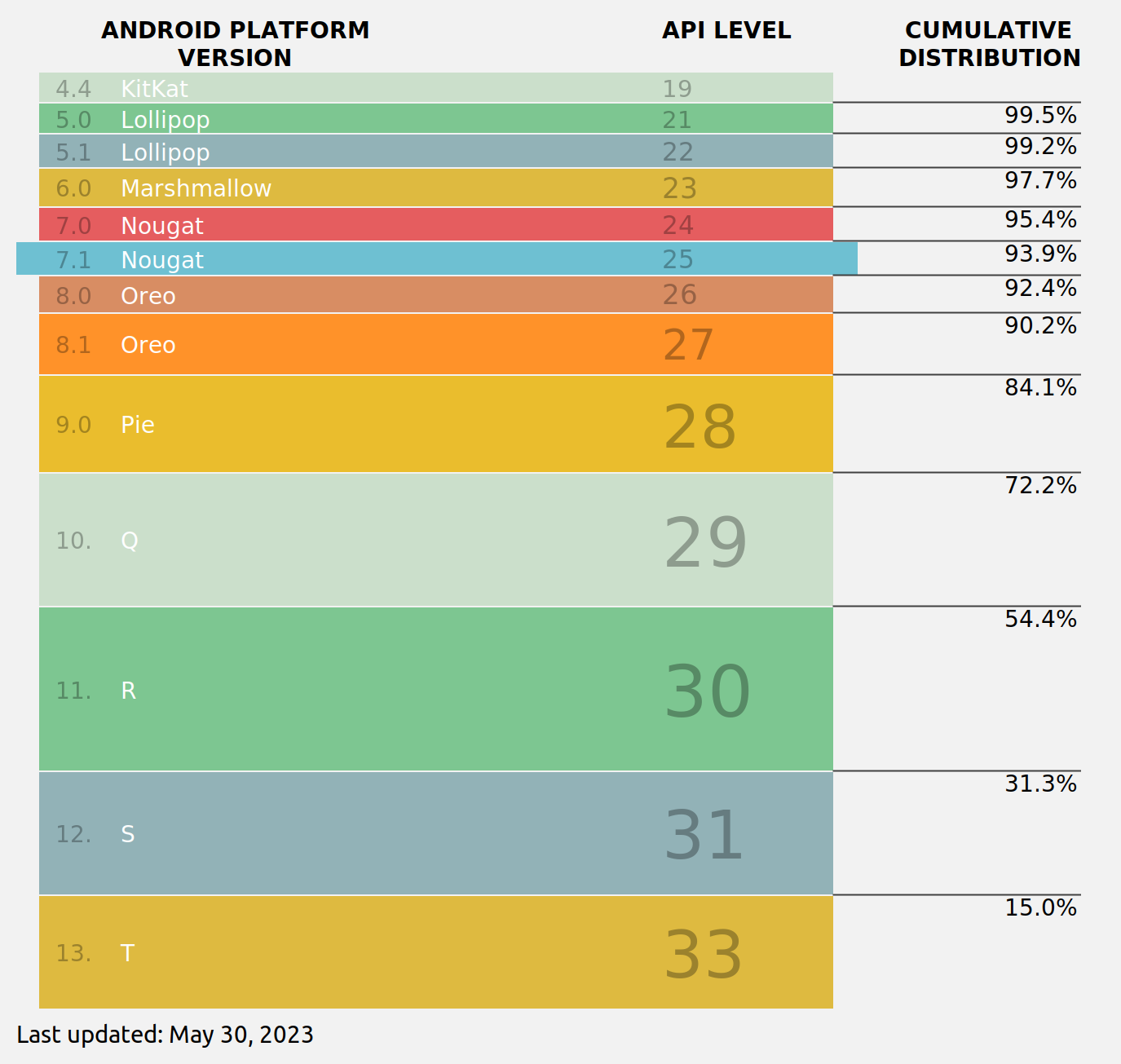
Infographic of the distribution of installed Android versions, showing that 93.9% of the population is running Android 7.1 or above.

If you use Android 7.0 or earlier, you may need to take action to ensure you can still access websites secured by Let’s Encrypt certificates. We recommend installing and using Firefox Mobile, which uses its own trust store instead of the Android OS trust store, and therefore trusts ISRG Root X1.

If you are a site operator, you should keep an eye on your website usage statistics and active user-agent strings during Q2 and Q3 of 2024. If you see a sudden drop in visits from Android, it is likely because you have a significant population of users on Android 7.0 or earlier. We encourage you to provide the same advice to them as we provided above.

If you are an ACME client author, please make sure that your client correctly downloads and installs the certificate chain provided by our API during every certificate issuance, including renewals. Failure modes we have seen in the past include a) never downloading the chain at all and only serving the end-entity certificate; b) never downloading the chain and instead serving a hard-coded chain; and c) only downloading the chain at first issuance and not re-downloading during renewals. Please ensure that your client does not fall into any of these buckets.

We appreciate your understanding and support, both now and in the years to come as we provide safe and secure communication to everyone who uses the web. If you have any questions about this transition or any of the other work we do, please ask on our community forum.

We’d like to thank IdenTrust for their years of partnership. They played an important role in helping Let’s Encrypt get to where we are today and their willingness to arrange a stopgap cross sign in 2021 demonstrated a true commitment to creating a secure Web. 

We depend on contributions from our supporters in order to provide our services. If your company or organization can help our work by becoming a sponsor of Let’s Encrypt please email us at sponsor@letsencrypt.org. We ask that you make an individual contribution if it is within your means.