







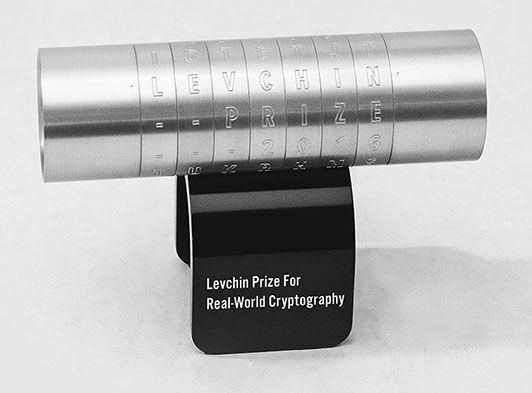
On April 13, 2022, the Real World Crypto steering committee presented the Max Levchin Prize for Real-World Cryptography to Let’s Encrypt. The following is the speech delivered by our Executive Director, Josh Aas, upon receiving the award. We’d like to thank our community for supporting us and invite you to join us in making the Internet more secure and privacy-respecting for everyone.
Thank you to the Real World Crypto steering committee and to Max Levchin for this recognition. I couldn’t be more proud of what our team has accomplished since we started working on Let’s Encrypt back in 2013.
My first temptation is to name some names, but there are so many people who have given a significant portion of their lives to this work over the years that the list would be too long. You know who you are. I hope you’re as proud as I am at this moment.
Let’s Encrypt is currently used by more than 280 million websites, issuing between two and three million certificates per day. I often think about how we got here, looking for some nugget of wisdom that might be useful to others. I’m not sure I’ve really come up with anything particularly profound, but I’m going to give you my thoughts anyway. Generally speaking: we started with a pretty good idea, built a strong team, stayed focused on what’s important, and kept ease of use in mind every step of the way.
Let’s Encrypt ultimately came from a group of people thinking about a pretty daunting challenge. The billions of people living increasingly large portions of their lives online deserved better privacy and security, but in order to do that we needed to convince hundreds of millions of websites to switch to HTTPS. Not only did we want them to make that change, we wanted most of them to make the change within the next three to five years.
We thought through a lot of options but in the end we just didn’t see any other way than to build what became Let’s Encrypt. In hindsight building Let’s Encrypt seems like it was a good and rewarding idea, but at the time it was a frustrating conclusion in many ways. It’s not an easy solution to commit to. It meant standing up a new organization, hiring at least a dozen people, understanding a lot of details about how to operate a CA, building some fairly intense technical systems, and setting all of it up to operate for decades. Many of us wanted to work on this interesting problem for a bit, solve it or at least put a big dent in it, and then move on to other interesting problems. I don’t know about you, but I certainly didn’t dream about building and operating a CA when I was younger.
It needed to be done though, so we got to work. We built a great team that initially consisted of mostly volunteers and very few staff. Over time that ratio reversed itself such that most people working on Let’s Encrypt on a daily basis are staff, but we’re fortunate to continue to have a vibrant community of volunteers who do work ranging from translating our website and providing assistance on our community forums, to maintaining the dozens (maybe hundreds?) of client software options out there.
Today there are just 11 engineers working on Let’s Encrypt, as well as a small team handling fundraising, communication, and administrative tasks. That’s not a lot of people for an organization serving hundreds of millions of websites in every country on the globe, subject to a fairly intense set of industry rules, audits, and high expectations for security and reliability. The team is preparing to serve as many as 1 billion websites. When that day comes to pass the team will be larger, but probably not much larger. Efficiency is important to us, for a couple of reasons. The first is principle - we believe it’s our obligation to do the most good we can with every dollar entrusted to us. The second reason is necessity - it’s not easy to raise money, and we need to do our best to accomplish our mission with what’s available to us.
It probably doesn’t come as a surprise to anyone here at Real World Crypto that ease of use was critical to any success we’ve had in applying cryptography more widely. Let’s Encrypt has a fair amount of internal complexity, but we expose users to as little of that as possible. Ideally it’s a fully automated and forgettable background task even to the people running servers.
The fact that Let’s Encrypt is free is a huge factor in ease of use. It isn’t even about how much money people might be willing or able to pay, but any financial transaction requirement would make it impossible to fully automate our service. At some point someone would have to get a credit card and manage payment information. That task ranges in complexity from finding your wallet to obtaining corporate approval. The existence of a payment in any amount would also greatly limit our geographic availability because of sanctions and financial logistics.
All of these factors led to the decision to form ISRG, a nonprofit entity to support Let’s Encrypt. Our ability to provide this global, reliable service is all thanks to the people and companies who believe in TLS everywhere and have supported us financially. I’m so grateful to all of our contributors for helping us.
Our service is pretty easy to use under normal circumstances, but we’re not done yet. We can be better about handling exceptional circumstances such as large revocation events. Resiliency is good. Automated, smooth resiliency is even better. That’s why I’m so excited about the ACME Renewal Info work we’re doing in the IETF now, which will go into production over the next year.
Everyone here has heard it before, but I’ll say it again because we can’t afford to let it slip our minds. Ease of use is critical for widespread adoption of real world cryptography. As we look toward the future of ISRG, our new projects will have ease of use at their core. In fact, you can learn about our newest project related to privacy-preserving measurement at two of this afternoon’s sessions! Getting ease of use right is not just about the software though. It’s a sort of pas de trois, a dance for three, between software, legal, and finance, in order to achieve a great outcome.
Thank you again. This recognition means so much to us.
此内容由惯性聚合(RSS阅读器)自动聚合整理,仅供阅读参考。 原文来自 — 版权归原作者所有。