





惯性聚合 高效追踪和阅读你感兴趣的博客、新闻、科技资讯
阅读原文 在惯性聚合中打开

推荐订阅源

L
LINUX DO - 最新话题
cs.CV updates on arXiv.org
PCI Perspectives
PCI Perspectives
cs.AI updates on arXiv.org
K
KPMG report finds enterprise disconnect between AI and its ROI | CIO
H
Heimdal Security Blog
S
Security @ Cisco Blogs
N
News | PayPal Newsroom
J
Java Code Geeks
罗磊的独立博客
Security Archives - TechRepublic
N
News and Events Feed by Topic
V
V2EX
WordPress大学
WordPress大学
Google Online Security Blog
N
News and Events Feed by Topic
www.infosecurity-magazine.com
月光博客
月光博客
AI
AI
小众软件
小众软件
The GitHub Blog
The GitHub Blog
MongoDB | Blog
MongoDB | Blog
A
Arctic Wolf
CTFtime.org: upcoming CTF events
美团技术团队
Threat Intelligence Blog | Flashpoint
Exploit-DB.com RSS Feed
Hacker News - Newest:
Hacker News - Newest: "LLM"
T
Tailwind CSS Blog
S
Schneier on Security
博客园 - 三生石上(FineUI控件)
F
Full Disclosure
B
Blog RSS Feed
Forbes - Security
Forbes - Security
S
SegmentFault 最新的问题
钛媒体:引领未来商业与生活新知
钛媒体:引领未来商业与生活新知
人人都是产品经理
人人都是产品经理
云风的 BLOG
云风的 BLOG
Jina AI
Jina AI
Cisco Talos Blog
Cisco Talos Blog
U
Unit 42
Project Zero
Project Zero
H
Hacker News: Front Page
Y
Y Combinator Blog
Application and Cybersecurity Blog
The Cloudflare Blog
大猫的无限游戏
大猫的无限游戏
S
Secure Thoughts
The Hacker News
The Hacker News
Microsoft Azure Blog

Let's Encrypt

The difficulty of making sure your website is broken Simplifying Certificate Renewals for Millions of Domains with ACME Renewal Information (ARI) Six-Day and IP Address Certificates Available in Certbot Shorter Certificate Lifetimes and Rate Limits DNS-PERSIST-01: A New Model for DNS-based Challenge Validation On the Importance of "Hello" and "Thanks" 6-day and IP Address Certificates are Generally Available 10 Years of Let's Encrypt Certificates Decreasing Certificate Lifetimes to 45 Days Ten Years of Community Support ACME Renewal Information (ARI) Published as RFC 9773 Native ACME Support Comes to NGINX End of Life Plan for RFC 6962 Certificate Transparency Logs OCSP Service Has Reached End of Life We've Issued Our First IP Address Certificate Expiration Notification Service Has Ended Reflections on a Year of Sunlight How We Reduced the Impact of Zombie Clients Sustaining a More Secure Internet: The Power of Recurring Donations Ending TLS Client Authentication Certificate Support in 2026 How Pebble Supports ACME Client Developers Ten Years of Let's Encrypt: Announcing support from Jeff Atwood We Issued Our First Six Day Cert Encryption for Everybody Scaling Our Rate Limits to Prepare for a Billion Active Certificates Ending Support for Expiration Notification Emails Announcing Six Day and IP Address Certificate Options in 2025 Announcing Certificate Profile Selection Ending OCSP Support in 2025 Intent to End OCSP Service More Memory Safety for Let’s Encrypt: Deploying ntpd-rs Let’s Encrypt Continues Partnership with Princeton to Bolster Internet Security Takeaways from Tailscale’s Adoption of ARI An Engineer’s Guide to Integrating ARI into Existing ACME Clients Deploying Let's Encrypt's New Issuance Chains New Intermediate Certificates Introducing Sunlight, a CT implementation built for scalability, ease of operation, and reduced cost A Year-End Letter from our Vice President Our role in supporting the nonprofit ecosystem Increase your security governance with CAA Shortening the Let's Encrypt Chain of Trust ISRG’s 10th Anniversary Improving Resiliency and Reliability for Let’s Encrypt with ARI Thank you to our 2023 renewing sponsors A Look into the Engineering Culture at ISRG Let’s Encrypt improves how we manage OCSP responses A New Life for Certificate Revocation Lists Nurturing Continued Growth of Our Oak CT Log TLS Beyond the Web: How MongoDB Uses Let’s Encrypt for Database-to-Application Security Let’s Encrypt Receives the Levchin Prize for Real-World Cryptography New Major Funding from the Ford Foundation TLS Simply and Automatically for Europe’s Largest Cloud Customers Making the Web safer and more secure for everyone Resources for Certificate Chaining Help Speed at scale: Let’s Encrypt serving Shopify’s 4.5 million domains Preparing to Issue 200 Million Certificates in 24 Hours The Next Gen Database Servers Powering Let's Encrypt A Year-End Letter from the Executive Director of Let's Encrypt and ISRG Extending Android Device Compatibility for Let's Encrypt Certificates Standing on Our Own Two Feet [Updated] Let's Encrypt's New Root and Intermediate Certificates Let's Encrypt Has Issued a Billion Certificates Multi-Perspective Validation Improves Domain Validation Security How Let's Encrypt Runs CT Logs Onboarding Your Customers with Let's Encrypt and ACME Introducing Oak, a Free and Open Certificate Transparency Log Transitioning to ISRG's Root The ACME Protocol is an IETF Standard Facebook Expands Support for Let’s Encrypt Looking Forward to 2019 Let's Encrypt Root Trusted By All Major Root Programs Engineering deep dive: Encoding of SCTs in certificates Looking Forward to 2018 ACME Support in Apache HTTP Server Project Wildcard Certificates Coming January 2018 Milestone: 100 Million Certificates Issued ACME v2 API Endpoint Coming January 2018 OVH Renews Platinum Sponsorship of Let's Encrypt Let’s Encrypt 2016 In Review Launching Our Crowdfunding Campaign Our First Grant: The Ford Foundation Squarespace OCSP Stapling Implementation Introducing Internationalized Domain Name (IDN) Support ISRG Legal Transparency Report, January 2016 - June 2016 What It Costs to Run Let's Encrypt Let's Encrypt Root to be Trusted by Mozilla Full Support for IPv6 Defending Our Brand [Updated] Progress Towards 100% HTTPS, June 2016 Leaving Beta, New Sponsors ISRG Legal Transparency Report, July 2015 - December 2015 New Name, New Home for the Let's Encrypt Client Software Our Millionth Certificate OVH Sponsors Let's Encrypt Entering Public Beta Facebook Sponsors Let's Encrypt Public Beta: December 3, 2015 Why ninety-day lifetimes for certificates? The CA's Role in Fighting Phishing and Malware Let's Encrypt is Trusted
New "Generation Y" Hierarchy of Root and Intermediate Certificates
2025-11-24 · via Let's Encrypt

By Aaron Gable ·

In a ceremony held in September, Let’s Encrypt generated two new Root Certification Authorities (CAs) and six new Intermediate CAs, which we’re collectively calling the “Generation Y” hierarchy. Now we’re moving to begin issuing certificates from this new hierarchy, and to submit it to various root programs for inclusion in their trust stores.
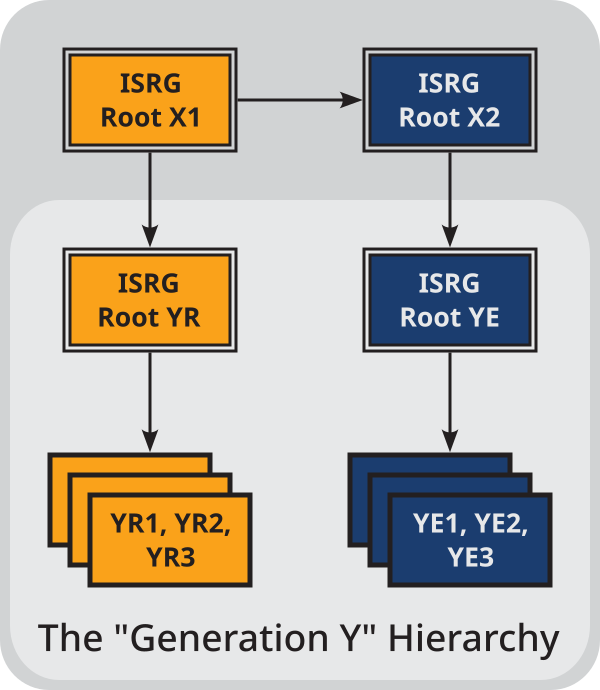
Diagram of the new Generation Y Root and Intermediate CAs

The two new roots look very similar to our existing roots. The new ISRG Root YR has an RSA 4096 key and is valid for twenty years, just like ISRG Root X1. Similarly, the new ISRG Root YE has an ECDSA P-384 key, just like ISRG Root X2. We’ve made a few adjustments (for example, replacing “Internet Security Research Group” with “ISRG” to save a few bytes), but nothing major. Each of these new roots is intended to eventually replace its corresponding predecessor, and to that end we have cross-signed the new roots from the old ones.

The six new intermediates consist of three intermediates each issued from each of the two new roots. ISRG Root YE has issued the YE1, YE2, and YE3 intermediates, while ISRG Root YR has issued the YR1, YR2, and YR3 intermediates. These have two key differences from our current crop of issuing intermediates. First, their names: we’re now numbering intermediates under each root sequentially, rather than using the same numbering sequence across all intermediates. This makes it slightly easier to keep track of which intermediates are currently in use, and prepares for a possible post-quantum future where we have additional key types.

Second and more importantly: these intermediates do not contain the “TLS Web Client Authentication” Extended Key Usage. This means that these intermediates cannot issue end-entity certificates containing that EKU. As we’ve already announced, we will be phasing out issuance of tlsClientAuth certificates in 2026 due to a root program requirement. Until that time, we will only be using the new hierarchy to issue certificates under the “tlsserver” and “shortlived” profiles, which already omit that EKU. After the tlsClientAuth deprecation is complete, we will shift to using the new intermediates for all issuance.

If you’re requesting the tlsserver or shortlived profile, you can expect to see issuance from (the Staging equivalent of) the new hierarchy as of today. We expect to make the same change in our Production environment next month. As before, each issuance will choose which intermediate to use at random, to discourage intermediate key pinning.

We’ll be submitting the new roots for inclusion in the Apple, Chrome, Microsoft, Mozilla, and other root programs shortly thereafter. We look forward to updating you again when the new hierarchy is officially included in those trust stores!