


There's only a handful of people in the county who can tell you what time high tide is at without checking their phone. But any oyster farmer can tell you - the tides dictate what time they start work at.
When local newspaper the Waterford News & Star went to Ann Rinn at Dungarvan Bay, the 14 employees started at six that morning. By 2pm, they had all left the premises. Next week, they'll start at 7am and finish at 3. At low tide, 'the lads' head out into the bay, which is covered in the farm's 60 hectares of Oyster baskets. It's a race against time to collect the ones ready to be harvested before the tide comes in, transforming a swamp-like view into a Mediterranean-looking vista.
One day, though, when the lads went out to collect that day's harvest, they found most of the oysters were dead. This has happened three times in the last seven years and no one can explain why. If it happens again, the entire industry and way of life may disappear.
Clíona Mhic Giolla Chuda Sales, Marketing and General Manager of Waterford Oysters told the government committee on Fisheries and Maritime affairs that her company has lost more than €9m worth of stock over the past two summers, when over 70% of oysters on their farm were found dead.
The Waterford News & Star headed out to Waterford Oysters in An Rinn to find out more.
Oyster industry in An Rinn
Operating since the 1980s, oyster farming is a vital part of the An Rinn economy, employing around 100 people and trading with important markets such as China and France.
The idea was first put forward in the 1980s as a way to stimulate the economy in the Gaeltacht region and provide employment for young men who at that time were emigrating in droves.
"There was nothing else for them here," Michael, the co-owner of the business, explained.
Now, the area has three large oyster farms as well as several one-person farms operating in the bay.
Dungarvan Bay, in particular, is ideal for oyster farming because the tide goes in and out at a slow rate, making it easier to access the oysters.
‘Working the bags’, as Clíona put it, is beneficial because it allows the oysters to have a deeper shell. Time spent out of water also strengthens them, meaning they can survive for longer periods out of the water – ideal for international shipping.
Now, this entire industry is under threat.
“Mortality event”
There were mass oyster "mortality events" in Dungarvan Bay in 2019, 2024 and 2025. Clíona explained how unusual the situation is: “We would have known that to happen the odd time before that, but you’d be talking about every 10 or 15 years, there’d be something wrong for some reason. But nothing like three years out of seven.”
Oysters take three years to grow, so losing 70% of their stock in 2024 means they still haven’t recovered from the loss.
The mortality event happened at the same time over the past two years, in the first two weeks of August. Other than the timing, there is no apparent similarities between one year and the other. No weather event or human activity that repeated at the same time that could have caused it.
“We’re not taking holidays this year,” Clíona explained, as usually the premise closes for two weeks in August to give everyone a break. This year, they’re keeping a close eye on the bay.
It wasn’t just the oysters that suffered over the past two Augusts. Anecdotal evidence from local fishermen and sea swimmers suggests that shrimp and crabs washed up dead on the shore and were found already dead in fishing nets at the time.
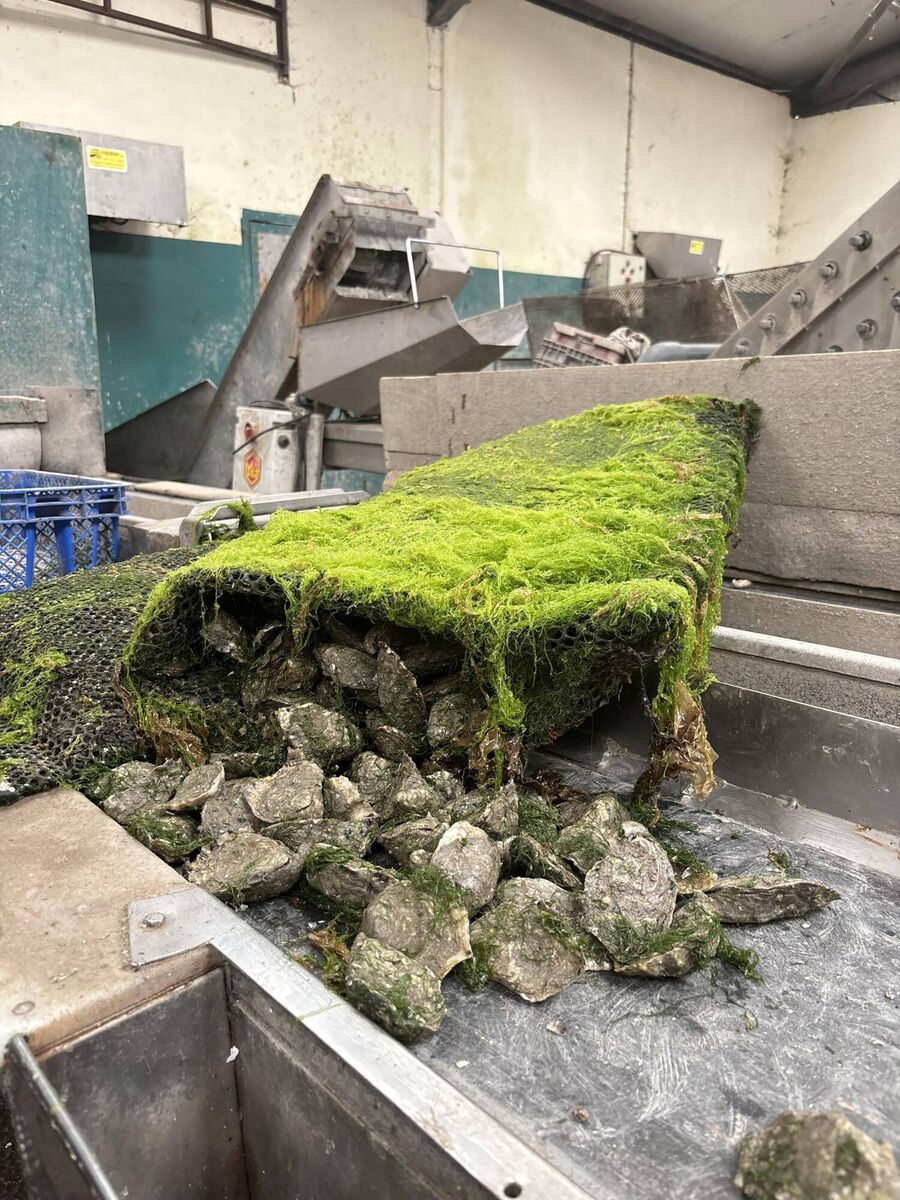
A type of seaweed called 'Ulva', grows on the outside of the baskets of oysters. During the last two mortality events, all of the Ulva were found dead too.
Clíona and Micheal explained that the same reasons why Dungarvan Bay is so good for oysters is also why they’re particularly susceptible to pollution. Because the tide comes in so slowly, if a pollutant is introduced into the bay at low tide, it could sit among the oysters for hours before being diluted by the sea.
No causes identified
Despite extensive testing carried out by BIM (Bord Iascaigh Mhara) and Waterford City and County Council, it remains unclear why these oysters perished and whether this will happen again this year.
Clíona explained that while things like salinity and temperature of the water can be readily measured, ‘pollution’ is a broad term and there is no single test that can be carried out to see if a pollutant is present in the water.
In 2019, 60% of the fully grown stock died and Clíona pointed out that "other bays in the county and in the country were not at all affected”. Although the definitive cause has not been identified, Clíona strongly suspects it is linked to pollution. She said: “Oyster in a bay are a species that are very sensitive to pollution and in a sense they act as the canary in the coalmine with regards to the health of the ecosystem and the environment in the bay."
She continued: “Our product depends on clean waters and a sound ecosystem for them to thrive.”
Clíona also explained the importance of oysters to the health of bodies of water. She said: “Oysters are a product with a very low carbon footprint and in fact, oysters are deployed in bays around the world in order to help clean up polluted waters."
This summer, “a comprehensive suite of testing” will be carried out to try and solve the mystery.
Clíona said they are engaging with the public and are asking them to report anything unusual in the water.
They’ve also asked local fishermen to be on the lookout for algal blooms or “anything noteworthy.” She concluded: “All eyes will be on Dungarvan bay for the next ten weeks or so to see if we have a repeat of the losses again this year. Please God we won’t.”
License issues
Even without freak mortality events, breaking into the oyster farming industry is incredibly difficult with many smaller farms being absorbed by bigger ones. One reason for this is around licensing.
All oyster farmers must have a license in order to operate but obtaining a license is a difficult process.
Clíona explained: “When you get a license, you don’t own the ground in the bay, you just have permission to use it.” At the committee meeting, it was revealed that just 18 licenses were issued since January 2025 and there are more than five hundred applications waiting to be processed.
Clíóna said it can take up to four years to get a license.
“It's really difficult to encourage young people to get into this industry when you have such a log jam.”
This has implications for the bay. Recent research and projects have shown that oysters have a profoundly positive effect on biodiversity. If the oysters were to leave the bay, migrating birds, crabs and fish would leave with them.
When the interview wrapped up, a silver fish leaps in the water. "Probably bass," Clíona says.
Working here for 30 years means she knows pretty much every species in the area.
此内容由惯性聚合(RSS阅读器)自动聚合整理,仅供阅读参考。 原文来自 — 版权归原作者所有。