



In the last post, I wrote about the hacker mindset—the habit of unseeing the superficial levels of a system so you can get to know the underlying details and learn to manipulate the world in more flexible ways. One example, which I borrowed from Gwern, was how people who do speed runs of video games will study the underlying hardware so they can exploit bugs that let them walk through walls to reach the final level.
In the comments, Thu wondered what I have unseen to get better at writing. I found it very fun to meditate on. I haven’t explicitly set out to “see through” the game that is writing, but when I look back at how I thought about it fifteen years ago compared to today, it is clear that my understanding of writing, both as a craft and as a career, is much more high resolution and technical now and much less stuck in the conventional narratives that I took as truth when I was younger.
The part where I’ve most explicitly applied the hacker mindset has been in relation to the systems that make it possible to turn creativity into a career—how you can finance your creative work and how you can find an audience and peers and mentors who help you develop. So let me start there.
I also have some thoughts on how you can use a hacker mindset to get better at the craft itself, which I’ll get to at the end.
The conventional way to think about a career as a writer, at least in the aughts when I got started, was that you write a book, get it accepted by a publisher, and then… somehow you get money so you can pay rent. I followed this path until I was 25: I edited a magazine, worked in theaters, and toured as a poet.
But then, prompted by my now wife Johanna, I started to think about it more like a hacker. If you take a literary career and break it apart, like a machine, what is it made of?
There is text getting written.
There is money flowing in, so you can pay the bills while writing.
There are readers and peers that create some sort of social context for the writing, which helps you feel like what you do has meaning, and so that you can grow from the feedback from others.
There are a bunch of other things, too, but this is essentially it: writing, funding, social context.
And once Johanna prompted me to take it apart like that, we realized there are easier, better, more fun, and faster ways to access those three things than doing it the conventional route.
If you go through a publisher, you will, in most cases, not earn enough to live off your writing, and on top of that you will have to make a bunch of trade-offs to satisfy your editor. There will be meetings and emails and expectations—all taking time from the writing. And there will be subtle (or not so subtle) pressures to make your work more commercial and less personally satisfying in order to pay for the overhead of editors and designers, marketing people, and accountants.
If you get a decent-paying part-time job, you can, in most cases, afford to write more than if you have a publisher, and you don’t have to make any compromises. This, in turn, means you can write work that is much more attractive to your type of people, so you can, with some work, assemble a more fun audience than you would if you had a publisher. You get more of everything.
You could see a writing career as a flow diagram. Here is Claude drawing it for me:
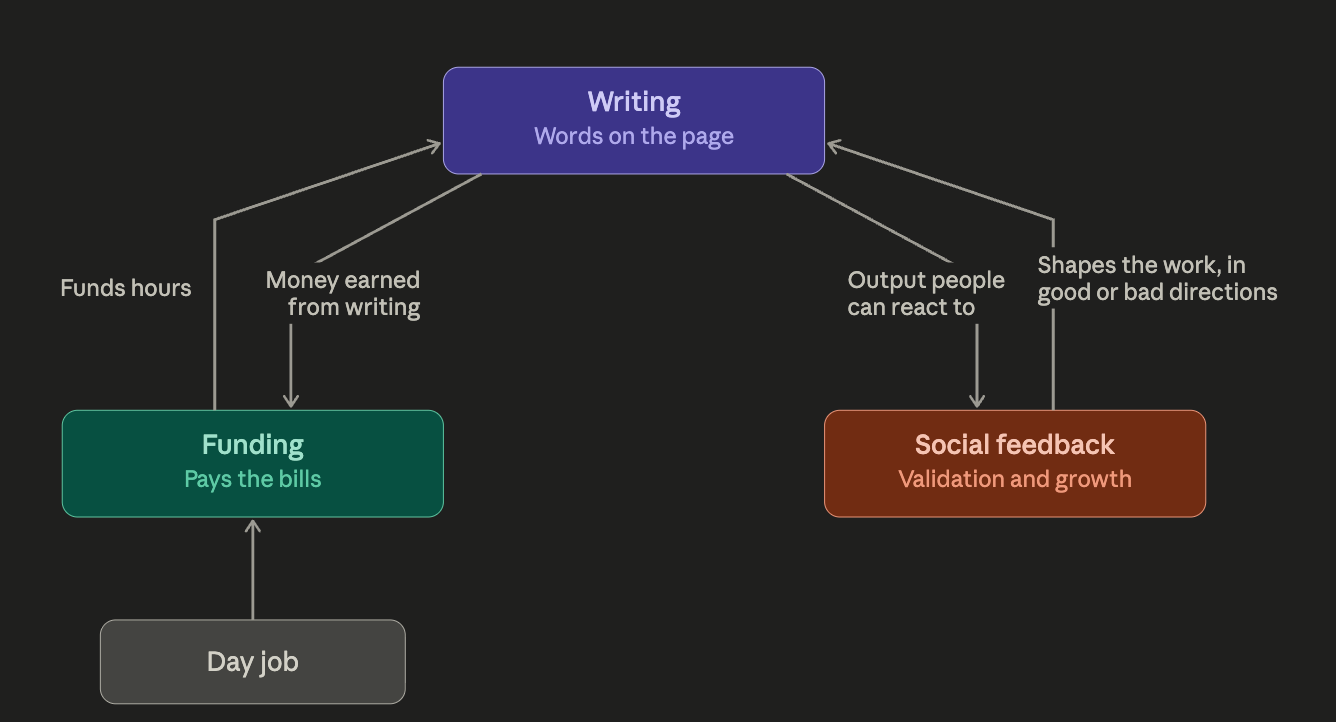
You have the core activity, which is putting words on the page.
And then you have a flow of money, which is necessary to pay the bills and fund the hours you need to write. This flow of money can come from the writing itself, or from somewhere else—whatever allows you to write more.
And then there is a second flow, which is social feedback—people admiring your work, peers and mentors and editors giving you advice and input. This flow of information changes the work, for better or worse. If the audience or the expectations are misaligned, you can get audience captured and produce bad work. But if the flow is good, you can get into this lovely flywheel where the input you get from others helps you improve your writing, which drives in even more and better input, which again improves the writing, and so on. This is called creating a scene.
In the average, normal writing career of a published author, these flows are not great. There isn’t that much money flowing in, so you can’t afford to write as much as you want, and the feedback that arrives from the audience and your editors isn’t improving your work as rapidly as it could. Also, everything moves very slowly.
But if you think hard about these flows, separately, and tweak them one after the other, I’m pretty sure you can find ways to improve your current machinery, step by step. You can fund more hours of writing (for example by becoming a freelance software engineer, so you can charge a lot per hour, and cutting back on your living expenses), and you can shape your writing so that it attracts the audience and mentors you need to grow in the direction that feels most exciting to you. After enough tweaks like this, you will have a very good machinery, fitted to your needs.
此内容由惯性聚合(RSS阅读器)自动聚合整理,仅供阅读参考。 原文来自 — 版权归原作者所有。