








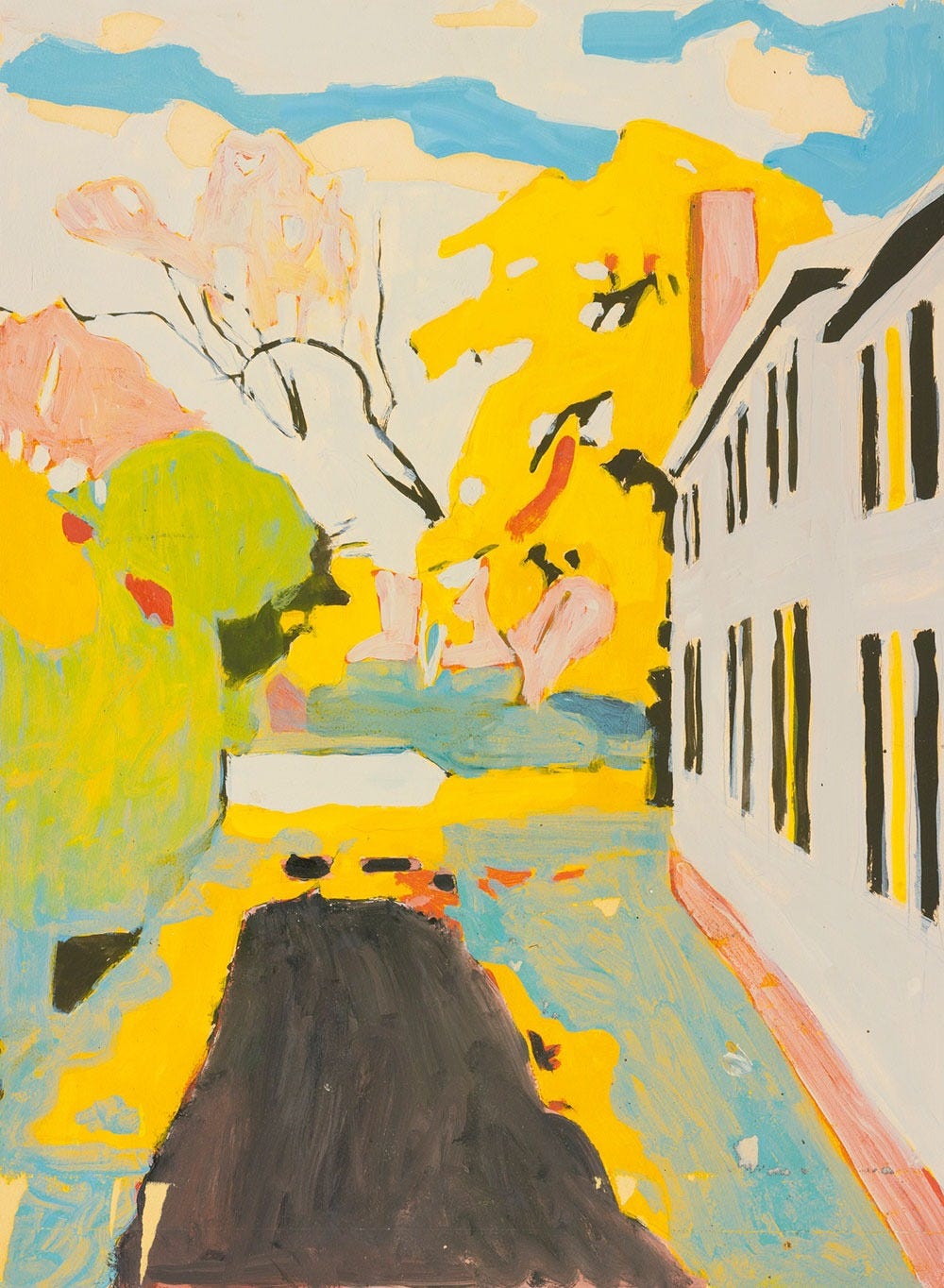
The Driveway, Fairfield Porter, c. 1967
It was on November 20, 2024, that I handed in my keys at the art gallery where I had worked and began writing full time. It has now been a year. Let me reflect on how it’s been.
But first, since this is a sort of yearly review, here are the ten most read essays this year:
Almost anything you give sustained attention to will begin to loop on itself
When facing a complicated problem, don’t try to solve it, try to understand it
The paradox is that when I accept myself just as I am, I change
A list of books and essays that I love (this was paywalled when I published it, but I’ve unlocked it now)
Also, for those who are new here, these are the ten most popular pre-2025 essays on Escaping Flatland:
Everything that turned out well in my life followed the same design process
Almost everyone I’ve met would be well-served thinking more about what to focus on
The main thing I remember, looking back, is how tired I was for the first three months after I quit my job. All through December, January, and February, I felt wrung out, empty, and sad. This came as a bit of a surprise to me. I had expected to be filled with energy now that I had reached my goal and finally had plenty of time to work on my projects.
What I had failed to acknowledge to myself was just how hard Johanna and I had been working for the preceding five years, and how much rest I owed my body. It had been four years since we decided to leave Sweden and start a new life; we had had our second kid and renovated a farm house, while homeschooling, working, and writing this blog (often at 5 in the morning before work, or late at night while the kids slept). Johanna and I were committed to what we were doing. We wanted to provide a good childhood for our kids and we wanted to pursue projects we found worthwhile; we didn’t want to sacrifice the wrong thing. But this also meant we had so much to do, and so little time and money, that we couldn’t afford to waste time complaining. We couldn’t acknowledge how tired we were. We just had to brace ourselves and do the work.
I remember us discussing how we might be able to postpone the major repairs on the house until 2024, to save money so that I could afford to keep writing the blog a little longer. I remember we had a deadline when I would have to give up my writing if I couldn’t find a way to fund it properly. The only option under those circumstances was to be frugal, stoical, work hard, do all short-term renovations ourselves, and spend all my spare time writing. And when the deadline came we were “so close” to making it that we kept postponing until it ended up being … four years of working every day without a vacation. I managed to find time to see a grand total of three films in 1642 days.
“But was it really four years?” Johanna says. She runs the numbers. “I can’t believe we lived like that for four years.”
Then, once I could afford to quit my day job and the pressure let up, all of my suppressed tiredness and pain welled up. I remember sitting at the kitchen table in January, joking about the time when the house rained in and we had no money to fix it. How I would have to run out in the middle of the night and try to secure the tarpaulin that had been caught in the storm, waving violently, and how I would curse the wind. How we woke up one morning with the balcony door blown wide open and a tongue of water reaching into the room. Johanna told the kids the story about a day three years prior when I had an interview for a job that would pay enough that we might be able to pay for the repairs and hold on to the farm. Johanna and I spent all day practicing what I would say, and then, just before I had to leave for the interview, I stepped in a pot with the baby’s pee, spraying it all over me, ruining my only good pair of clothes. So much for that job! So much for us affording a new roof! As we laughed, the 8-year-old reached out and squeezed my hand. I stopped laughing and felt the tears well up in my eyes.
There was so much tiredness and frustration and pain that I had not allowed myself to feel and express, and I spent much of last winter having it ooze out of me.
Thinking back, a frustrating thing about living in an unconventional way was that we felt like we weren’t allowed to complain about our problems. Maybe this is a Swedish thing. But if you break the script and then run into problems, people (not all people, but many) take it as proof that you were wrong and they were right. My family and several of my friends, for instance, disagreed with our decision to homeschool our kids (homeschooling is frowned upon and illegal in Sweden, so we had to emigrate). Homeschooling in a country where you don’t have any family to rely on for support, and where you don’t speak the language, is, quite obviously, exhausting. But given how much they had disapproved, I didn’t feel comfortable showing this. Only once did I let my guard down and mentioned to a friend how tired I was and how strained our economic situation was. He suggested we put the kids in kindergarten. I just wanted someone to feel some sympathy; I didn’t need solutions—we had one already. I didn’t share our struggles again.
Another time, when my parents visited, I went up at 5 am to write and then fell asleep on the floor while we ate lunch. While I lay there, they told Johanna about one of their friends who had waited until the kids moved away from home before he indulged his writing hobby, as a piece of advice. Maybe we read too much into all such small things, but we didn’t feel we could be open with our challenges.
When people make unconventional decisions, it often feels like they are measured to another standard than those who follow the default script. If you do the normal thing and it fails you, then it isn’t your fault; it’s the system. But if you do an unconventional thing, even small, normal setbacks are read as proof of your foolishness. When a normal solution isn’t working, no one suggests you are wrongheaded for not trying an unconventional solution instead. But they will hold you accountable if you do something differently.
If I had been more confident and open with what I thought and felt, I suspect that I could have received more sympathy and support. But, as I said, the pressure was so high in 2021-24 that I simply couldn’t. I didn’t have the emotional reserves necessary. We had to get the work done. So I packed my frustration and sadness and pain deep into my bones and worked more or less every waking hour (when I wasn’t taking care of the kids) until we got out of the hole. As did Johanna.
I’m happy we held together and made the necessary sacrifices, because our plans were sound, and we love the life we’ve now made for our kids and ourselves. But in 2025, I didn’t want any more sacrifices. I wanted time to decompress. I wanted to read books, be with Johanna and the kids, and go for long runs, which I did.
Fortunately, it wasn’t only pain that seeped up when the pressure was removed. 3-4 months after I quit my job, we also started to experience a happiness deeper than any we have experienced before. With more time, Johanna and I settled into a very lovely work rhythm where we spend several hours a day reading books together and talking. We’ve had so much fun writing the blog this year. It has felt less like “trying to write essays” and more like tending our conversation and harvesting thoughts. The process has been more open and playful than ever, like I’m putting fewer restrictions on what I feel I can write about. Because of this, the writing has felt more personal and strange than before, and we feel like we’ve been able to go deeper into the ideas.
Writing full time has also meant that there are fewer distractions, so the ideas are always churning in our heads. It’s like we’re living inside the essays now, instead of just visiting them.
Right now, as I’m typing this, Johanna is lying at the other end of the sofa with a pile of books on her belly, taking notes; the four-year-old is looking through Don Rosa’s Uncle Scrooge collections, and the eight-year-old is drawing horses.
Johanna waves her pencil at me, trying to get my attention, and seems to be bursting with things she wants to discuss. I tell her I’m just about to wrap this up so I can give it to her for comments, and then I’ll put the kids to sleep, so we can talk uninterrupted. “What time is it?” she says. “Oh. They should have been in bed 30 minutes ago.”
I’m very grateful to be alive in a time like this where it is possible to do something like this blog and support my family with it. Getting to this point was hard at times, yes. But five years ago, before Substack, these essays could not have been written at all. So thank you, thank you so much for being here, and in particular, thank you to everyone who has been generous enough to support the work.
Here is last year’s retrospective:
Thank you, Esha, for your help copy editing the essays this year :)