


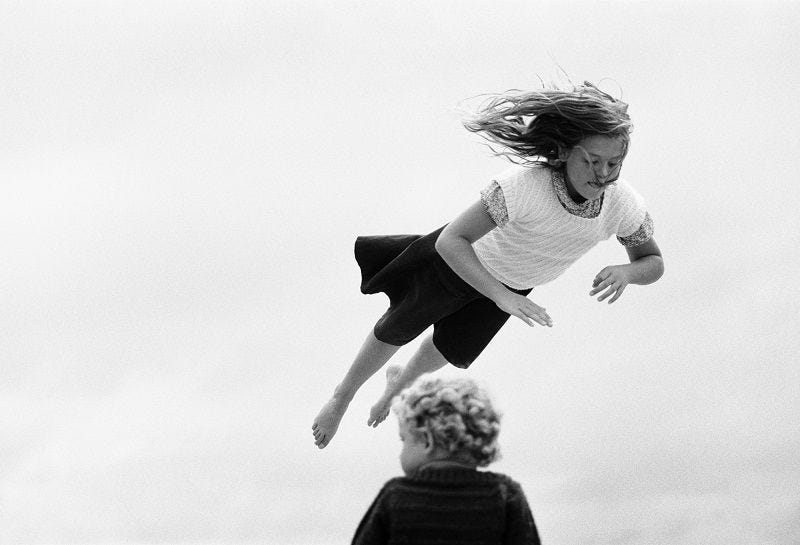
Cousin Bichonnade in Flight, Jacques Henri Lartigue, 1905

The second Monday in March, I flew to Copenhagen to record a podcast with my friend Jackson Dahl. It’s now online, and you can watch/listen on YouTube, Spotify, Apple Podcasts, X, or Substack, and find full transcript and links here.
Meeting people like Jackson has been very important to me. I grew up in the Swedish countryside, and, as you might know, live on an island in the Baltic Sea. Actually, I live on such a remote corner of the island that the locals call it the Wild West. Everyone who “wants to get ahead in life” moves away from here as soon as they can (and a worrying share of the other passengers on the flight to Copenhagen were sick people on their way to the larger hospital on the mainland: three ambulances waited on the tarmac when we climbed the stairs from the plane). It’s not a world where people feel the possibilities are particularly vast.
But walking along Copenhagen’s canals with Jackson, the world feels very big. And welcoming. I think of one of Venkatesh Rao’s posts from 2014 called “Don’t Surround Yourself with Smart People”: what you need, Rao says, is people who are differently free, people who are free in ways that you are not, and who can therefore point out things you’re blind to, other games you could play. That’s what it’s felt like to meet Jackson (and others like him—I’ve been quite lucky in that regard).
The first time Jackson interviewed me, ten months ago, he was on vacation in Copenhagen with his family and had managed to get hold of an overheated office space where we sat with two microphones and sweated. Since then the podcast has become his job, and when I arrived at the house where we were to record—an old mill that, in the early 1900s, was converted into a home by an eccentric engineer—Jackson and a technician were standing among piles of cameras, lights, and cables.
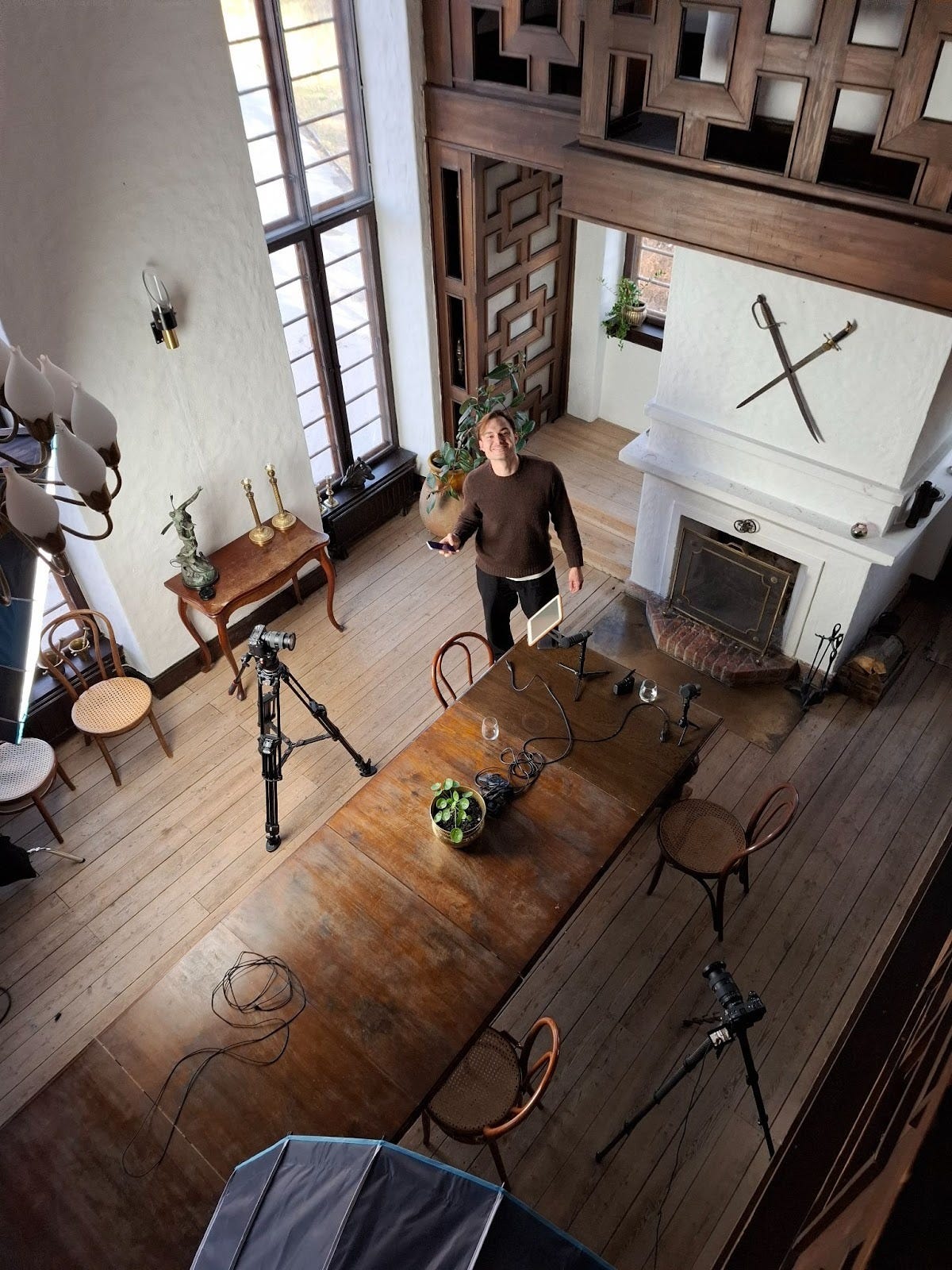
During the just under three hours we spent recording, we talked about the value of lingering in confusion, using constraints to enable more creative work, how I journal, why love is like eating dogs, and many other things. I won’t attempt to summarize it. But in case you don’t feel like listening to the whole thing, let me cut and paste one thread that felt very alive to me, which was me grappling with what I believe in.
For context, before getting to the part about beliefs, I first want to quote a passage where Jackson asked me about my maternal grandfather, Nils, who was my first, and most important, role model.
(I’ve edited what follows for brevity.)
Jackson: You wrote about your maternal grandfather, Nils, who passed away last summer:
Life is not a story that builds to a climax; it is a story that meanders. Every single moment in life is as worthy of care and attention as the climax of a story.
What I grieved wasn’t Nils’s worn-out body finally giving up. That felt good, actually; it was a relief for him. What I grieved was all the moments that were gone.
Even more, I grieved all of the moments he had been alive to himself, all of the moments that no one else will ever remember. The feeling of sun on his skin. The long nights in the snowplow, clearing the roads through the pine forests.
The feeling, if any, of his last night when Maud the Elder held his hand and he seemed for a moment to slide out of his dementia sleep and smile. It was the goneness of all of those moments that hurt.
Are there any other moments that come to mind that you would like the world to know about Nils?
Henrik: He was a very special man and meant a lot to me. He retired as a road worker when he was 60, which was the same year I was born. So he spent a lot of time caring for me when my mom started working again. He would take me camping. He was a very down-to-earth kind of person.
There is one beautiful story that says a lot about how he was.
When he was four years old, he and his siblings would get one sugar cube on Saturdays and put it over the fire to make caramel. He did that, and it slid down his throat so he couldn’t breathe. But he was so sensitive that he didn’t want to disturb anyone.
He just went around hugging his mom, his dad, and his seven siblings. Then he went out and lay down in the meadow and prepared to die. Then the sugar melted and slid down.
He wasn’t the most talkative person, but he was extremely determined to do well and to help people. Even during COVID, when he was 92 and basically not holding together anymore, he would still take his walker and walk 500 meters down to the house where the elderly people were in quarantine.
He would go from window to window, sit on his walker, and talk to them. He would always try to find some way that he could be of use.
When I met Johanna, we bought my grandparents’s house, and they moved to a senior apartment next door.
That was a special experience. For the three years we lived there (until, sadly, we had to leave Sweden to homeschool our daughter), Nils was the closest friend I had. I spent more time with him than any other friend between the ages of 25 and 28.
Toward the very end, he couldn’t speak and was completely lost and had to move to the retirement home himself. I don’t think he recognized almost anyone. But he still had that instinct to care.
One of the nurses told us there was another elderly woman in a wheelchair who was having a panic attack; she was acting out and throwing stuff. Nils saw that and, although he couldn’t speak or do anything, he just got up and moved slowly across the room and took her hand. He just sat there for two hours holding her hand; he could feel that his presence made her calm.
He never cared at all about himself and was never self-centered in any way whatsoever. When he died, he instructed that he didn’t want a grave. He wanted to be put in the communal grave without a plaque.
Maybe my atheism comes from him. He didn’t believe in a life after this. He just believed in being of service, being of use, and disappearing into the night. He formed me in so many ways.
In another part of the conversation, where I mentioned that God wasn’t a concept that was alive to me (apart from in the Spinozan sense that God is the totality of reality), Jackson asked what I do believe in.
I had never actually tried to articulate it, so I might change my mind if I think more about it. But this is the answer that arrived when I tried to feel into the question:
Henrik: I believe that we all have something we can contribute.
The universe itself is so extraordinary, with quantum particles, black holes, and evolution. We get to come here and explore and take part in this unfolding creation, and that is remarkable and big in itself. On top of that, because of the accident of your genetics and the place you were born, there are going to be certain things that will only be possible through you.
There will be certain things that only you will be in a position to care for. For some reason, it feels imperative to me that you should protect and be a guardian of that possibility and make sure that you leave the universe a better place.
You should strive to be a force toward higher complexity. When you leave the planet, the fight against entropy should have been won a little bit. Civilization should be a little more coherent.
We should have better theories of the world, richer relationships, more diversity, and more perspectives. It would be super boring if the universe were just rocks floating in dead space because that wouldn’t have as much complexity as biological evolution. I want to be a force for increasing complexity.
Jackson: Is it fulfilled potential? Is that too simple?
Henrik: That’s a good way of defining it down. But what is of primary importance isn’t what I feel. I am not all that important in myself. Of course I value myself because I have to live in my body.
But what matters more to me is this continual unfolding that my ancestors were part of. How can I play a part in this ongoing evolutionary dance?
We’re in this big jam session. How do I make sure that when I leave the stage, the music is still going?
Jackson: The music was going on. It kept going.
Henrik: Hopefully, it is going in an even better direction than when you entered because people around you have grown and are playing more interesting stuff in reaction to what you did.
Jackson is a wonderful interviewer. I think you will enjoy the full episode (and the one we did last year). I also recommend the one he did with Cyan Banister—that was a special one.