

惯性聚合 高效追踪和阅读你感兴趣的博客、新闻、科技资讯
阅读原文 在惯性聚合中打开

推荐订阅源

L
LINUX DO - 最新话题
A
Arctic Wolf
I
Intezer
V
Vulnerabilities – Threatpost
C
Cisco Blogs
MyScale Blog
MyScale Blog
NISL@THU
NISL@THU
Y
Y Combinator Blog
C
CERT Recently Published Vulnerability Notes
P
Privacy International News Feed
H
Hackread – Cybersecurity News, Data Breaches, AI and More
酷 壳 – CoolShell
酷 壳 – CoolShell
Recorded Future
Recorded Future
云风的 BLOG
云风的 BLOG
S
SegmentFault 最新的问题
Microsoft Security Blog
L
LangChain Blog
博客园 - 聂微东
博客园 - 叶小钗
F
Fortinet All Blogs
钛媒体:引领未来商业与生活新知
钛媒体:引领未来商业与生活新知
Recent Announcements
C
Cyber Attacks, Cyber Crime and Cyber Security
Latest news
Latest news
Simon Willison's Weblog
P
Palo Alto Networks Blog
S
Schneier on Security
C
Cybersecurity and Infrastructure Security Agency CISA
V
V2EX
freeCodeCamp Programming Tutorials: Python, JavaScript, Git & More
The Hacker News
The Hacker News
博客园 - 司徒正美
Threat Intelligence Blog | Flashpoint
L
LINUX DO - 热门话题
罗磊的独立博客
K
Kaspersky official blog
Last Week in AI
Last Week in AI
Know Your Adversary
Know Your Adversary
小众软件
小众软件
Stack Overflow Blog
Stack Overflow Blog
T
Threat Research - Cisco Blogs
D
DataBreaches.Net
Scott Helme
Scott Helme
P
Proofpoint News Feed
P
Privacy & Cybersecurity Law Blog
P
Proofpoint News Feed
博客园 - 三生石上(FineUI控件)
Hugging Face - Blog
Hugging Face - Blog
OSCHINA 社区最新新闻
OSCHINA 社区最新新闻
F
Full Disclosure

Maggie Appleton

The Dark Forest and Generative AI One Developer, Two Dozen Agents, Zero Alignment Gas Town’s Agent Patterns, Design Bottlenecks, and Vibecoding at Scale January 2026 | Maggie Appleton A Treatise on AI Chatbots Undermining the Enlightenment A Brief History & Ethos of the Digital Garden Vibe Code is Legacy Code May 2025 | Maggie Appleton Home-Cooked Software and Barefoot Developers Statistically, When Will My Baby Be Born? Speculative Calendar Events ChatGPT Would be a Decent Policy Advisor March 2025 | Maggie Appleton The Expanding Dark Forest and Generative AI Humanity's Last Exam Squish Meets Structure Common Misconceptions in AI Undetected AI Exam Answers Unbaited Smidgeons Growing a Human: The First 30 Weeks How to Import Academic Papers from Zotero into Tana December 2024 | Maggie Appleton Aesthetic Command Lines with Hyper, Spaceship, and Oh My Zsh Leaving Elicit July 2024 | Maggie Appleton A Short History of Bi-Directional Links The Pattern Language of Project Xanadu Assumed Audiences Ambient Co-presence On Opening Essays, Conference Talks, and Jam Jars Spinning Worlds, Seasickness, and Dealing with Vestibular Neuritis A Collection of Design Engineers Gathering Structures Daily Notes Pages Historical Trails December 2023 | Maggie Appleton September 2023 | Maggie Appleton Digital Gardening for Non-Technical Folks Language Model Sketchbook, or Why I Hate Chatbots June 2023 | Maggie Appleton Computational Notebooks Folk Interfaces Reverse Outlining with Language Models Command K Bars Spatial Web Browsing A Picture Worth a Thousand Programmes Programmable Notes Programming Portals Teenage Skeuomorphic Desktop Designs Growing the Evergreens Why You Own an iPad and Still Can't Draw A Brief Introduction to Digital Anthropology Transclusion and Transcopyright Dreams The Block-Paved Path to Structured Data Empty Pointers and Constellations of AI Metaphors We Web By The Gift Economy Epistemic Disclosure November 2022 | Maggie Appleton Joining Ought July 2022 | Maggie Appleton The Linear Oppression of Note-taking Apps Paleolithic Nostalgia Interoperable Personal Libraries and Ad Hoc Reading Groups The Finest Narrative Non-Fiction Essays Algorithmic Transparency October 2021 | Maggie Appleton Plebeian Programming with Keyboard Maestro The Cultural Anthropology of React August 2021 | Maggie Appleton Natureculture, Moral Purity, and Cultural Boundaries The Echo & Narcissus Writing Club Pink, Soft, Glittering Developers Fetishism & Mechanical Keyboards Making Programming Visual, Spatial, and Learnable Organic, Local, Artisan Data Storage Positioning Elements & Scrollytelling in CSS Painting Roam Research with Custom CSS A Digital Anthropology Reading List The Eponymous Laws of Programming A History of Cyborgs Neologisms GreenSock Animations with React Hooks The Bare Essentials of Greensock September 2020 | Maggie Appleton Illustrating Gatsby's Key Concepts Problematic Proteins New Harvest & Illustrating the Cultivated Meat Podcast Synecdoche: Drawing the Part for the Whole A Meta-Tour of This Site Douglas, Dirt, and Matter Out of Place The Knowledge Hydrant A Naïve Exploration of Computer-Supported Collaborative Learning Silent Synchronous Reading Sessions What the Fork is React Suspense? Visually Workshopping the AWS Cloud Are Data Unions the Future of Data? Pattern Languages in Programming and Interface Design A Metaphorical Reading Collection
What the Fork is Rust?
2020-01-10 · via Maggie Appleton

The Rust programming language keeps winning the middle-school popularity contest of the developer world: “most loved” on Stack Overflow surveys.

Chart showing rust at the top of the rankings for most loved languages with 83.5%

So, what’s this Rust thing and why is everyone enamoured?
Let’s explore…

An Introduction to Rust

Rust is a programming language mainly used to build 'system software.' Which means any software that acts as a platform for other software to run on top of it. iOS, linux, and windows are all system software. Rust is also becoming popular for making web apps. We can compile rust files into web assembly, which lets us run them in the browser.

The power of rust is that it balances speed and safety. Safety here means memory safety. Mishandling how we store data on physical microchips can lead to bugs and security flaws. High-level languages are abstract and safer. Low-level languages work directly with memory, making them dangerous but fast. Rust lives in the happy middle ground

This happy balance Rust manages to strike – between speed, control over memory, and human-friendliness is what makes it so popular.

The kind of programmes you can write with Rust would otherwise be made in a language like C or C++. A lot of developers find the C-suite challenging to work with, so this friendly alternative is very welcome!

It’s got the Goldilocks Effect going on. Not too slow, not too dangerous, not too complicated – just right.

The Rust community is also infamous for being welcoming, open, and encouaging to newcomers. Fostering that kind of culture is very likely why it’s gained so much traction in the last few years.

Anyone who hangs out in Developer World long enough realises frameworks and languages are identities much more than they’re tools. You belong to Team React, or Camp Python, or the Rust Crew.

And no one wants to join a bunch of judgey gatekeepers.
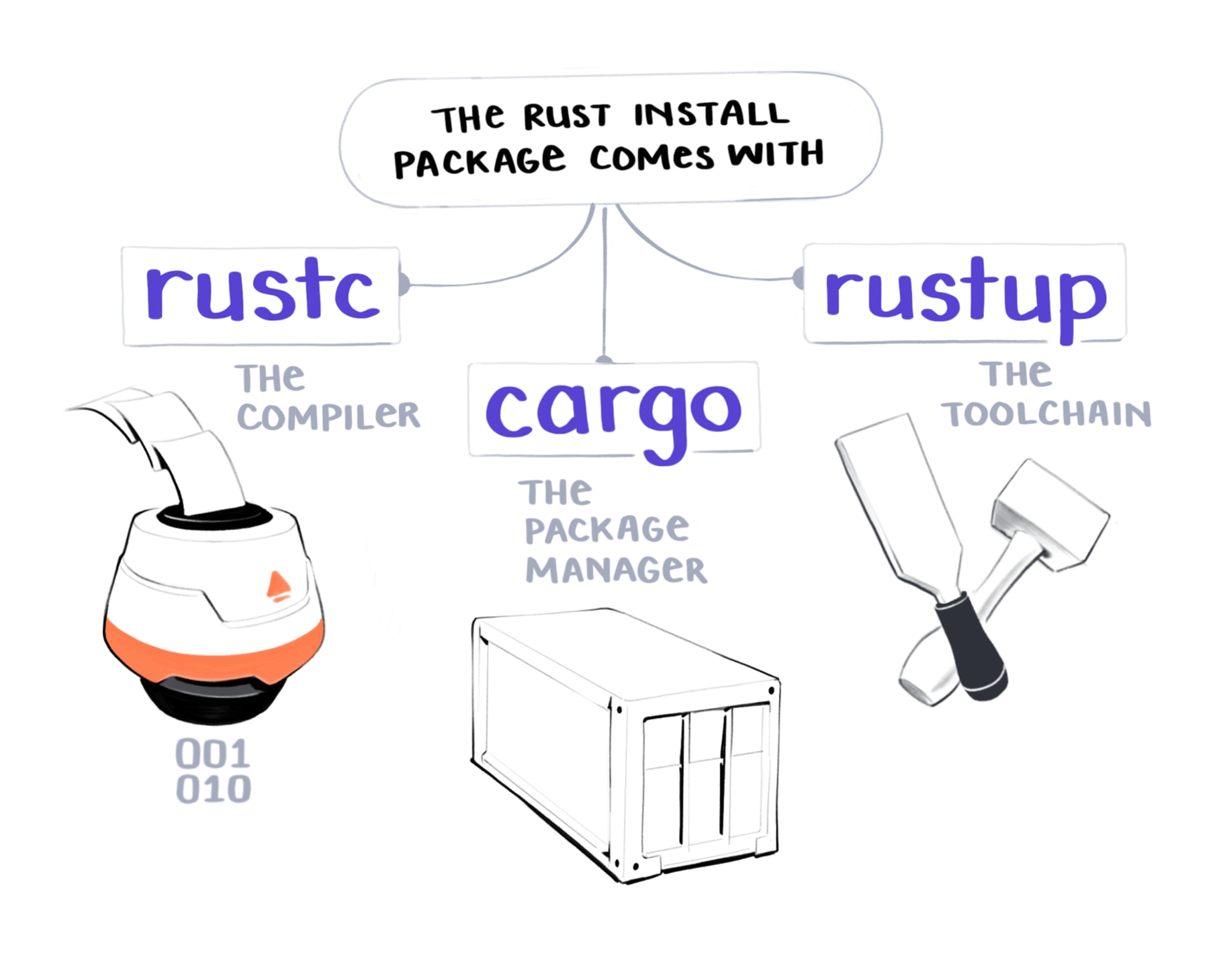
The rust install package comes with 'rustc' - the compiler, 'cargo' - the package manager, and 'rustup' - the toolchain

Rust is statically typed. This means the data type of every variable must be known at compile time. You can declare data types or let rust make an educated guess. Rust's compiler is strict. It won't let you mix data types.

Rust is obsessed with ownership. Every value belongs to a variable. Values are like pet hamsters, they need an owner. If LeBron owns this hamster, then we assign LeBron to Shaq, ownership move to Shaq. LeBron no longer owns the hamster.

I’ve just done a sweeping and completely incomplete overview of Rust here. But it’s enough to point you in the right direction. There’s plenty more to explore.

While researching and making these I watched Pascal Precht’s new egghead course that shows you how to

Write Your First Program with Rust

https://egghead.io/courses/write-your-first-program-with-the-rust-language

Pascal covers more specific details like how Rust handles variables, mutability, functions, pointers, borrowing, loops, and errors.

If you’re curious to start Rusting, worth taking a look.


Want more illustrated notes on web development?

Take a look at Building Custom React Hooks

Building Custom React Hooks

Illustrated notes on building custom React hooks , Fixing Common Git Mistakes

Fixing Common Git Mistakes

Illustrated notes on common mistakes people make in Git, and how to fix them
, or JavaScript Bits You Skipped the First Time Around

JavaScript Bits You Skipped the First Time Around

Illustrated notes on advanced but fundamental topics in JavaScript