



惯性聚合 高效追踪和阅读你感兴趣的博客、新闻、科技资讯
阅读原文 在惯性聚合中打开

推荐订阅源

S
Securelist
C
Cybersecurity and Infrastructure Security Agency CISA
cs.AI updates on arXiv.org
S
Security Affairs
Hacker News: Ask HN
Hacker News: Ask HN
L
Lohrmann on Cybersecurity
PCI Perspectives
PCI Perspectives
Threat Intelligence Blog | Flashpoint
C
Cyber Attacks, Cyber Crime and Cyber Security
Recent Commits to openclaw:main
OSCHINA 社区最新新闻
OSCHINA 社区最新新闻
MyScale Blog
MyScale Blog
月光博客
月光博客
W
WeLiveSecurity
T
Threat Research - Cisco Blogs
Martin Fowler
Martin Fowler
CTFtime.org: upcoming CTF events
Recorded Future
Recorded Future
The GitHub Blog
The GitHub Blog
Webroot Blog
Webroot Blog
Security Archives - TechRepublic
TaoSecurity Blog
TaoSecurity Blog
P
Proofpoint News Feed
Google DeepMind News
F
Full Disclosure
U
Unit 42
Jina AI
Jina AI
博客园 - 司徒正美
阮一峰的网络日志
阮一峰的网络日志
L
LINUX DO - 最新话题
宝玉的分享
宝玉的分享
大猫的无限游戏
大猫的无限游戏
The Hacker News
The Hacker News
The Last Watchdog
The Last Watchdog
T
Troy Hunt's Blog
腾讯CDC
T
Threatpost
H
Hacker News: Front Page
P
Palo Alto Networks Blog
博客园 - 聂微东
Last Week in AI
Last Week in AI
有赞技术团队
有赞技术团队
Help Net Security
Help Net Security
L
LINUX DO - 热门话题
N
News and Events Feed by Topic
人人都是产品经理
人人都是产品经理
让小产品的独立变现更简单 - ezindie.com
奇客Solidot–传递最新科技情报
奇客Solidot–传递最新科技情报
Application and Cybersecurity Blog
Spread Privacy
Spread Privacy

Maggie Appleton

The Dark Forest and Generative AI One Developer, Two Dozen Agents, Zero Alignment Gas Town’s Agent Patterns, Design Bottlenecks, and Vibecoding at Scale January 2026 | Maggie Appleton A Treatise on AI Chatbots Undermining the Enlightenment A Brief History & Ethos of the Digital Garden Vibe Code is Legacy Code May 2025 | Maggie Appleton Home-Cooked Software and Barefoot Developers Statistically, When Will My Baby Be Born? ChatGPT Would be a Decent Policy Advisor March 2025 | Maggie Appleton The Expanding Dark Forest and Generative AI Humanity's Last Exam Squish Meets Structure Common Misconceptions in AI Undetected AI Exam Answers Unbaited Smidgeons Growing a Human: The First 30 Weeks How to Import Academic Papers from Zotero into Tana December 2024 | Maggie Appleton Aesthetic Command Lines with Hyper, Spaceship, and Oh My Zsh Leaving Elicit July 2024 | Maggie Appleton A Short History of Bi-Directional Links The Pattern Language of Project Xanadu Assumed Audiences Ambient Co-presence On Opening Essays, Conference Talks, and Jam Jars Spinning Worlds, Seasickness, and Dealing with Vestibular Neuritis A Collection of Design Engineers Gathering Structures Daily Notes Pages Historical Trails December 2023 | Maggie Appleton September 2023 | Maggie Appleton Digital Gardening for Non-Technical Folks Language Model Sketchbook, or Why I Hate Chatbots June 2023 | Maggie Appleton Computational Notebooks Folk Interfaces Reverse Outlining with Language Models Command K Bars Spatial Web Browsing A Picture Worth a Thousand Programmes Programmable Notes Programming Portals Teenage Skeuomorphic Desktop Designs Tending Evergreen Notes in Roam Research Growing the Evergreens Why You Own an iPad and Still Can't Draw A Brief Introduction to Digital Anthropology Transclusion and Transcopyright Dreams The Block-Paved Path to Structured Data Empty Pointers and Constellations of AI Metaphors We Web By The Gift Economy Epistemic Disclosure November 2022 | Maggie Appleton Joining Ought July 2022 | Maggie Appleton The Linear Oppression of Note-taking Apps Paleolithic Nostalgia Interoperable Personal Libraries and Ad Hoc Reading Groups The Finest Narrative Non-Fiction Essays Algorithmic Transparency October 2021 | Maggie Appleton Plebeian Programming with Keyboard Maestro The Cultural Anthropology of React August 2021 | Maggie Appleton Natureculture, Moral Purity, and Cultural Boundaries The Echo & Narcissus Writing Club Pink, Soft, Glittering Developers Fetishism & Mechanical Keyboards Making Programming Visual, Spatial, and Learnable Organic, Local, Artisan Data Storage Positioning Elements & Scrollytelling in CSS Painting Roam Research with Custom CSS A Digital Anthropology Reading List The Eponymous Laws of Programming A History of Cyborgs Neologisms GreenSock Animations with React Hooks The Bare Essentials of Greensock September 2020 | Maggie Appleton Illustrating Gatsby's Key Concepts Problematic Proteins New Harvest & Illustrating the Cultivated Meat Podcast Synecdoche: Drawing the Part for the Whole A Meta-Tour of This Site Douglas, Dirt, and Matter Out of Place The Knowledge Hydrant A Naïve Exploration of Computer-Supported Collaborative Learning Silent Synchronous Reading Sessions What the Fork is React Suspense? Visually Workshopping the AWS Cloud Are Data Unions the Future of Data? Pattern Languages in Programming and Interface Design A Metaphorical Reading Collection
Speculative Calendar Events
maya ⛓️ · 2025-03-17 · via Maggie Appleton

My calendar fails me in many ways, but the most egregious is its failure to support speculative events.

Every week, I engage in an elaborate scheduling game with multiple people. I do this with friends I need to get coffee with, professional contacts trying to set up meetings, and new acquaintances who want to catch a weekday breakfast.

We email, WhatsApp or DM each other very specific lists of options.
8-10:30 a.m. on Tuesday, Weds, and Friday next week?
Or 2-3:30 p.m. next next Thursday?
Or 11 a.m. on February 20th?

Once this message is sent, these time blocks need to be marked on my calendar somehow. One naïve, hacky solution is to add them as normal events, but with a ? at the end. Coffee with Paul?

But real calendar events have real repercussions: my co-workers can’t book calls with me at times when I have blocks on my calendar. My watch buzzes me 10 minutes before each one. My Mac pops a little notification reminder in the corner of my screen. Receiving notifications for not-real speculative events is immensely frustrating.

So I don’t want to add them as real events. Because they are not real events. They are speculative possibilities of events. The majority of them won’t be filled, and having both speculative and real events looking and behaving like the same type of thing is messy and confusing. I can’t glance at my calendar to get a quick read on how busy my day or week is.

But I also need to remember who I have promised time slots to! I am often telling multiple people I’m free 8-10:30 a.m. on Tuesday next week. What if they all say yes to that time?

What I need is a new type of calendar primitive: the speculative event . Speculative events may or may not happen. So they show up tentatively. Perhaps with a dashed border and some light opacity.

A speculative calendar event marked with a dotted border, light opacity background, and question mark icon

A very basic implementation of this idea in Mac’s native calendar could be adding a little “unconfirmed” checkbox in the editing window:
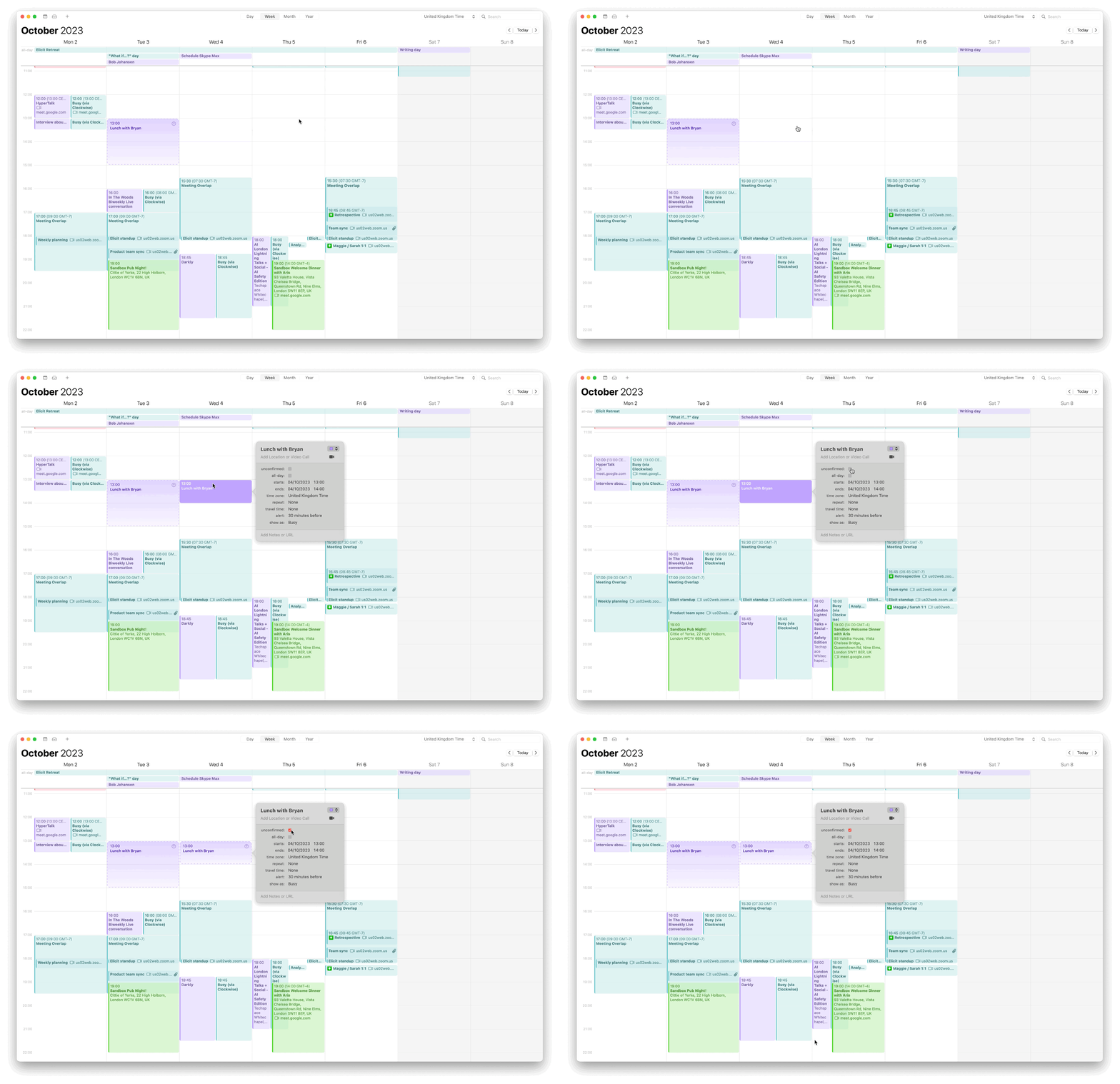
Marking a new calendar event as 'unconfirmed' in Mac calendar

This is not the ideal design solution, but it’s a low-effort starting point. By visually distinguishing these events and turning off their notifications, we’ve solved most of the problem.

Without this, I shall have to continue doing what I do now: sending people lists of times that I may or may not be free for, forgettings I’ve promised those times, booking other events and meetings into those times, and then having to play four extra rounds of oh-sorry-I’m-actually-busy-email-scheduling-ping-pong.

Some of the fancy new calendar startups like Cron and Amie are trying to solve this problem by letting you send someone a link with your available times.

The recipient can then select which slots also work for them, and the event is added to your calendar. This is perfect for professional meetings, but feels a bit impersonal and automated for some contexts. When I’m trying to coordinate dinner with family or a close friend over WhatsApp, sending an automated scheduling link makes me look and feel like an intolerable tech bro.

Maybe I don’t want a perfectly optimised system. Maybe I just want a bit more flexibility in marking up my calendar.

Just as I was finishing this note, I spotted the infamous 37Signals / Basecamp / HEY team announced they’ve added a new calendar view to their email service. And it includes a “maybe” event type!

It works exactly as I described in my concept above. The event displays with a light, monochrome patterned background and doesn’t have notifications. Good to see this out in a real product, although I’m not about to move from my beautiful system-level MacOS calendar to something as quirky as HEY.

End Notes

I’ve had this frustration for a long time. But only had the impulse to mock up a tangible solution after reading Julian Lehr’s beautiful reflection on Multi-layered Calendars .

Seeing others beautifully present ideas always compels me to contribute my own. Thanks to Julian for making the effort, and everyone else consistently publishing small, thoughtful, well-crafted ideas in public.