







At React Rally 2020 I gave a talk on magic, kinship, and ritual within the React development community. Anthropology isn’t something we hear a lot of about in the world of programming, and this is my lighthearted attempt to explore some of the odd cultural behaviours and norms we’ve come to see as ‘normal’ in the web development world.
Video Recording

Links and References
- “Anthropology is Philosophy with the people in it” - Tim Ingold from Anthropology: Why it Matters (An excellent brief introduction to Anthropology).
- “Deep Hanging Out” coined by Clifford Geertz in a 1998 New York Review of Books essay
- Imagined Communities theory from Benedict Anderson
- Social interaction is a performance by Erving Goffman . Proposed in the book The Presentation of Self in Everyday Life
- Cultural Capital - The theory cultural knowledge and information you hold within a community works in much the same way as financial and material capital. From Pierre Bourdieu’s essay one Cultural Reproduction and Social Reproduction
- Alfred Gell on the connections between technology, enchantment, and magic in his essay on The Technology of Enchantment and the Enchantment of Technology
- “Technology is society made durable” from Bruno Latour in his 1990 essay by the same title.
The Abridged Essay Version
I’ve been immersed in the world of React developers since 201610ya . As a cultural anthropologist, the beliefs, norms, and social dynamics of Reactland have always been more intriguing to me than the useEffect hook or concurrent mode.
What is cultural anthropology?
If you have never head of “cultural anthropology,” don’t worry. That’s expected. It doesn’t often overlap with the world of web development and as a discipline it’s not great at self-promotion.
It’s essentially the study of human cultures and trying to understand how they work.
Or as one of my favourite anthropologists Tim Ingold puts it:
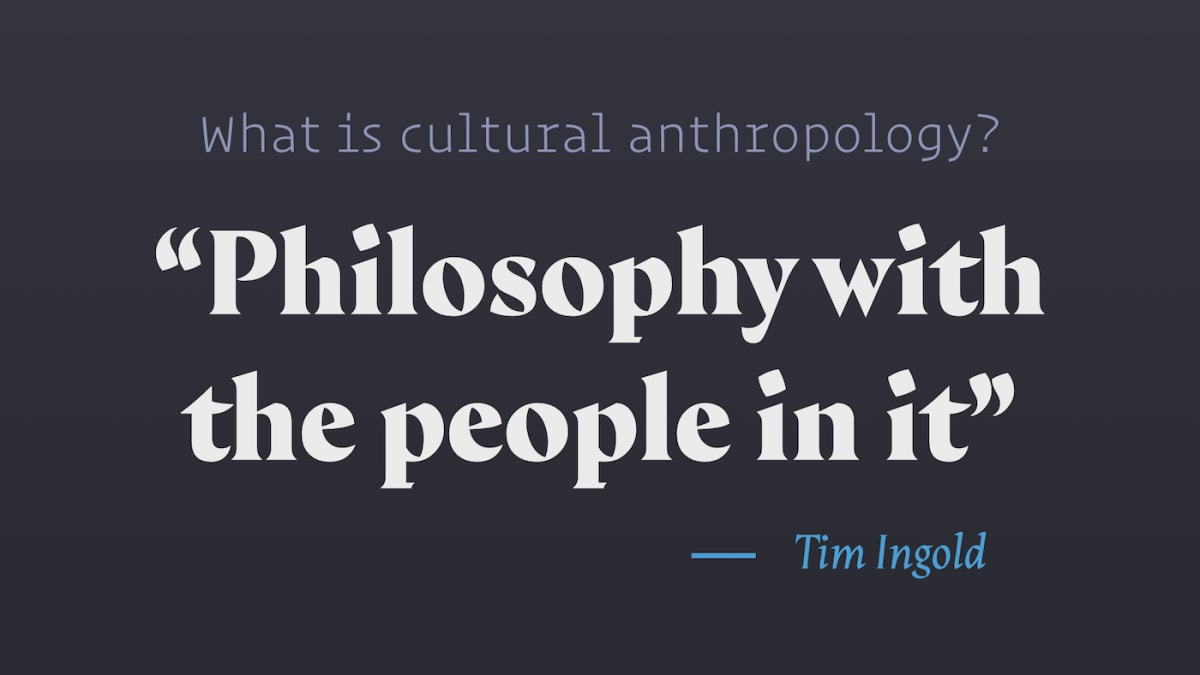
Anthropology tries to answer many of the same questions philosophers concern themselves with;
Why do we have language? How should we organise our societies and institutions? How do we deal with birth, death, morality, and conflict?
Philosophers turn inwards to find these answers. They go into a small quiet room alone, think a lot, and read books by mostly old dead white men to find answers.
In contrast, Anthropology turns outwards - it looks for the answers in people. By living among them, learning from them, and taking part in their lives. A process known as Participant Observation .
It isn’t searching for one universal truth of all humanity, but rather particular truths for particular people, at particular points in time.
Why care about the anthropology of React?
Looking at React through a cultural lens helps us understand it as more than simply “a JavaScript library for building user interfaces”.
Technical definitions can be reductive - they draw a technological box around our concepts that hide the historical and cultural context.

What happens if we expand our understanding to include all the people who surround this React, and how they might affect and be affected by what’s inside it?

What if we entertain the idea that humans and the culture of React are an essential part of what defines React? What if we consider it a cultural ecosystem we’re active participants in, rather than simply a package we npm install
Cultural anthropology is perfectly placed to help us find answers to these questions.
Understanding the “The React Community”
We should establish who we’re talking about when we say “the react community” - where do we think the boundaries of the React community are, and who do we think is part of it?

I drew a very incomplete and fuzzy map of the React world here. It’s definitely not comprehensive or to scale.
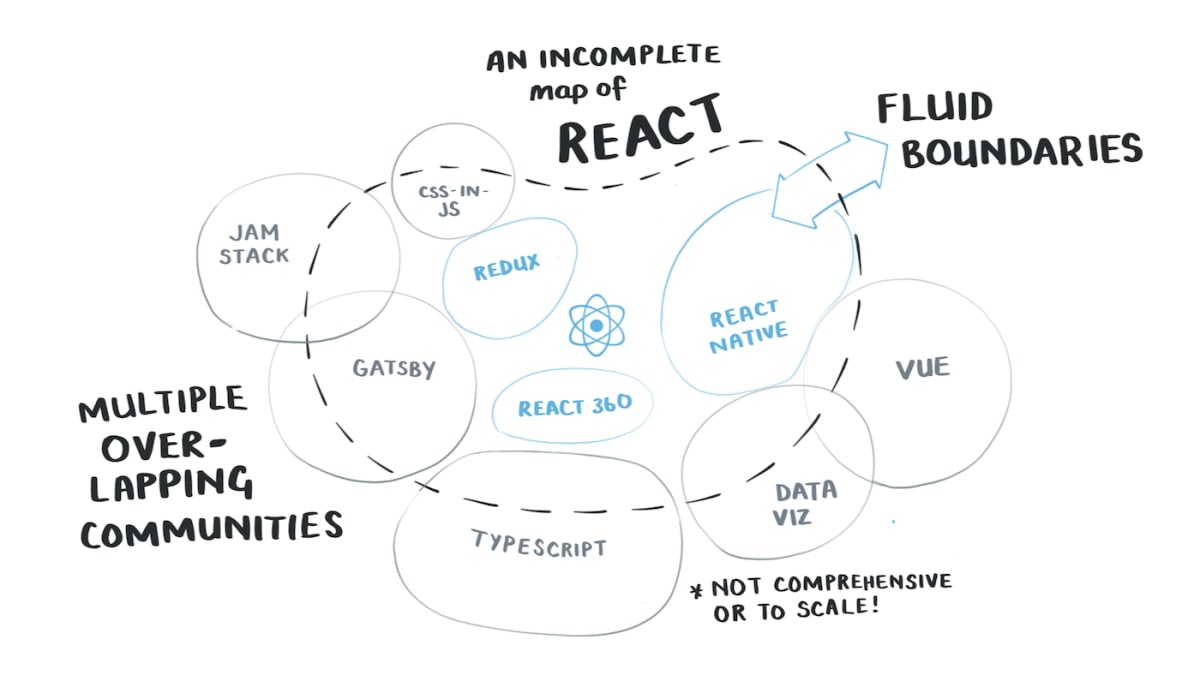
I drew this to point out two key things. First, being a React person isn’t a mutually exclusive identity - you can be other things too.
We have many overlapping and neighbouring communities we all belong to. You might also be part of the Data Viz world, or hang out within a sub niche like React Native.
Second, our community has very fluid boundaries. People flow in and out quite easily – anyone who finds it can join. To become a member you didn’t need to fill out a form and send it to a committee, or go through an initiation ceremony.
You also have the freedom to leave whenever you like.
These fuzzy boundaries sometimes make us a little bit anxious - it’s hard to know who’s part of the group, and weakens our sense of being a cohesive whole.
Another way to try and understand the React community is to look at some rough numbers.

These are interesting indicators, but they’re not necessarily helpful if we’re primarily interested in how React works as a cultural system.
Rather than talking about stats and numbers, it’s much more meaningful for us to talk about React an an imagined community
This was a concept developed by a political scientist called Benedict Anderson in the 198046ya ’s.
Anderson was writing about how nations imagine themselves as collective wholes, but his theory maps very well to how online communities like React work.
An imagined community has nothing to do with it being imaginary in the sense of being fake, but simply that it’s something we have to mentally construct across thousands of individual minds. It gets built through shared images and rituals.
Anderson specifically uses the idea of a national daily newspaper.
The act of sitting down and reading the daily news, and imagining a whole nation of other people, similar like you, sitting and reading those exact same words at roughly the same time, creates a sense of collective belonging.
It’s a daily ritual that reaffirms your membership, and sense of unity with a greater whole.
Coming Soon
Feel free to bug me on Bluesky to finish writing this.