
惯性聚合 高效追踪和阅读你感兴趣的博客、新闻、科技资讯
阅读原文 在惯性聚合中打开

推荐订阅源

Y
Y Combinator Blog
Security Archives - TechRepublic
钛媒体:引领未来商业与生活新知
钛媒体:引领未来商业与生活新知
Apple Machine Learning Research
Blog — PlanetScale
Blog — PlanetScale
OSCHINA 社区最新新闻
OSCHINA 社区最新新闻
G
Google Developers Blog
F
Full Disclosure
大猫的无限游戏
大猫的无限游戏
酷 壳 – CoolShell
酷 壳 – CoolShell
T
Threat Research - Cisco Blogs
A
Arctic Wolf
Threat Intelligence Blog | Flashpoint
The Cloudflare Blog
博客园 - 【当耐特】
AWS News Blog
AWS News Blog
U
Unit 42
V
Vulnerabilities – Threatpost
P
Privacy International News Feed
T
Tor Project blog
Microsoft Security Blog
宝玉的分享
宝玉的分享
Google DeepMind News
爱范儿
爱范儿
cs.CL updates on arXiv.org
Recorded Future
Recorded Future
freeCodeCamp Programming Tutorials: Python, JavaScript, Git & More
奇客Solidot–传递最新科技情报
奇客Solidot–传递最新科技情报
C
CXSECURITY Database RSS Feed - CXSecurity.com
T
Threatpost
Latest news
Latest news
GbyAI
GbyAI
S
SegmentFault 最新的问题
MongoDB | Blog
MongoDB | Blog
N
Netflix TechBlog - Medium
Hacker News: Ask HN
Hacker News: Ask HN
美团技术团队
N
News | PayPal Newsroom
J
Java Code Geeks
Exploit-DB.com RSS Feed
Microsoft Azure Blog
K
KPMG report finds enterprise disconnect between AI and its ROI | CIO
The Hacker News
The Hacker News
The GitHub Blog
The GitHub Blog
V
V2EX
N
News and Events Feed by Topic
T
Troy Hunt's Blog
Security Latest
Security Latest
博客园 - 叶小钗
P
Palo Alto Networks Blog

Maggie Appleton

The Dark Forest and Generative AI One Developer, Two Dozen Agents, Zero Alignment Gas Town’s Agent Patterns, Design Bottlenecks, and Vibecoding at Scale January 2026 | Maggie Appleton A Treatise on AI Chatbots Undermining the Enlightenment A Brief History & Ethos of the Digital Garden Vibe Code is Legacy Code May 2025 | Maggie Appleton Home-Cooked Software and Barefoot Developers Statistically, When Will My Baby Be Born? Speculative Calendar Events ChatGPT Would be a Decent Policy Advisor March 2025 | Maggie Appleton The Expanding Dark Forest and Generative AI Humanity's Last Exam Squish Meets Structure Common Misconceptions in AI Undetected AI Exam Answers Unbaited Smidgeons Growing a Human: The First 30 Weeks How to Import Academic Papers from Zotero into Tana December 2024 | Maggie Appleton Aesthetic Command Lines with Hyper, Spaceship, and Oh My Zsh Leaving Elicit July 2024 | Maggie Appleton A Short History of Bi-Directional Links The Pattern Language of Project Xanadu Assumed Audiences Ambient Co-presence On Opening Essays, Conference Talks, and Jam Jars Spinning Worlds, Seasickness, and Dealing with Vestibular Neuritis A Collection of Design Engineers Gathering Structures Daily Notes Pages Historical Trails December 2023 | Maggie Appleton September 2023 | Maggie Appleton Digital Gardening for Non-Technical Folks Language Model Sketchbook, or Why I Hate Chatbots June 2023 | Maggie Appleton Computational Notebooks Folk Interfaces Reverse Outlining with Language Models Command K Bars Spatial Web Browsing A Picture Worth a Thousand Programmes Programmable Notes Programming Portals Teenage Skeuomorphic Desktop Designs Tending Evergreen Notes in Roam Research Growing the Evergreens Why You Own an iPad and Still Can't Draw A Brief Introduction to Digital Anthropology Transclusion and Transcopyright Dreams The Block-Paved Path to Structured Data Empty Pointers and Constellations of AI Metaphors We Web By Epistemic Disclosure November 2022 | Maggie Appleton Joining Ought July 2022 | Maggie Appleton The Linear Oppression of Note-taking Apps Paleolithic Nostalgia Interoperable Personal Libraries and Ad Hoc Reading Groups The Finest Narrative Non-Fiction Essays Algorithmic Transparency October 2021 | Maggie Appleton Plebeian Programming with Keyboard Maestro The Cultural Anthropology of React August 2021 | Maggie Appleton Natureculture, Moral Purity, and Cultural Boundaries The Echo & Narcissus Writing Club Pink, Soft, Glittering Developers Fetishism & Mechanical Keyboards Making Programming Visual, Spatial, and Learnable Organic, Local, Artisan Data Storage Positioning Elements & Scrollytelling in CSS Painting Roam Research with Custom CSS A Digital Anthropology Reading List The Eponymous Laws of Programming A History of Cyborgs Neologisms GreenSock Animations with React Hooks The Bare Essentials of Greensock September 2020 | Maggie Appleton Illustrating Gatsby's Key Concepts Problematic Proteins New Harvest & Illustrating the Cultivated Meat Podcast Synecdoche: Drawing the Part for the Whole A Meta-Tour of This Site Douglas, Dirt, and Matter Out of Place The Knowledge Hydrant A Naïve Exploration of Computer-Supported Collaborative Learning Silent Synchronous Reading Sessions What the Fork is React Suspense? Visually Workshopping the AWS Cloud Are Data Unions the Future of Data? Pattern Languages in Programming and Interface Design A Metaphorical Reading Collection
The Gift Economy
MadMakhno (Fuck Elon SDE) · 2022-11-23 · via Maggie Appleton

A gift economy is a system of exchange based on gift giving.

Valuables are given without explicit agreement of future rewards between individuals, or within a contained community of people.
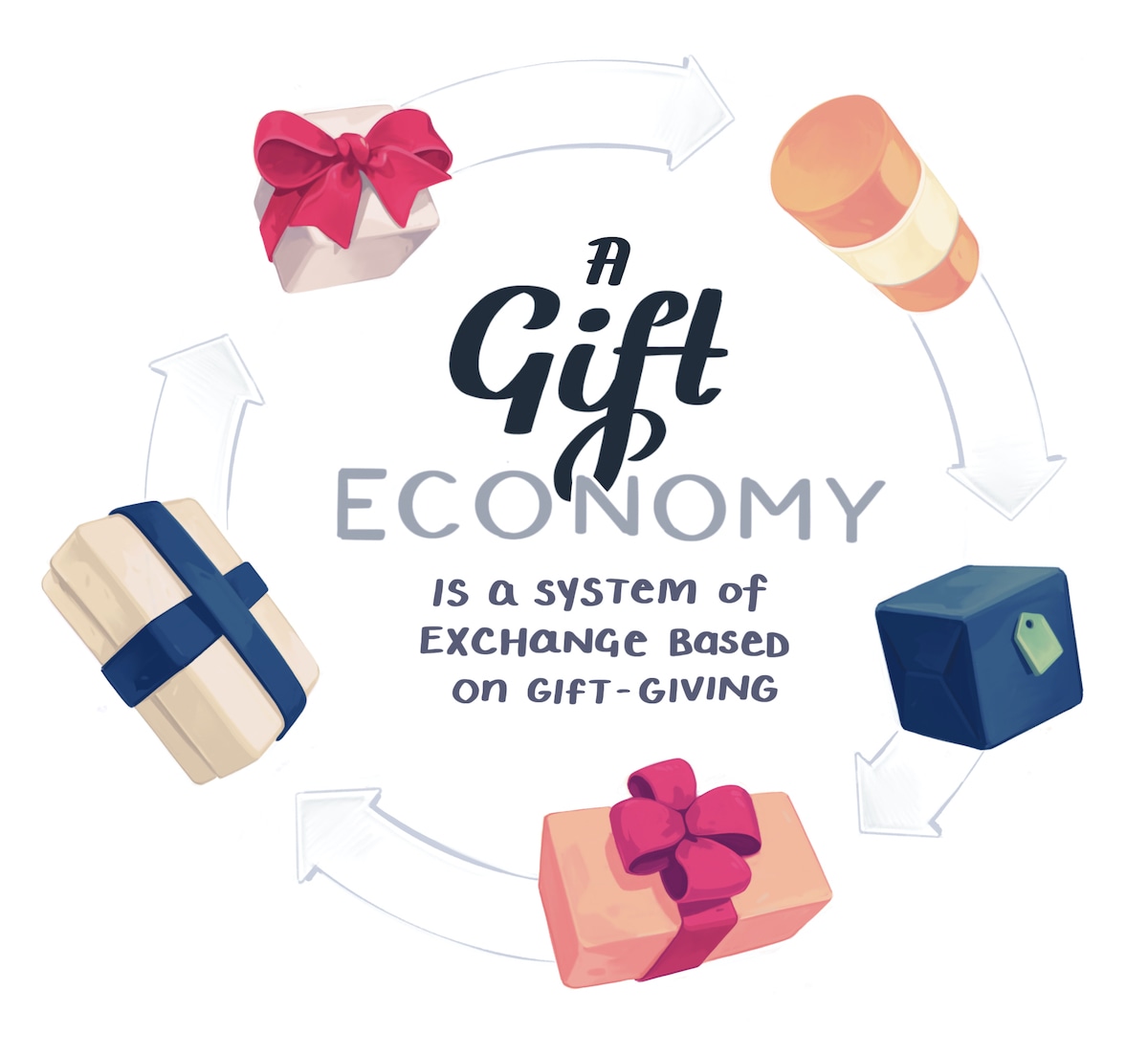
Gift economies are systems of exchange based on gift-giving

Gift economies have a few key qualities. They are…

  1. Loosely and informally tracked - it is bad form to calculate the exact value of gifts you receive, or keep an obsessive log of it the way we do with business finances
  2. Indirect - it is not always two individuals giving back and forth. Instead gifting is generalised to a whole community where you may give to people who have not given directly to you
  3. Delayed - we do not reciprocate gifts the minute we receive them, but instead wait to repay the offering at a later date

The emphasis in a gift exchange is on strengthening the bond between the givers and receivers.

It creates a kind of “positive debt,” where two people or groups are now tied to one another - one party will always owe the other something. It’s a purposeful way of entwining lives and communities together.

Why do we feel compelled to reciprocate gifts?

The grand mystery of gifting and gift economies is why we feel obliged to reciprocate. When someone gives you something, it sparks a strong desire to return in kind.

We don’t have a pat answer to where this compulsion comes from, but we can certainly argue generosity and social connection are useful evolutionary traits if we want to get biologically reductive about it.

Marcel Mauss is perhaps the most infamous Anthropologist to explore this question in his book The Gift Not to be mistaken with Lewis Hyde’s book of the same name, although it’s more focused on art and creation as a gift. Not a bad read, but a bit of a title hijack.


The Gift

Mauss concluded that the objects we are given “are seen to partake of something of the personality of the giver”. 154

Mauss described it through the idea of the Maori idea of hau - the “spirit of the gift” where the giver’s ‘soul’, or some kind of personal quality, is entangled with the gift object that wishes to return home to its owner. Thus compelling the receiver to make a return.

This interpretation of Maori hau ended up being strongly criticised as a misunderstanding and vast oversimplification of the true cultural meaning.

But the deeper idea Mauss was trying to get at is still worth highlighting. Just without a culturally appropriated term.

Reciprocating Appropriately

When we return a gift, our offering has to be of similar or slightly higher value than the original. But not by too much.

If you bring me a ginger biscuit with my cup of tea, and two days later I reciprocate with a gourmet, two-tiered red velvet cake with your name in icing, we would all consider that an awkward, creepy, and overall a socially inappropriate response.

Just giving you a ginger biscuit back works well enough. Returning a gift of the exact same value resolves the debt, but also breaks the cycle.

Everyone is now even, and there’s no more need to continue biscuit-gifting. We can safely return to the pre-biscuit-gifting-days, but doing so also weakens our social connection.

If I have a particular political or personal interest in strengthening our social relationship, I need to give you a treat of slightly higher value – perhaps a chocolate hobnob or home-made scone.

Which both demonstrates I’m invested in this relationship, and also leaves you slightly indebted to me, thus compelling the gift cycle onwards.

Gift Economies and Market Economies

We often contrast the Gift Economy with the Market Economy. This is a wild oversimplification, but humans like to think in Cultural Dichotomies.

We often contrast gift economies with market or barter economies

Market Economies are systems of exchange based on buying and selling things with money. A market exchange is specific, quantifiable, direct, immediate, founded upon an explicit agreement. As in, this croissant costs £1 right now.

Buying an irrationally overpriced granola bar from an airport vending machine is an example of a pure market exchange without a social layer. It’s me, a machine, and a £3 bar of sugar to help me survive this long layover.

I want food, and whoever owns this machine wants money. This is not the time or the place for a gift economy. It would be terribly inconvenient for me to rely on an unpredictable system of granola bar gifts from the strangers around me while starving in an unfamiliar airport.

There are humans who own this vending machine, who will eventually get that money. But they are very far away in time and space – both geographically and socially.

If challenged, I would have a terrible time tracking them down and having a chat. I have only the weakest sense of a human relationship with them, and there is hardly a social bond being woven – this granola bar is about an immediate and specific exchange of needs.

Here, the market economy works wonders. Life necessities like food, shelter, and water are not good candidates for a gifting system. Which is why we tend to gift luxury items, novelties, and socks.

This is also why it’s problematic when food, shelter, and water are framed as “gifts” which is sometimes how charitable donations work – as optional acts of generosity.