惯性聚合 高效追踪和阅读你感兴趣的博客、新闻、科技资讯
阅读原文 在惯性聚合中打开

推荐订阅源

cs.AI updates on arXiv.org
H
Hackread – Cybersecurity News, Data Breaches, AI and More
酷 壳 – CoolShell
酷 壳 – CoolShell
小众软件
小众软件
奇客Solidot–传递最新科技情报
奇客Solidot–传递最新科技情报
钛媒体:引领未来商业与生活新知
钛媒体:引领未来商业与生活新知
有赞技术团队
有赞技术团队
大猫的无限游戏
大猫的无限游戏
Security Latest
Security Latest
V
V2EX
Hugging Face - Blog
Hugging Face - Blog
IT之家
IT之家
让小产品的独立变现更简单 - ezindie.com
月光博客
月光博客
博客园 - Franky
Threat Intelligence Blog | Flashpoint
Simon Willison's Weblog
S
Securelist
T
Threatpost
Last Week in AI
Last Week in AI
P
Privacy International News Feed
S
SegmentFault 最新的问题
aimingoo的专栏
aimingoo的专栏
CTFtime.org: upcoming CTF events
MyScale Blog
MyScale Blog
P
Palo Alto Networks Blog
Cisco Talos Blog
Cisco Talos Blog
T
Tailwind CSS Blog
Blog — PlanetScale
Blog — PlanetScale
G
GRAHAM CLULEY
GbyAI
GbyAI
G
Google Developers Blog
cs.CL updates on arXiv.org
B
Blog RSS Feed
A
About on SuperTechFans
H
Help Net Security
T
Threat Research - Cisco Blogs
C
Check Point Blog
S
Schneier on Security
Google DeepMind News
T
The Exploit Database - CXSecurity.com
博客园 - 叶小钗
Scott Helme
Scott Helme
博客园 - 司徒正美
美团技术团队
W
WeLiveSecurity
O
OpenAI News
Exploit-DB.com RSS Feed
AWS News Blog
AWS News Blog
I
InfoQ

Maggie Appleton

The Dark Forest and Generative AI One Developer, Two Dozen Agents, Zero Alignment Gas Town’s Agent Patterns, Design Bottlenecks, and Vibecoding at Scale January 2026 | Maggie Appleton A Treatise on AI Chatbots Undermining the Enlightenment A Brief History & Ethos of the Digital Garden Vibe Code is Legacy Code May 2025 | Maggie Appleton Home-Cooked Software and Barefoot Developers Statistically, When Will My Baby Be Born? Speculative Calendar Events ChatGPT Would be a Decent Policy Advisor March 2025 | Maggie Appleton The Expanding Dark Forest and Generative AI Humanity's Last Exam Squish Meets Structure Common Misconceptions in AI Undetected AI Exam Answers Unbaited Smidgeons Growing a Human: The First 30 Weeks How to Import Academic Papers from Zotero into Tana December 2024 | Maggie Appleton Aesthetic Command Lines with Hyper, Spaceship, and Oh My Zsh Leaving Elicit July 2024 | Maggie Appleton A Short History of Bi-Directional Links The Pattern Language of Project Xanadu Assumed Audiences Ambient Co-presence On Opening Essays, Conference Talks, and Jam Jars Spinning Worlds, Seasickness, and Dealing with Vestibular Neuritis A Collection of Design Engineers Gathering Structures Daily Notes Pages Historical Trails December 2023 | Maggie Appleton September 2023 | Maggie Appleton Digital Gardening for Non-Technical Folks Language Model Sketchbook, or Why I Hate Chatbots June 2023 | Maggie Appleton Computational Notebooks Folk Interfaces Reverse Outlining with Language Models Command K Bars Spatial Web Browsing A Picture Worth a Thousand Programmes Programmable Notes Programming Portals Teenage Skeuomorphic Desktop Designs Growing the Evergreens Why You Own an iPad and Still Can't Draw A Brief Introduction to Digital Anthropology Transclusion and Transcopyright Dreams The Block-Paved Path to Structured Data Empty Pointers and Constellations of AI Metaphors We Web By The Gift Economy Epistemic Disclosure November 2022 | Maggie Appleton Joining Ought July 2022 | Maggie Appleton The Linear Oppression of Note-taking Apps Paleolithic Nostalgia Interoperable Personal Libraries and Ad Hoc Reading Groups The Finest Narrative Non-Fiction Essays Algorithmic Transparency October 2021 | Maggie Appleton Plebeian Programming with Keyboard Maestro The Cultural Anthropology of React August 2021 | Maggie Appleton Natureculture, Moral Purity, and Cultural Boundaries The Echo & Narcissus Writing Club Pink, Soft, Glittering Developers Fetishism & Mechanical Keyboards Making Programming Visual, Spatial, and Learnable Organic, Local, Artisan Data Storage Positioning Elements & Scrollytelling in CSS Painting Roam Research with Custom CSS A Digital Anthropology Reading List The Eponymous Laws of Programming A History of Cyborgs Neologisms GreenSock Animations with React Hooks The Bare Essentials of Greensock September 2020 | Maggie Appleton Illustrating Gatsby's Key Concepts Problematic Proteins New Harvest & Illustrating the Cultivated Meat Podcast Synecdoche: Drawing the Part for the Whole A Meta-Tour of This Site Douglas, Dirt, and Matter Out of Place The Knowledge Hydrant A Naïve Exploration of Computer-Supported Collaborative Learning Silent Synchronous Reading Sessions What the Fork is React Suspense? Visually Workshopping the AWS Cloud Are Data Unions the Future of Data? Pattern Languages in Programming and Interface Design A Metaphorical Reading Collection
Building a Second Brain: The Illustrated Notes
DnA · 2023-04-04 · via Maggie Appleton

In 20197ya I took a course called Building a Second Brain by Tiago Forte. Throughout the course I illustrated summaries of the main concepts which you can find below.

Much like it sounds, building a “second brain” is about creating a system – outside your physical skin-and-bone bodily boundaries – for storing, organising, and eventually transforming information.

This idea is not especially new; commonplace books for storing personal knowledge have been around for centuries. Although digital mediums have made it easier and faster to capture, browse, search, and retrieve the information in these systems.

A Small Disclaimer

In the 3 years since taking the course, I’ve learned much more about the world of personal knowledge management (PKM) and its long history. Tiago’s course is a light introduction to the concept of knowledge management, but not deeply rooted in the historical literature. I’d encourage you to explore beyond it.

The price tag on the course has also blossomed since I took it, and the marketing material a bit outlandish. I don’t necessarily endorse or actively encourage anyone to take the course.

I also find the metaphor of a “second brain” troubling in that it doesn’t speak to the significance of embodied cognition and tacit knowledge in how human cognition works. Filling up a “digital brain” as if it were a filing cabinet is highly unlikely to lead to meaningful knowledge and wisdom.

Some of the content below is good, sensible advice for managing your digital information, but it is not groundbreaking or life changing. It also isn’t based in much scientific evidence for what makes people effective thinkers, writers, and creators.

As Andy Matuschak poetically pointed out , “people who write extensively about note-writing rarely have a serious context of use.”

Exercise your own discernment here.
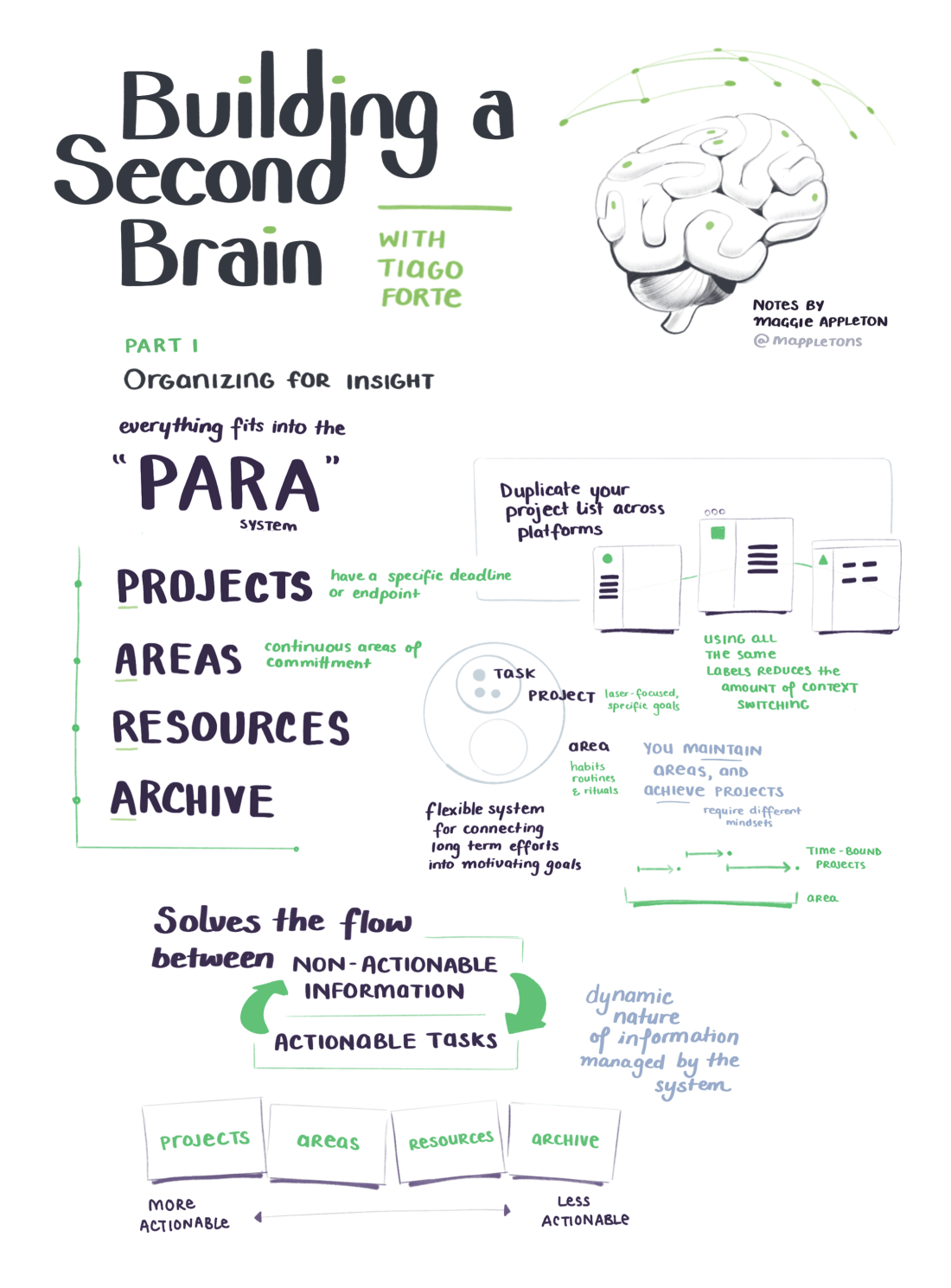
Building a second brain (BASB) illustrated notes on the PARA system of organising content projects, areas, resources, and archives

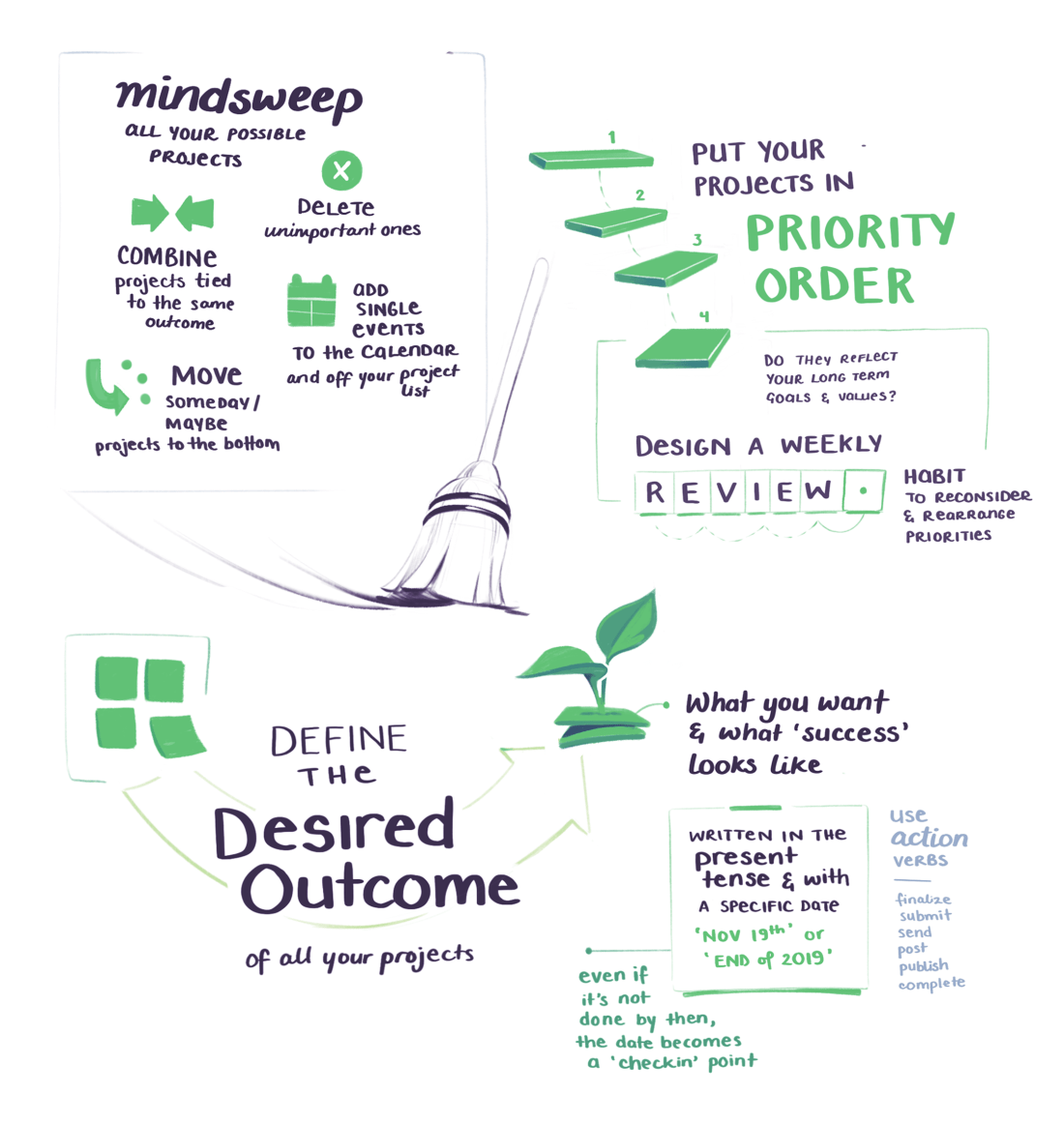
BASB sketchnotes on putting projects in priority order and defining the desired outcome

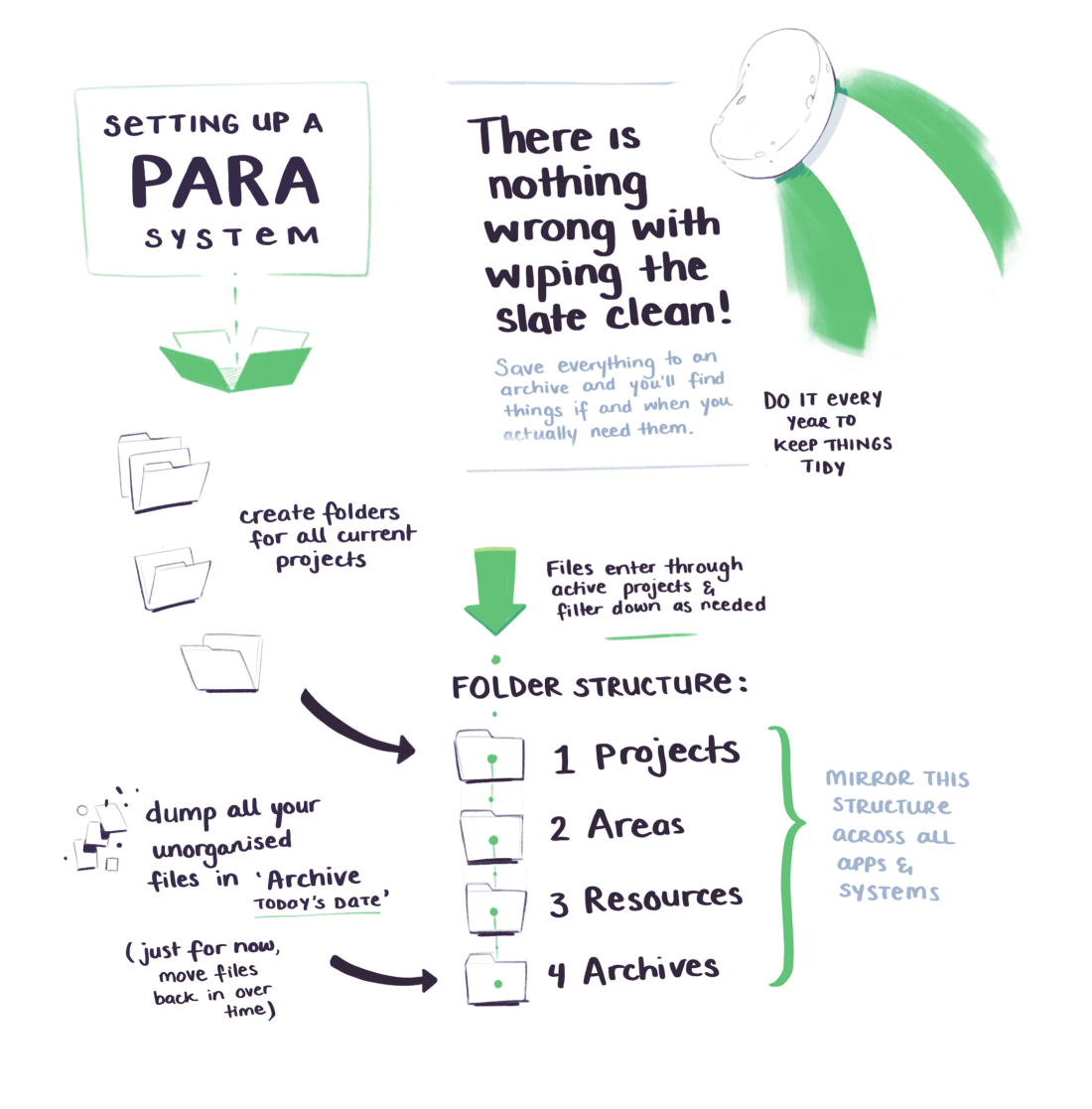
BASB sketchnotes on wiping the slate clean and setting up PARA as a folder structure

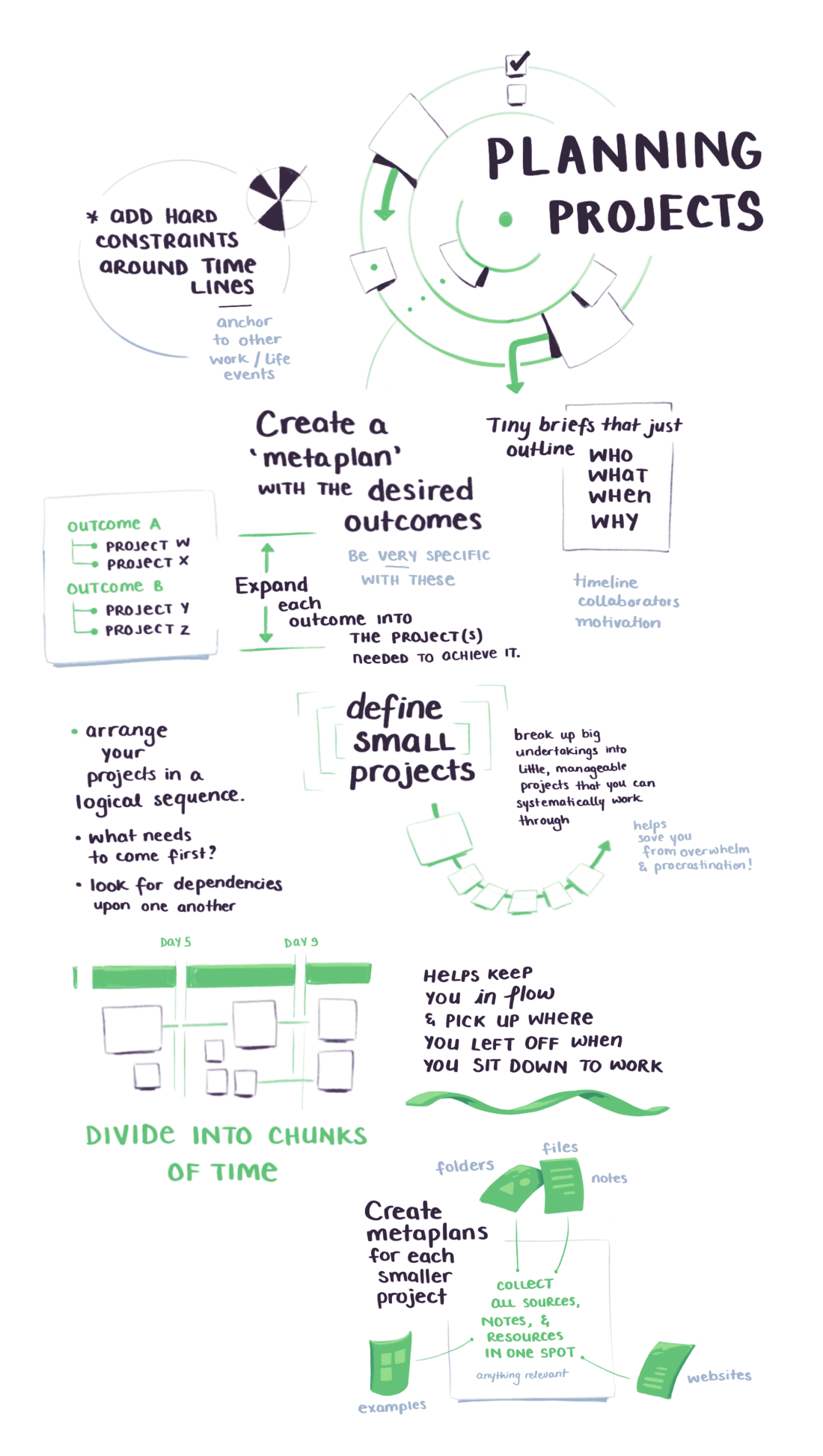
BASB sketchnotes on creating metaplans before you start your project

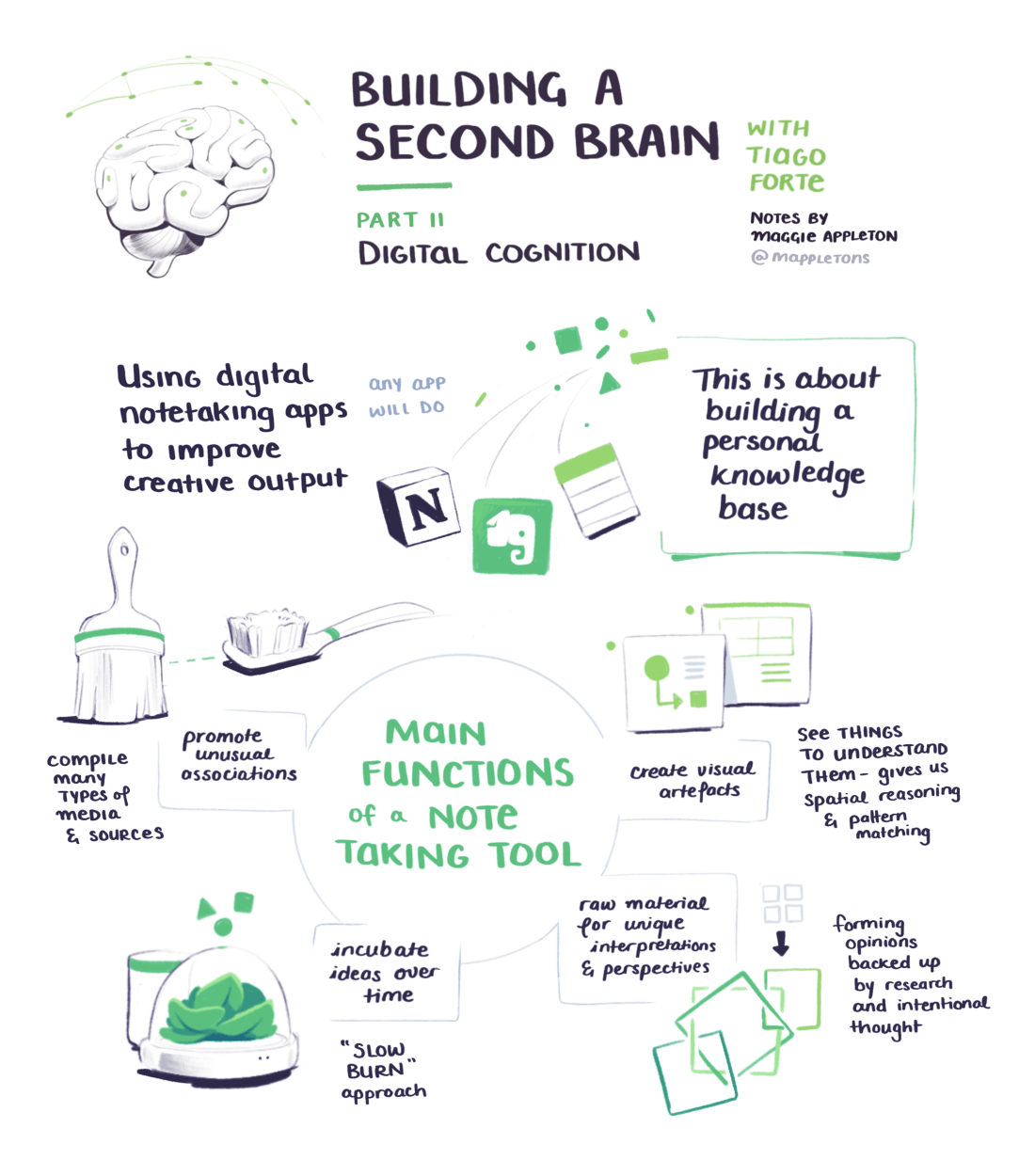
BASB sketchnotes on digital cognition and building a personal knowledge base

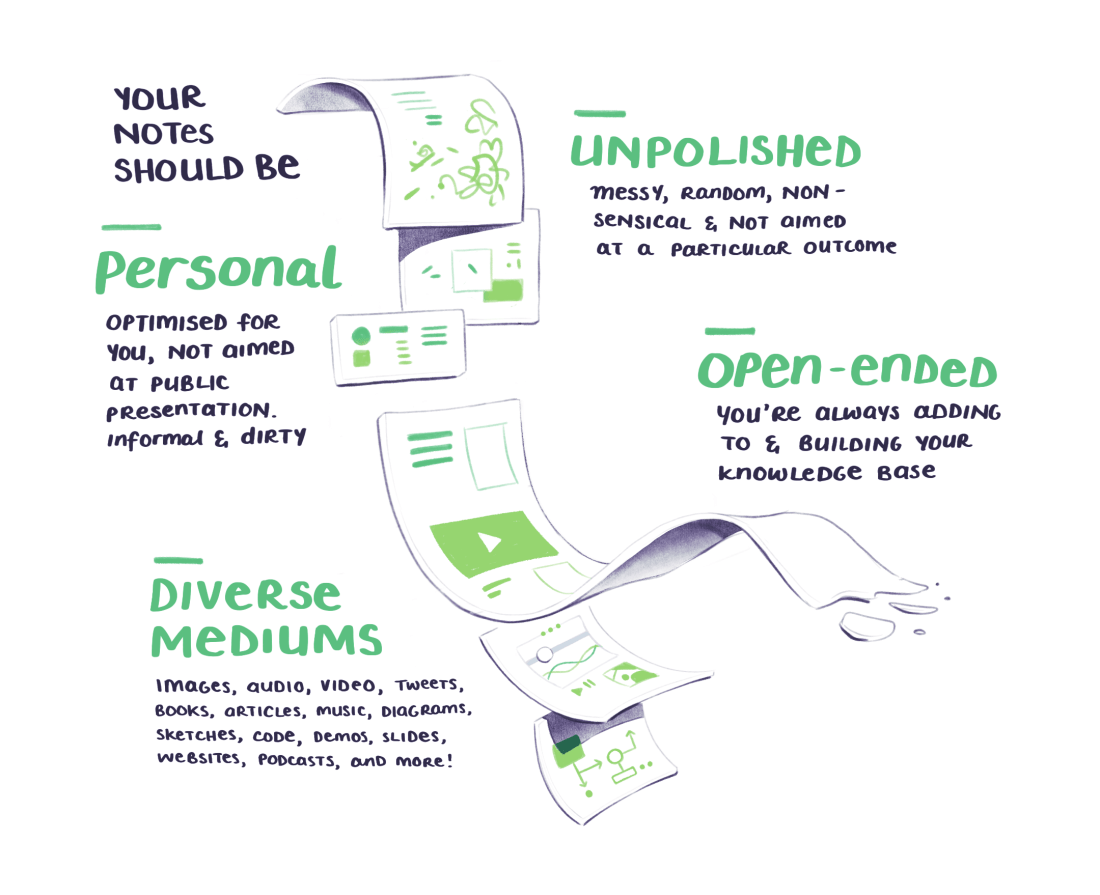
BASB sketchnotes on your notes being unpolished, personal, open-ended, and diverse

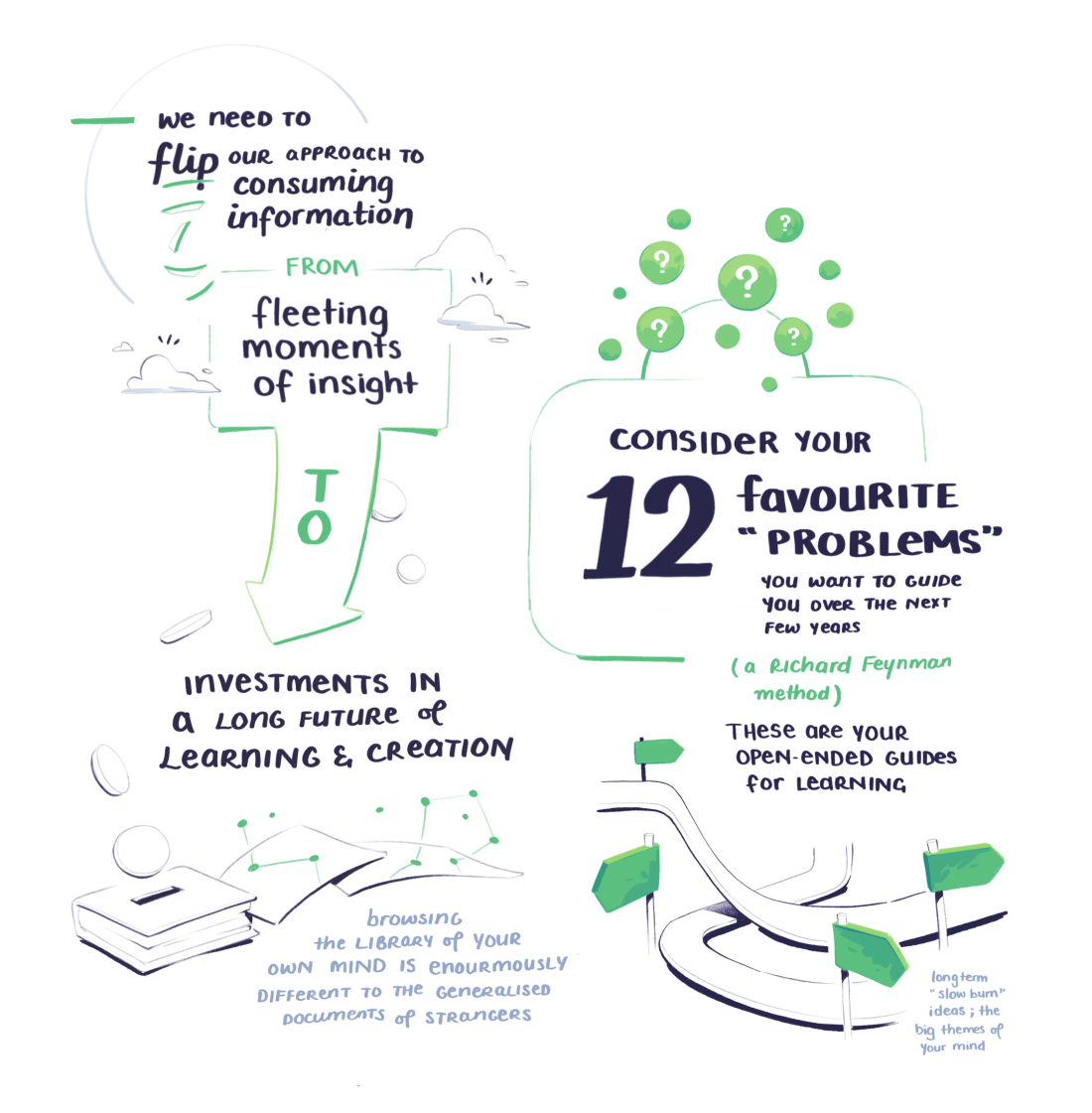
BASB sketchnotes on considering 12 favourite problems to focus on

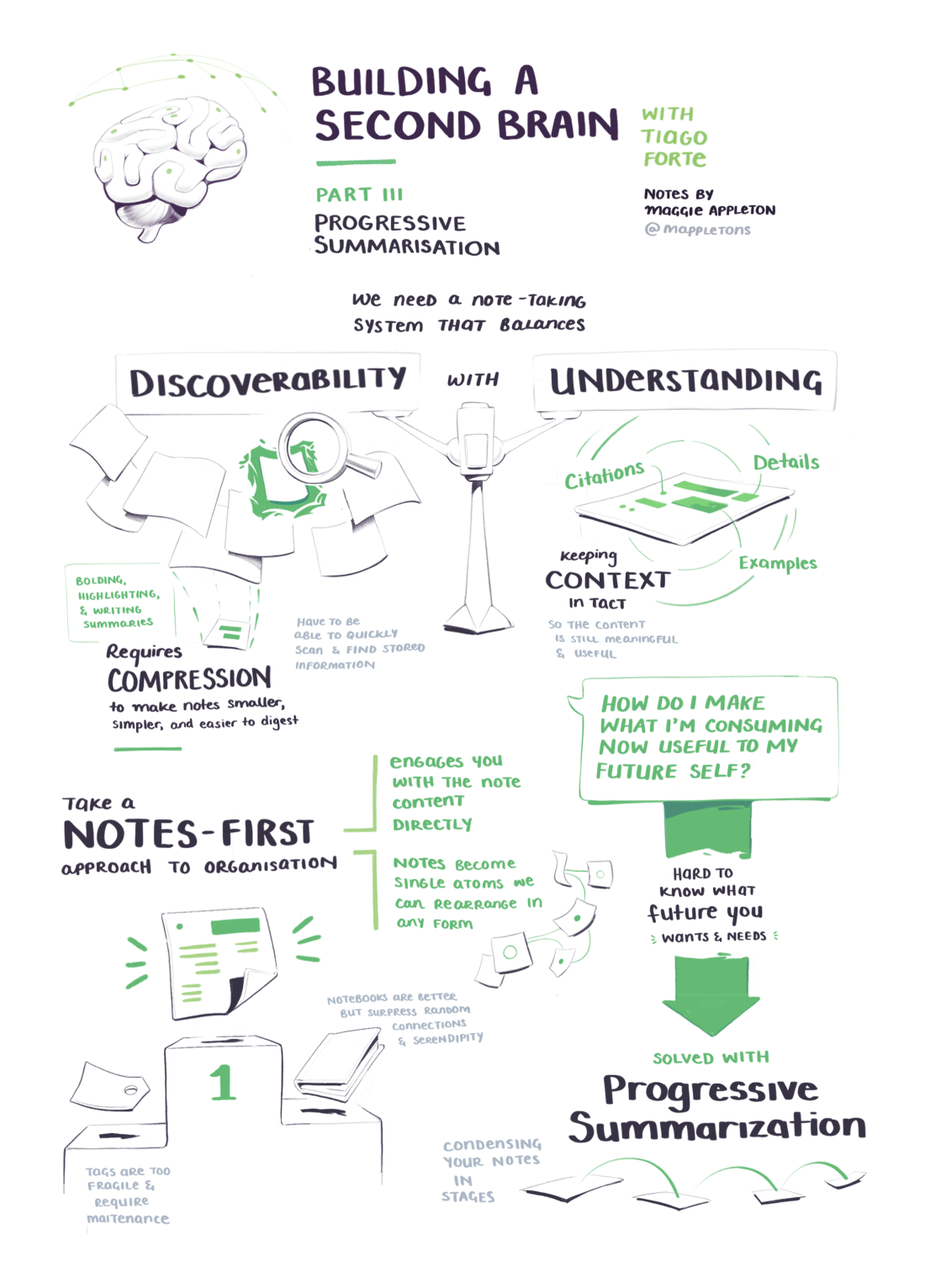
BASB sketchnotes on balancing discoverability with understanding in your notes

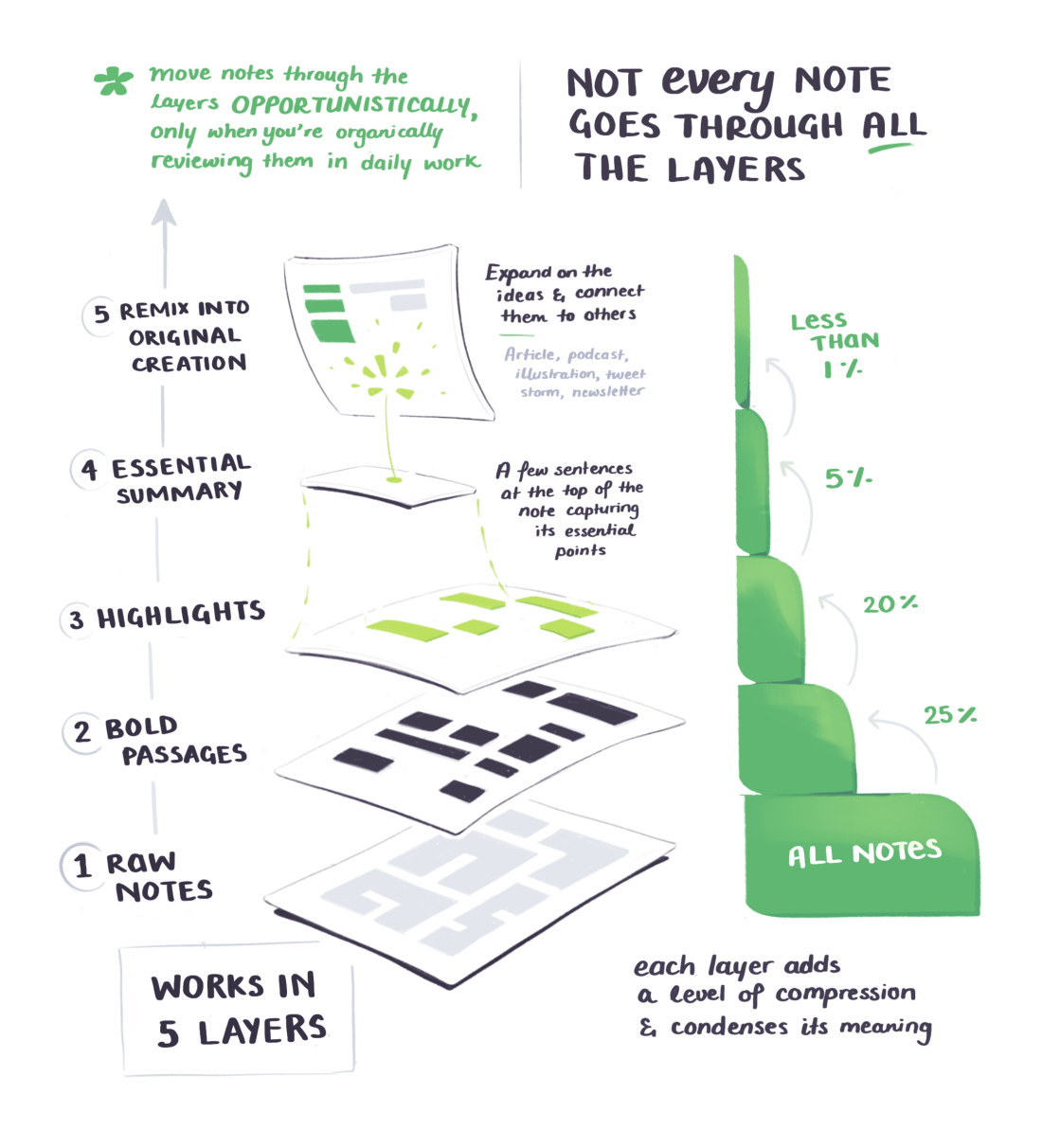
BASB sketchnotes on putting your notes through 5 layers of progressive summarisation

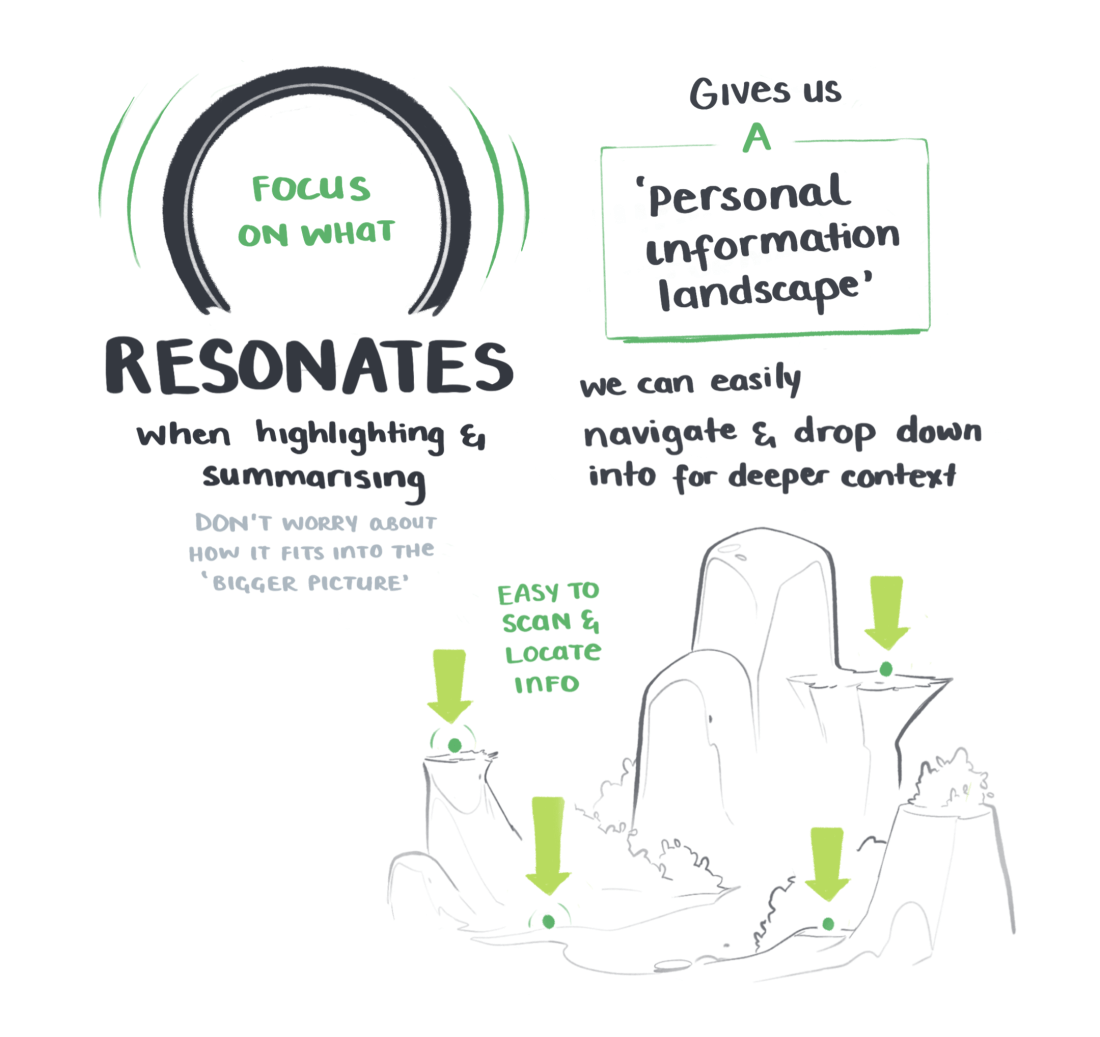
BASB sketchnotes on focusing on what resonates when summarising your notes

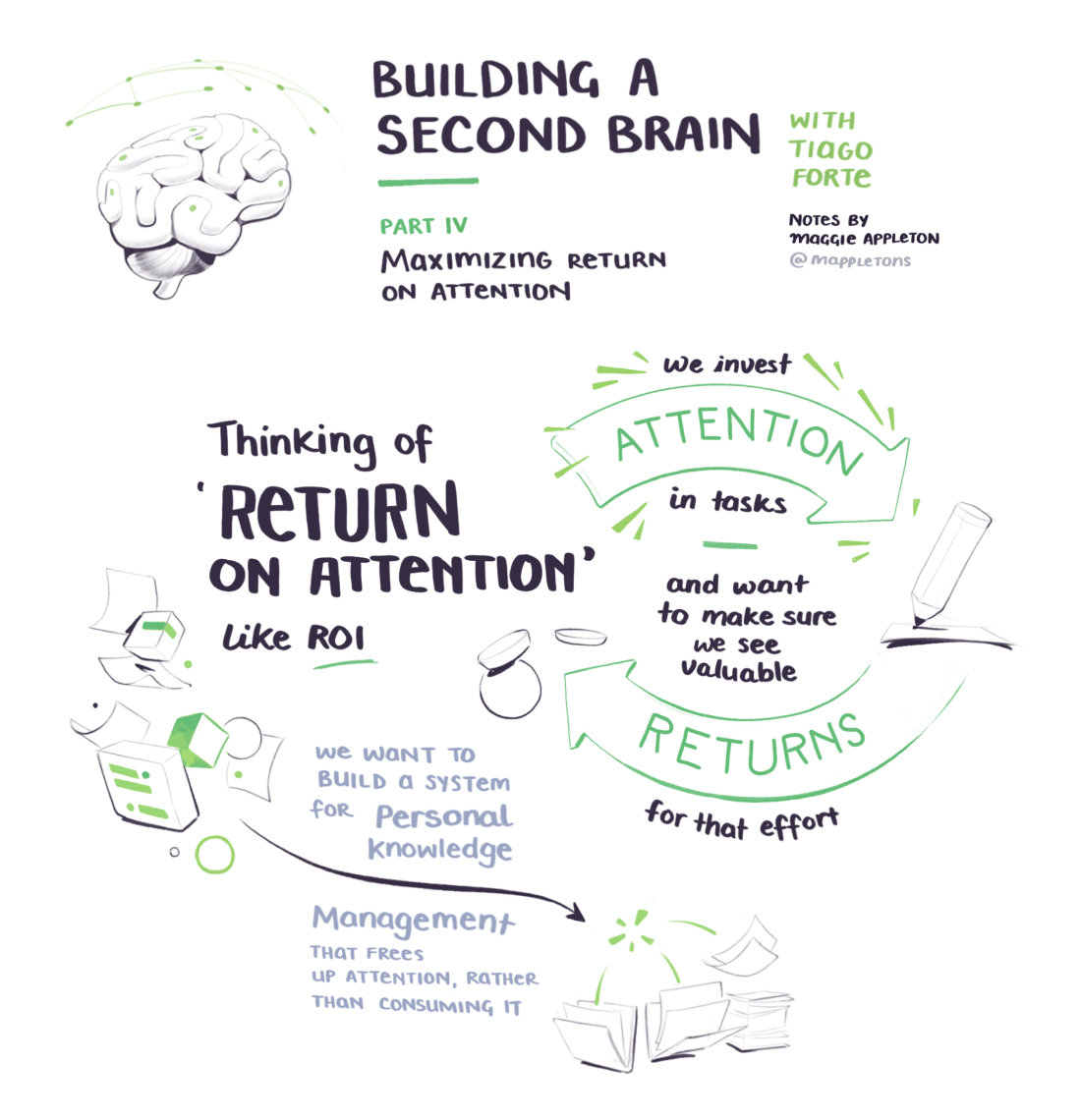
BASB sketchnotes on thinking of return on attention like ROI

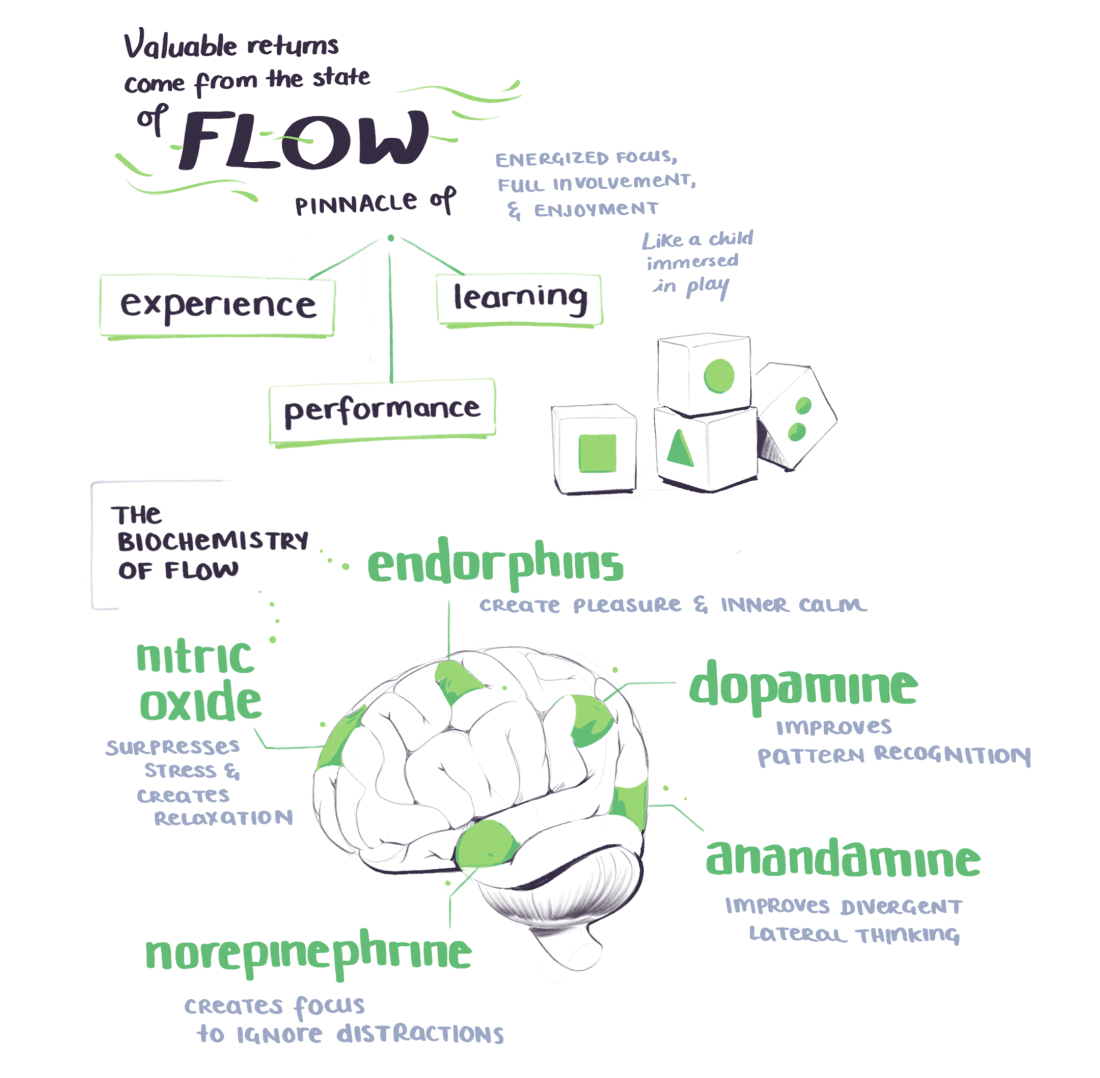
BASB sketchnotes on flow state as the pinnacle of experience, learning, and performance. As well as the biochemistry of flow state.

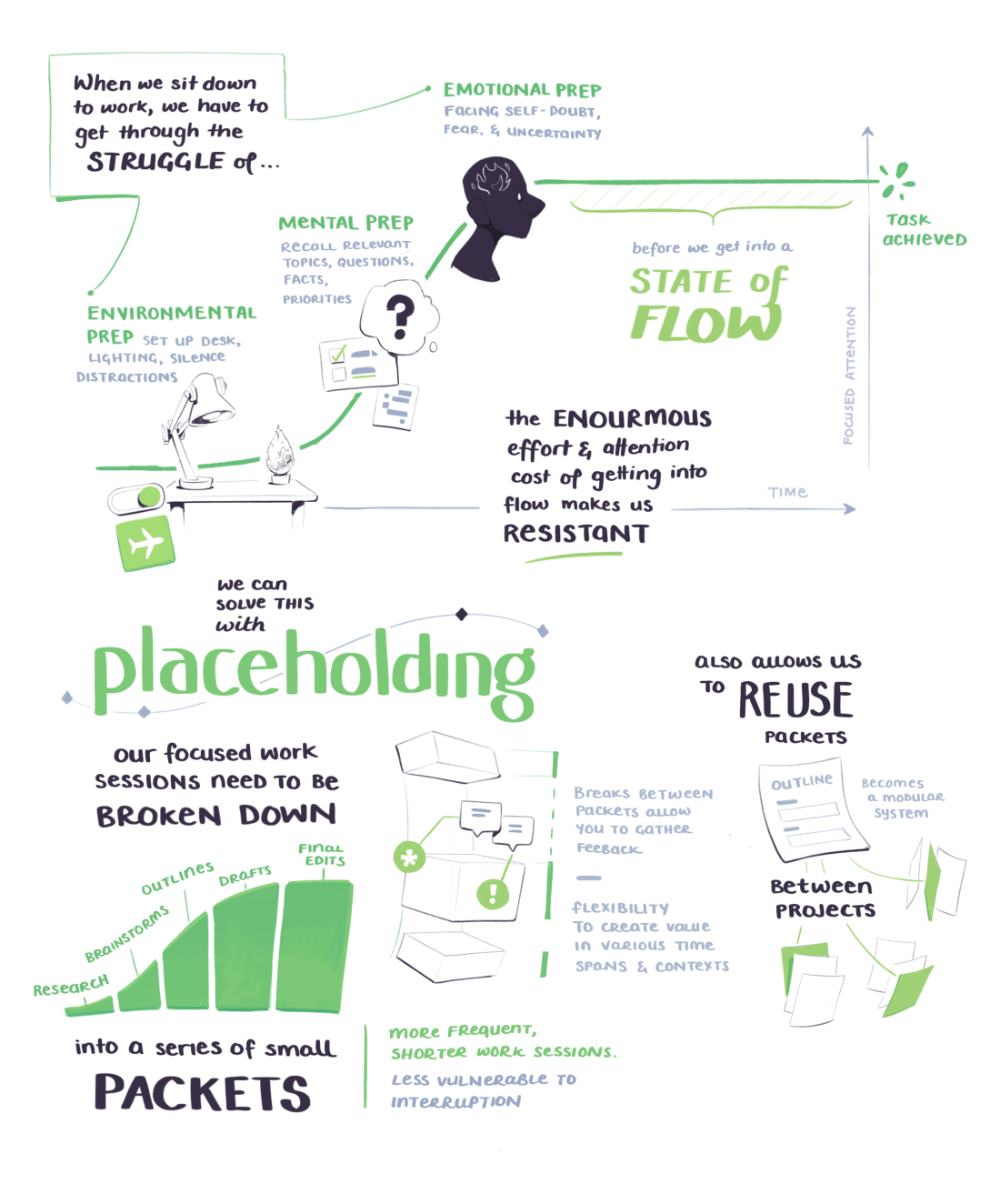
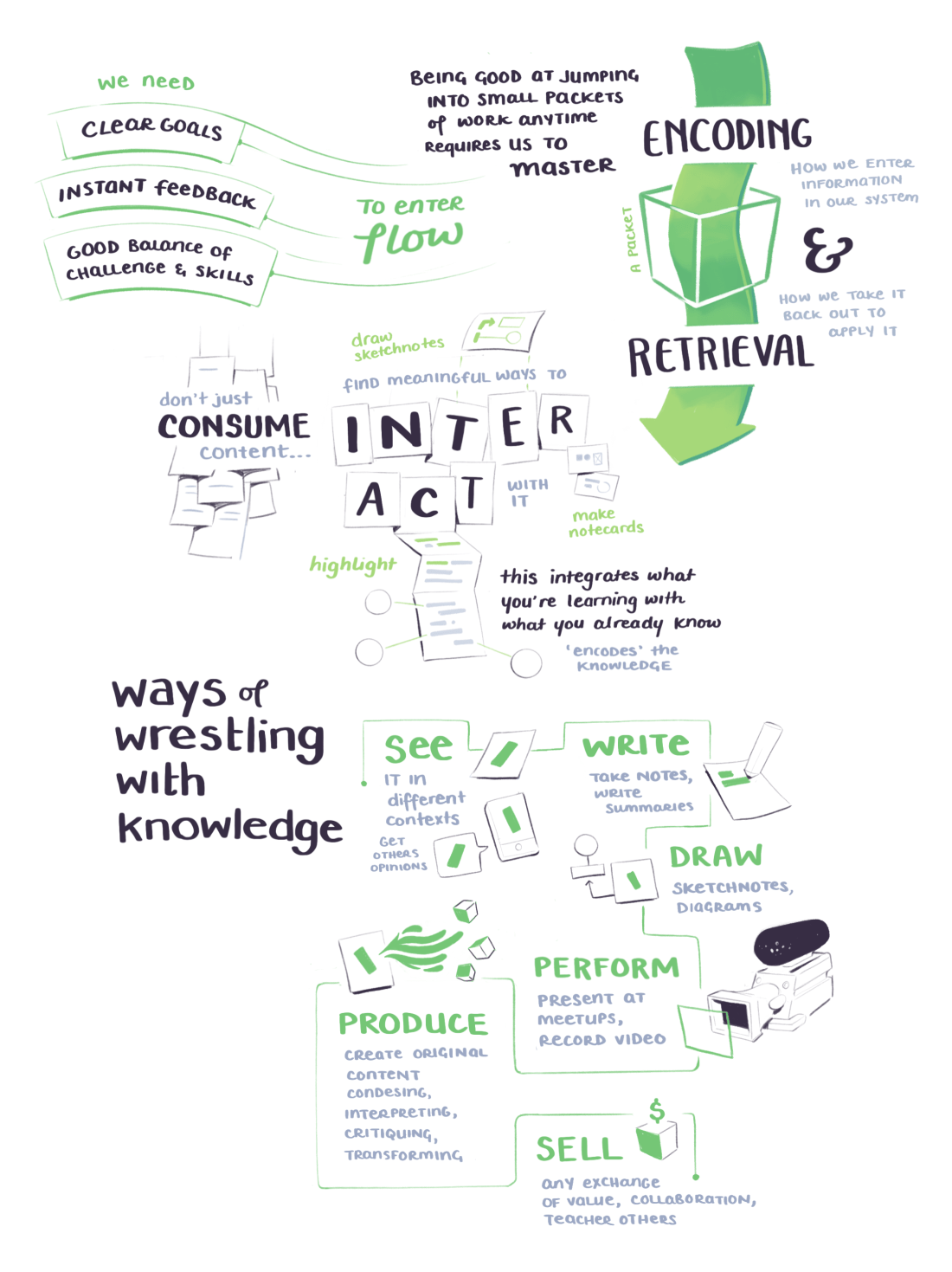
BASB sketchnotes on solving the interruptability of flow with placeholding and breaking work down into smaller packets

BASB sketchnotes on wrestling with knowledge by interacting with it in meanginful ways

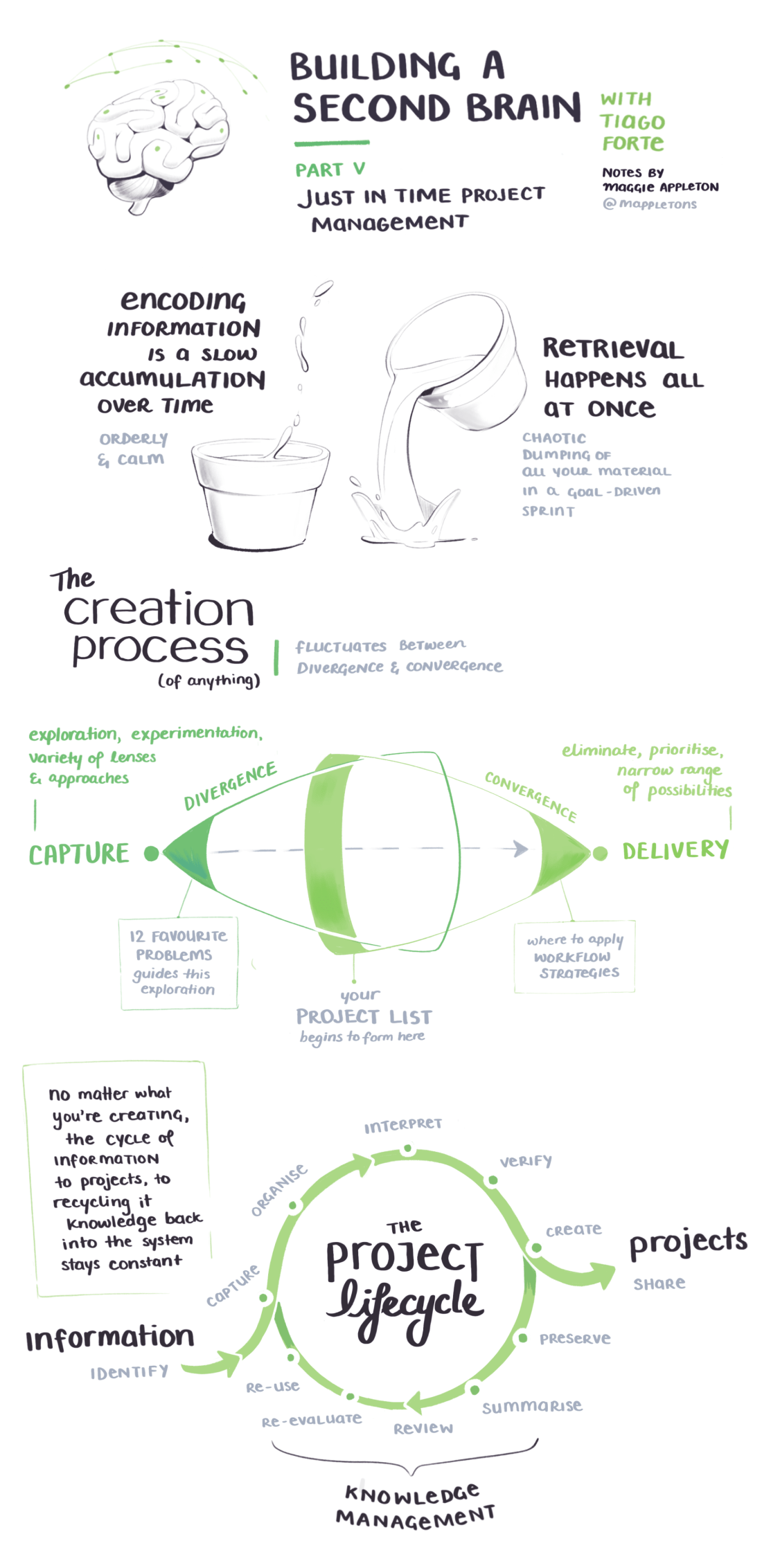
Just in time project management helps us balance our workflow between capture and delivery.

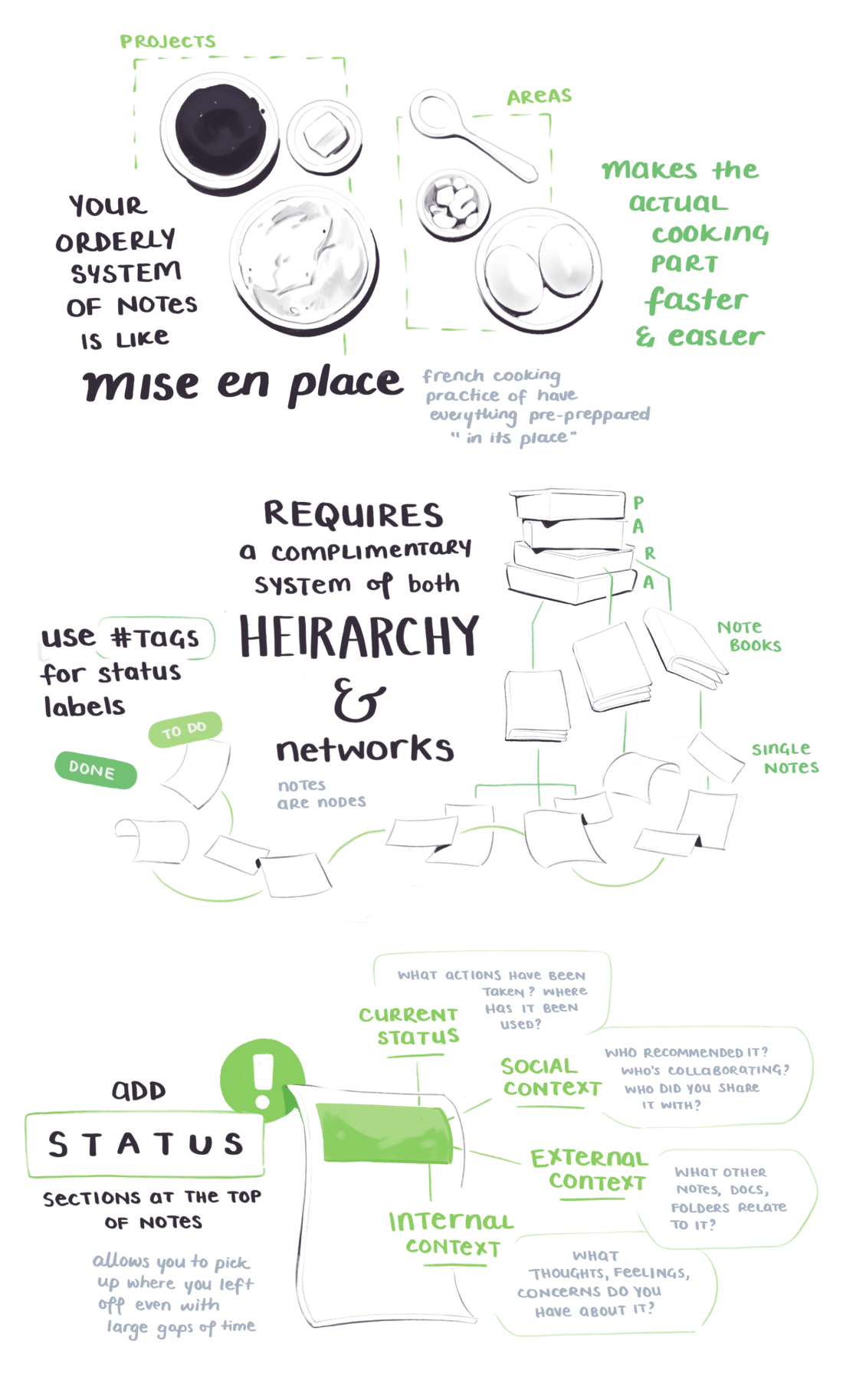
Your orderly system of notes is like mise en place – everything in its place

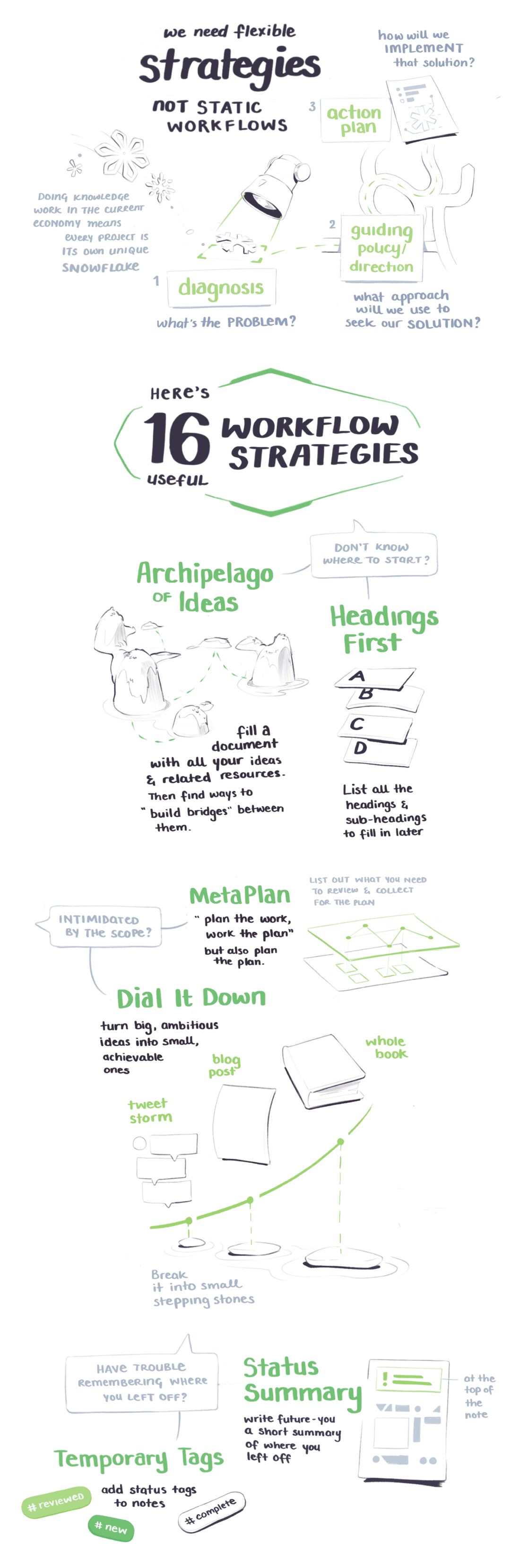
We need flexible strategies, not static workflows. We diagnose the problem, form a guiding policy to tackle it, and write an action plan to implement it.

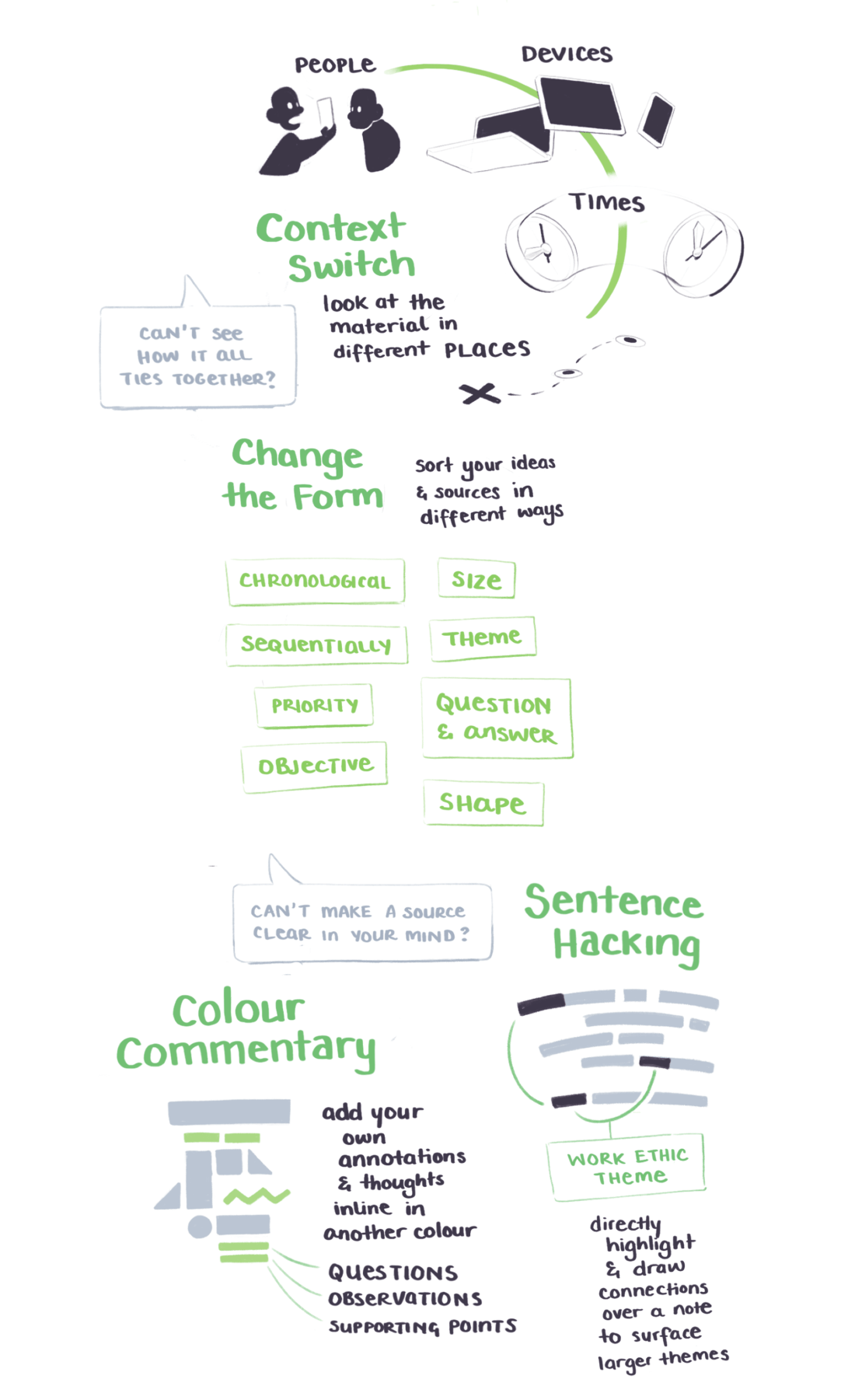
Some workflow strategies we can use include context switching, changing the form of our notes, and adding color commentary through annotations and highlights.