









Published on:
May 22, 2026
Built by Zach Rice as a side project in 2018, Gitleaks became the most starred secrets scanner on GitHub, racking up tens of millions of downloads, and finding its way into security programs at companies like GitLab and Red Hat. For a long time, it was simply the default choice. But then the project stalled. After Rice joined Truffle Security in 2023, his focus shifted to TruffleHog, development slowed, and Rice has been open about no longer having full control over the repo and name.
Meanwhile, the problem Gitleaks was built to solve has only gotten more serious. According to GitHub's own data, more than 39 million secrets were leaked across GitHub in 2024 alone. Developers have been accidentally leaking secrets into public code for as long as there has been public code. The only thing that changes is the number keeps going up. And vibe coding is not helping. AI-assisted development has changed the risk profile significantly. Developers move fast, skip manual review, and Rice himself has noted that people routinely override AI warnings about hardcoded credentials just to maintain momentum. More code is being written than ever before, and more of it is slipping through unreviewed.
That gap between where Gitleaks is today and where the threat landscape is is exactly why teams are looking for alternatives. We have covered the five strongest options below, from drop-in replacements to full AppSec platforms, so you can find the right fit without having to do all the research yourself.
Betterleaks is the clearest successor to Gitleaks, built by the same author and designed as a drop-in replacement that also fixes the core detection and flexibility shortcomings of its predecessor. It swaps entropy-based detection for token efficiency scanning (98.6% recall vs 70.4%), replaces hard-coded validation logic with rules written in the Common Expression Language (CEL), and can slot into AI agent workflows as naturally as any other CLI tool. If you are looking for the next generation of Gitleaks, that is where to start. For teams that want secrets detection as part of a broader security platform rather than a standalone scanner, Aikido is the best choice. It uses Betterleaks under the hood and bundles it alongside SAST, SCA, AI Pentesting, and Device Protection in one place. But depending on your stack and how much coverage you need, there are several others worth considering.
{{cta}}
Every modern application depends on secrets. API keys, passwords, tokens, certificates. The credentials that let your services talk to each other and access the systems they depend on. The problem is that they have a habit of ending up somewhere they shouldn't.
The most common culprit is source code. A developer hardcodes a credential to test something quickly, intends to swap it out before pushing, and either forgets or assumes it will be caught in review. Often it isn't. And even if the credential gets removed in the next commit, it lives on in the history of that repository forever, unless you go through the painful process of rewriting your Git history. That history is more exposed than most teams realize. Private repositories get cloned to developer machines, shared in internal wikis, and occasionally made public by accident. Bots continuously scan public code for usable credentials and can start exploiting them within minutes of exposure.
This is the problem Gitleaks was built to solve. By scanning repositories and their full commit history for exposed credentials, it gives teams a way to catch what manual review misses.
Beyond the project's uncertain future, there are technical limitations that have become harder to ignore. Gitleaks relies on entropy to identify candidate secrets, measuring how random a string looks as a way of flagging potential credentials. The problem is that plenty of real secrets do not look particularly random, and plenty of random strings are not secrets at all. Against the CredData dataset, entropy-based detection achieves around 70.4% recall, meaning nearly a third of real secrets can slip through. Beyond that, Gitleaks has no ability to verify whether a detected secret is actually live, meaning every finding requires manual triage to determine whether it poses a real risk.
Validation Logic | Filtering | Open Source | Active Maintenance | |
Betterleaks | ✅ CEL-based, configurable | ✅ BPE tokenization (98.6% recall) | ✅ MIT | ✅ 4 maintainers |
Aikido Security | ✅ CEL-based via Betterleaks engine | ✅ Via Betterleaks engine | ❌ | ✅ |
TruffleHog | ✅ Live API verification, 800+ types | ⚠️ Entropy-based, higher noise | ✅ AGPL-3.0 | ✅ Truffle Security |
GitHub Advanced Security | ✅ Validity checks, partner alerts | ⚠️ Pattern matching, limited customisation | ❌ | ✅ |
Spectral (Check Point) | ⚠️ Detection-focused, validation not documented | ✅ SPEQL custom detectors, 2000+ built-in | ❌ | ⚠️ Maintained by Check Point, enterprise-paced updates |
Betterleaks is the direct successor to Gitleaks, built by the same author and designed as a drop-in replacement. Your existing CLI flags and configs work out of the box, so switching requires minimal effort. And it fixes every core technical shortcoming listed above.
Detection accuracy improves significantly, with token efficiency scanning based on BPE tokenization hitting 98.6% recall against the CredData dataset. Validation logic is written in CEL, giving security teams the flexibility to define what counts as a live credential without forking the project. Betterleaks handles doubly and triply encoded credentials by default, catching a common obfuscation technique that many scanners miss entirely. It also slots naturally into automated pipelines including AI agent workflows
The project launched in early 2026 under an MIT license. Rice leads it alongside three co-maintainers, including engineers from Red Hat, Amazon, and RBC, directly addressing the single-maintainer stability concern that hung over Gitleaks. It is sponsored by Aikido Security, but governed independently.
Best for: teams already using Gitleaks that want better detection accuracy and a more actively maintained project without changing their workflow
Aikido's secrets detection is part of a broader security platform rather than a standalone scanner. It scans code repositories and Git history for exposed credentials, surfaces findings directly in your IDE, and integrates into CI pipelines to catch secrets before code is merged or deployed. It also includes liveness detection to verify whether an exposed secret is still active. The platform uses Betterleaks' detection engine under the hood, which means it inherits the token efficiency approach and CEL-based validation rather than relying on entropy.
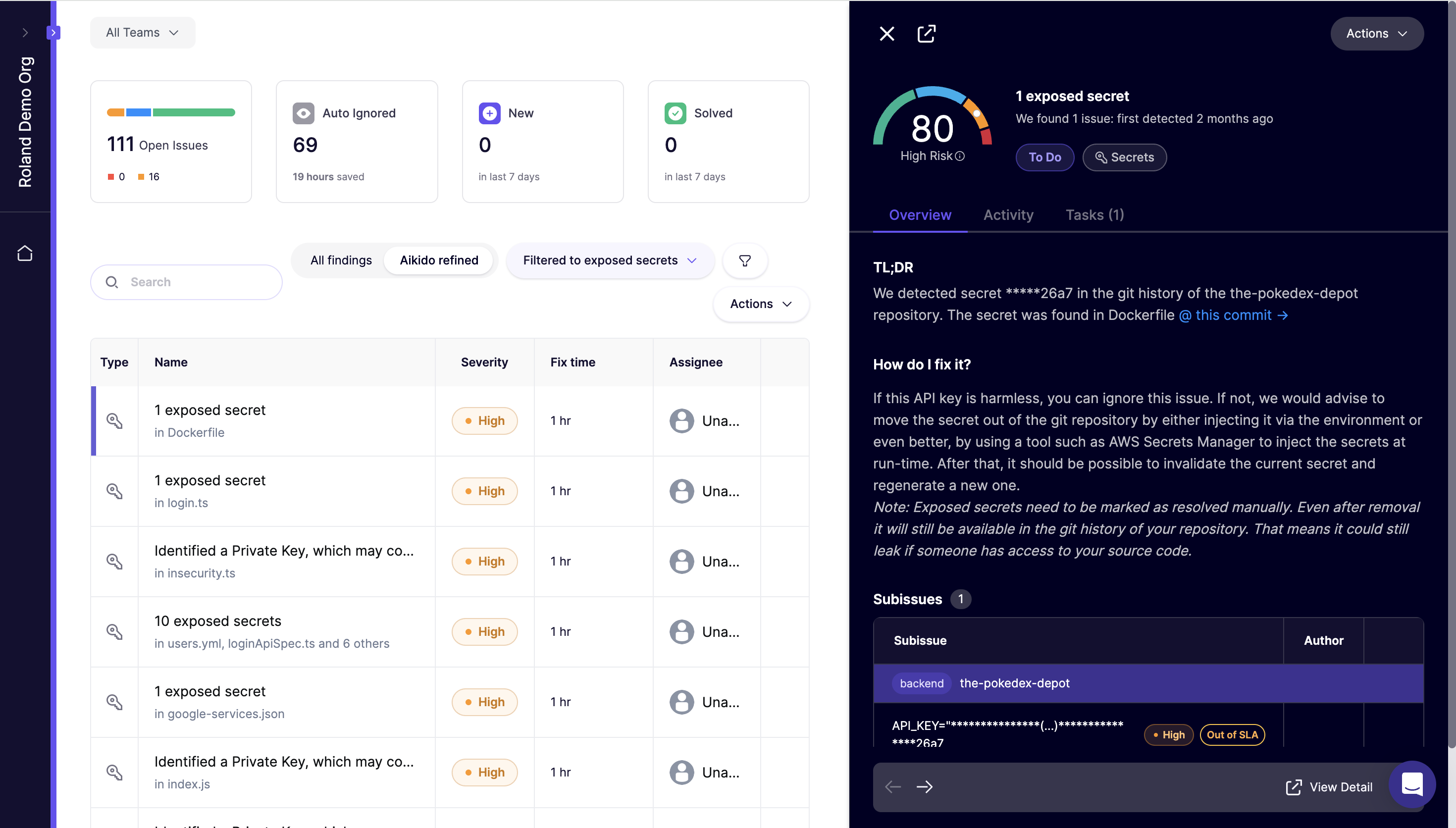
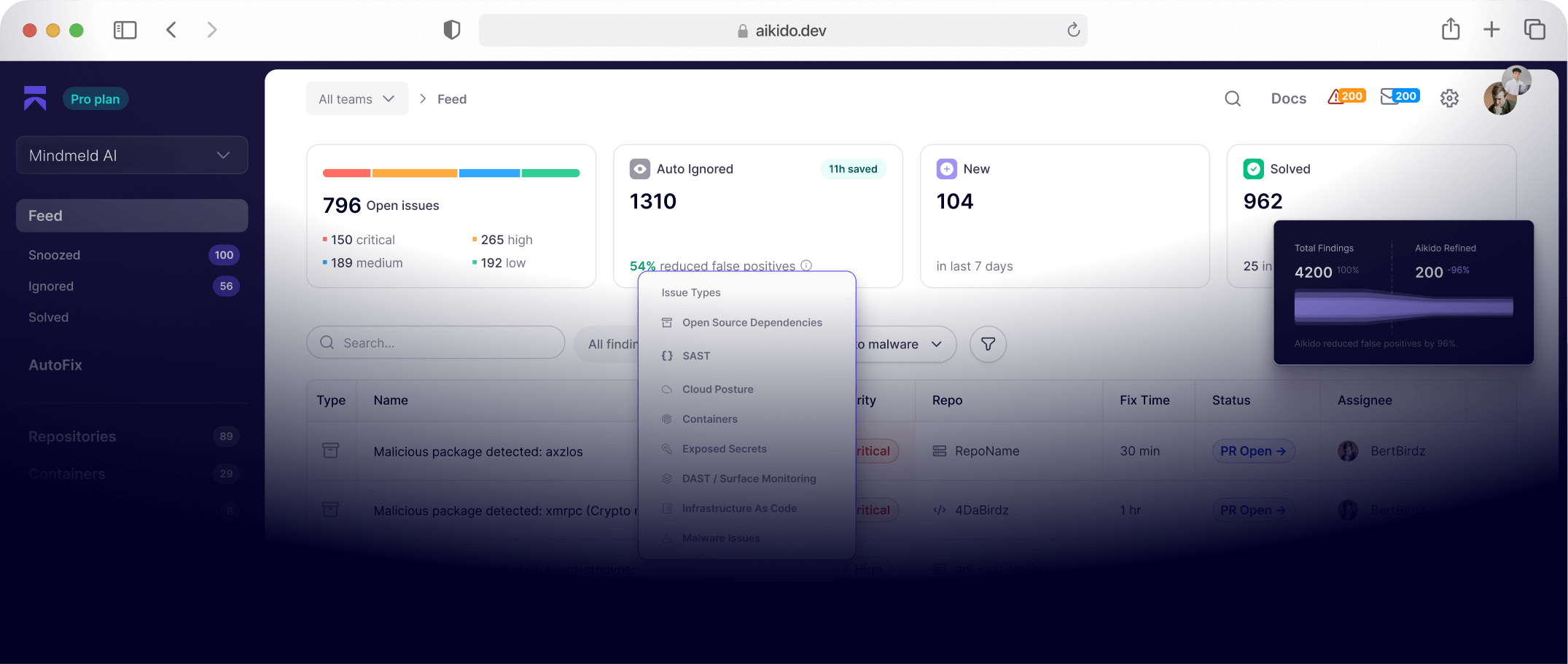
Where Aikido differs from a standalone tool is scope. Secrets scanning sits alongside SAST, SCA, AI Pentesting, Device Protection, IaC scanning, container image scanning, and cloud security posture management in a single platform. Teams may want secrets detection as part of a wider security program rather than as an isolated tool, as consolidation reduces the number of integrations to manage and keeps findings in one place. It also means you are not relying on a single open source maintainer for uptime or updates.
Best for: teams that want secrets detection as part of a broader AppSec platform rather than managing a standalone scanner
{{walkthrough}}
TruffleHog is an open source secrets scanner with widespread adoption, maintained by Truffle Security. Its defining capability is live credential verification. TruffleHog supports detecting over 800 credential types and makes API calls to confirm whether a discovered secret is still active. That matters in practice because most secrets found in old commits are already expired. TruffleHog tells you which ones are not, which significantly narrows down what actually needs remediation.
It also scans beyond Git repositories, covering S3 buckets, Docker images, Slack, Jira, Confluence, and GitHub and GitLab orgs, including pull request comments and issues. For teams whose secrets have spread into collaboration tools, this is useful coverage, though teams wanting that breadth alongside broader AppSec capabilities will find more in a platform like Aikido.
The trade-offs are worth noting. TruffleHog is licensed under AGPL-3.0, which creates obligations if you modify and distribute it. TruffleHog has limited support for detecting generic credentials which means if you have credentials for an internal custom service or other generic credentials, TruffleHog won't be able to detect them by default.
Best for: teams that want live credential verification across a wide range of sources and are comfortable with the AGPL license and the operational trade-offs of active API verification
GitHub Advanced Security is worth considering if your team is already on GitHub and wants secrets detection that lives natively within that ecosystem. It scans repositories, pull requests, issues, wikis, and Git history for exposed credentials, and includes push protection that blocks commits containing known secrets before they land. Validity checks are available for supported provider patterns, and in October 2025 GitHub added base64-encoded secret detection with push protection by default, addressing one of the more common obfuscation techniques.
In March 2026, GitHub also extended scanning to AI coding agent workflows via MCP integration, making it possible to catch secrets generated by tools like Claude Code before they reach version control.
The main limitation is scope. GitHub Advanced Security only works within GitHub. It does not offer the kind of configurable validation logic that Betterleaks or TruffleHog provide. And custom pattern support requires additional configuration. GitHub Advanced Security sits on top of an existing GitHub subscription, and since April 2025 secrets scanning and code scanning are billed as separate add-ons per active committer on top of that. For teams that need both capabilities, the costs add up quickly. For teams already deeply invested in GitHub who want a low-friction baseline, it is a reasonable starting point. For teams that need broader coverage or more flexibility, it will need supplementing.
Best for: teams already on GitHub that want a low-setup baseline for secrets detection without adding an external tool
Spectral started life as an independent developer security startup before being acquired by Check Point in 2022 and folded into the CloudGuard platform. It covers secrets scanning alongside IaC scanning and SCA, and includes SPEQL, a YAML-based proprietary query language that lets teams write and share custom detectors without modifying the core tool. It scans across Git repositories, containers, logs, and cloud storage, and integrates with most major CI systems.
The limitations are worth understanding before evaluating it. Spectral focuses on detection rather than validation, so teams will need a separate step in their workflow to confirm whether a detected secret is still active. Filtering relies on pattern matching and custom SPEQL rules rather than the kind of token efficiency approach that meaningfully reduces noise. And while the tool can be run as a standalone CLI without full CloudGuard onboarding, pricing and support go through Check Point's enterprise sales process, which is a different buying experience than the self-serve models offered by most other tools in this list.
A big question for most teams is whether Spectral's roadmap will keep pace with a threat landscape that is moving fast. Check Point is a large enterprise security vendor whose core business is network security. Developer-first secrets scanning is not where their priorities lie, and the pace of innovation since the acquisition has reflected that. For teams that need a secrets scanner today, there are options that are more actively developed and better suited to the way modern engineering teams work.
Best for: teams already operating within the Check Point security ecosystem who want secrets scanning that integrates with their existing tooling without introducing a new vendor
If you need… | Instead of Gitleaks consider… | Why? |
A drop-in replacement with better detection | Betterleaks | Same author, backwards-compatible CLI, 98.6% recall vs 70.4% |
Secrets detection as part of a full AppSec platform | Aikido Security | Secrets, SAST, SCA, DAST, and cloud security in one platform |
Betterleaks detection without the maintenance overhead | Aikido Security | Runs Betterleaks under the hood, fully managed |
Flexible, customisable validation rules in an open source tool | Betterleaks | Only open source scanner with CEL-based validation |
A GitHub-native baseline with minimal setup | GitHub Advanced Security | Native push protection, minimal setup, stays within GitHub |
Enterprise governance and compliance | Aikido Security | Built-in compliance reports for SOC 2, ISO 27001, and more |
Gitleaks changed the space and Rice built something genuinely important. But security tooling has to keep pace with the threats it is defending against, and right now that means keeping up with an attack surface that looks very different from the one Gitleaks was built for. The tools in this list reflect where the space is heading. The right one for your team comes down to how much operational overhead you are willing to take on, and whether secrets scanning is a standalone problem or part of a broader security program you are trying to consolidate.
If you are coming from Gitleaks and want the lowest-friction upgrade, Betterleaks is the obvious starting point. If you want that same detection quality without the operational overhead of running and maintaining open source tooling yourself, Aikido gives you Betterleaks under the hood as part of a platform that covers your entire security posture. For most engineering teams, that is the more sustainable path.
What is the best open source secrets scanner?
Betterleaks is the strongest option for teams coming from Gitleaks, with better detection accuracy and an active four-person maintenance team. TruffleHog is the best choice if live credential verification across multiple sources is the priority. Both are open source, though TruffleHog is AGPL-3.0 while Betterleaks is MIT.
What secrets detection tool has the lowest false positive rate?
Betterleaks. It uses a detection approach that achieves 98.6% recall against the CredData dataset compared to 70.4% for entropy-based tools like Gitleaks. Aikido, which runs Betterleaks under the hood, adds liveness detection on top, automatically filtering out expired or revoked credentials.
What is the best drop-in replacement for Gitleaks?
Betterleaks is the most direct replacement, built by the same author with backwards compatibility in mind. Your existing CLI flags, configs, and pre-commit hooks work out of the box, so switching is fast and requires no reworking of your setup.
Why is Gitleaks no longer actively developed?
After Rice joined Truffle Security in 2023, his focus shifted to TruffleHog and development on Gitleaks slowed. Rice has also been open about no longer having full control over the repo and name. Security patches will continue, but new features and detector updates will not. Betterleaks is where that work is now happening.
What are the most important features to look for in a secrets scanner?
Detection accuracy and false positive rate matter most. A scanner that flags everything is not useful if your team spends more time triaging noise than fixing real issues. Beyond that, look for validation logic and active maintenance. The comparison table above covers how each tool in this list performs across those dimensions.
Which AppSec platforms include secrets detection?
Aikido Security includes secrets detection as part of a broader platform covering SAST, SCA, DAST, IaC scanning, and cloud security. Spectral, now part of Check Point CloudGuard, also bundles secrets scanning alongside other code security capabilities.
Last updated on:
May 22, 2026
<script type="application/ld+json">
{
"@context": "https://schema.org",
"@graph": [
{
"@type": "BlogPosting",
"@id": "https://www.aikido.dev/blog/gitleaks-alternatives#article",
"mainEntityOfPage": {
"@type": "WebPage",
"@id": "https://www.aikido.dev/blog/gitleaks-alternatives"
},
"headline": "5 Gitleaks Alternatives and Why They Are Better",
"description": "Gitleaks is no longer actively developed. We compare the five strongest alternatives in 2026, including Betterleaks, TruffleHog, Aikido Security, GitHub Advanced Security, and Spectral, across detection accuracy, validation logic, open source licensing, and maintenance activity.",
"url": "https://www.aikido.dev/blog/gitleaks-alternatives",
"datePublished": "2026-05-01T00:00:00Z",
"dateModified": "2026-05-01T00:00:00Z",
"author": {
"@type": "Person",
"@id": "https://www.aikido.dev/authors/nicholas-thomson",
"name": "Nicholas Thomson",
"jobTitle": "Senior SEO & Growth Lead",
"url": "https://www.aikido.dev/authors/nicholas-thomson",
"worksFor": {
"@type": "Organization",
"name": "Aikido Security",
"url": "https://www.aikido.dev"
},
"sameAs": [
"https://www.linkedin.com/",
"https://x.com/"
]
},
"publisher": {
"@type": "Organization",
"@id": "https://www.aikido.dev#organization",
"name": "Aikido Security",
"url": "https://www.aikido.dev",
"logo": {
"@type": "ImageObject",
"url": "https://www.aikido.dev/logo.png"
}
},
"image": {
"@type": "ImageObject",
"url": "https://www.aikido.dev/images/gitleaks-alternatives.png",
"width": 1200,
"height": 630
},
"articleSection": "DevSec Tools & Comparisons",
"keywords": [
"Gitleaks alternatives",
"secrets scanning",
"secrets detection",
"Betterleaks",
"TruffleHog",
"Aikido Security",
"GitHub Advanced Security",
"Spectral Check Point",
"open source secrets scanner",
"credential leakage",
"API key detection",
"hardcoded secrets",
"CEL validation",
"token efficiency scanning",
"BPE tokenization",
"AppSec platform",
"DevSecOps",
"SAST",
"SCA",
"vibe coding security"
],
"timeRequired": "PT10M",
"inLanguage": "en",
"about": [
{
"@type": "SoftwareApplication",
"name": "Gitleaks",
"url": "https://github.com/gitleaks/gitleaks",
"applicationCategory": "SecurityApplication"
},
{
"@type": "SoftwareApplication",
"name": "Betterleaks",
"url": "https://github.com/betterleaks/betterleaks",
"applicationCategory": "SecurityApplication",
"license": "https://opensource.org/licenses/MIT"
},
{
"@type": "SoftwareApplication",
"name": "TruffleHog",
"url": "https://github.com/trufflesecurity/trufflehog",
"applicationCategory": "SecurityApplication",
"license": "https://www.gnu.org/licenses/agpl-3.0.en.html"
},
{
"@type": "SoftwareApplication",
"name": "Aikido Security",
"url": "https://www.aikido.dev",
"applicationCategory": "SecurityApplication"
},
{
"@type": "SoftwareApplication",
"name": "GitHub Advanced Security",
"url": "https://docs.github.com/en/get-started/learning-about-github/about-github-advanced-security",
"applicationCategory": "SecurityApplication"
},
{
"@type": "SoftwareApplication",
"name": "Spectral",
"url": "https://spectralops.io",
"applicationCategory": "SecurityApplication"
}
],
"mentions": [
{
"@type": "Person",
"name": "Zach Rice",
"url": "https://www.linkedin.com/in/zricethezav/"
},
{
"@type": "Organization",
"name": "Truffle Security",
"url": "https://trufflesecurity.com"
},
{
"@type": "Organization",
"name": "Check Point",
"url": "https://www.checkpoint.com"
},
{
"@type": "Organization",
"name": "GitGuardian",
"url": "https://www.gitguardian.com"
},
{
"@type": "DefinedTerm",
"name": "Secrets Scanning",
"description": "The process of identifying exposed credentials such as API keys, passwords, and tokens in source code, commit history, and other data sources."
},
{
"@type": "DefinedTerm",
"name": "Token Efficiency Scanning",
"description": "A detection approach used by Betterleaks that measures how efficiently a BPE tokenizer compresses a string, providing a stronger signal for identifying real credentials than entropy-based methods."
},
{
"@type": "DefinedTerm",
"name": "Common Expression Language (CEL)",
"description": "A flexible, portable expression language used by Betterleaks to define validation logic for detected secrets."
},
{
"@type": "DefinedTerm",
"name": "Entropy-based Detection",
"description": "A method of identifying potential secrets by measuring the randomness of strings, used by tools including Gitleaks and TruffleHog."
}
],
"speakable": {
"@type": "SpeakableSpecification",
"cssSelector": [".article-headline", ".article-summary", ".faq-question", ".faq-answer"]
}
},
{
"@type": "WebPage",
"@id": "https://www.aikido.dev/blog/gitleaks-alternatives",
"url": "https://www.aikido.dev/blog/gitleaks-alternatives",
"name": "5 Gitleaks Alternatives and Why They Are Better",
"description": "Gitleaks is no longer actively developed. We compare the five strongest alternatives in 2026, including Betterleaks, TruffleHog, Aikido Security, GitHub Advanced Security, and Spectral.",
"isPartOf": {
"@type": "WebSite",
"@id": "https://www.aikido.dev#website",
"name": "Aikido Security",
"url": "https://www.aikido.dev"
},
"breadcrumb": {
"@id": "https://www.aikido.dev/blog/gitleaks-alternatives#breadcrumb"
},
"primaryImageOfPage": {
"@type": "ImageObject",
"url": "https://www.aikido.dev/images/gitleaks-alternatives.png"
}
},
{
"@type": "BreadcrumbList",
"@id": "https://www.aikido.dev/blog/gitleaks-alternatives#breadcrumb",
"itemListElement": [
{
"@type": "ListItem",
"position": 1,
"name": "Home",
"item": "https://www.aikido.dev"
},
{
"@type": "ListItem",
"position": 2,
"name": "Blog",
"item": "https://www.aikido.dev/blog"
},
{
"@type": "ListItem",
"position": 3,
"name": "5 Gitleaks Alternatives and Why They Are Better",
"item": "https://www.aikido.dev/blog/gitleaks-alternatives"
}
]
},
{
"@type": "Organization",
"@id": "https://www.aikido.dev#organization",
"name": "Aikido Security",
"url": "https://www.aikido.dev",
"logo": {
"@type": "ImageObject",
"url": "https://www.aikido.dev/logo.png"
},
"sameAs": [
"https://www.linkedin.com/company/aikido-security",
"https://x.com/aikido_security",
"https://github.com/AikidoSec"
]
},
{
"@type": "ItemList",
"@id": "https://www.aikido.dev/blog/gitleaks-alternatives#itemlist",
"name": "5 Gitleaks Alternatives in 2026",
"description": "The five strongest alternatives to Gitleaks for secrets scanning in 2026",
"numberOfItems": 5,
"itemListElement": [
{
"@type": "ListItem",
"position": 1,
"name": "Betterleaks",
"description": "The direct successor to Gitleaks, built by the same author with token efficiency scanning achieving 98.6% recall and CEL-based validation.",
"url": "https://github.com/betterleaks/betterleaks"
},
{
"@type": "ListItem",
"position": 2,
"name": "Aikido Security",
"description": "A full AppSec platform that uses Betterleaks under the hood alongside SAST, SCA, DAST, and cloud security.",
"url": "https://www.aikido.dev/code/secrets-detection"
},
{
"@type": "ListItem",
"position": 3,
"name": "TruffleHog",
"description": "An open source secrets scanner with live credential verification across 800+ secret types and broad source coverage.",
"url": "https://github.com/trufflesecurity/trufflehog"
},
{
"@type": "ListItem",
"position": 4,
"name": "GitHub Advanced Security",
"description": "A GitHub-native secrets scanning solution with push protection, validity checks, and MCP integration for AI agent workflows.",
"url": "https://docs.github.com/en/get-started/learning-about-github/about-github-advanced-security"
},
{
"@type": "ListItem",
"position": 5,
"name": "Spectral",
"description": "A secrets scanner now part of Check Point CloudGuard, offering SPEQL custom detectors and broad source coverage.",
"url": "https://spectralops.io"
}
]
},
{
"@type": "FAQPage",
"@id": "https://www.aikido.dev/blog/gitleaks-alternatives#faq",
"mainEntity": [
{
"@type": "Question",
"name": "What is the best open source secrets scanner?",
"acceptedAnswer": {
"@type": "Answer",
"text": "Betterleaks is the strongest option for teams coming from Gitleaks, with better detection accuracy and an active four-person maintenance team. TruffleHog is the best choice if live credential verification across multiple sources is the priority. Both are open source, though TruffleHog is AGPL-3.0 while Betterleaks is MIT."
}
},
{
"@type": "Question",
"name": "What secrets detection tool has the lowest false positive rate?",
"acceptedAnswer": {
"@type": "Answer",
"text": "Betterleaks. It uses a detection approach that achieves 98.6% recall against the CredData dataset compared to 70.4% for entropy-based tools like Gitleaks. Aikido, which runs Betterleaks under the hood, adds liveness detection on top, automatically filtering out expired or revoked credentials."
}
},
{
"@type": "Question",
"name": "What is the best drop-in replacement for Gitleaks?",
"acceptedAnswer": {
"@type": "Answer",
"text": "Betterleaks is the most direct replacement, built by the same author with backwards compatibility in mind. Your existing CLI flags, configs, and pre-commit hooks work out of the box, so switching is fast and requires no reworking of your setup."
}
},
{
"@type": "Question",
"name": "Why is Gitleaks no longer actively developed?",
"acceptedAnswer": {
"@type": "Answer",
"text": "After Rice joined Truffle Security in 2023, his focus shifted to TruffleHog and development on Gitleaks slowed. Rice has also been open about no longer having full control over the repo and name. Security patches will continue, but new features and detector updates will not. Betterleaks is where that work is now happening."
}
},
{
"@type": "Question",
"name": "What are the most important features to look for in a secrets scanner?",
"acceptedAnswer": {
"@type": "Answer",
"text": "Detection accuracy and false positive rate matter most. A scanner that flags everything is not useful if your team spends more time triaging noise than fixing real issues. Beyond that, look for validation logic and active maintenance."
}
},
{
"@type": "Question",
"name": "Which AppSec platforms include secrets detection?",
"acceptedAnswer": {
"@type": "Answer",
"text": "Aikido Security includes secrets detection as part of a broader platform covering SAST, SCA, DAST, IaC scanning, and cloud security. Spectral, now part of Check Point CloudGuard, also bundles secrets scanning alongside other code security capabilities."
}
}
]
}
]
}
</script>
Tired of false positives?
Try Aikido like 100k others.
Start Now
Get a personalized walkthrough
Trusted by 100k+ teams
Book Now
Scan your app for IDORs and real attack paths
Trusted by 100k+ teams
Start Scanning
See how AI pentests your app
Trusted by 100k+ teams
Start Testing
See how Aikido's secrets detection works
No CC required. Scan results in 32 seconds.
Start Now
•
DevSec Tools & Comparisons
AI SAST is emerging as a new SAST category, but the meaning is unclear. We clarify the difference between AI-native SAST and AI-assisted SAST, as well as how AI SAST sits in the stack between traditional SAST and AI pentesting.

•
DevSec Tools & Comparisons
Tenable Nessus is a powerful scanner, but powerful tools that nobody uses don't make software more secure. Compare five alternatives built for how engineering teams actually work.
•
DevSec Tools & Comparisons
Compare the Top GitGuardian Alternatives for secrets scanning in 2026. See where Aikido Security, GitHub Secret Protection, TruffleHog, Gitleaks, Semgrep, Snyk, Cycode, Checkmarx, and GitLab fit best.
Secure your code, cloud, and runtime in one central system.
Find and fix vulnerabilities fast automatically.
No credit card required | Scan results in 32secs.

此内容由惯性聚合(RSS阅读器)自动聚合整理,仅供阅读参考。 原文来自 — 版权归原作者所有。