




Published on:
Jun 26, 2026
Developer devices are now the number one target of supply chain attacks, and Koi built their platform to address that. Founded in 2024, Koi combines a network-level Supply Chain Gateway with endpoint inventory and governance across packages, extensions, and AI tooling.
But Koi is no longer an independent company. Palo Alto Networks completed its acquisition of Koi in April 2026, finalizing a deal estimated at around $400 million. If you're evaluating Koi today, you're effectively evaluating a feature on Palo Alto Networks' roadmap, and that changes the conversation significantly.
Palo Alto Networks plans to fold Koi's technology into Cortex XDR, and extend it to Prisma AIRS, its AI security platform. That means a startup that competed on speed and simplicity is now inside one of the most complex, sprawling security platforms on the market. Customers will be faced with attendant changes to the pricing, sales cycles, and integration complexity that comes with that.
If you are evaluating Koi, or looking beyond it, the question is whether you want endpoint install governance as one module inside a legacy enterprise suite, or a platform that covers the full developer attack surface from the code your engineers write to the tools they install, without the overhead.
Best overall: Aikido Security for teams that want device protection alongside coverage of the entire SDLC. Aikido Device Protection blocks malicious installs across packages, extensions, browser plugins, and AI tools at the device level, with transparent pricing and minimum-package-age defenses Koi doesn't advertise. Additionally, Aikido is a complete security platform that offers best-in-class SAST, SCA, secrets, IaC, containers, DAST, AI pentesting, and cloud posture, so you're not stitching together half a dozen tools.
Koi was built to secure the software layer that developers manage themselves. EDRs watch for malicious executables, and SCA tools scan dependencies for known CVEs, but neither was designed to catch a malicious VS Code extension or a hijacked npm package before it executes, because neither has visibility into that layer.
Koi's answer is to govern the install moment. Its Supply Chain Gateway intercepts installs from public marketplaces and registries before they reach the device, while the Endpoint product maintains a continuous inventory of software already running across the organization and can remove or quarantine risky items when found.
Rather than deploying its own on-device component, Koi uses existing MDM or EDR agents already in place, which is what their "agentless" positioning refers to. Koi doesn't publish technical documentation publicly, so the precise mechanics of how these layers interact are difficult to verify from the outside.
The Wings risk engine continuously re-evaluates packages, extensions, and models as they change, which means Koi isn't working from a static list. Software that was clean at install can be flagged when a new version introduces malicious code, which is exactly what happened in the axios compromise. Some of Wings' findings are surfaced publicly through Koidex, Koi's threat intelligence index, though most of the engine's logic and the underlying detection methodology sit behind the product.
Koi was acquired by Palo Alto Networks in April 2026. The deal validates that developer workstation supply chain risk is real and urgent. What it changes is what you're actually buying. Palo Alto has said Koi will be available three ways, integrated into Prisma AIRS, as a new Cortex XDR module, and as a standalone offering. The standalone option means existing customers won't immediately be forced into a full Palo Alto engagement, but pricing, packaging, and roadmap are now subject to Palo Alto's commercial model. Acquisitions like this typically take 12 to 18 months to fully integrate. In the meantime, roadmaps slow, pricing changes, and the focused startup that competed on speed becomes one product inside a portfolio of more than 20. Teams that want something they can deploy this week are not well served by that model.
Governing what developers install is only one part of keeping a codebase secure. For example, a developer installs a clean package, Koi clears it, the install goes through, and the endpoint is protected. But if that same developer has a hardcoded API key in a config file committed to an internal repo, a SQL injection vulnerability in the service they're writing, or a misconfigured S3 bucket, Koi has no visibility into any of it. Endpoint governance and application security are solving different problems.
Most malicious packages are new releases. A maintainer account gets compromised, a malicious version gets published, and the attack window is the first 24 to 48 hours before the broader community catches it. Holding new packages for a configurable cooldown period before they're allowed through is one of the most effective defenses against this pattern. Koi doesn't publicly describe an equivalent countermeasure. Aikido Device Protection ships with a default 48-hour minimum package age policy that stops "publish-and-pray" malware before it spreads.
Koi has no public pricing, no self-serve trial, and limited public technical documentation. Evaluation runs through a Palo Alto Networks sales conversation and a custom POC. For developer-led organizations that prefer to assess tools by reading the docs and trying them out, that's a serious friction point.
Not every platform offering SCA or supply chain protection extends that coverage to the device itself. Check whether a potential alternative monitors installs in real time across package managers, IDE extensions, browser plugins, and AI tools, or whether its supply chain coverage stops at scanning what is already in the repository.
Look for a platform that also covers SAST, SCA, secrets detection, IaC misconfigurations, container images, and cloud posture, so you are not adding another dashboard to an already crowded security toolchain.
When a security vendor gets acquired, the standalone product often becomes a feature inside a larger suite, with pricing, packaging, and roadmap decisions moving to the parent company. Check whether a potential alternative is independent and developer-focused, or whether it sits inside a legacy enterprise platform where its scope, integration model, and direction are shaped by that larger business.
Published pricing, self-serve trials, and public technical documentation let you evaluate a tool against your actual needs before talking to a salesperson. If costs are only available on request and evaluation runs through a custom POC, total cost of ownership and product fit becomes hard to assess upfront.
| Tool | Supply chain age defenses | Vendor independence | Full platform breadth | Pricing and evaluation transparency |
|---|---|---|---|---|
| Aikido | ✅ Default 48-hour minimum package age | ✅ | ✅ SAST, SCA, secrets, IaC, containers, DAST, CSPM | ✅ Published pricing, free tier |
| Koi | ❌ No countermeasure advertised | ❌ Acquired by Palo Alto Networks | ❌ Endpoint governance only | ❌ No public pricing, sales-led |
| Socket | ⚠️ Configurable via Socket Firewall | ✅ | ⚠️ SCA, plus rules-based SAST and containers via Socket Basics; no DAST or cloud | ✅ Free tier, public pricing |
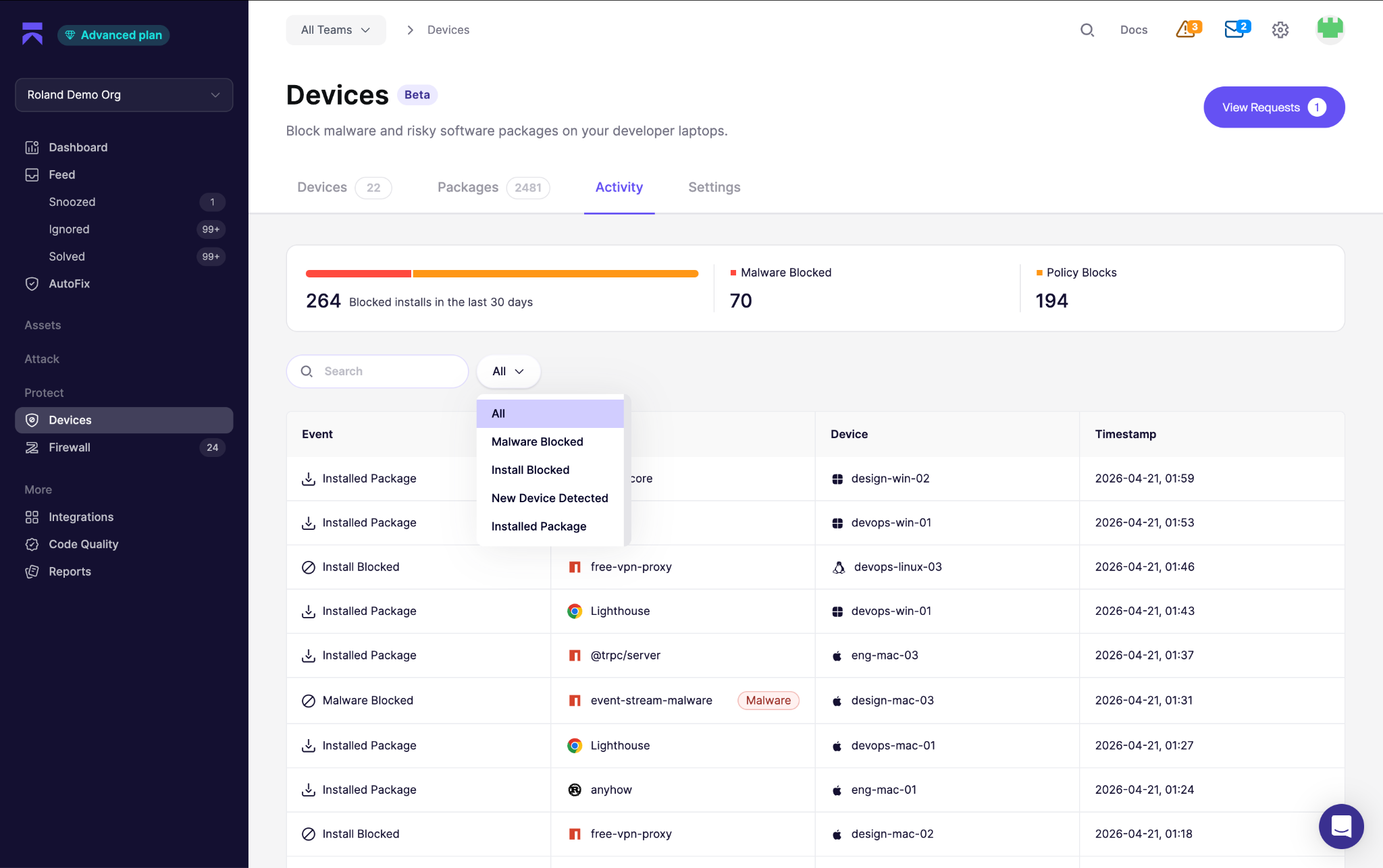
Aikido Security is the best alternative for teams looking at Koi, going further on developer device protection while extending across the rest of the developer attack surface in one platform.
Aikido Device Protection monitors every package install, browser extension, IDE plugin, and AI tool across developer devices, blocking malicious software before it reaches the machine. The key difference from Koi is how that protection gets enforced. Aikido deploys its own on-device agent through MDM tools like Jamf or Fleet, intercepting installs at the kernel level as they happen. Koi takes an orchestration approach, relying on whatever SWG, EDR, or MDM the customer already runs to act on its alerts, which adds dependencies and means Koi can only move as fast as the slowest tool in the stack.
Aikido's on-device agent also works off-network, catching install traffic on personal hotspots, coffee shop WiFi, or anywhere developers actually work. And while Koi advertises no equivalent supply chain age defense, Aikido ships with a default 48-hour minimum package age policy that holds new and updated packages until the broader community has had time to catch malicious releases, which is exactly the pattern behind attacks like axios and Nx/Singularity.
Aikido Device Protection builds on Safe Chain, an open-source CLI wrapper that's been running on developer machines for over a year and crosses 200,000 weekly downloads. Both run on Aikido Intel, a real-time threat intelligence engine that analyzes over 100,000 suspicious projects per day.
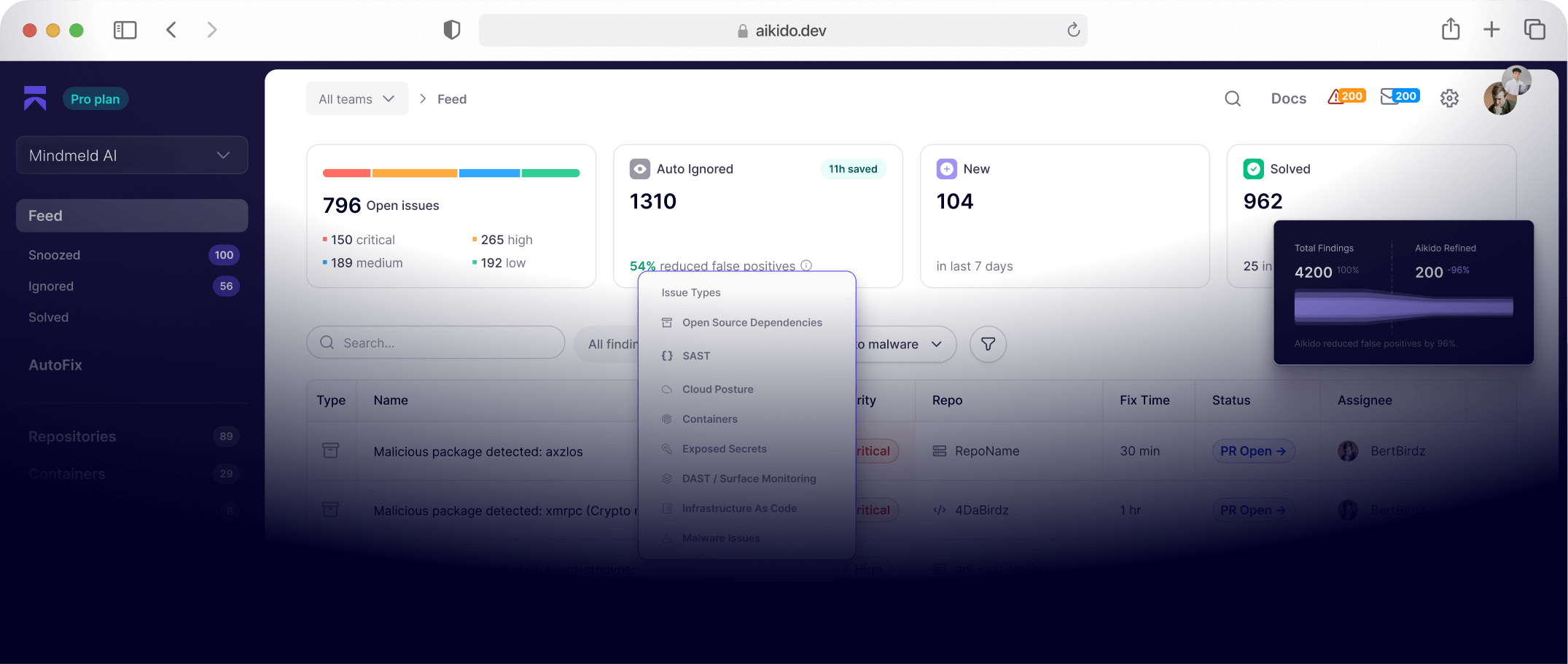
Where Koi stops at the install moment, Aikido's platform covers SAST, SCA, secrets detection, IaC, container images, DAST, AI Pentesting, and cloud posture, so teams are not stitching together a separate tool for every layer of the stack. Findings surface directly in pull requests with AutoFix suggestions attached, and native integrations with Slack, Jira, Linear, and Vanta mean issues flow into the workflows engineers already use rather than sitting in a dashboard nobody checks.
Reviewers consistently highlight ease of onboarding, noise reduction, and developer workflow fit as the standout differences from legacy tools.
Teams ranging from startups to enterprises that want device-level supply chain protection alongside coverage of the full SDLC
Free plan available, with published platform tiers and custom enterprise options.
{{cta}}
Socket is a supply chain security platform built around behavioral analysis of open source packages. Where traditional SCA tools scan dependencies against known CVE databases, Socket analyzes what packages actually do. It looks at network connections, filesystem access, shell execution, and obfuscated code patterns, flagging threats before any CVE exists. It integrates as a GitHub App that comments on pull requests whenever a dependency changes, and its Socket Firewall intercepts at the package manager config layer, wrapping the package manager itself to check packages before install.
Socket approaches the supply chain problem from the repository and CI/CD pipeline inward, which means endpoint coverage beyond package managers is still limited and actively being built out. Socket has recently shipped VS Code and Open VSX extension blocking, but browser extensions and MCP server governance remain less developed than Koi's, which covers extension and marketplace governance natively across more ecosystems.
Where Socket goes deeper is in package analysis itself. Where Koi goes wider is in extension and marketplace governance across browser stores, VS Code Marketplace, OpenVSX, and MCP servers. For a team specifically evaluating Koi alternatives, Socket is a credible option if package supply chain is the primary concern, but it doesn't yet match Koi's breadth across the broader software install ecosystem.
Teams looking for behavioral analysis of open source dependencies, with risk surfaced in pull requests, who don't yet need broader AppSec coverage.
Endpoint coverage beyond package managers is still maturing; no AI SAST, DAST, IaC, or cloud posture management; not a standalone security platform.
Free for open source projects. Paid plans for teams and enterprises; pricing available on request.
What is Koi Security?
Koi is an endpoint security platform that governs software installs across developer devices. It monitors and controls what developers can install from browser extension marketplaces, package managers, IDE extension stores, MCP servers, and AI model repositories, blocking malicious or non-compliant software before it reaches the machine.
Why are teams looking for Koi Security alternatives?
Most teams looking for a Koi alternative need coverage beyond the install moment. Koi governs what gets installed but has no visibility into source code vulnerabilities, open-source dependency risk in existing repos, hardcoded secrets, IaC misconfigurations, or cloud posture. Teams also have open questions about roadmap and pricing following Koi's acquisition by Palo Alto Networks in June 2026.
What is the difference between install-time protection and repository scanning?
Install-time protection governs what software reaches a developer's device or environment, blocking malicious packages, extensions, and AI tools before they execute. Repository scanning analyzes code and dependencies already in your codebase, identifying known CVEs, secrets, and misconfigurations. Most teams need both. Install-time protection stops novel supply chain attacks that have no CVE yet, while repository scanning catches vulnerabilities already present in the stack.
What is the best Koi Security alternative in 2026?
Aikido Security is the strongest alternative for most teams. It goes beyond Koi in protecting developer devices, while also covering the full SDLC, including SAST, SCA, secrets, IaC, containers, DAST, AI Pentesting, and cloud posture.
What is device-level endpoint protection and why does it matter?
Device-level endpoint protection means a security agent sits on the developer machine itself, monitoring and blocking software installs regardless of how or where they originate. This is distinct from network-layer or proxy-based approaches, which intercept traffic at a perimeter point. Anything that bypasses the gateway bypasses the protection, whether that is a manually downloaded file, a private registry, or an AI coding agent operating outside the expected channel. A device-level agent has no such blind spots because it operates below the install layer itself.
Is Koi Security free?
Koi does not publish pricing publicly. Teams interested in Koi need to contact the sales team for a quote, which has become more uncertain following the Palo Alto Networks acquisition.
Last updated on:
Jun 26, 2026
<script type="application/ld+json">
{
"@context": "https://schema.org",
"@graph": [
{
"@type": "BlogPosting",
"@id": "https://www.aikido.dev/blog/top-koi-alternatives-2026#blogposting",
"headline": "Top Koi alternatives in 2026",
"description": "A comparison of the strongest Koi Security alternatives in 2026 following the Palo Alto Networks acquisition, with detailed analysis of Aikido Security and Socket as the leading options for developer device and supply chain protection.",
"url": "https://www.aikido.dev/blog/top-koi-alternatives-2026",
"datePublished": "2026-06-26",
"dateModified": "2026-06-26",
"inLanguage": "en-US",
"isAccessibleForFree": true,
"wordCount": 2400,
"timeRequired": "PT10M",
"author": {
"@id": "https://www.aikido.dev/authors/nicholas-thomson#person"
},
"publisher": {
"@id": "https://www.aikido.dev/#organization"
},
"mainEntityOfPage": {
"@id": "https://www.aikido.dev/blog/top-koi-alternatives-2026#webpage"
},
"image": {
"@type": "ImageObject",
"url": "https://www.aikido.dev/blog/top-koi-alternatives-2026/cover.png",
"width": 1200,
"height": 630
},
"keywords": [
"Koi Security alternatives",
"developer device protection",
"software supply chain security",
"endpoint security",
"Palo Alto Networks acquisition",
"Aikido Security",
"Socket Security",
"supply chain malware",
"minimum package age",
"VS Code extension security",
"MCP server security",
"developer endpoint governance"
],
"about": [
{
"@type": "Thing",
"name": "Software supply chain security"
},
{
"@type": "Thing",
"name": "Developer endpoint protection"
},
{
"@type": "Thing",
"name": "Application security"
}
],
"mentions": [
{
"@type": "SoftwareApplication",
"name": "Koi Security",
"applicationCategory": "SecurityApplication",
"operatingSystem": "Cross-platform"
},
{
"@type": "SoftwareApplication",
"name": "Aikido Security",
"applicationCategory": "SecurityApplication",
"operatingSystem": "Cross-platform",
"url": "https://www.aikido.dev"
},
{
"@type": "SoftwareApplication",
"name": "Socket",
"applicationCategory": "SecurityApplication",
"operatingSystem": "Cross-platform",
"url": "https://socket.dev"
},
{
"@type": "Organization",
"name": "Palo Alto Networks",
"url": "https://www.paloaltonetworks.com"
},
{
"@type": "SoftwareApplication",
"name": "Cortex XDR",
"applicationCategory": "SecurityApplication"
},
{
"@type": "SoftwareApplication",
"name": "Prisma AIRS",
"applicationCategory": "SecurityApplication"
},
{
"@type": "SoftwareApplication",
"name": "Aikido Device Protection",
"applicationCategory": "SecurityApplication",
"url": "https://www.aikido.dev/protect/device-protection"
},
{
"@type": "SoftwareApplication",
"name": "Safe Chain",
"applicationCategory": "SecurityApplication",
"url": "https://github.com/AikidoSec/safe-chain"
},
{
"@type": "SoftwareApplication",
"name": "Aikido Intel",
"applicationCategory": "SecurityApplication",
"url": "https://intel.aikido.dev"
}
],
"speakable": {
"@type": "SpeakableSpecification",
"cssSelector": ["h1", "h2", "h3"]
}
},
{
"@type": "WebPage",
"@id": "https://www.aikido.dev/blog/top-koi-alternatives-2026#webpage",
"url": "https://www.aikido.dev/blog/top-koi-alternatives-2026",
"name": "Top Koi alternatives in 2026",
"description": "A comparison of the strongest Koi Security alternatives in 2026 following the Palo Alto Networks acquisition.",
"isPartOf": {
"@id": "https://www.aikido.dev/#website"
},
"inLanguage": "en-US",
"breadcrumb": {
"@id": "https://www.aikido.dev/blog/top-koi-alternatives-2026#breadcrumb"
},
"primaryImageOfPage": {
"@type": "ImageObject",
"url": "https://www.aikido.dev/blog/top-koi-alternatives-2026/cover.png"
}
},
{
"@type": "BreadcrumbList",
"@id": "https://www.aikido.dev/blog/top-koi-alternatives-2026#breadcrumb",
"itemListElement": [
{
"@type": "ListItem",
"position": 1,
"name": "Home",
"item": "https://www.aikido.dev"
},
{
"@type": "ListItem",
"position": 2,
"name": "Blog",
"item": "https://www.aikido.dev/blog"
},
{
"@type": "ListItem",
"position": 3,
"name": "Top Koi alternatives in 2026",
"item": "https://www.aikido.dev/blog/top-koi-alternatives-2026"
}
]
},
{
"@type": "Organization",
"@id": "https://www.aikido.dev/#organization",
"name": "Aikido Security",
"url": "https://www.aikido.dev",
"logo": {
"@type": "ImageObject",
"url": "https://www.aikido.dev/logo.png",
"width": 600,
"height": 60
},
"sameAs": [
"https://www.linkedin.com/company/aikido-security",
"https://x.com/AikidoSecurity",
"https://github.com/AikidoSec"
]
},
{
"@type": "Person",
"@id": "https://www.aikido.dev/authors/nicholas-thomson#person",
"name": "Nicholas Thomson",
"jobTitle": "Senior SEO & Growth Lead",
"url": "https://www.aikido.dev/authors/nicholas-thomson",
"worksFor": {
"@id": "https://www.aikido.dev/#organization"
},
"sameAs": [
"https://www.linkedin.com/",
"https://x.com/"
]
},
{
"@type": "ItemList",
"@id": "https://www.aikido.dev/blog/top-koi-alternatives-2026#itemlist",
"name": "Top Koi alternatives in 2026",
"itemListOrder": "https://schema.org/ItemListOrderAscending",
"numberOfItems": 2,
"itemListElement": [
{
"@type": "ListItem",
"position": 1,
"item": {
"@type": "SoftwareApplication",
"name": "Aikido Security",
"url": "https://www.aikido.dev",
"applicationCategory": "SecurityApplication",
"operatingSystem": "Cross-platform",
"description": "Security platform providing device protection, SAST, SCA, secrets detection, IaC scanning, container images, DAST, AI pentesting, and cloud posture management.",
"offers": {
"@type": "Offer",
"price": "0",
"priceCurrency": "USD",
"availability": "https://schema.org/InStock"
}
}
},
{
"@type": "ListItem",
"position": 2,
"item": {
"@type": "SoftwareApplication",
"name": "Socket",
"url": "https://socket.dev",
"applicationCategory": "SecurityApplication",
"operatingSystem": "Cross-platform",
"description": "Supply chain security platform built around behavioral analysis of open source packages."
}
}
]
},
{
"@type": "FAQPage",
"@id": "https://www.aikido.dev/blog/top-koi-alternatives-2026#faqpage",
"mainEntity": [
{
"@type": "Question",
"name": "What is Koi Security?",
"acceptedAnswer": {
"@type": "Answer",
"text": "Koi is an endpoint security platform that governs software installs across developer devices. It monitors and controls what developers can install from browser extension marketplaces, package managers, IDE extension stores, MCP servers, and AI model repositories, blocking malicious or non-compliant software before it reaches the machine."
}
},
{
"@type": "Question",
"name": "Why are teams looking for Koi Security alternatives?",
"acceptedAnswer": {
"@type": "Answer",
"text": "Most teams looking for a Koi alternative need coverage beyond the install moment. Koi governs what gets installed but has no visibility into source code vulnerabilities, open-source dependency risk in existing repos, hardcoded secrets, IaC misconfigurations, or cloud posture. Teams also have open questions about roadmap and pricing following Koi's acquisition by Palo Alto Networks in April 2026."
}
},
{
"@type": "Question",
"name": "What is the difference between install-time protection and repository scanning?",
"acceptedAnswer": {
"@type": "Answer",
"text": "Install-time protection governs what software reaches a developer's device or environment, blocking malicious packages, extensions, and AI tools before they execute. Repository scanning analyzes code and dependencies already in your codebase, identifying known CVEs, secrets, and misconfigurations. Most teams need both. Install-time protection stops novel supply chain attacks that have no CVE yet, while repository scanning catches vulnerabilities already present in the stack."
}
},
{
"@type": "Question",
"name": "What is the best Koi Security alternative in 2026?",
"acceptedAnswer": {
"@type": "Answer",
"text": "Aikido Security is the strongest alternative for most teams. It goes beyond Koi in protecting developer devices, while also covering the full SDLC, including SAST, SCA, secrets, IaC, containers, DAST, AI Pentesting, and cloud posture."
}
},
{
"@type": "Question",
"name": "What is device-level endpoint protection and why does it matter?",
"acceptedAnswer": {
"@type": "Answer",
"text": "Device-level endpoint protection means a security agent sits on the developer machine itself, monitoring and blocking software installs regardless of how or where they originate. This is distinct from network-layer or proxy-based approaches, which intercept traffic at a perimeter point. Anything that bypasses the gateway bypasses the protection, whether that is a manually downloaded file, a private registry, or an AI coding agent operating outside the expected channel. A device-level agent has no such blind spots because it operates below the install layer itself."
}
},
{
"@type": "Question",
"name": "Is Koi Security free?",
"acceptedAnswer": {
"@type": "Answer",
"text": "Koi does not publish pricing publicly. Teams interested in Koi need to contact the sales team for a quote, which has become more uncertain following the Palo Alto Networks acquisition."
}
}
]
}
]
}
</script>
Tired of false positives?
Try Aikido like 100k others.
Start Now
Get a personalized walkthrough
Trusted by 100k+ teams
Book Now
Scan your app for IDORs and real attack paths
Trusted by 100k+ teams
Start Scanning
See how AI pentests your app
Trusted by 100k+ teams
Start Testing
Block malicious installs before they land
Free plan available. Set up in minutes.
Start Now
•
DevSec Tools & Comparisons
Socket built its name on malware detection. But detection speed alone is no longer the whole story. Here's how Aikido and four other alternatives compare on supply chain security, reachability analysis, licensing, and more.

•
DevSec Tools & Comparisons
AI SAST is emerging as a new SAST category, but the meaning is unclear. We clarify the difference between AI-native SAST and AI-assisted SAST, as well as how AI SAST sits in the stack between traditional SAST and AI pentesting.
•
DevSec Tools & Comparisons
Tenable Nessus is a powerful scanner, but powerful tools that nobody uses don't make software more secure. Compare five alternatives built for how engineering teams actually work.
Secure your code, cloud, and runtime in one central system.
Find and fix vulnerabilities fast automatically.
No credit card required | Scan results in 32secs.

此内容由惯性聚合(RSS阅读器)自动聚合整理,仅供阅读参考。 原文来自 — 版权归原作者所有。