


Hard-coded secrets in code are a leading cause of data breaches—and the numbers are alarming. Developers push new secrets to Git every 8 seconds (GitGuardian Report), contributing to over 10 million detected exposures in public repos in 2023 alone. Attackers routinely scan for these credentials, exploiting mistakes before teams even notice (Dark Reading).
Secret scanning tools are the modern answer to this growing threat: they continuously monitor code, CI/CD pipelines, and cloud infrastructure for sensitive tokens, passwords, and keys. These tools don’t just alert you—they automate detection and remediation, helping teams close security gaps before they become incidents.
This guide spotlights the top secret scanning tools for 2025, showing you which solutions fit best for developers, startups, and enterprises.
Aikido Security stands out as an all-in-one platform with reliable, low-noise secret detection and easy remediation, making it a top choice for teams of any size.
Secret scanning tools search code, configs, and infrastructure for passwords, API keys, or other sensitive data that may have been accidentally exposed. They use pattern recognition, entropy checks, and sometimes machine learning to spot secrets in git repos, pull requests, and CI/CD pipelines before they reach production. Given that researchers found over 10 million secrets leaked on GitHub in 2023, these tools are vital for defending against breaches and achieving compliance. Top solutions not only discover secrets, but also automate remediation and integrate directly into developer workflows. For more background, see GitHub’s guide to secret scanning and OWASP’s Cheatsheet on Secrets Management.
When choosing a secret scanning tool, focus on accuracy, workflow integration, remediation capability, and reporting features. For a more detailed evaluation checklist, check out OWASP’s Secrets Management Cheat Sheet.
With these essentials in mind, let’s explore the top secret scanning tools of 2025.
(Listed alphabetically below; each tool offers unique approaches to secret detection and management.)
Here's a quick comparison of the top 5 secret scanning tools based on detection accuracy, integration capabilities, and remediation features:
| Tool | VCS | Mgmt | Noise | Verify | CI/CD | Best For |
|---|---|---|---|---|---|---|
| Aikido Security | ✅ GitHub/GitLab/BB | ✅ Console + SSO | ✅ AI triage | ✅ Live checks | ✅ Hooks • PRs | Unified AppSec |
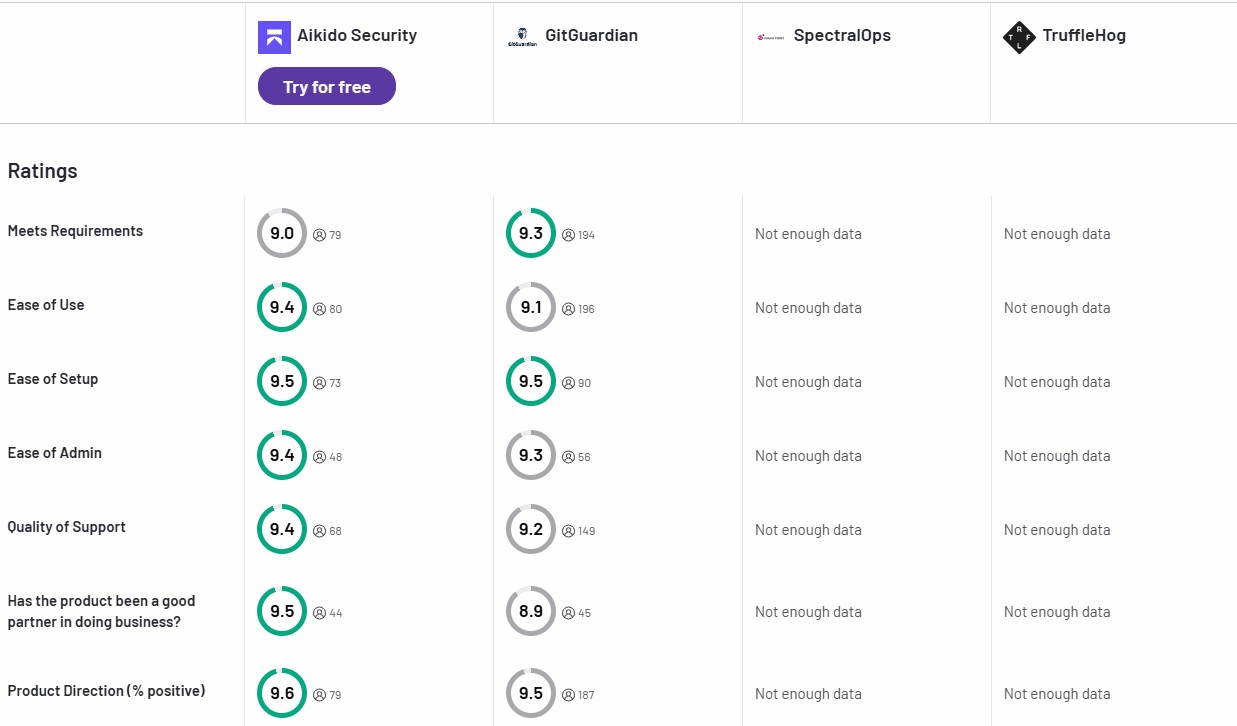
| GitGuardian | ✅ Major VCS | ✅ Portal | ⚠️ Tuning | ✅ Provider checks | ✅ CI • PRs | Enterprises |
| TruffleHog | ✅ Deep history | ⚠️ Basic OSS • ✅ Enterprise | ⚠️ Analyst tuning | ⚠️ Partial live | ✅ CLI • CI | Power users |
| Gitleaks | ✅ Git repos | ❌ Console | ⚠️ Manual rules | ❌ Live checks | ✅ CI • CLI | Light OSS |
| Detect Secrets | ✅ Plugins | ❌ Console | ⚠️ Baselining | ❌ Live checks | ✅ Hooks • CI | Custom rules |
Legend: ✅ = good • ⚠️ = partial • ❌ = none
Aikido Security stands out as a comprehensive application security platform that includes sophisticated secret scanning as part of its unified approach. Unlike point solutions that only handle secrets, Aikido provides context-aware detection that understands how secrets relate to your broader security posture.
Key features:
Best for: Development teams wanting comprehensive security with minimal overhead. Aikido is particularly valuable for organizations that need secret scanning as part of a broader security program, not as an isolated tool.
Pricing: Free tier available with generous limits, then transparent per-developer pricing that includes all security features, not just secret scanning.
GitGuardian has built a reputation as the secret scanning specialist, focusing exclusively on detecting and managing exposed secrets across development workflows. Their platform is particularly strong at historical analysis and enterprise-grade secret lifecycle management.
Key features:
Pain points: Some users report that costs can rise quickly for organizations with a large number of repositories, making it challenging for scaling teams on a budget. Others mention occasional false positives, requiring manual review and tuning to avoid alert fatigue.
For more firsthand feedback, see GitGuardian reviews on G2.
Best for: Security teams that need specialized secret management capabilities and comprehensive audit trails. GitGuardian excels in enterprises with strict compliance requirements and complex secret lifecycle needs.
Pricing: Freemium model with limited scanning, paid tiers based on repository count and advanced features.

GitHub Advanced Security provides native secret scanning for GitHub repositories, making it the natural choice for teams heavily invested in the GitHub ecosystem. The integration depth is unmatched since it's built directly into the platform.
Key features:
Pain points: GitHub Advanced Security's capabilities are largely limited to repositories hosted on GitHub – if you host code elsewhere or work with hybrid environments, you’ll need additional tooling. Detection depends heavily on community-contributed rules, which may lag behind less common or newer secret types. Several users also note that false positives can require manual review, and custom pattern creation is less intuitive than in some competitors. Its secret scanning features are gated by GitHub’s higher-tier paid plans, which could impact cost-sensitive teams.
For more user experiences and feedback, see GitHub Advanced Security reviews on G2.
Best for: Teams using GitHub Enterprise that want comprehensive security features with zero external dependencies. Particularly valuable for organizations that prioritize keeping their security tools within their existing platform ecosystem.
Pricing: Included with GitHub Enterprise subscriptions, pay-per-repository for individual features on other plans.

Spectral positions itself as the context-aware security platform that understands not just what secrets look like, but how they're used within your applications and infrastructure. This contextual approach significantly reduces false positives.
Key features:
Pain points: Spectral’s rich policy engine and customization options can be overwhelming for new users, leading to a potentially steep learning curve for teams that want to unlock its full capabilities. Smaller teams or startups may also find cost to be a barrier, as pricing is contact-based and often best suited for large-scale enterprise needs.
Read more on user experiences and challenges in Spectral reviews on G2.
Best for: DevOps teams that need sophisticated policy management and want to reduce the operational overhead of managing secrets across complex, multi-environment deployments.
Pricing: Contact-based pricing focused on enterprise customers with significant infrastructure complexity.

TruffleHog represents the open-source approach to secret scanning, providing powerful detection capabilities without licensing costs. It's particularly popular among security researchers and teams that prefer self-hosted solutions.
Key features:
Pain Points: TruffleHog is powerful, but users often report higher false positive rates compared to commercial platforms, which can create noise and slow down remediation efforts. Additionally, it lacks built-in remediation workflows—teams are responsible for manually addressing detected secrets and creating their own playbooks for alerting or credential rotation. Less technical teams may find setup and tuning challenging.
For more user insights and feedback, see TruffleHog reviews on G2.
Best for: Security-conscious teams that prefer open-source tools and have the technical expertise to customize and maintain their secret scanning infrastructure.
Pricing: Free and open-source, with commercial support options available from Truffle Security.
Detect-secrets by Yelp takes a minimalist approach to secret scanning, focusing on high accuracy and low operational overhead. It's designed to integrate seamlessly into development workflows without creating friction.
Key features:
Best for: Development teams that want effective secret scanning without complexity. Detect-secrets works particularly well for teams that prefer lightweight tools and don't need extensive enterprise features.
Pricing: Free and open-source with community support.
Developers need secret scanning tools that fit naturally into their coding workflow without creating friction or slowing down development. The best developer-focused tools provide immediate feedback, clear guidance, and can be easily integrated into daily development practices.
What developers should look for:
Top picks for developers:
Aikido Security leads the developer experience with its comprehensive IDE integration and intelligent filtering. The platform understands that developers want to focus on building features, not wrestling with security tools. Aikido provides context-aware alerts that explain not just what was found, but why it's dangerous and how to fix it properly.
GitHub Advanced Security is perfect for developers already living in GitHub. The native integration means secret alerts appear naturally in your pull request workflow, and the community-driven pattern database catches secrets from services you're likely using.
Detect-secrets appeals to developers who prefer lightweight, configurable tools. Its pre-commit hook integration means you catch secrets locally before they ever reach the remote repository, and the baseline approach prevents being overwhelmed by historical issues.
| Tool | Ease | CI/CD | Noise | Best For |
|---|---|---|---|---|
| Aikido Security Dev-first | ✅ Easy UI | ✅ Hooks • ✅ PRs | ✅ AI triage | All-in-one AppSec for devs |
| Gitleaks | ✅ Simple CLI | ✅ Hooks • ✅ CI | ⚠️ Manual rules | Lightweight OSS |
| Detect Secrets | ⚠️ Config heavy | ✅ Hooks • ✅ CI | ⚠️ Baselining | Custom rules |
| TruffleHog | ⚠️ Steep setup | ✅ Deep CI scans | ⚠️ Tuning | History scans |
Legend: ✅ = good • ⚠️ = partial • ❌ = none
Enterprise environments require secret scanning tools that can handle massive scale, provide comprehensive audit trails, and integrate with existing security and compliance frameworks. These tools need to balance automated detection with human oversight and policy enforcement.
Enterprise requirements:
Top enterprise picks:
Aikido Security provides enterprise-grade secret scanning as part of its unified security platform. The centralized dashboard gives security teams visibility across all repositories while allowing development teams to maintain ownership of their remediation efforts. Advanced features include automated risk scoring, batch remediation capabilities, and comprehensive compliance reporting.
GitGuardian excels in environments where secret management is a primary concern. Their platform provides detailed analytics on secret exposure trends, automated incident response workflows, and deep integration with enterprise identity providers for access control.
Spectral stands out for organizations with complex, multi-cloud deployments. Its context-aware approach reduces false positives in large environments where the same secret patterns might appear in multiple contexts with different risk levels.
| Tool | Scale | Mgmt | Compliance | Noise | Best For |
|---|---|---|---|---|---|
| Aikido Security Enterprise+ | ✅ Multi-tenant | ✅ Console • RBAC | ✅ Frameworks | ✅ AI triage | Unified AppSec at scale |
| GitGuardian | ✅ Thousands+ | ✅ Central portal | ✅ Audit reports | ⚠️ Needs tuning | Enterprise security teams |
| SpectralOps | ✅ Cloud-native | ✅ Policy engine | ✅ Check Point stack | ✅ Context aware | Large orgs & cloud envs |
| TruffleHog Enterprise | ✅ Enterprise edition | ✅ Dashboards | ⚠️ Limited | ⚠️ Manual tuning | Deep repo history scans |
Legend: ✅ = good • ⚠️ = partial • ❌ = none
Startups need secret scanning tools that provide maximum protection with minimal overhead. Budget constraints, small teams, and rapid development cycles mean the ideal tools are either free or very cost-effective while still delivering enterprise-grade protection.
Startup priorities:
Best startup choices:
Aikido Security offers a compelling value proposition for startups with its free tier that includes comprehensive secret scanning alongside other security features. As startups grow, the transparent per-developer pricing makes budgeting predictable without surprise costs.
GitHub Advanced Security is perfect for startups already using GitHub, as it provides powerful secret scanning capabilities with no additional tools to learn or maintain. The integration with GitHub's workflow means developers can stay focused on product development.
TruffleHog provides enterprise-grade detection capabilities at zero cost, making it attractive for cash-strapped startups. The open-source nature means you can customize it as needed without vendor lock-in concerns.
| Tool | Setup | Cost | Noise | Best For |
|---|---|---|---|---|
| Aikido Security Startup pick | ✅ Plug & play | ✅ Free tier | ✅ AI filters | Fast security setup |
| GitGuardian | ✅ Easy portal | ✅ Free tier | ⚠️ Some tuning | Small teams scaling |
| Gitleaks | ✅ Simple CLI | ✅ Free OSS | ⚠️ Manual rules | Budget-conscious teams |
| Detect Secrets | ⚠️ Config heavy | ✅ Free OSS | ⚠️ Baselining | DIY setups |
Legend: ✅ = good • ⚠️ = partial • ❌ = none
Open-source and free secret scanning tools have reached impressive maturity levels, offering capabilities that rival commercial solutions. These tools are perfect for individual developers, small teams, or organizations that prefer self-hosted solutions.
Free tool advantages:
Top free options:
TruffleHog leads the free category with sophisticated entropy analysis and an extensive pattern library. The community actively maintains detection rules, and the tool can handle both historical scanning and real-time monitoring.
Detect-secrets provides a more curated approach with lower false positive rates. Its baseline methodology is particularly clever for teams that want to focus on preventing new secret exposures rather than dealing with historical issues.
GitLeaks offers another strong open-source option with good performance characteristics and straightforward configuration. It's particularly popular in CI/CD environments where speed is important.
The open-source ecosystem provides several powerful secret detection tools that organizations can customize, extend, and deploy according to their specific needs. These tools offer transparency, flexibility, and community-driven innovation.
Open source benefits:
Leading open source tools:
TruffleHog remains the gold standard for open-source secret detection. Its combination of entropy analysis and pattern matching provides excellent coverage, and the active community ensures rapid updates when new secret formats emerge.
Detect-secrets excels in production environments where precision matters more than recall. The tool's focus on minimizing false positives makes it particularly suitable for teams that can't afford alert fatigue.
GitLeaks provides excellent performance for CI/CD integration scenarios. Its configuration system allows fine-tuning for specific environments while maintaining good out-of-the-box performance.
Secrets-patterns-db isn't a scanner itself but provides the pattern databases used by many other tools. Contributing to this project helps improve secret detection across the entire ecosystem.
These open-source tools form the backbone of secret detection for many organizations and often serve as the detection engines for commercial products. Their transparency and community-driven development ensure they stay current with evolving threat patterns.
Secret scanning is essential for protecting your code and data. With Aikido, you can automate checks early to ensure secrets don’t slip through. Aikido fits seamlessly into your workflow, scales with your team, and helps catch issues before they become risks.
此内容由惯性聚合(RSS阅读器)自动聚合整理,仅供阅读参考。 原文来自 — 版权归原作者所有。