惯性聚合 高效追踪和阅读你感兴趣的博客、新闻、科技资讯
阅读原文 在惯性聚合中打开

推荐订阅源

博客园_首页
Security Archives - TechRepublic
Application and Cybersecurity Blog
cs.CV updates on arXiv.org
C
CERT Recently Published Vulnerability Notes
S
Security @ Cisco Blogs
S
Security Affairs
D
Darknet – Hacking Tools, Hacker News & Cyber Security
L
Lohrmann on Cybersecurity
cs.AI updates on arXiv.org
Hacker News: Ask HN
Hacker News: Ask HN
Forbes - Security
Forbes - Security
H
Heimdal Security Blog
A
Arctic Wolf
NISL@THU
NISL@THU
P
Proofpoint News Feed
W
WeLiveSecurity
S
Schneier on Security
AI
AI
Schneier on Security
N
News and Events Feed by Topic
L
LINUX DO - 最新话题
Cisco Talos Blog
Cisco Talos Blog
AWS News Blog
AWS News Blog
Hacker News - Newest:
Hacker News - Newest: "LLM"
Know Your Adversary
Know Your Adversary
Scott Helme
Scott Helme
V
Vulnerabilities – Threatpost
Cyberwarzone
Cyberwarzone
I
Intezer
S
Securelist
Help Net Security
Help Net Security
Microsoft Security Blog
量子位
让小产品的独立变现更简单 - ezindie.com
小众软件
小众软件
Last Week in AI
Last Week in AI
Jina AI
Jina AI
OSCHINA 社区最新新闻
OSCHINA 社区最新新闻
WordPress大学
WordPress大学
罗磊的独立博客
月光博客
月光博客
雷峰网
雷峰网
A
About on SuperTechFans
The GitHub Blog
The GitHub Blog
T
The Blog of Author Tim Ferriss
MongoDB | Blog
MongoDB | Blog
大猫的无限游戏
大猫的无限游戏
博客园 - 司徒正美
CTFtime.org: upcoming CTF events

Aikido Security's Blog

GlassWorm goes native: New Zig dropper infects every IDE on your machine Aikido Attack finds multiple 0-days in Hoppscotch The cybersecurity doomerism around Mythos doesn't match what we see on the ground axios compromised on npm: maintainer account hijacked, RAT deployed Popular telnyx package compromised on PyPI by TeamPCP Aikido × Lovable: Vibe, Fix, Ship CanisterWorm Gets Teeth: TeamPCP's Kubernetes Wiper Targets Iran TeamPCP deploys CanisterWorm on NPM following Trivy compromise Security testing is validating software that no longer exists Aikido Recognized by Frost & Sullivan with the 2026 Customer Value Leadership Award in ASPM GlassWorm Hides a RAT Inside a Malicious Chrome Extension fast-draft Open VSX Extension Compromised by BlokTrooper Glassworm Strikes Popular React Native Phone Number Packages Glassworm Is Back: A New Wave of Invisible Unicode Attacks Hits Hundreds of Repositories How Security Teams Fight Back Against AI-Powered Hackers Introducing Betterleaks, an open source secrets scanner by the author of Gitleaks Trump’s 2026 cybersecurity strategy: From compliance to consequence How does AI pentesting work with compliance? What continuous pentesting actually requires Rare Not Random: Using Token Efficiency for Secrets Scanning Persistent XSS/RCE using WebSockets in Storybook’s dev server Why Determinism Is Still a Necessity in Security WAF vs. RASP vs. ADR Introducing Aikido Infinite: A new model of self-securing software How Aikido secures AI pentesting agents by design Astro Full-Read SSRF via Host Header Injection How to Get Your Board to Care About Security (Before a Breach Forces the Issue) What is Slopsquatting? The AI Package Hallucination Attack Already Happening SvelteSpill: A Cache Deception Bug in SvelteKit + Vercel Top 6 Wiz Code Alternatives Aikido recognized as Platform Leader in Latio Tech's 2026 Application Security Report From detection to prevention: How Zen stops IDOR vulnerabilities at runtime npm backdoor lets hackers hijack gambling outcomes Introducing Upgrade Impact Analysis: When breaking changes actually matter to your code Why Trying to Secure OpenClaw is Ridiculous Claude Opus 4.6 found 500 vulnerabilities. What does this change for software security? Introducing Aikido Expansion Packs: Safer defaults inside the IDE International AI Safety Report 2026: What It Means for Autonomous AI Systems Self-Securing Software: What It Is, Why It Matters, and How It Works npx Confusion: Packages That Forgot to Claim Their Own Name What Is Continuous Pentesting? Introducing Aikido Package Health: a Better Way to Trust Your Dependencies AI Pentesting: Minimum Safety Requirements for Security Testing Secure SDLC for Engineering Teams (+ Checklist) Fake Clawdbot VS Code Extension Installs ScreenConnect RAT G_Wagon: npm Package Deploys Python Stealer Targeting 100+ Crypto Wallets Gone Phishin': npm Packages Serving Custom Credential Harvesting Pages Malicious PyPI Packages spellcheckpy and spellcheckerpy Deliver Python RAT Top 10 AI Security Tools For 2026 Agent Skills Are Spreading Hallucinated npx Commands Understanding Open-Source License Risk in Modern Software The CISO Vibe Coding Checklist for Security Top 6 Graphite alternatives for AI code review in 2026 From “No Bullsh*t Security” to $1B: We Just Raised Our $60m Series B Critical n8n Vulnerability Allows Unauthenticated Remote Code Execution (CVE-2026-21858) Top 14 VS Code Extensions for 2026 AI-Driven Pentesting of Coolify: Seven CVEs Identified Top Continuous Pentesting Tools in 2026 SAST vs SCA: Securing the Code You Write and the Code You Depend On JavaScript, MSBuild, and the Blockchain: Anatomy of the NeoShadow npm Supply-Chain Attack How Engineering and Security Teams Can Meet DORA’s Technical Requirements IDOR Vulnerabilities Explained: Why They Persist in Modern Applications Shai Hulud strikes again - The golden path MongoBleed: MongoDB Zlib Vulnerability (CVE-2025-14847) and How to Fix It First Sophisticated Malware Discovered on Maven Central via Typosquatting Attack on Jackson The Fork Awakens: Why GitHub’s Invisible Networks Break Package Security Top 10 Cyber Security Tools For 2026 SAST in the IDE is now free: Moving SAST to where development actually happens AI Pentesting in Action: A TL;DV Recap of Our Live Demo The Top 7 Threat Intelligence Tools in 2026 React & Next.js DoS Vulnerability (CVE-2025-55184): What You Need to Fix After React2Shell OWASP Top 10 for Agentic Applications (2026): What Developers and Security Teams Need to Know DAST vs Pentesting v AI Pentesting: Why DAST Cannot Replace Modern Pentesting PromptPwnd: Prompt Injection Vulnerabilities in GitHub Actions Using AI Agents Top 7 Cloud Security Vulnerabilities Critical React & Next.js RCE Vulnerability (CVE-2025-55182): What You Need to Fix Now How to Comply With the UK Cybersecurity & Resilience Bill: A Practical Guide for Modern Engineering Teams Shai Hulud 2.0: What the Unknown Wonderer Tells Us About the Attackers’ Endgame SCA Everywhere: Scan and Fix Open-Source Dependencies in Your IDE Safe Chain now enforces a minimum package age before install Shai Hulud Attacks Persist Through GitHub Actions Vulnerabilities Shai Hulud Launches Second Supply-Chain Attack: Zapier, ENS, AsyncAPI, PostHog, Postman Compromised CORS Security: Beyond Basic Configuration Revolut Selects Aikido Security to Power Developer-First Software Security The Future of Pentesting Is Autonomous How Aikido and Deloitte are bringing developer-first security to enterprise Secrets Detection: A Practical Guide to Finding and Preventing Leaked Credentials Invisible Unicode Malware Strikes OpenVSX, Again AI as a Power Tool: How Windsurf and Devin Are Changing Secure Coding Building Fast, Staying Secure: Supabase’s Approach to Secure-by-Default Development OWASP Top 10 2025: Official List, Changes, and What Developers Need to Know Top 10 JavaScript Security Vulnerabilities in Modern Web Apps The Return of the Invisible Threat: Hidden PUA Unicode Hits GitHub repositorties Top 7 Black Duck Alternatives in 2026 What Is IaC Security Scanning? Terraform, Kubernetes & Cloud Misconfigurations Explained AutoTriage and the Swiss Cheese Model of Security Noise Reduction Top Software Supply Chain Security Vulnerabilities Explained The Top 7 Kubernetes Security Tools Top 10 Web Application Security Vulnerabilities Every Team Should Know What Is CSPM (and CNAPP)? Cloud Security Posture Management Explained
Top 5 GitHub Advanced Security Alternatives for DevSecOps Teams in 2026
The Aikido Team · 2025-09-11 · via Aikido Security's Blog

Published on:

Sep 11, 2025

GitHub Advanced Security (GHAS) is GitHub’s add-on security suite that brings code scanning (SAST), secret detection, and supply chain insights into your repositories. It’s commonly used by teams on GitHub Enterprise to catch vulnerabilities in code, prevent leaked secrets, and enforce dependency security. However, many organizations are now exploring alternatives due to its complex setup, noisy results, and steep pricing.

GHAS often overwhelms developers with alerts and false positives, and is only available as a paid add-on for Enterprise accounts. In practice, what should be a helpful safety net can turn into a source of friction and fatigue. Here’s what some of its users have to say:

GHAS review

Head of  Engineering at Mid-Market sharing their struggles with GitHub Enterprise 

GHAS review

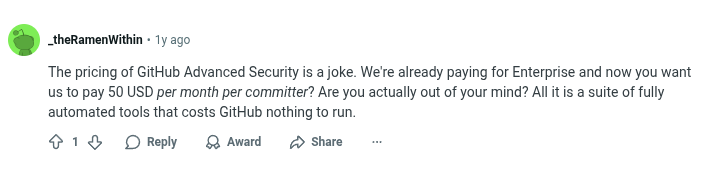
Reddit user complaining about GitHub Advanced’s pricing

GHAS review

User sharing their experience with GitHub Advanced Security

Users also shared:

“After leaving one of the legacy players, we did a full sprint and found GHAS to be underwhelming on a few fronts...” – Reddit user (r/cybersecurity)

For many teams, the pain points include alert fatigue (too many low-value findings and false positives), limited coverage (only code hosted on GitHub repos, no cloud or containers), enterprise-only pricing, and its lack of a developer-first experience. If these sound familiar, it might be time to look at alternatives that better fit your needs.

TL;DR

Aikido Security stands out as the #1 GitHub Advanced alternative, providing security solutions with a modern developer-first experience. It stands out first and foremost because it is built with the end-user in mind; meaning better developer experience and a more innovative product roadmap. In the backend, GitHub uses a SAST engine that is version sensitive because it needs to compile the code. Aikido, on the other hand, uses OpenGrep, which is an engine that does not need to compile. The result? For large monorepos, the scanner won’t time out like it does for GitHub AS, and for all repos, Aikido stands out for performance and quality of findings.

Secondly, for users that want more security coverage, Aikido offers far more: DAST & API security, runtime protection, IaC, reachability analysis, cloud security (CSPM), AI penetration testing, and an in-app firewall. These features are best-in-class as standalone solutions, can be integrated on a modular basis, or can be provided as a complete security platform, depending on your organization’s needs. To benefit from all the capabilities that Aikido offers, GitHub Security sers would have to leverage multiple tools such as GitHub Secrets Protection, GitHub Code Security, Stackhawk, and more. 

Also, it ties into your pipelines and IDEs to scan code, dependencies, containers, IaC – you name it – in the background, then uses AI triage to kill ~85% of the noise.Numerous organizations have ripped and replaced GitHub Advanced Security with Aikido Security.

Comparison Between GitHub Advanced Security and Aikido

Feature GitHub Advanced Security Aikido
Scope Focuses on securing code within GitHub Covers code, dependencies, containers, Kubernetes clusters and cloud
SAST Uses CodeQL for static analysis of supported languages Integrated static analysis with automatic triage
SCA Uses Dependabot and dependency review for open-source vulnerability alerts Continuously scans dependencies with license checks and auto-fix pull requests
Cloud / IaC Security Limited to code repositories, and relies on integrations Provides cloud and infrastructure posture analysis
Noise Reduction Requires manual triage and custom CodeQL queries Uses automated triage to reduce false positives and alert fatigue
Pricing Add-on to GitHub Enterprise, and billed per active committer Transparent flat-rate for tiered pricing with a free plan available

If you’re ready, here are our top GitHub Advanced alternatives: :

Exploring top security tools beyond GitHub-native options? Check out our Top AppSec Tools in 2026 for a curated guide on the top application security solutions teams are using today.
GHAS

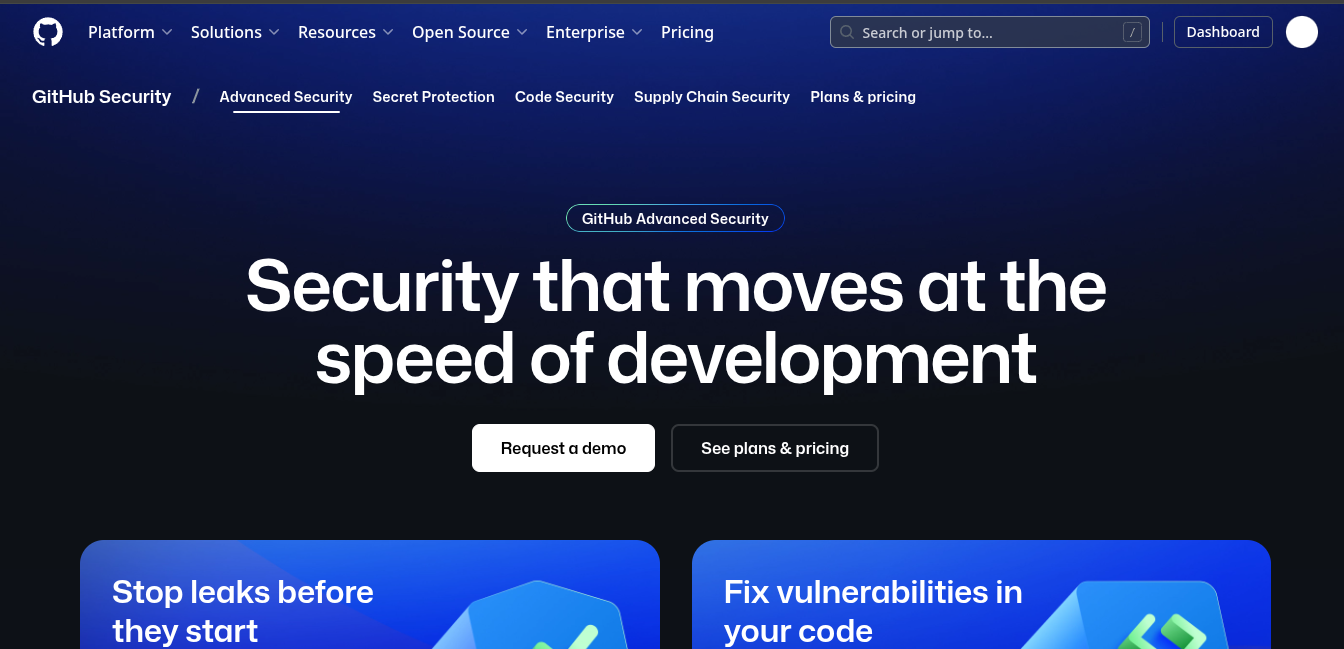
GitHub Advanced Security Website

GitHub Advanced Security is a suite of features built into GitHub’s Enterprise tier, for application security. It includes:

Why Look for Alternatives?

Even with GitHub’s backing, GitHub Advanced Security has its limits:

Key Criteria for Choosing an Alternative

When looking for GitHub Advanced alternatives, here’s what to prioritize:

Top 5 Alternatives to GitHub Advanced Security in 2026

Each of the tools below addresses GHAS’s shortcomings in different ways. Below we break down their core features along with everything you need to know before choosing an alternative.
1. Aikido Security

Aikido Security

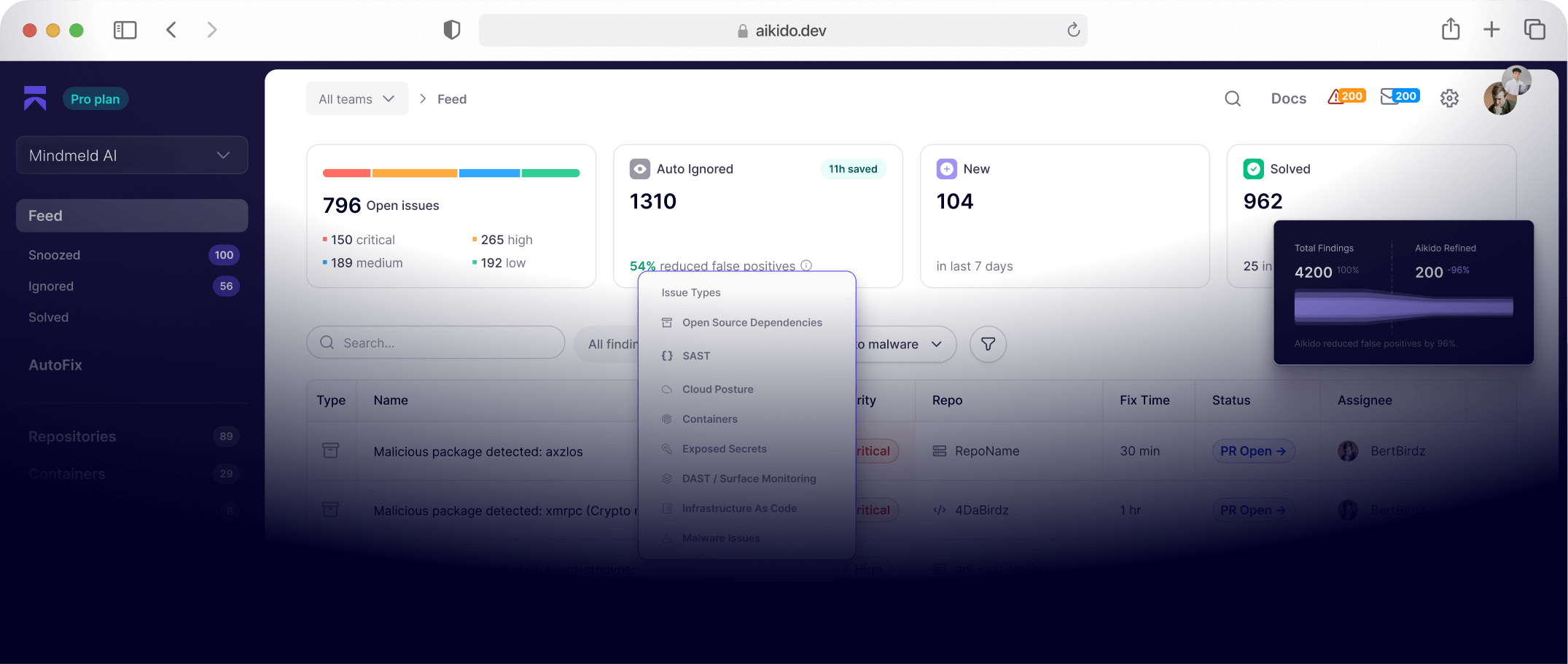
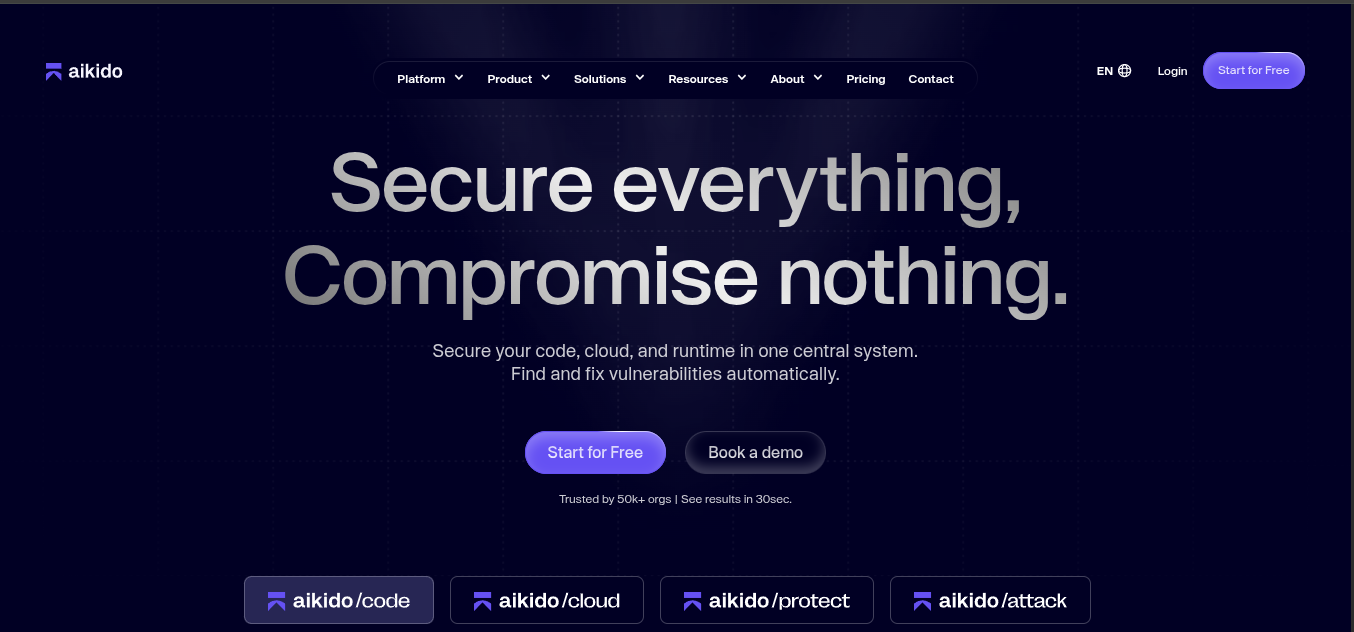
Aikido Security website

Aikido Security is a modern, developer-first application security platform which provides the best-in-class capabilities as standalone alternatives to GHAS, or as one suite covering everything. It offers static code analysis (SAST), open-source dependency scanning (SCA), secret detection, IaC scanning, cloud security, container image scanning, DAST, and more.

Unlike GHAS, which is tied to GitHub, Aikido is platform agnostic with support for multiple code hosts as well as integrating into CI/CD pipelines, IDEs, and issue trackers.

Key Features:

  • Beast-of-Breed Scanners: Aikido offers the best-in-class scanners for your IT landscape including, SAST, SCA, secrets, IaC, containers, and cloud configs etc. when compared with other scanners No patchwork needed.
  • Developer-Centric Workflow: Instant feedback in PRs and IDEs, plus AI-powered autofix and actionable remediation workflows.
  • Low Noise, High Signal: Uses reachability analysis and curated rules to surface what matters. Cutting false positives by up to 85%.
  • Built for Devs: – Integrates deeply with GitHub, GitLab, Bitbucket, Jira, Slack, and much. You can run scans locally, in pull requests, or as part of your release process.
  • Fast, Continuous Feedback: Scans run in minutes, not hours.
  • Connected “code-to-cloud” coverage: Aikido links code, cloud, and runtime in one seamless workflow. You can start with the module for (code scanning, container/IaC scanning, API security, and runtime protection) and scale to gain deeper context as you expand.

Why Choose It: 

Pick Aikido if you want a GHAS alternative that’s truly developer-first and goes far beyond code. It's the best choice for fast-moving teams looking for a single suite that covers everything, as well as enterprises looking for specific tools that solve their security pain points ,with minimal friction, and zero enterprise lock-in.

Pros:
  • Flat-rate plans make budgeting simple and predictable.
  • Cross-platform support (GitHub, GitLab, Bitbucket, Jenkins etc.)
  • Provides context-aware remediation guidance and risk scoring 
  • Auto-fix functionality for common issues and dependencies
  • Broad language support 
  • Advanced filtering reduces false positives, making alerts actionable.
Hosting Model:
  • Saas (Software-as-a-service)
  • On-Premise
Target Users:
  • Startups and small-to-medium teams seeking an one suite, everything covered application security platform 
  • Enterprises looking to address specific security pain points 
Pricing:
  • Free: $0 (2 users, full scanner suite, 10 repos)
  • Basic: $350/month (ideal for small teams, 10+ users, 100 repos)
  • Pro: $700/month (growing teams, custom rules, 20 million reqs/month)
  • Advanced: $1050 (enterprise feature set)

Custom offerings are also available for startups (30% discount) and enterprises 

Gartner Rating: 4.9/5.0
Aikido Security Reviews:

Beyond Gartner, Aikido Security also has a rating of 4.7/5 on Capterra, Getapp and SourceForge
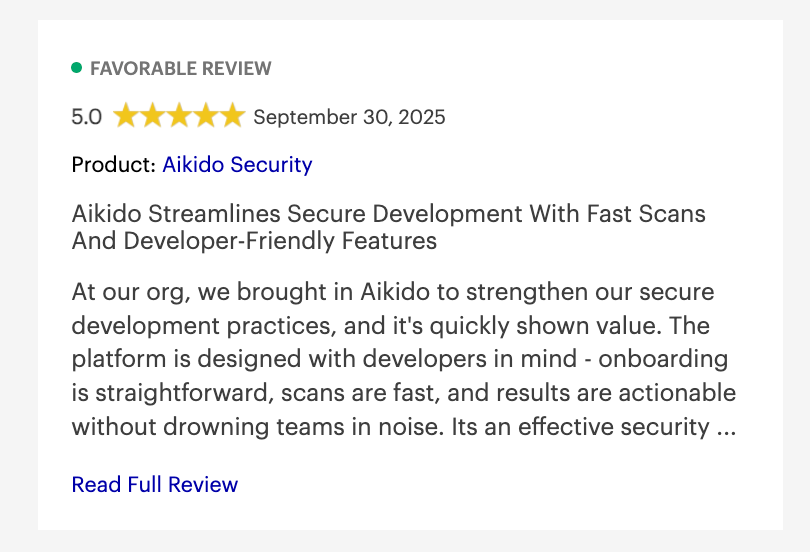
Aikido Security review

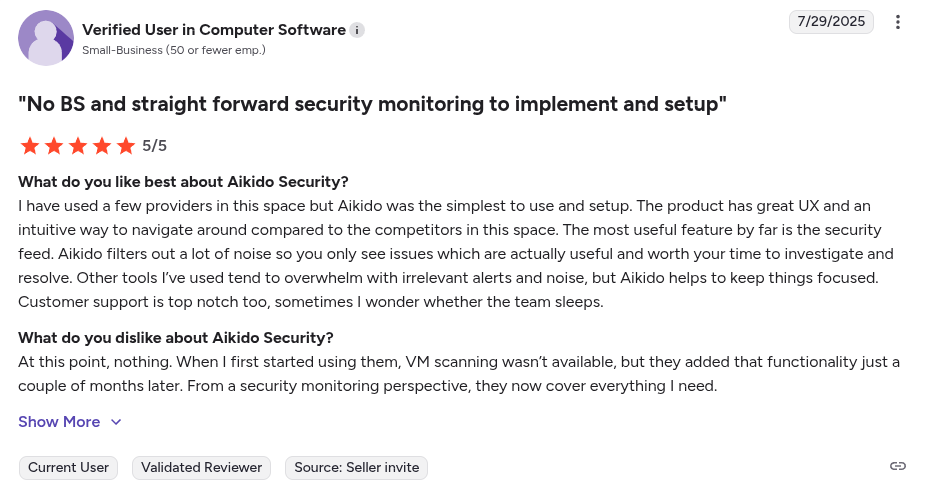
User sharing how Aikido enabled secure development in their organization


Aikido Security review

User sharing how efficient Aikido Security is at filtering noise

2. Bearer

Bearer

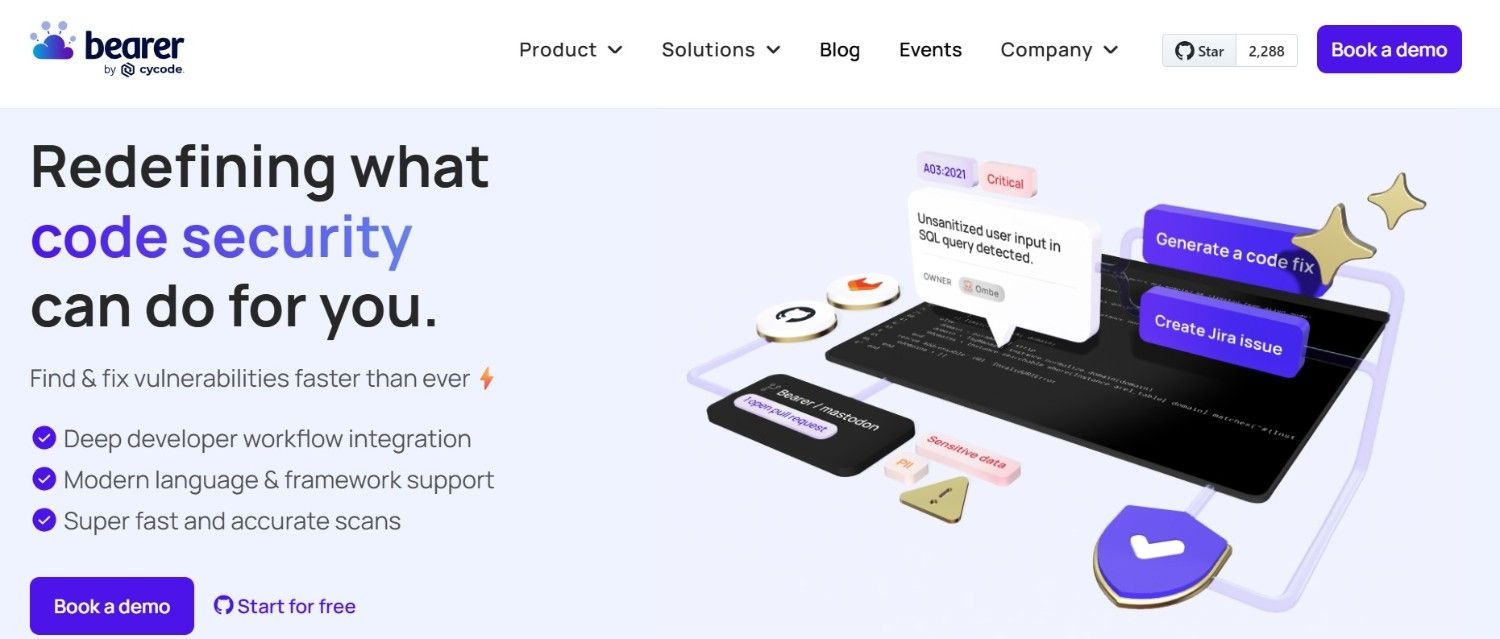
Bearer website


Bearer is a static analysis tool focused on data security and privacy. Unlike GHAS, Bearer identifies not just code vulnerabilities but also where sensitive data (like PII, PHI, and PCI) flows through your app. Built with privacy regulations like GDPR and HIPAA in mind, Bearer is a good choice for teams prioritizing security + compliance .

Their CLI tool is open source, fast, and built for developer workflows.

Key Features:

  • Sensitive Data Tracing: Detects personal data (emails, user IDs, health records) and tracks where it’s stored or transmitted.
  • OWASP + Privacy Rules: Combines traditional OWASP Top 10 style security checks with privacy-specific logic.
  • Developer & Compliance Friendly: Offers CI integration, GitHub/GitLab PR feedback, and privacy reports that map directly to compliance frameworks.

Why Choose It:

Use Bearer when your team handles sensitive data and wants early visibility into privacy risks, not just security flaws. Its open-source CLI makes it ideal for lean teams that want  built-in compliance.

Pros:
  • Automatically detects sensitive data flows (PII, credentials)
  • Developer-friendly workflow
  • AI-powered remediation
Cons:
  • Primarily enterprise focused
  • Limited scope beyond API and data security
  • Weaker automation and remediation support
  • Requires pairing with other tools for full AppSec coverage
  • Steep learning curve for new users
Hosting Model:
  • Saas (Software-as-a-service)
  • On-Premise
  • Hybrid 
Target Users:

Mid-to-large enterprises.

Pricing:

Custom pricing

Gartner Rating: 4.5/5.0 
Bearer Reviews:

Bearer reviews

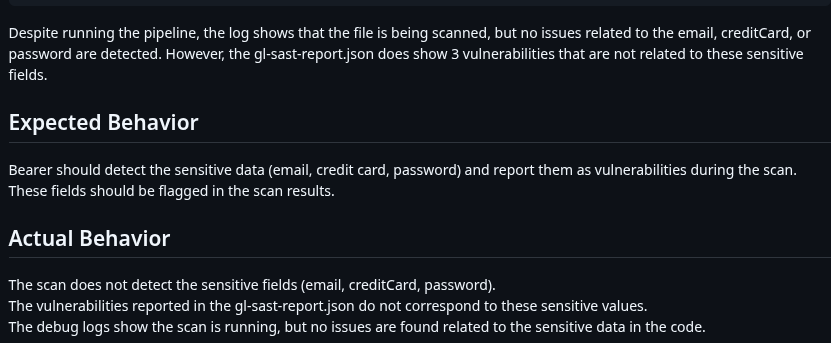
Bearer user sharing issue detecting sensitive data

3. Checkmarx One

Checkmarx One

Checkmarx One website

Checkmarx One is an enterprise-grade application security platform with a primary focus  on SAST. It unifies static code scanning, software composition analysis, container security, and infrastructure-as-code (IaC) scanning into a single unified interface. Unlike GHAS, it works across multiple repos and cloud providers, with rich security policy controls.

Key Features:

  • Unified AppSec Platform: Combines SAST, SCA, container/IaC scanning, and orchestration in one place.
  • Enterprise Policy Engine: Fine-grained risk scoring, custom rules, and integrations for compliance (e.g. SOC 2).
  • IDE & CI Integrations: Full support for VS Code, IntelliJ, Jenkins, GitHub Actions, and more.

Why Choose It: 

If you're at scale or in a regulated space, Checkmarx is a good option. You get enterprise-ready enforcement and coverage that GHAS lacks, including custom rule logic and broader scan targets. However, be ready to invest time and budget as it's not a lightweight solution.

Pros:
  • Broad language and framework coverage
  • Strong SAST engine with deep analysis
  • Enterprise-ready compliance and reporting
  • Robust security research and threat intel
Cons:
  • Limited agility for smaller dev teams
  • Primarily enterprise focused
  • Heavier administration for CI/CD pipelines
  • Separate pricing for each security module
Hosting Model:
  • Saas (Software-as-a-service)
  • On-premise
Target Users:

Enterprises

Pricing:

Custom pricing

Gartner Rating: 4.6/5.0
Checkmarx One Reviews:

Capterra  Checkmarx One a 3.9/5, based on over 50 reviews.
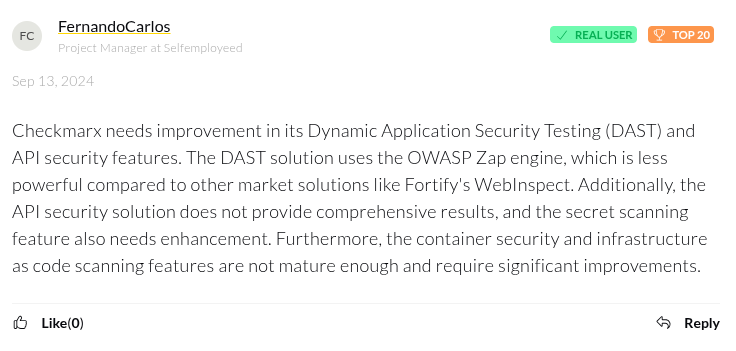
Checkmarx One Review

Checkmarx user sharing their struggles with its DAST tool

Checkmarx One Review

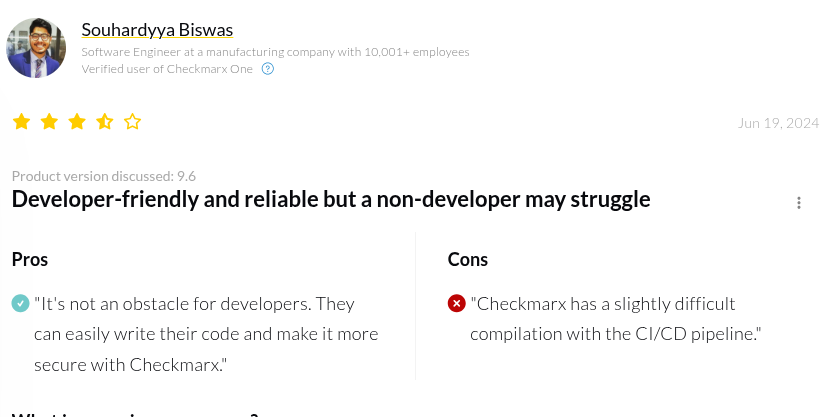
Checkmarx user sharing struggles with CI/CD compilation

4.SonarQube / SonarCloud

SonarQube / SonarCloud

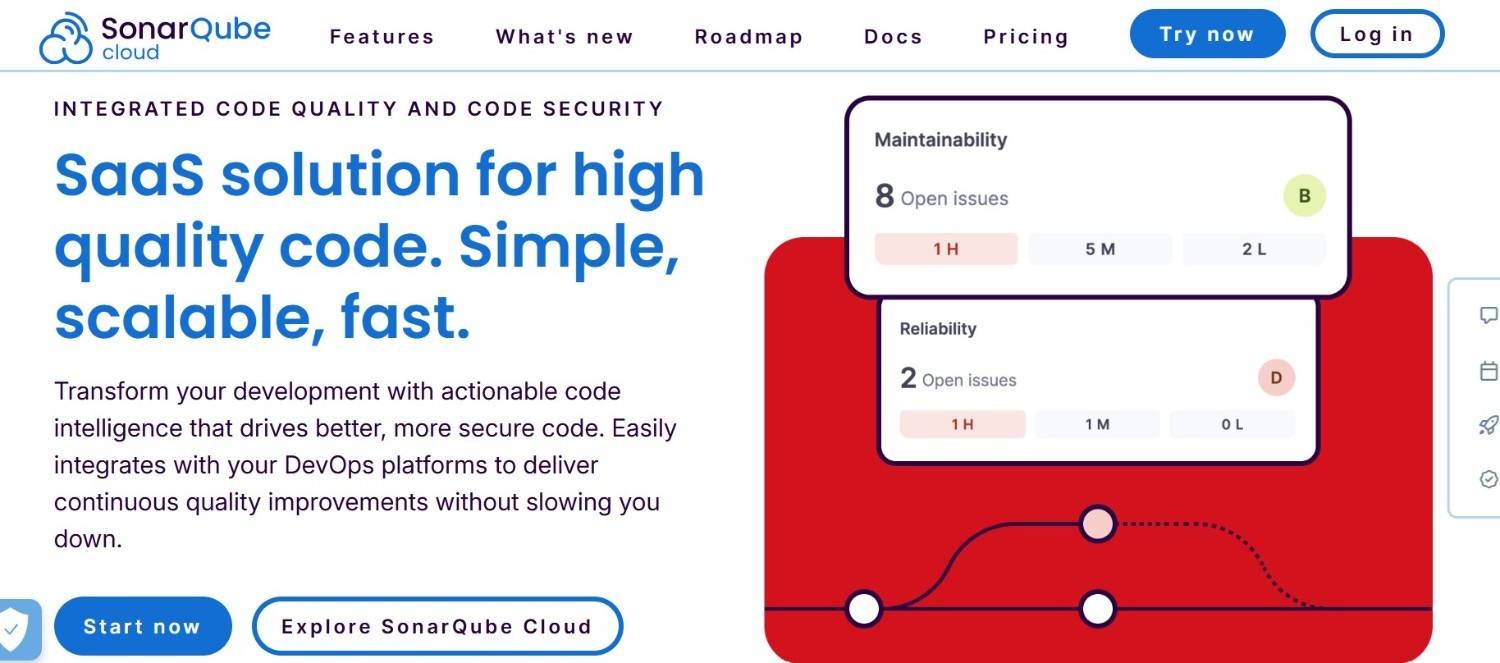
SonarQube/SonarCloud website

SonarQube and SonarCloud are trusted tools for code quality and security inspection. While traditionally focused on bugs and maintainability, their SAST coverage has grown and now includes OWASP Top 10 rules.

GitHub Advanced users often switch to Sonar for a cleaner, more integrated code review experience.

Key Features:

  • Code Quality + Security: Static code analysis across 30+ languages, including taint analysis for vulnerabilities.
  • PR & CI Integration: Works with GitHub Actions, Bitbucket Pipelines, and Azure DevOps. Quality gates help enforce standards at every PR.
  • Developer-First UX: Combines with SonarLint for in-IDE issue flagging, backed by clear fix guidance and quality dashboards.

Why Choose It:

Sonar is perfect for teams focused on code health and secure coding practices. It integrates well into PR reviews—plus, it catches a lot without overwhelming your team.However, It doesn’t cover your cloud and IaC workflows like developer-first platforms such as Aikido’s security, but as a code-focused tool, it’s more than suitable.

Pros:
  • Developer-friendly feedback in real-time.
  • Provides code quality checks and security scanning in one tool.
  • Integrates seamlessly with common DevOps platforms
  • Free community edition
Cons:
  • Pricing based on “Lines of Code (LOC)” can become expensive
  • Increased false positives for certain codebases
  • Limits on automatic analysis
  • Limited coverage for containers, runtime, cloud, IaC and security posture
Hosting Model:
  • Saas (Software-as-a-service)
  • On-premise
Target Users:
  • Small and medium-sized businesses (SMBs)
  • Enterprises
Pricing:

SonarQube’s pricing comes in two categories: cloud-based and self-managed.

Gartner Rating: 4.4/5.0
SonarQube/SonarCloud Reviews:

SonarQube / SonarCloud reviews

SonarCloud user sharing login issue with GitHub

5. SpectralOps

SpectralOps

SpectralOps website

SpectralOps is a fast, developer-friendly CLI scanner known for its secret detection and configuration linting. Now part of Check Point, it’s still available as a standalone tool and popular for lightweight security that fits directly into CI/CD workflows. Think of it as GHAS’s secret scanning—only faster and repo-agnostic.

Key Features:

  • Credential & Token Detection: Detects over 50 types of hardcoded secrets (AWS keys, API tokens, SSH keys etc.) 
  • IaC & Config Linting: Flags misconfigured permissions, exposed cloud settings, and common mistakes in Terraform, CloudFormation, and more.
  • Fast, Offline CLI: Single-binary, with local scan that runs anywhere

Why Choose It: 

Spectral is your go-to if you need a quick win on secrets and IaC scanning. Devs love it because it’s drop-in fast and doesn’t require cloud onboarding. Pair it with a more comprehensive tool like Aikido Security if you want deep SAST and full cloud coverage.

Pros:
  • Strong secrets detection feature
  • Supports integration with common CI/CD platforms
  • Supports custom policies
Cons:
  • Limited scope beyond Iac configuration and secrets scanning
  • Requires pairing with other platforms for full AppSec coverage
  • False positives
  • Enterprise features vary by offering
Hosting Model:

Hybrid

Target Users:
  • Small and medium-sized businesses (SMBs)
  • Enterprises
Pricing:
  • Free
  • Business: $475/month (ideal for small teams, 10+ users, 100 repos)
  • Enterprise: Custom pricing
Capterra Rating: 4.6/5.0

Comparing GitHub Advanced Alternatives

To help you compare the capabilities of the alternatives above, the table below summarizes each platform's coverage across key areas.

Tool SAST Secrets Detection Cloud/IaC Coverage Developer Experience Best For
Aikido Security ✅ Full, with AI autofix ✅ High-accuracy + PR comments ✅ Covers containers, IaC, configs ✅ Built for devs (CI, IDE, PR) Teams seeking security solutions that scale with minimal overhead
Bearer ✅ Privacy-focused SAST ⚠️ Limited ❌ None ✅ CLI + CI-friendly reports Privacy & compliance
Checkmarx One ✅ Enterprise-grade ✅ Available ✅ IaC, APIs, containers ⚠️ Heavy setup Large orgs
SonarQube / SonarCloud ✅ Code quality + SAST ❌ Not included ❌ None ✅ IDE plugin + clean UI Small dev teams
SpectralOps ⚠️ Basic patterns ✅ Fast + accurate ✅ IaC + config scans ✅ CLI-first UX Secrets + fast wins

Conclusion

GitHub Advanced Security gets the basics right,but for many teams, it’s noisy, limited, and locked behind enterprise pricing. The good news? You’ve got better options.

Whether you need broader coverage, cleaner dev experience, or just want to ship secure code without the fluff, tools like Aikido Security gets you there by providing the best-in-class solutions either as individual services or one suite with everything covered. 

Want less noise and more real protection?Start your free trial or book a demo with Aikido today.

FAQ

Q1. What are the limitations of GitHub Advanced Security?

While GHAS ends at your repository, Aikido continues into your runtime environment. Aikido directly addresses GitHub Advanced gaps by extending protection beyond code, covering dependencies, containers, infrastructure, and cloud posture.

Q2. What’s the best open-source alternative to GitHub Advanced Security?

While Semgrep and SonarQube are excellent starting points for teams who want standalone SAST or code-quality tooling, Aikido offers a broader, more mature automated approach. It combines the benefits of open-source scanners with managed coverage, triage automation, and security insights, making it ideal for teams that have outgrown DIY SAST setups.

Q3. Why consider Aikido as a GitHub Advanced Security alternative?

GitHub Advanced Security provides strong native coverage within GitHub, but that's the issue-it's limited to GitHub and scaling it often becomes expensive and complex. Aikido Security offers a modern alternative built for speed, simplicity, and breadth all at a transparent and affordable price. It extends protection beyond the repository - covering code, dependencies, containers, infrastructure, and cloud posture as well as reduces the noise developers face by automatically prioritizing findings and providing clear remediation guidance

Q4. Can I use GHAS with other security tools?

Yes, but this often increases cost and complexity. Aikido replaces the need for context-switching between tools - combining dependency scanning, IaC, and DAST capabilities that GHAS lacks, while still integrating with CI/CD workflows if you want to keep existing scanners.

Q5. How do I choose the right GHAS alternative?

Choosing the right alternative depends on your team's priorities. Whether you're focused on code-level protection, broader infrastructure coverage, or faster developer workflows. Aikido simplifies this decision by providing a platform where you can access the tools you need, as well as stack others on-top as your needs change. No more jumping between platforms and context-switching, just security made easier.

You Might Also Like:

Last updated on:

May 15, 2026

Tired of false positives?

Try Aikido like 100k others.

Start Now

Get a personalized walkthrough

Trusted by 100k+ teams

Book Now

Scan your app for IDORs and real attack paths

Trusted by 100k+ teams

Start Scanning

See how AI pentests your app

Trusted by 100k+ teams

Start Testing

DevSec Tools & Comparisons

Top 5 Tenable Nessus alternatives in 2026

Tenable Nessus is a powerful scanner, but powerful tools that nobody uses don't make software more secure. Compare five alternatives built for how engineering teams actually work.

DevSec Tools & Comparisons

Top GitGuardian alternatives for secrets scanning in 2026

Compare the Top GitGuardian Alternatives for secrets scanning in 2026. See where Aikido Security, GitHub Secret Protection, TruffleHog, Gitleaks, Semgrep, Snyk, Cycode, Checkmarx, and GitLab fit best.

DevSec Tools & Comparisons

5 Gitleaks alternatives and why they are better

Looking for a Gitleaks alternative? We compare Betterleaks, TruffleHog, Aikido, GitHub Advanced Security, and Spectral so you can find the best secrets scanner for your team.

Get secure now

Secure your code, cloud, and runtime in one central system.
Find and fix vulnerabilities fast automatically.

No credit card required | Scan results in 32secs.