


However, many developers and security engineers have grown frustrated with Veracode’s downsides – from its clunky UX and high price tags to its overly complex setup, frequent false positives, noisy results and scans that just slow down CI pipelines, and that's naming a few. As a result, some users feel Veracode delivers more security theater than actionable security.
Aikido Security stands out as the top Veracode alternative, providing security solutions with a modern developer-first experience. The platform covers everything from code to cloud, to protect (automate application protection, threat detection and response) and attack (detect, exploit and validate your entire attack surface, on demand).
You can benefit from one suite with everything covered or you can get each best-in-class product (SAST, SCA, DAST) and expand and integrate as you wish.
Also, it ties into your pipelines and IDEs to scan code, dependencies, containers, IaC, and more,in the background, then uses AI triage to kill ~85% of the noise.
See How Veracode Compares To Aikido Security
| Feature | Veracode | Aikido Security |
|---|---|---|
| Platform | Customer say UI is "clunky" and UX feels disjointed | Modern interface with real-time dashboards and smooth user experience |
| Scanning | No real-time scanning; scans must be manually triggered | Real-time scanning with continuous monitoring integrated into CI/CD |
| Developer Experience | Steep learning curve; not developer-friendly | Developer-focused with IDE plugins and fix guidance directly in code |
| Pricing | Primarily Enterprise-tier focus with high cost and long setup time | Transparent, flexible pricing with a free tier and fast onboarding |
| Exploitable Path | Lacks exploitable path analysis | Exploitable path (reachability) analysis that reduces alert noise by ~85% |
| AI Code Analysis | No support for AI-generated code scanning | Cursor and Windsurf integrations that scan and suggest fixes on AI-generated code. |
| Cloud Security | No dedicated cloud security solution | Cloud security to find & fix misconfigured cloud resources |
| Local (on-prem scanner) | No support for on-prem scanning | Run Aikido's scanners inside your environment to stay compliant |
| Pentesting | Penetration Testing as a Service (PTaaS) that takes weeks. | Agentic Pentesting (Human-Level Pentesting, Automated by AI) that delivers results in hours. |
Here are a few reviews from Veracode users:
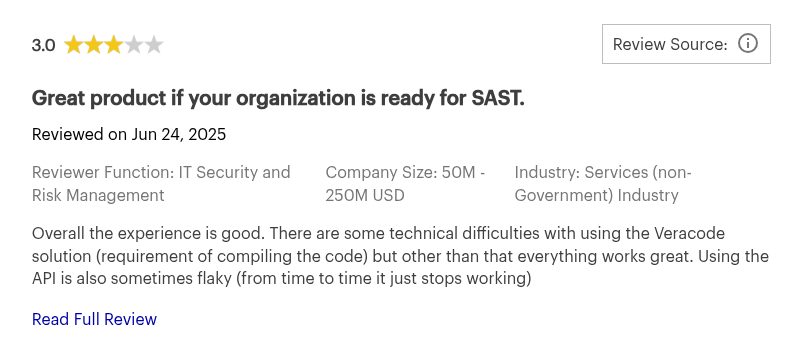

Users also shared:
If this sounds familiar, then, you’re likely ready to explore alternatives. In this article, we’ll walk you through the best Veracode alternatives that provide real protection without the fluff. We’ll look at:
Also comparing SAST tools? Check out our Top 10 AI-powered SAST tools in 2025 for a full breakdown of the modern static analysis platforms teams are using today.
Veracode is an application security platform that offers SAST, DAST, and SCA to help teams find vulnerabilities across their applications.
In practice, Veracode is used by enterprises to scan for vulnerabilities in source code and web apps, often as part of compliance or risk management programs. It integrates with CI/CD pipelines and developer tools to embed security checks into the software development lifecycle.
In a traditional AppSec model, Veracode acts as a one-stop shop to find known coding flaws, insecure dependencies, and web app vulnerabilities before they reach production. Its support for a broad range of languages and report generation has made it a go-to for security teams. Veracode’s platform also includes governance features like policy management and compliance reporting, which appeal to larger organizations with strict security requirements.
Despite Veracode’s capabilities, many teams start looking for a better solution once they encounter its friction:
In short, teams want to “shift left” and empower developers to fix issues quickly but Veracode slows them down. Searching for a suitable Veracode alternative means finding tools that aren’t only faster but more accurate, easier to use, and cost-effective.
Below is a quick list of the top Veracode alternatives we’ll be covering, with a sneak peek at why each is on the list:
Now, let’s see how each tool stacks up against Veracode.
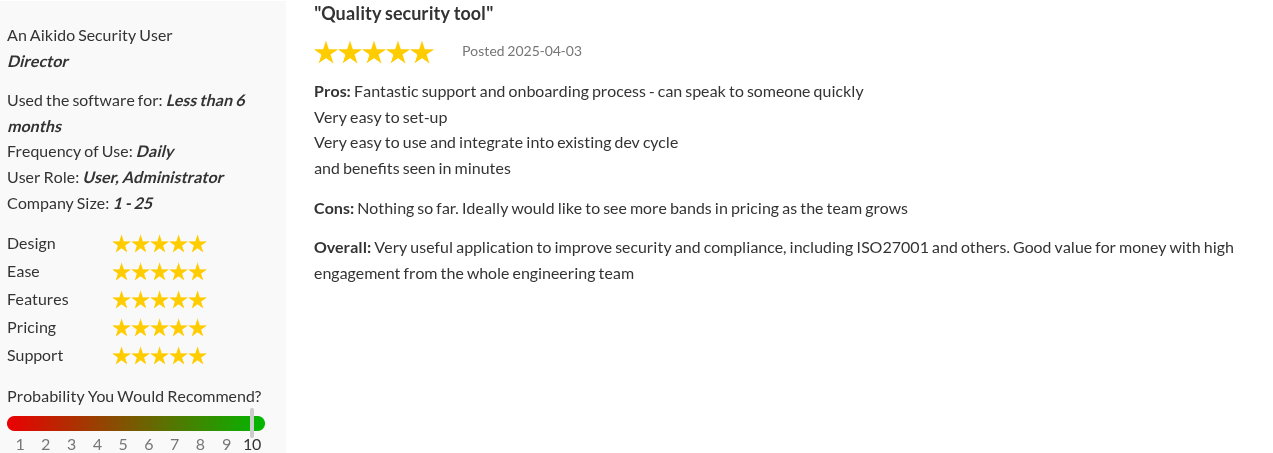
Aikido Security is the ultimate security platform that covers everything from code to cloud and even runtime security. It’s designed for software teams that want real protection without the noise. The goal: give developers a single pane of glass for security without the usual friction, while giving engineering and security leaders peace of mind.
Aikido offers best-in-class static code analysis (SAST), open-source dependency scanning (SCA), container scanning, infrastructure-as-code (IaC) scanning, dynamic testing (DAST), API testing, and more. Each module can be selected as a standalone solution that can compete with alternatives, or can be integrated to create a complete code to cloud to runtime security platform.
Unlike Veracode, Aikido offers cloud security and within the code security space it offers: code quality, malware detection, end-of-life runtimes, on-premise code scanning, AI Autofix for IaC and custom SAST rules. Meanwhile, it has superior coverage for container security (end of life runtimes for containers, AI Autofix), and it also offers Zen, a firewall for bot, attack and geo-blocking and rate-limiting.
Other capabilities that are not available in Veracode include reachability analysis, deduplication and AI Auto-Triage, which all contribute to making Aikido far superior.
The standout feature, however, is that Aikido can do what Veracode does, but better: reducing false positives, enabling developers to more easily find what they need, providing actionable guidance and automated fixes.
If you're fed up with bloated dashboards, false positives, and disconnected tools, Aikido is built for you. It unifies scanners, simplifies triage, and speaks “developer”.
Whether you're a lean startup or scaling security across a large engineering org, Aikido gives you full-stack protection that fits how modern teams actually build software. It’s everything Veracode promises minus the legacy friction.
Custom offerings are also available for startups (30% discount) and enterprises
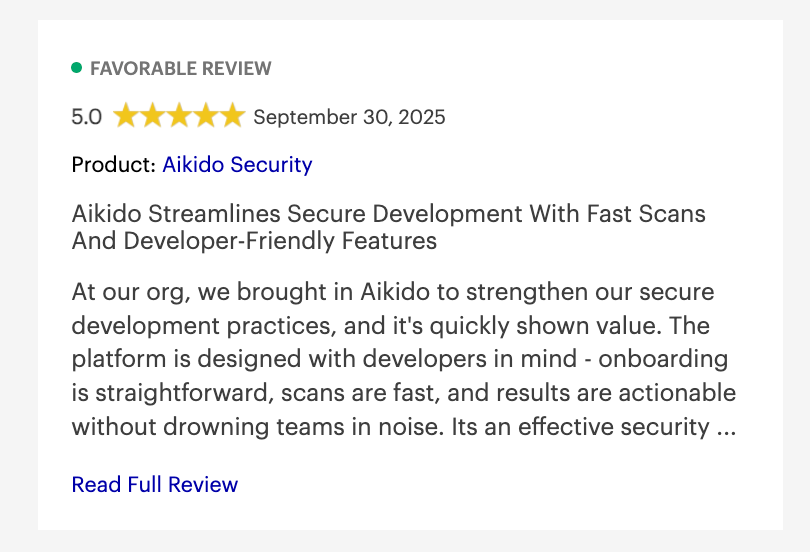
Beyond Gartner, Aikido Security also has a rating of 4.7/5 on Capterra and SourceForge

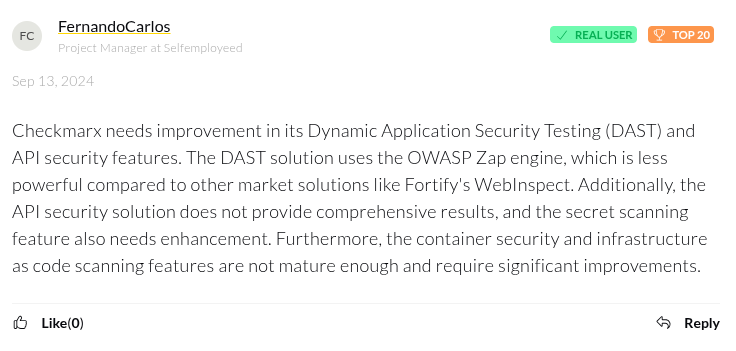
Checkmarx is a long-established name in application security, best known for its static application security testing (SAST) capabilities. Its modern platform—Checkmarx One—is a unified, cloud-native AppSec suite that includes SAST, software composition analysis (SCA), API security, infrastructure-as-code (IaC) scanning, container scanning, and even some DAST features.
Where Veracode scans compiled binaries, Checkmarx scans source code directly, which makes it more flexible and easier to integrate into dev workflows. Enterprises often choose it for its deep language coverage, ability to customize rules, and optional on-premise deployment.
Checkmarx is a solid Veracode alternative if your top priority is robust static code analysis, especially for large, regulated codebases. It’s also ideal if you want full control over where scans run or need highly customizable rules.
While it still has a learning curve and can generate false positives without tuning, its flexibility, broad language support, and enterprise readiness make it a strong pick for security teams that want depth and configurability over simplicity.
Here a few details you should note if considering Checkmarx as your Veracode alternative:
Custom pricing
Checkmarx One is rated 3.9/5, based on over 50 reviews on Capterra
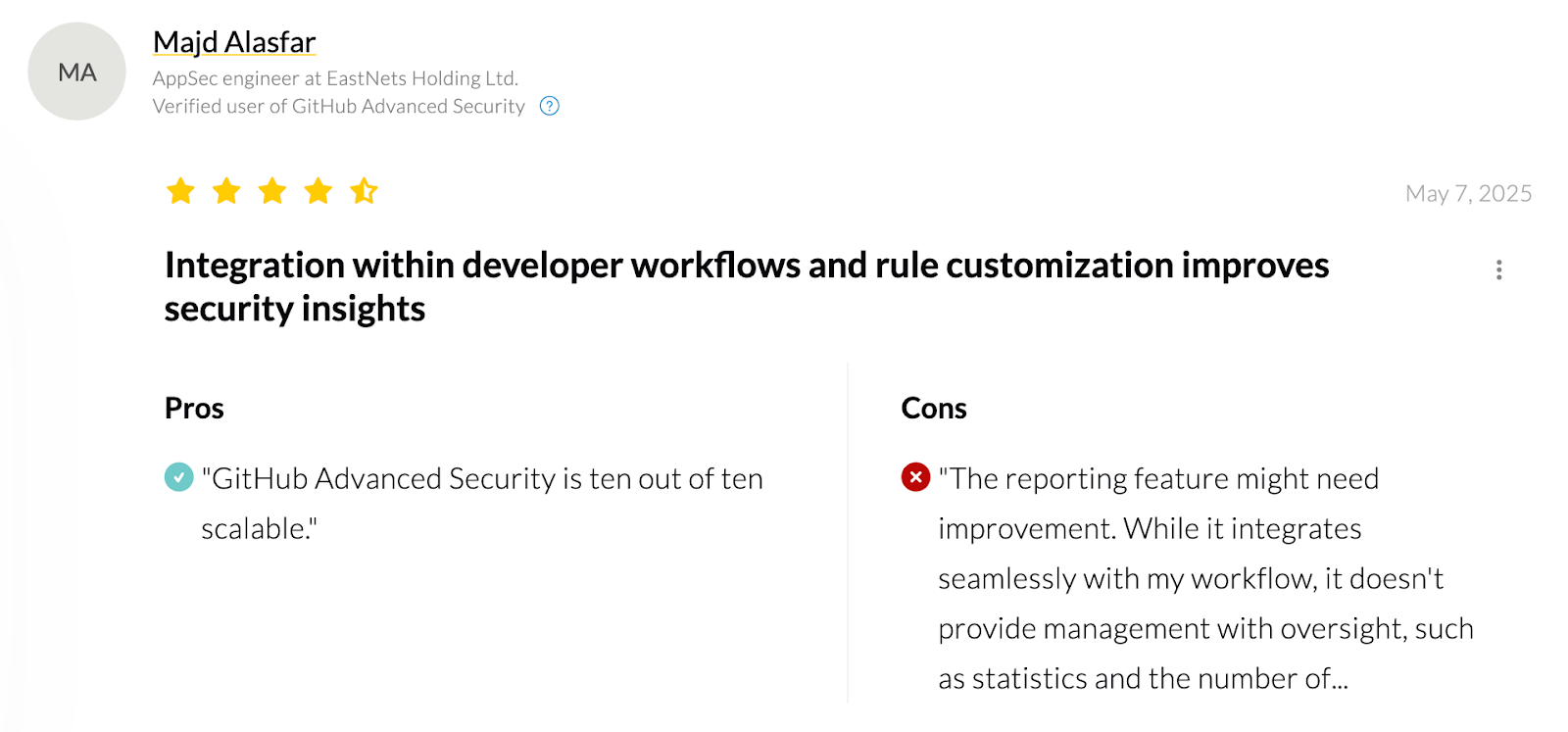
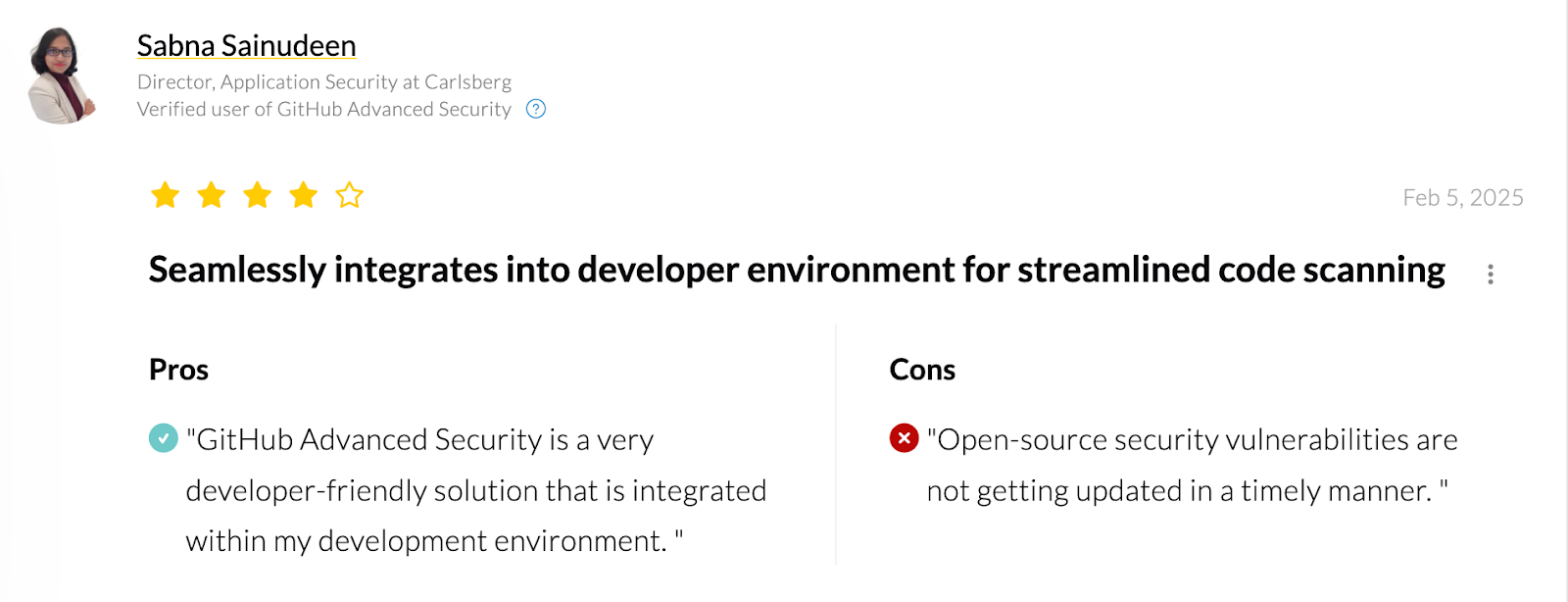
GitHub Advanced Security (GHAS) is GitHub’s native suite of security features designed to scan code directly within the GitHub ecosystem. It includes CodeQL-based static analysis, secret scanning, and open-source dependency scanning (via Dependabot). It’s not a standalone platform, but rather a fully integrated experience for teams already building on GitHub.
GitHub Advanced Security (GHAS)
Its strength lies in blending security checks seamlessly into the developer workflow—findings appear directly in pull requests, with no need for context switching. For teams already using GitHub, it turns the repo itself into a secure development platform, but it does not offer the same coverage as other platforms on this list.
GHAS is a top choice for teams already building on GitHub. It doesn’t require additional infrastructure or licenses beyond GitHub Enterprise, and developers love how security feedback fits neatly into their existing workflow.
The main tradeoff? It’s GitHub-only. If your org spans multiple platforms or needs more advanced features like DAST or IaC scanning, GHAS won’t cover it all. Still, for most use cases, it’s a fast, developer-friendly way to catch vulnerabilities early—without buying another product. Let’s breakdown what GHAS offers even more:

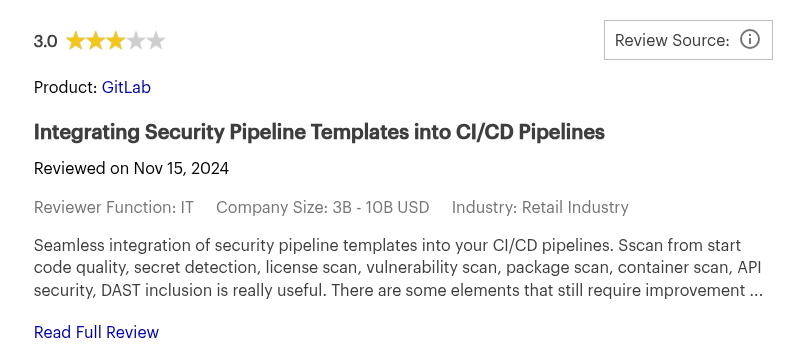
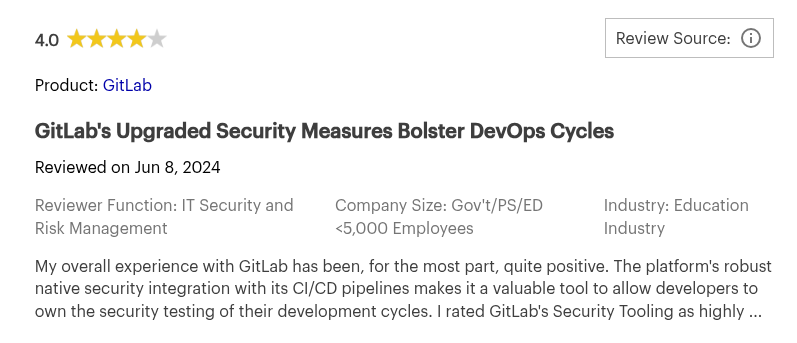
GitLab Ultimate is GitLab’s top-tier plan, bundling a wide array of built-in security features into its DevOps platform. It includes SAST, DAST, container and dependency scanning, secret detection, and infrastructure-as-code checks—all triggered natively through GitLab CI pipelines.
Rather than building custom integrations or using separate scanners, GitLab Ultimate enables security right out of the box for teams already using GitLab for version control and CI/CD.
GitLab Ultimate is a solid pick for teams already deep in the GitLab ecosystem. It automates security without adding tools or workflow complexity. You don’t get the same depth as an End-to-End Security platform, but for many teams, “good enough + built-in” beats “powerful but external.”
Ideal for small-to-medium engineering teams who want to stay secure without overloading their stack—or their security budget.
Custom pricing

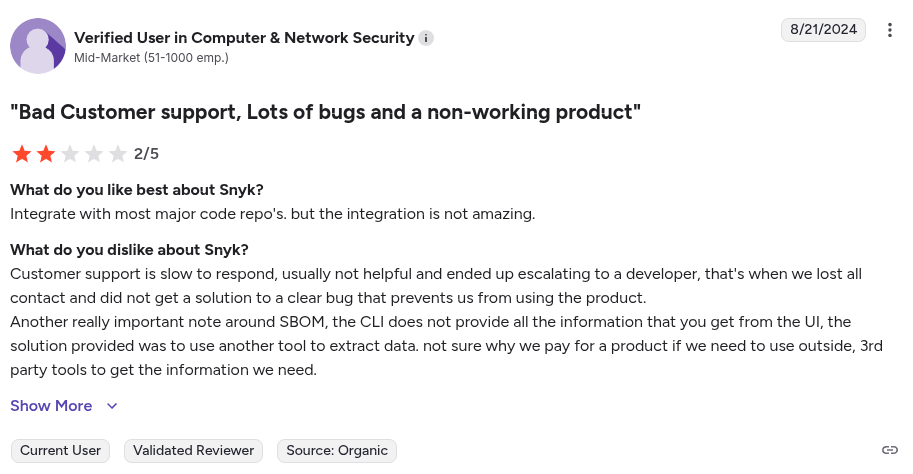
Snyk is a security platform that originally gained traction through its intuitive open-source vulnerability scanning and ease of use. Over time, it has expanded to include Snyk Code (SAST), Snyk Container, and IaC scanning.
Snyk is ideal for engineering teams who want security tools that feel like part of their workflow. However, Snyk’s SAST engine may lag behind with large codebases like Checkmarx. Also generates a lot of false positives.
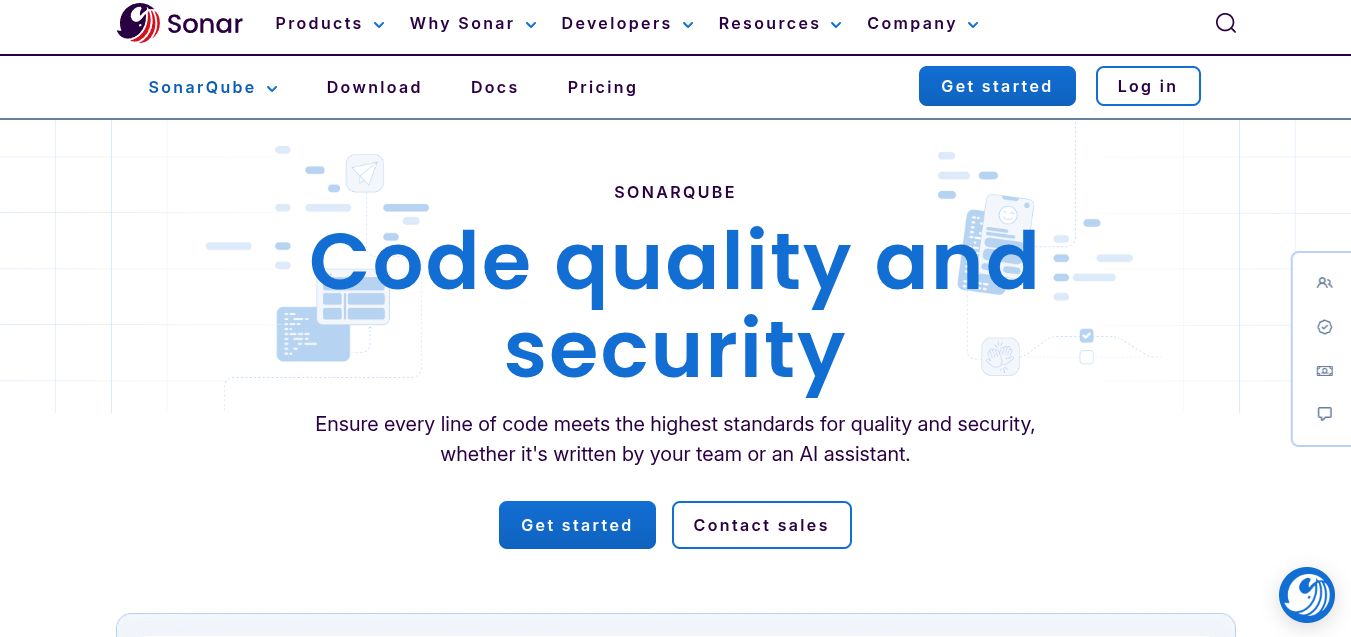
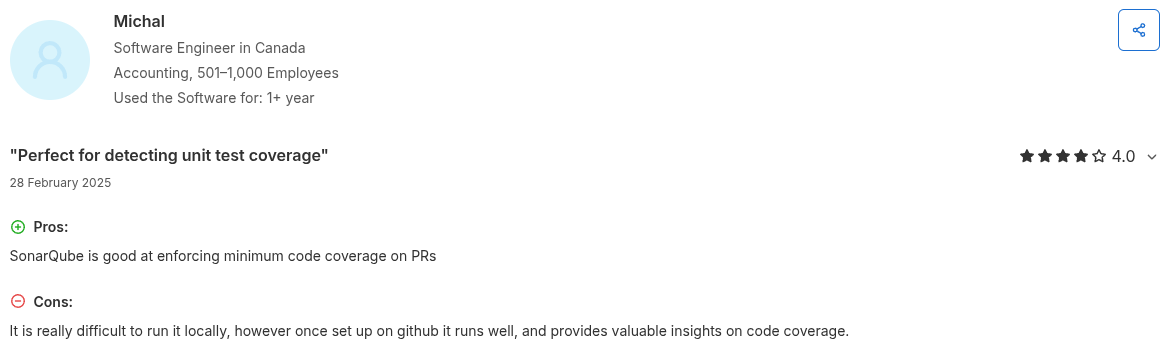
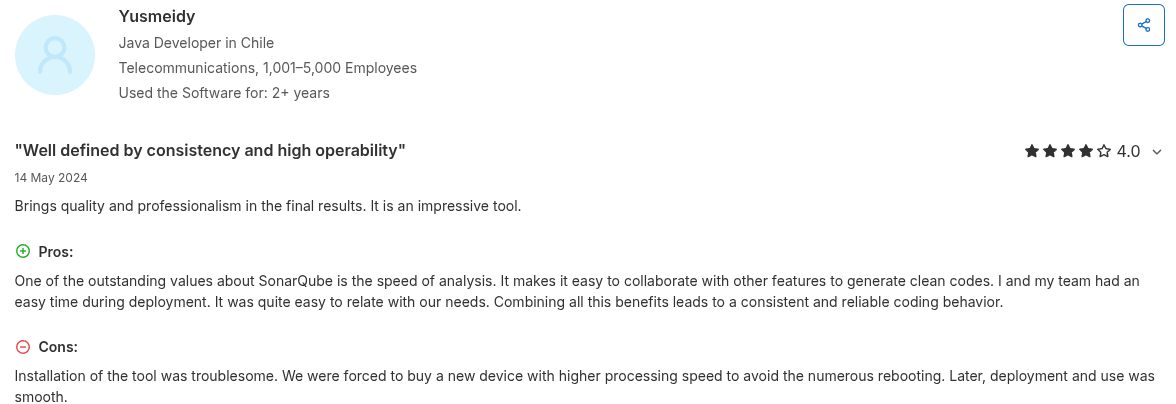
SonarQube is best known for improving code quality and cleanliness, but it also includes an expanding set of security-focused rules especially in its Developer and Enterprise editions. Built by SonarSource, it's often used internally by dev teams to enforce consistent code, detect bugs, and catch security issues early.
Many organizations already use it for quality gates and test coverage, so enabling its security features is often a natural next step. It supports 20+ languages and offers both on-prem and cloud-based SonarCloud versions.
Why Choose It:
SonarQube is perfect for teams looking to combine code quality and basic security in one tool. While it doesn’t offer dynamic analysis or deep open-source scanning, it reliably catches many of the most common and dangerous vulnerabilities early, and it’s easy to set up and manage.
If your team already uses SonarQube for quality control, enabling security checks adds minimal overhead. And for security-light organizations or teams wanting a cost-effective Veracode alternative, the Developer Edition packs in plenty of value.
SonarQube’s pricing comes in two categories: cloud-based and self-managed.
Besides Gartner, Capterra also rates SonarQube a 4.5/5
To make the decision easier, below is a comparison of Veracode and these top alternatives on key aspects:
| Tool | SAST | DAST | SCA | IaC |
|---|---|---|---|---|
| Aikido Security | ✅ | ✅ | ✅ | ✅ |
| Checkmarx | ✅ | ⚠️ | ✅ | ✅ |
| GitHub Advanced Security | ✅ | ❌ | ✅ | ❌ |
| GitLab Ultimate | ✅ | ✅ | ✅ | ✅ |
| Snyk | ✅ | ❌ | ✅ | ✅ |
| SonarQube | ✅ | ❌ | ❌ | ❌ |
Note: All tools above (except SonarQube Community) offer commercial plans. False positive levels are relative assessments; actual results may vary by project.
Use the comparison table to identify which alternative aligns with your priorities – for instance, Aikido excels in breadth and low noise, GHAS wins on integration, Snyk on open-source coverage, etc. Next, we’ll address some common questions when choosing a Veracode alternative.
Veracode helped define application security. But for modern teams, it's no longer enough. Today’s best alternatives focus on speed, clarity, and developer experience.
If you’re tired of security theater—scans that generate alerts but no action— and looking for a tool that prioritises real outcomes: fewer false positives, faster fixes, and seamless CI/CD integration, Aikido Security is your solution.
Aikido Security stands out for offering full-stack coverage (from SAST and code quality, to cloud config scanning) with a developer-first interface and near-zero noise. It’s built to be used—not avoided.
Most of the tools in this guide offer free trials or community plans. Try a few. See what fits your workflow. The best AppSec solution is the one your team actually enjoys using.
Ready to move on from Veracode’s legacy friction? Schedule a demo or start your free trial today—no credit card required.
SonarQube Community Edition is a solid free option for static code analysis and basic security checks. If your code is open source, you can also use GitHub Advanced Security for free (includes CodeQL scanning, secret detection, and Dependabot updates). Snyk offers a free tier for scanning open source libraries and containers, making it a good fit for smaller teams or trial use.
Aikido Security is great for small teams that want an all-in-one solution without high false positives or complex onboarding. Snyk is also a strong choice, especially if you're focused on open source and container security. Both tools are easy to set up and offer transparent pricing.
Aikido is faster to onboard, flags fewer false positives, and provides broader coverage - including code, containers, IaC, and even runtime protection. It's built for developers, integrates directly into CI/CD and version control, and offers flat pricing with no surprises. Veracode, by contrast, is slower, more expensive, and often less developer-friendly.
Yes. Many teams use a combination of tools - for example, GitHub Advanced Security for pull request scanning and Snyk for dependency management, or SonarQube for quality gates alongside a platform like Aikido for full-stack coverage. Just make sure you avoid duplicate alerts and assign clear ownership for triaging.
Note: False positive levels are relative assessments; actual results may vary by project.
Use the comparison table to identify which alternative aligns with your priorities. For instance, Aikido excels in breadth and low noise, GHAS is great for existing Github users.
You Might Also Like:
此内容由惯性聚合(RSS阅读器)自动聚合整理,仅供阅读参考。 原文来自 — 版权归原作者所有。