


Black Duck was once a category leader in Software Composition Analysis (SCA), and now focuses primarily on open-source and licence risk management. It was built around security-team control and linear, waterfall delivery models. Since undergoing a transformation in 2017, the company has stood still in regards to innovation. As enterprises are reevaluating tooling built for pure compliance rather than real security, many are looking for Black Duck alternatives.
In 2026, engineering and security teams report that Black Duck feels dated for how modern teams actually build software:
As Aikido’s State of AI in Security & Development 2026 report highlights, teams face pressure to automate security without slowing innovation, and tool sprawl is an ongoing concern.
That’s why security leaders are exploring alternatives. They’re looking for DevSecOps tools that deliver accuracy and smooth integration, platforms built for current development needs rather than outdated systems.
If BlackDuck's limited focus, complexity and cost are slowing your team down and you’re looking for other solutions, Aikido Security is the #1 among Black Duck alternatives. Aikido offers the best-in-class security tools (SAST, SCA, DAST, and more) for start-ups to enterprises, coming out on top in technical comparisons and POC head-to-heads in each of these tool categories..
For organizations searching for a comprehensive platform that provides end-to-end security coverage, the Aikido platform covers code, cloud, protect (automate application protection, threat detection and response) and attack (detect, exploit and validate your entire attack surface, on demand).
One key feature of Aikido is its false positive reduction. It reduces false positives by up to 85% through intelligent auto-triage and reachability analysis, surfacing only the vulnerabilities that actually impact your running code. This drastically shortens mean time to remediation (MTTR).
Aikido is tailored to improve developer experience and time-to-value. Unlike Black Duck, which operates on a test → build → retest → deploy workflow, Aikido embeds security directly into developer workflows, enabling continuous scanning of live repositories, in line with agile and DevSecOps principles.
Aikido connects to repos in 5 to 10 minutes via GitHub App or CLI, whereas Black Duck onboarding can take weeks or months and may even require professional services.
The payoff: Developers get one-click fixes via automated pull requests, and Aikido’s transparent, flat-rate pricing keeps costs predictable as teams scale. In addition, CISOs and other leaders can demonstrate technical control coverage of compliance frameworks directly from the security platform. Aikido is built for teams that need to move fast without compromising security.
The table below outlines the significant distinctions between Aikido and Black Duck, helping you determine which platform best aligns with your team’s priorities.
| Category | Aikido Security | Black Duck |
|---|---|---|
| Code security (SAST, SCA, IaC, secrets discovery, EOL runtime…) | ✅ Unified coverage; AI AutoFix for SAST/IaC; SCA/SBOM/license; custom SAST rules; runtime awareness |
⚠ Focused on SCA/SBOM/license; SAST via Coverity ❌ No Custom SAST rules |
| Containers | ✅ Image scanning, OSS/license checks, AI AutoFix for containers, EOL runtime alerts |
⚠ Limited to container SCA/license ❌ No EOL/runtime tracking |
| AI & Automation | ✅ AI AutoTriage, AI AutoFix (SAST/IaC/containers), reachability analysis | ❌ Absent (triaging is available but not AI-based) |
| DAST & API Scanning | ✅ | ✅ |
| Compliance Frameworks |
✅ Prebuilt checks for ISO 27001, SOC 2, NIST, PCI, HIPAA, DORA, NIS2, OWASP Top 10, GDPR + more ✅ Seamless integration with GRC providers to automate controls (Vanta, Drata, Secureframe, Thoropass…) |
⚠ License compliance only, no framework control mappings ❌ No out-of-the-box integrations available |
| Deployment & Integration | ✅ Cloud SaaS (SOC 2) + optional self-hosted; CI/CD + IDE integration; 5–10 min setup | ⚠ Primarily on-prem; longer onboarding (weeks and months) |
| User Focus | ✅ Developer-first (GitHub App, CLI, real-time PR feedback) | ⚠ Security/compliance-team oriented |
Black Duck is a well-established security tool. It uses multiple scanning engines covering dependencies, source code, binaries, and code snippets to uncover hidden risks and generate SBOMs in formats like SPDX and CycloneDX.
Synopsys acquired Black Duck in 2017, integrating it into the Software Integrity Group until its rebrand and spin-out in 2024. However, this has impacted the company’s overall vision, product roadmap and innovation.
Black Duck remains a trusted DevSecOps platform, offering deep visibility and strong governance over open-source and third-party components. However, as DevSecOps practices evolve, many teams struggle to balance Black Duck’s complexity and cost with the speed and flexibility modern development requires.
Setting up and maintaining Black Duck often demands considerable time and effort, from configuring policies to integrating with CI/CD pipelines. Developer experience is another growing concern. When scans delay builds or disrupt workflows, adoption rates drop quickly. What once empowered teams now slows them down.
Modern teams are shifting toward developer-first security tools that fit naturally into the way developers already work. They want instant, contextual feedback inside pull requests or IDEs, not delayed reports buried in dashboards. Aikido supports this shift by offering best-in-class products (SAST, DAST, SCA, API security and more) that combine speed and security through real-time scanning, smart prioritization, and automated remediation.
Let’s examine what makes each alternative worth considering and why Aikido stands out as the top choice for teams ready to move beyond Black Duck’s complexity.
The alternatives below represent some of the top DevSecOps tools. Each delivers advanced security insights and adaptable rules that meet the needs of enterprise-scale security workflows.
Enterprises choose Aikido Security as a modern, developer-first end-to-end security platform that unifies SCA, SAST, IaC, secrets discovery, hardened containers, advanced malware detection, and more extended functionality if desired (CSPM, code quality, runtime protection, and AI pentesting). It delivers fast, actionable feedback in pull requests with AI-powered AutoTriage and AutoFix.
Aikido complements or replaces Black Duck to expand coverage, reduce noise, and accelerate remediation. On feature breadth across major security domains, Aikido provides ≈3x broader coverage than Black Duck. All this can be achieved without the long setup cycles or high false-positive rates of legacy tools like Black Duck.
All paid plans start from $300/month for 10 users.
|
Developer (Free Forever): |
|
|
Basic: |
|
|
Pro: |
|
|
Advanced: |
|
|
Enterprise: |
|
If your team struggles with legacy security tools like Black Duck, which demand heavy infrastructure and long scan times, Aikido is your solution. By delivering accurate alerts that fit naturally into your workflow, it enables high-quality releases without compromising open-source security.
Veracode is a cloud-based security platform combining static, dynamic, and software composition analysis. It identifies vulnerabilities in code, dependencies, and third-party libraries while integrating seamlessly with development pipelines. Automation and centralized reporting let organizations scale security without burdening developers.
Veracode’s pricing is customized for each organization, so there isn’t a fixed public pricing table. Costs typically depend on:
Because pricing varies, the best approach is to contact Veracode directly for a quote tailored to your tech stack and scanning requirements.
Veracode offers a centralized, enterprise-grade security platform that combines static and open-source analysis to manage risk throughout the software lifecycle. Integration into CI/CD pipelines supports development velocity while ensuring compliance.
Snyk is a modern security tool that brings open-source and dependency security earlier in development. It identifies vulnerabilities in pull requests, IDEs, and pipelines, helping teams address security risks before they reach production. By integrating into development workflows, Snyk enables teams to maintain secure software supply chains.
|
Free Tier: |
|
|
Team Plan: |
|
|
Enterprise Plan: |
|
|
Add-Ons: |
|
Snyk integrates into developer workflows to address vulnerabilities early, while supporting license and compliance checks without requiring complex infrastructure. As a DevSecOps security tool, it provides practical open-source security for teams focused on maintaining speed.
JFrog Xray provides detailed insights into open-source components and container images, scanning each layer for vulnerabilities and license issues. It analyzes the whole dependency tree to reveal actual risks across the software supply chain. As a DevSecOps security tool, its CI/CD integration ensures that problems are detected early, allowing developers to fix them before they reach production.
|
Pro (Cloud – Xray + Artifactory): |
|
|
Enterprise X (Cloud – DevSecOps bundle): |
|
|
Enterprise +: |
|
|
Consumption-based add-ons: |
|
JFrog Xray offers full visibility into artifacts and dependencies, integrating security directly into DevOps workflows. Its policy enforcement across pipelines supports consistent operations and effective risk management.
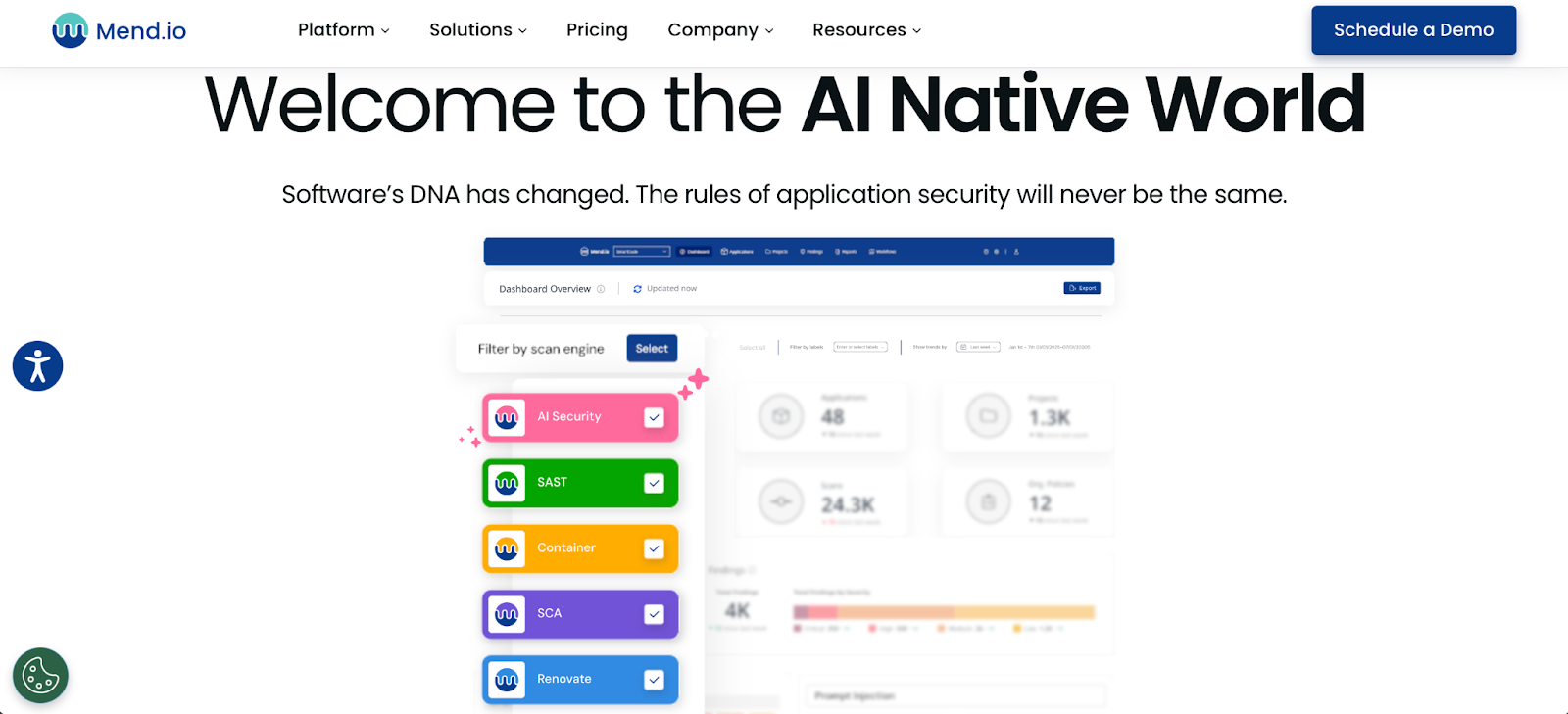
Mend offers a solution for DevSecOps security, helping teams identify vulnerabilities, manage licenses, and maintain compliance. By analyzing dependency trees and integrating with CI/CD pipelines, it detects risks early. With visibility and automated remediation, Mend enables organizations to maintain secure software supply chains efficiently.
|
Starting pricing: |
|
|
Higher tier entry: |
|
|
Scope: |
|
|
Bundles: |
|
Mend combines open-source security, license compliance, and risk prioritisation, integrating seamlessly into development workflows. As a DevSecOps security tool, it enables teams to maintain speed while gaining actionable insights for comprehensive management of third-party risks.
Checkmarx SCA gives teams with clear visibility into open-source libraries, container images, and binary dependencies. It scans full dependency trees, including transitive ones, to identify vulnerabilities, malicious code, and license issues. As a DevSecOps security tool with integration into IDEs, CI/CD pipelines, and a central dashboard, Checkmarx helps teams detect and manage risks early and efficiently.
Checkmarx pricing is customized for each organization and generally depends on team size, number of repositories, and chosen modules. While exact rates aren’t publicly listed, the platform includes tools like SAST, SCA, DAST, API security, IaC security, and secrets detection. Costs increase with team size and larger deployments can be more expensive.
Checkmarx provides enterprise-level DevSecOps security across code, binaries, containers, and dependencies, offering clear insights and actionable prioritization. For teams needing mature and well-managed security solutions, Checkmarx is a reliable choice.
Semgrep is a static security tool that detects code patterns, enforces security policies, and identifies vulnerabilities early in development. By analyzing code as it’s written, teams can catch issues before they reach production. Its lightweight, customizable rules enable scanning of repositories, pull requests, and CI/CD pipelines without slowing down development.
|
Community Edition (Free): |
|
|
Teams (Paid): |
|
|
Enterprise: |
|
|
Billing & Usage Notes: |
|
Semgrep helps teams embed customizable security rules directly into development workflows, enabling early detection without slowing velocity. For organizations seeking a code-focused DevSecOps security tool, Semgrep offers a forward-looking approach.
The table below compares leading Black Duck alternatives.
| Tool | Integrations | Best Features | Considerations |
|---|---|---|---|
| Aikido | 100+ integrations including GitHub, GitLab, Bitbucket, AWS, Azure, Google Cloud. | Best-in-products across SCA, SAST, IaC, and cloud; AI-driven noise reduction and AutoFix; 50,000+ customers across code, cloud, and runtime security. | None |
| Veracode | GitHub, Jenkins, Azure DevOps, Jira | Mature platform with deep SAST, DAST, and SCA integration | Slower scans; complex onboarding for smaller teams |
| Snyk | GitHub, GitLab, Bitbucket, Docker, VS Code, IntelliJ | Developer-first security; excellent dependency scanning and auto-fix suggestions | Cost scales quickly with usage; occasional alert noise |
| JFrog Xray | GitHub, GitLab, Jenkins, Artifactory, Docker | Comprehensive binary and artifact scanning; deep CI/CD integration | Requires JFrog ecosystem for full functionality |
| Mend | GitHub, GitLab, Bitbucket, Azure DevOps, Jenkins | Full dependency scanning, license compliance, and automated remediation | Interface can feel complex for new users |
| Checkmarx | GitHub, GitLab, Bitbucket, Jenkins, AWS | Advanced SCA with deep code insights and governance; strong compliance coverage | Requires dedicated setup and tuning for optimal results |
| Semgrep | GitHub, GitLab, Bitbucket, CI/CD | Lightweight, customizable static analysis; developer-friendly rules engine | Limited runtime analysis; advanced management behind paid plans |
This guide explores seven trusted Black Duck alternatives, each offering unique strengths in DevSecOps security and open-source risk management. Whether your focus is on smoother workflows or broader coverage, these options help teams stay secure without adding extra operational load.
BlackDuck was launched in 2002. In its 20+ years of existence, it has tried to keep up with new security challenges. In 2026 the landscape is miles different. Teams today need security tools that move at the same pace as their development cycles. Complexity, long scan times, and poor developer experience are no longer trade-offs teams are willing to accept.
Whether you’re securing code, containers, APIs, or cloud infrastructure, the best alternative isn’t just about coverage, it's about developer experience, scale, cost and support.
That’s where Aikido stands out. Built for developers, trusted by security teams, and designed for modern development practices, Aikido keeps application security simple, connected, and effective.
Schedule a demo or start your free trial today. No credit card required.
Why do teams say Black Duck is for security teams, not developers?
Because its architecture and UX are security-centric. Black Duck was built to satisfy compliance audits and legal requirements, not developer productivity. Developers rarely interact with it directly; findings arrive late and require manual triage. Aikido reverses this dynamic by embedding security where developers work: inside their IDE, Git PRs, repos, and CI/CD pipelines.
What does “Black Duck operates linearly (waterfall)” mean?
Its testing model is sequential: you build, then scan, then fix in a later cycle. This mirrors the waterfall software delivery methodology, not continuous integration. In practice, it delays feedback and causes security debt to accumulate. Aikido performs continuous, incremental scans on every branch update, aligning with modern DevSecOps principles and agile software development.
Is Black Duck considered a legacy tool?
Yes. Like first-generation AppSec solutions (Fortify for SAST, WhiteHat for DAST), Black Duck belongs to an earlier era of point solution tools. Its focus on SCA and on-prem deployments reflects the needs of 2002 era security teams. Modern enterprises seek a unified, cloud-native platform that consolidates SCA, SAST, IaC, and runtime security in one place, which is exactly what Aikido delivers.
Aikido merges capabilities that traditionally required separate tools (SCA, SAST, IaC, containers, DAST). This reduces license and maintenance overhead while improving coverage. Cloud-based deployment means no hardware costs or professional services. The result: ≈ 3× feature coverage with significantly lower total cost of ownership (TCO).
We already use Black Duck for license compliance and need deep legal audit trails. Why should we evaluate a different solution?
Great! Aikido provides evidence logging and license visibility, but goes further by catching and fixing real security threats before code is merged. Keep Black Duck if legal needs deep audit continuity while developers gain modern, actionable security tooling.
Can Aikido and Black Duck coexist?
While Aikido can fully replace your Black Duck deployment, enterprises sometimes retain Black Duck in the short term for consistent legal SBOM/license functions, while deploying Aikido first and foremost for comprehensive AppSec and developer enablement. Aikido can integrate alongside existing compliance systems to extend coverage without disruption.
此内容由惯性聚合(RSS阅读器)自动聚合整理,仅供阅读参考。 原文来自 — 版权归原作者所有。