




AI has changed how we write code. Developers are now shipping faster, experimenting more, and relying on AI to handle parts of their workflow that used to take hours.
However, as speed increases, so does risk.
More code means more chances for vulnerabilities to slip through. And if testing still happens at the end of the process, it’s already too late. That’s where AI-powered SAST tools come in.
They help teams spot and fix issues early, keeping up with the same speed that AI brings to development.
In this article, we break down the 10 leaders in AI SAST tools. We explore the core features of each tool and the unique ways they implement AI to enhance vulnerability discovery, prioritization, and remediation.
Static Application Security Testing (SAST) is a methodology for analyzing an application's source code, bytecode, or binary to identify vulnerabilities and security flaws early in the software development lifecycle (SDLC). SAST finds vulnerabilities within the source code, which means that it is often the first defense against insecure code.
While SAST analyzes code from the inside out, DAST (Dynamic Application Security Testing) tests from the outside in.
Think of it this way:
Both are essential, but they serve different purposes in the SDLC. To learn more read SAST vs DAST what you need to know

SAST tools are one of the most effective ways to find and fix vulnerabilities before your code ever runs. Here are its key advantages:
In short, SAST empowers developers to build secure software by design not as an afterthought.
There are many different vulnerabilities SAST can find and it depends on the coding practices used, technology stack and frameworks. Below are some of the most common vulnerabilities a SAST tool will typically uncover.
Detects improper sanitization of user inputs that could lead to database compromise.
Example Python code vulnerable to SQL Injection:
# Function to authenticate user
def authenticate_user(username, password):
   query = f"SELECT * FROM users WHERE username = '{user}' AND password = '{password}'"
   print(f"Executing query: {query}")  # For debugging purposes
   cursor.execute(query)
   return cursor.fetchone()
The above code is vulnerable because the query variable uses string interpolation (f-string) and directly inserting user input via '{username}' which enables any malicious actor to inject SQL code from their input to the DB.
Identifies instances where user inputs are incorrectly validated or encoded, allowing injection of malicious scripts.
Example of client-side javascript code vulnerable to XSS:
<script>
   const params = new URLSearchParams(window.location.search);
   const name = params.get('name');
   if (name) {
          // Directly inserting user input into HTML without sanitization
          document.getElementById('greeting').innerHTML = `Hello, ${name}!`;
   }
</script>
The code above is vulnerable because it uses .innerHTML to directly insert user input into HTML without sanitization.
Highlights areas where improper handling of memory allocation could lead to data corruption or system crashes.
Example C code vulnerable to buffer overflow:
1#include
2void vulnerableFunction() {
3    char buffer[10]; // A small buffer with space for 10 characters
4
5    printf("Enter some text: ");
6    gets(buffer); // Dangerous function: does not check input size
7
8    printf("You entered: %s\n", buffer);
9}
10
11int main() {
12    vulnerableFunction();
13    return 0;
14}
The above code is vulnerable because it uses the gets()C function which is dangerous. The gets() function doesn’t know the size of the buffer it's reading into, which can lead to reading more data than the buffer can hold, resulting in a buffer overflow.
Finds weak encryption algorithms, improper key management, or hardcoded keys.
Example of vulnerable Python cryptography code using obsolete MD5 hash function:
import hashlib

def store_password(password):
    # Weak hashing algorithm (MD5 is broken and unsuitable for passwords)
    hashed_password = hashlib.md5(password.encode()).hexdigest()
    print(f"Storing hashed password: {hashed_password}")
    return hashed_password
Altogether, SAST tools provide valuable insights, enabling developers to fix issues before they become critical.
You’ve learned what SAST is, and what kinds of vulnerabilities it finds, now let's see how it works behind the scenes.
The SAST process typically follows these four core steps:
The tool scans the application’s source code, bytecode, or binaries to create a structured representation (an abstract syntax tree or data flow graph). This helps it understand how the code is built, how data moves through it, and where security controls should exist.
Next, the tool applies a set of security rules and patterns to identify risky code constructs.
Not every finding is critical. SAST tools analyze context:
To reduce false positives and highlight what actually matters.
Finally, the results surface. Developers can act on them immediately, keeping security integrated in the daily workflow rather than treated as a separate phase.
All these steps today are taken to the next level with AI.
Right now you can’t get away from AI buzz (and BullSh*t). It can be difficult to know exactly how AI is being implemented in security tools.
Right now there are three trends with AI as it relates to SAST tools:
Next, we are going to compare some of the leaders in AI-powered SAST and explain the different ways these tools are implementing AI to enhance security.
Here are 10 industry leaders that are using AI in different ways to enhance the capabilities of traditional SAST (In alphabetical order)
Aikido takes the #1 spot as a SAST solution that goes beyond code scanning. For small to medium enterprises, you can get everything you need to secure your IT estate in one suite. For enterprises, Aikido offers SAST alongside best-in-class security products, so you can pick which module you need and unlock the platform when you're ready.
It uses AI to automatically fix vulnerabilities and filters out the noise (few false positives), so dev teams only see real issues. Aikido is the no-nonsense choice for CISOs, CTOs and developers who want fast, smart code security.
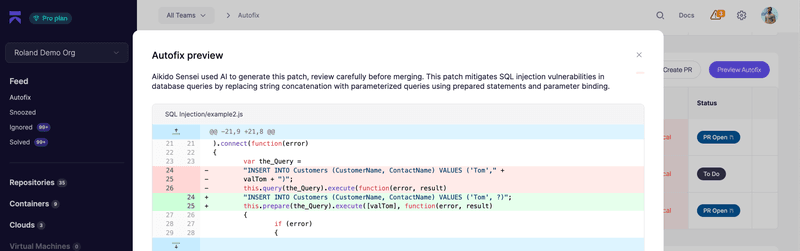
Core AI Capability | Auto Remediation (Dashboard + IDE)
Aikido Security uses AI to create code fixes for vulnerabilities discovered by its SAST scanner and can even generate automated pull requests to speed up the remediation process.
Unlike other tools, Aikido does not send your code to a third-party AI model, never stores or uses it to train AI, runs entirely on local servers, and has a unique method of ensuring your code does not leak through AI models.
Aikido first applies its own security rules to filter out false positives, and then uses a purpose-tuned LLM only to verify and refine suggestions. All analysis happens in a secure sandbox, so once the suggested remediation has passed validation, a pull request can be automatically created before the Sandbox environment is destroyed.
Aikido’s AutoFix also provides confidence scores, which are calculated without learning from your code so developers can make informed decisions.
Best for: CISOs that are aware of the needs of developers, from large enterprises, startups and scaleups.
None noted.
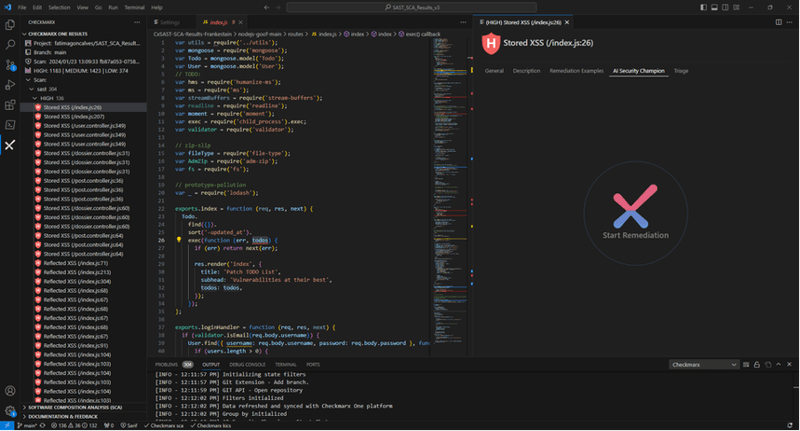
Core AI Capability | Auto Remediation (IDE only)
Checkmarx SAST tools can provide AI-generated coding suggestions to developers within their IDE. The tool connects to ChatGPT, transmits the developer's code to the OpenAI model and retrieves the suggestions. This method makes the process of querying ChatGPT easier but does not add any proprietary processes giving it limited capabilities right now.
WARNING:This use-case sends your proprietary code to OpenAI and may not meet compliance standards.
Best for: Organizations willing to accept (or manage) the risk of sending snippets of proprietary code to external AI services (like ChatGPT) for remediation suggestions
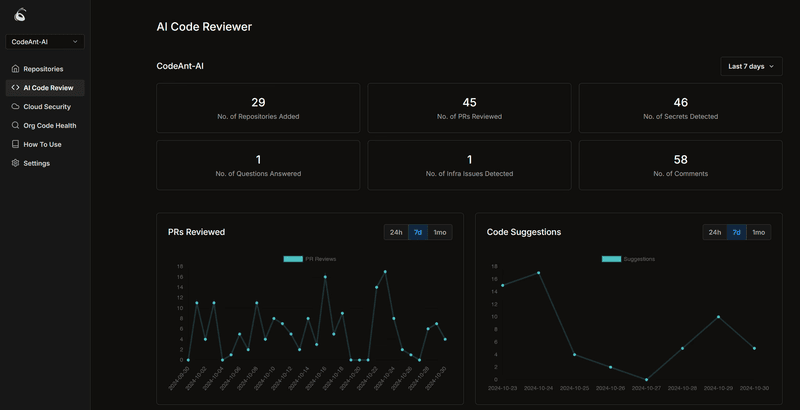
Core AI Capability | Improved Detection (Dashboard)
CodeAnt is a code security and quality tool that entirely uses AI for its discovery of code vulnerabilities and suggested fixes. CodeAnt does not provide documentation on how their AI models work but generally uses AI as their core detection engine, this can slow down detection, particularly in large enterprises.
Best for: Teams that prioritize speed & automation in code review and security, and want to offload much of the manual review effort.
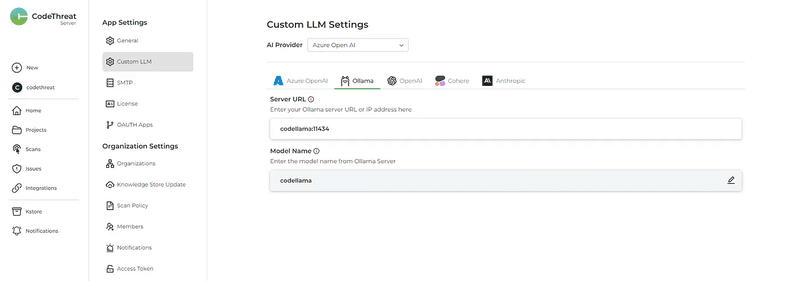
Core AI Capability | Automated Prioritization (Dashboard)
CodeThreat offers on-premise static code analysis and provides AI-assisted remediation strategies. A core difference is that CodeThreat allows you to integrate your own on-premise AI model into their tool. This has the advantage of not sending data to a third party but means it can only offer genetically trained AI models right now and you need to be running an on-premise AI LLM like ChatGPT.
Best for: Organizations with strict data sovereignty / compliance requirements that cannot allow code to leave premises
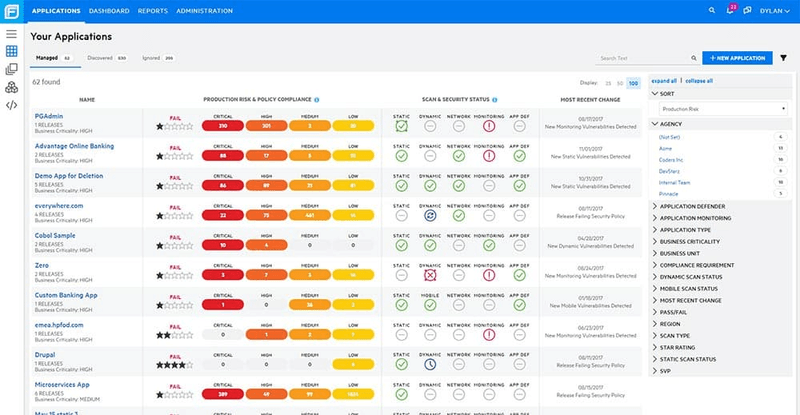
Core AI Capability | Improved Prioritization (Dashboard)
OpenText™ Static Application Security Testing (Fortify)scans source code for vulnerabilities and gives users the option to adjust thresholds when an alert is made. For example, likeliness of exploitability. Fortify’s AI Auto assistant reviews the previous thresholds assigned to vulnerabilities and makes intelligent predictions on what the thresholds for other vulnerabilities should be.
Note: Fortify Static Code Analyzer does not use AI to discover vulnerabilities or suggest fixes for them, instead it uses it to predict administrative settings used in the admin panels.
Best for: Teams that already have OpenText solutions integrated in their systems.
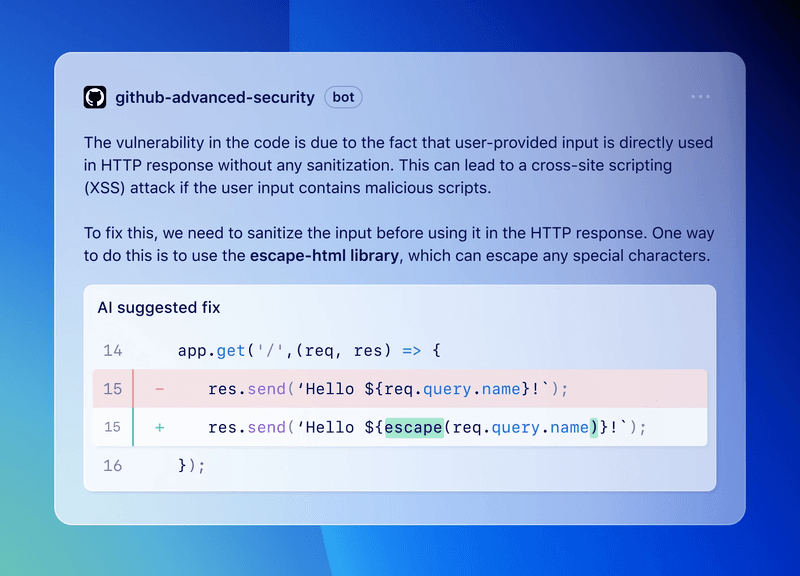
Core AI Capability | Auto Remediation (IDE + Dashboard)
GitHub CodeQL is a static code scanner that uses AI to create intelligent auto-remediation in the form of code suggestions. Developers can accept or dismiss the changes via pull requests in GitHub CodeSpaces or from their machine. It is part of GitHub Advanced Security.
Best for: Development teams already using GitHub / GitHub Advanced Security and wanting seamless integration of security and remediation in their workflow.
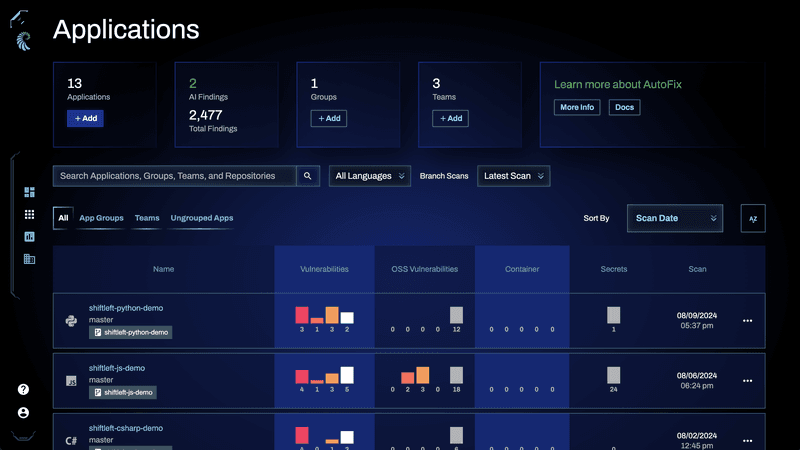
Core AI Capability | Auto Remediation (Dashboard)
Qwiet AI SAST is a rule-based static application security testing tool that leverages AI to auto-suggest remediation advice and code fixes for code vulnerabilities. Its core offering is its three-stage AI agents which Analyze the issue, Suggest a fix, and then validate the fix.
Best for: Teams that prioritise automated remediation support.
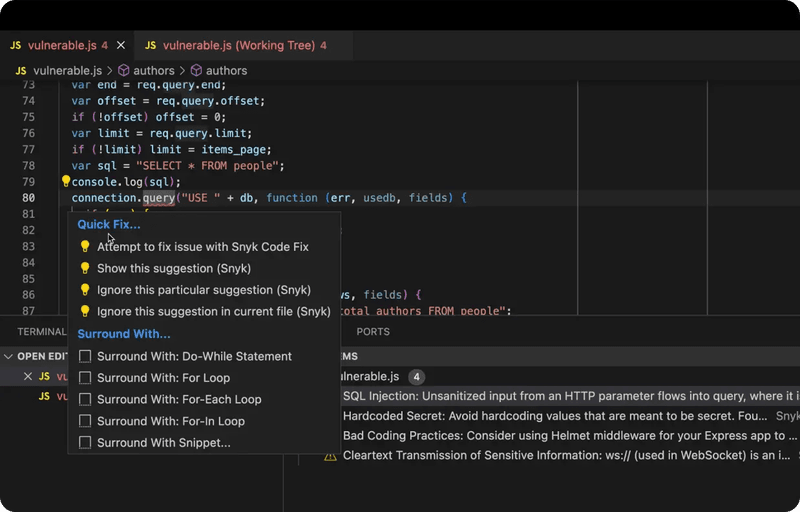
Core AI Capability | Auto Remediation (IDE)
Snyk Code is a SAST tool that can provide code suggestions to developers from within the IDE thanks to DeepCode AI (now Snyk Agent Fix) which Snyk acquired. DeepCode AI utilizes multiple AI models but Snyk's proprietary rules limit transparency and customization (even though it does allow for custom rules). Snyk's commercial tier can be costly for organizations that require coverage across different pipelines and developer teams.
Best for: Development teams already using Snyk / the Snyk platform (SCA, IaC, etc.) who want integrated code scanning
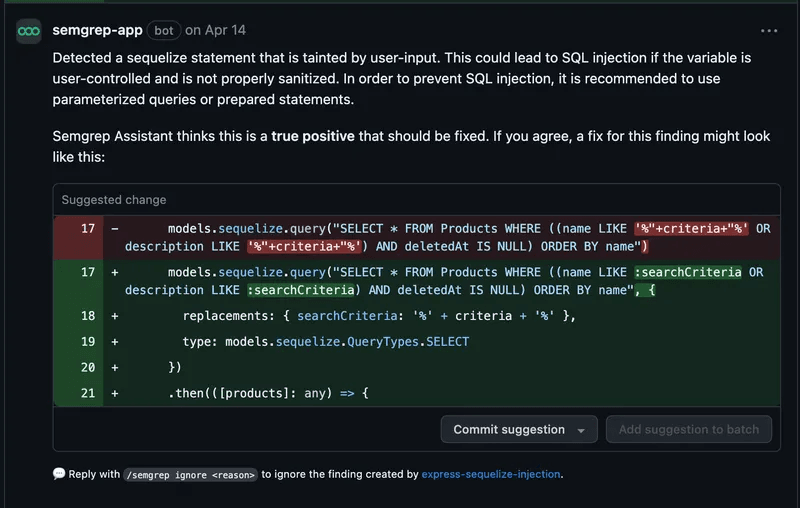
Core AI Capability | Improved Detection
SemGreps AI assistant, aptly named assistant, uses the context of the code surrounding a potential vulnerability to provide more accurate results and provide recommended code fixes. It can also be used to create rules for SemGrep to enhance its detection based on the prompts you provide.
Best for: Teams already in Semgrep ecosystem and want to enhance developer productivity and triage efficiency
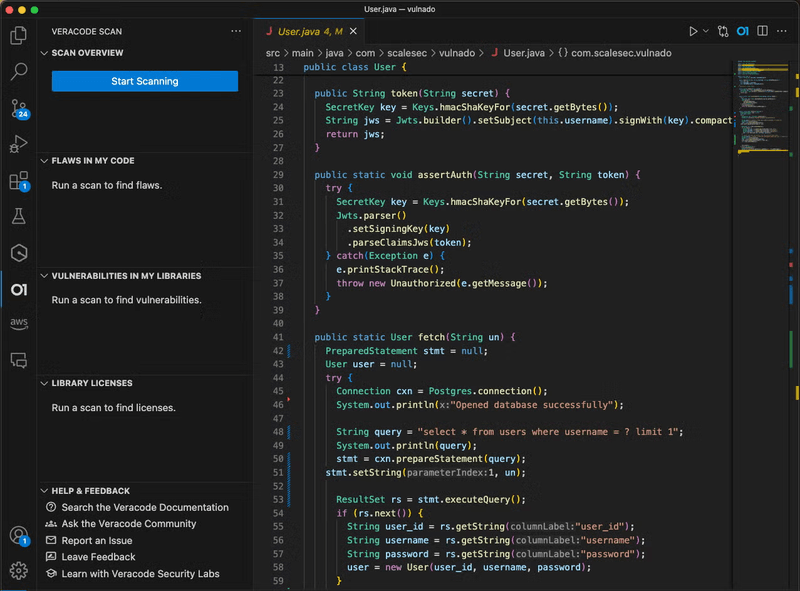
Core AI Capability | Auto Remediation
Veracode fix uses AI to suggest changes based on vulnerabilities within code when developers are using the Veracode IDE extension or CLI tool. The main differentiator for Veracode Fix is that their custom-trained model is not trained on code in the wild but on known vulnerabilities within their database. The positive of this will be more confidence in suggested fixes, the negative is that it is more limited in the scenarios that it can suggest code fixes.
Best for: Enterprises using the Veracode ecosystem that want reliable, verified AI-assisted fixes without exposing code to third-party models.
AI is a relatively new entrant to the security market, and industry leaders are continuously exploring innovative applications. AI should be viewed as a tool to enhance security systems, rather than as a sole source of truth. It's important to note that AI cannot transform subpar tools into effective ones. To maximize its potential, AI should be integrated with tools that already have a robust foundation and a proven track record.
| Name | Deployment | IDE Support | CI/CD Integration | Policy Customization | Compliance-Ready |
|---|---|---|---|---|---|
| Aikido Security SAST | SaaS | VS Code, JetBrains | GitHub, GitLab, Bitbucket, Azure DevOps, etc. | Yes | Yes |
| Checkmarx | On-prem / SaaS | VS Code, JetBrains | Jenkins, GitHub, GitLab, Azure | Yes (custom rules, thresholds) | Yes (enterprise, regulated use) |
| CodeAnt AI | On-Prem/SaaS | VS Code, JetBrains | GitHub, GitLab, Bitbucket | Yes | Yes |
| CodeThreat | On-prem / Private cloud | VS Code | GitHub Actions, Jenkins | Yes | Yes |
| Fortify SCA | On-prem / Hybrid | VS Code, IntelliJ, Eclipse | Broad CI/CD, build tool support | Yes (extensive rule sets) | Yes (enterprise compliance) |
| GitHub Advanced Security | SaaS (GitHub) | Codespaces, VS Code | GitHub Actions / PR scans | Yes (configurable rules, PR gating) | Yes (enterprise workflows) |
| Qwiet AI SAST | SaaS | VS Code | GitLab CI, Jenkins, CircleCI | Yes | Yes |
| Snyk Code | SaaS | VS Code, JetBrains | GitHub, GitLab, Bitbucket | Yes | Yes (enterprise-ready) |
| Semgrep Code | SaaS / Self-hosted | VS Code, JetBrains | GitHub Actions, Jenkins, GitLab CI | Yes | Yes (audit/compliance support) |
| Veracode Fix | SaaS | VS Code, JetBrains (via Veracode IDE plugin) | Veracode pipelines, Jenkins, GitHub | Limited (policy level only) | Yes (enterprise compliance) |
Application security has never been more complex and more critical. AI has made code generation effortless, but that same acceleration demands a new level of vigilance.
You can’t just use traditional SAST tools or DAST tools. You need to fight AI with AI. And you should continue the fight across in the cloud and at runtime.
That’s where Aikido shines.
Beyond SAST and DAST tools, Aikido brings a plethora of AI-driven tools, from vulnerability management to continuous compliance visibility, enabling you to secure your code, cloud, and runtime.
To continue your learning, you might also like:
此内容由惯性聚合(RSS阅读器)自动聚合整理,仅供阅读参考。 原文来自 — 版权归原作者所有。