





In the fast-moving world of DevSecOps, even a popular tool like Jit.io isn’t one-size-fits-all. Jit.io is a developer-focused AppSec platform that automates security by orchestrating multiple scanners (SAST, DAST, SCA, etc.) across code and cloud. It’s widely used for its “all-in-one” approach to shift-left security. But despite Jit’s strengths, many developers, CTOs, and CISOs start hunting for alternatives due to pain points like excessive alerts, scan performance, coverage gaps, or cost.
Aikido Security is the ultimate Jit.io alternative, providing a compete application security platform with SAST, DAST, SCA, CSPM, and AI Pentesting without having to stitch together multiple tools. It offers far more coverage with minimal noise (smart filtering of false positives) and delivers results directly into developer workflows, all with straightforward, fair pricing – ensuring a smoother, more effective AppSec experience than Jit’s piecemeal setup.
Modern teams often struggle with noise from false positives – in fact, 60% of organizations report that 21–60% of their security scan results are simply noise (duplicates or false alarms) (source). High noise can erode developer trust in the tool. Others cite slow scan speeds or a lack of certain features. Jit’s pricing model (based on code contributors) can also be confusing or expensive for growing teams (source).
Real users have voiced frustrations, with Jit saying the “product has so many powerful components that the UX can be a bit overwhelming” (source) and even noting “loading of integrated GitLab projects in the UI takes time” (source). Some have run into broken links or wanted more policy control (source). These issues drive teams to explore other solutions that are more streamlined or broader in coverage.
Skip directly to Top Jit.io Alternatives:
If you're comparing developer-first security tools, our Top AppSec Tools in 2025 highlights the best platforms built for fast, secure shipping.
Jit is a cloud-based Application Security Posture Management (ASPM) platform that integrates with your code, cloud, and security tools, then uses automation (“agents”) to aggregate findings, prioritize risks, and trigger actions like ticketing or remediation. It orchestrates a suite of security scanners in one place. It integrates static code analysis, open-source dependency scanning, secret detection, and cloud configuration scanning into your CI/CD pipeline.

Jit's main features include:
Even with Jit’s broad feature set, Jit doesn’t really replace security tools. It primarily sits on top of scanners, using its “agent”-based automation to orchestrate, prioritize, and act on findings rather than serving as the core detection engine itself. Jit might be a good tool to get started with, but it's only glue connecting other security together.
Teams also often seek alternatives for a few reasons:
When evaluating Jit.io alternatives, consider these factors:
Below, we'll look at six solid alternatives to Jit.io, each with its own strengths. For each option, we'll give you an overview, highlight key features, and explain why you might choose it over Jit.
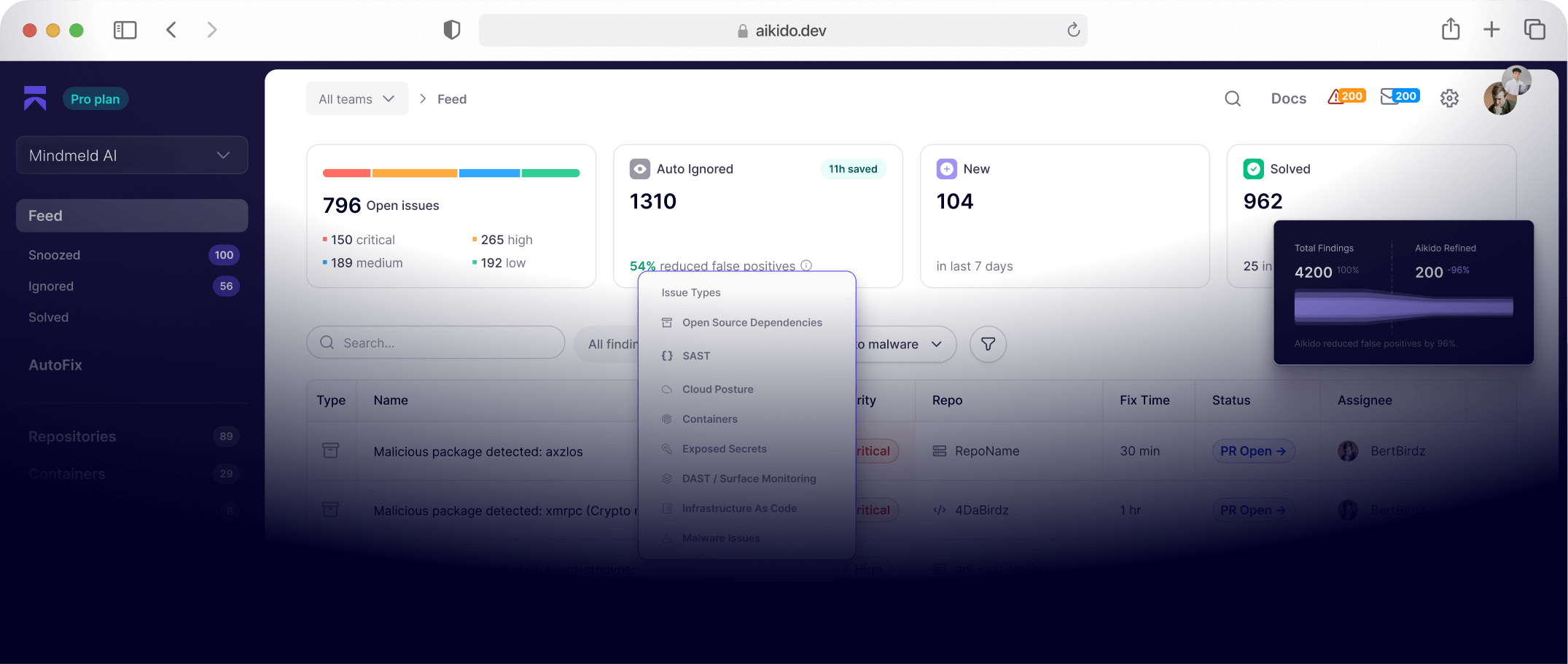
Overview: Aikido Security is a developer-first, all-in-one application security platform (code & cloud) that aims to simplify AppSec for agile teams. Like Jit, it offers multiple scanners under one roof – but with an emphasis on usability and automation. Aikido provides out-of-the-box scanning for code (SAST), open-source deps (SCA), secrets, containers, Infrastructure-as-Code, cloud misconfigs (CSPM), and more, all tightly integrated. It’s particularly suited for startups and mid-size dev teams that want broad coverage without heavy overhead. Standout use case: a small team can onboard Aikido and get results in minutes, securing everything from their GitHub repo to AWS settings, without needing a dedicated security engineer.
Key Features:
Why choose Aikido: Aikido is an ideal Jit.io alternative if you want more breadth with less complexity. It delivers similar full-stack coverage but in a more streamlined, developer-friendly package. Teams choose Aikido for its clean UX and quick setup (often under 5 minutes to first scan), and because it dramatically cuts down the noise that slows developers. If you’re a startup or mid-size company frustrated by Jit’s false positives or pricing, Aikido lets you start free, integrates easily with dev workflows, and scales up as needed. It’s basically a plug-and-play AppSec program – you get comprehensive security without needing to wrangle multiple tools or tune out thousands of alerts.
Aikido is a lead maintainer for Opengrep, which Jit.io uses as its default SAST scanner. However Aikido creates a better SAST experience with AI-powered Auto-Triage to reduce unnecessary alerts, using the context of your code to tell you which vulnerabilities are actually in your production code and reachable. Aikido’s focus on automation (auto-fix pull requests, Slack alerts, etc.) means you can achieve AppSec with a smaller team. You also get state-of-the-art SCA and DAST.
In short, choose Aikido for a unified security solution that actually empowers your developers (and doesn’t break the bank). (Bonus: If you still have a favorite tool, Aikido can even ingest findings from other scanners like Jit, so you don't miss out on that feature)

Overview: Checkmarx is a veteran in application security, known for its powerful static application security testing (SAST) and software composition analysis. It’s an enterprise-grade platform geared towards larger development organizations that need robust code scanning across many languages. Checkmarx is often used by companies that require on-premises scanning or have strict security/compliance policies. Its standout use case is deep source code analysis – it excels at finding complex security vulnerabilities in code during development, integrating into CI pipelines and IDEs for continuous scanning.
Key Features:
Why choose it: Checkmarx is the best fit when code security is your top priority and you need a proven, enterprise-scale solution. If Jit.io left you wanting more depth in static analysis (or if you operate in an environment where an on-prem tool is required), Checkmarx delivers extremely thorough code scanning and customization. It’s often the go-to for security-critical software where finding even subtle vulnerabilities is paramount. Choose Checkmarx over Jit if your development stack is large and varied, and you require the rigor and configurability that come with an established SAST platform.
Keep in mind, Checkmarx can be heavier to operate – it’s best for organizations that can invest time in fine-tuning rules and processing scan results (often with a dedicated AppSec team). It also carries enterprise high prices, so worth confirming that it's worth it for your setup.

Overview: SpectralOps (now part of Check Point) is a lightweight DevSecOps tool focused on secret detection and fast code scanning. It’s known for using AI/ML to identify hard-coded credentials, API keys, and other security weaknesses in code without slowing developers down. SpectralOps is a great alternative for teams that primarily want to shore up their code repositories against leaks and supply-chain threats. It’s especially popular for scanning Git repos to prevent committing sensitive info. Think of it as a nimble, developer-friendly security layer that runs in the background of your dev process.
Key Features:
Why choose it: Pick SpectralOps if secrets management and rapid code scanning are your primary concerns. For example, if your team has been burned by API keys leaking or you want a guardrail against committing cloud credentials, Spectral is one of the best in class. It’s an excellent Jit alternative for those who felt Jit was too heavy or slow – Spectral’s lightweight nature won’t bog down your CI. It doesn’t offer the full breadth of Jit (no built-in DAST or extensive SCA database), but it shines in its niche. Many teams actually use Spectral alongside other tools to confirm that no secret or misconfig sneaks into production. If you value a low false-positive rate and near-real-time feedback to developers (thanks to its AI-driven engine), SpectralOps is a good choice. It’s essentially a “dev-friendly sentinel” for your codebase, keeping it free of embarrassing leaks and easily exploitable config mistakes.

Overview: GitLab Ultimate is the top-tier offering of GitLab that includes a complete suite of built-in security testing tools. If your development pipeline already lives in GitLab, Ultimate turns the platform into a one-stop DevSecOps solution – covering SAST, DAST, container scanning, dependency scanning, and more, all integrated into your CI/CD. It’s geared toward organizations that want to embed security into their DevOps platform rather than using a separate AppSec product. Standout use case: teams using GitLab CI can simply enable the built-in security jobs and get vulnerability reports on every merge request, without juggling external scanners.
Key Features:
Why choose GitLab Ultimate: If your team already uses GitLab, Ultimate adds security with zero friction. It’s a no-brainer for CI/CD teams who want basic SAST, DAST, and SCA without adopting a new platform. For more advanced security, however, you'll likely need a more robust product like Aikido.

Overview: SonarQube is a popular open-source platform for code quality and security analysis. It’s primarily a SAST tool, analyzing source code for bugs, code smells, and security vulnerabilities. SonarQube (Community Edition) is free to use and widely adopted by developer teams to maintain code health. As a Jit alternative, SonarQube provides a focused solution for static analysis – great for teams who want to improve code security without introducing a complex new system. It’s often used on-premises, which appeals to those who need control over their data. The standout use case is continuous inspection of code for quality and security issues during development, with an emphasis on developer education (it shows why an issue is a problem and how to fix it).
Key Features:
Why choose SonarQube: SonarQube is ideal if you want a simple, self-hosted static analyzer that improves code quality and security without the overhead of a full AppSec suite.
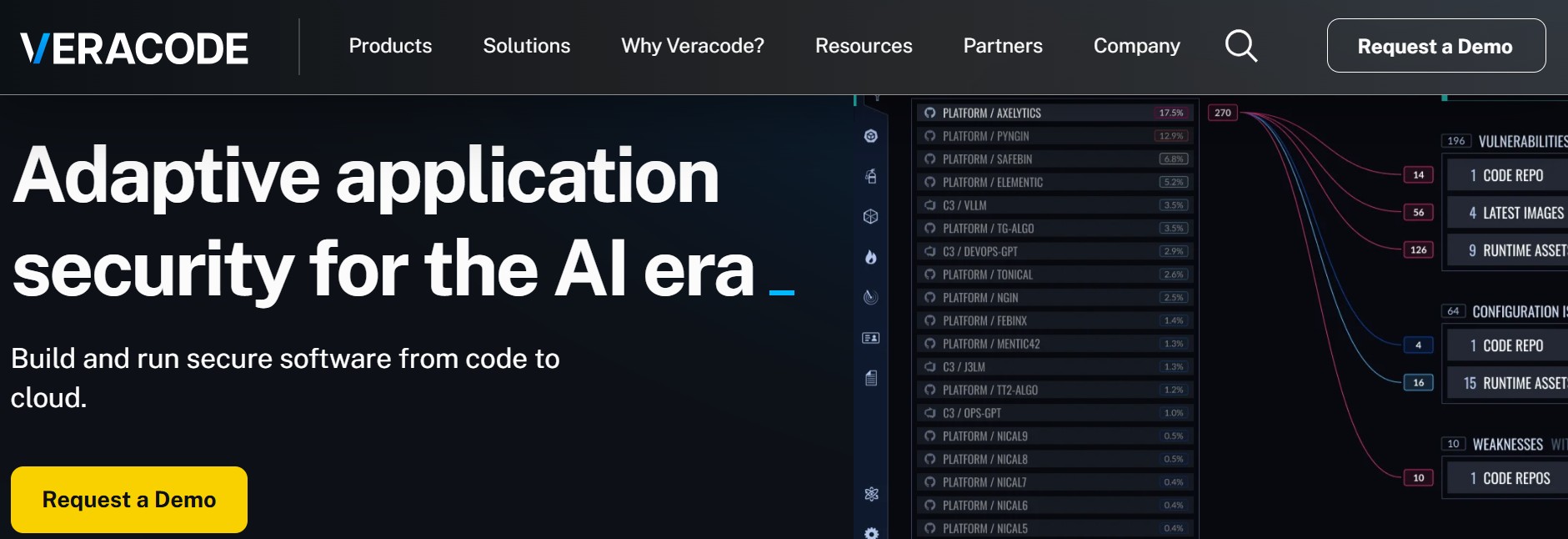
Overview: Veracode is a long-established cloud-based application security platform known for its comprehensive coverage and focus on enterprises. It offers static analysis, dynamic analysis, and software composition analysis as core services, along with manual penetration testing and e-learning for developers. Veracode pioneered the “upload your code binaries and get a report” model of SAST, making it quite convenient as a fully hosted solution. Who it’s for: large organizations and software vendors that need rigorous security checks (often for compliance or customer requirements) and want an end-to-end program. A typical use case is a company integrating Veracode scans into their release cycle to ensure each version meets a certain security baseline (and getting certified reports to prove it).
Key Features:
Why choose Veracode: Veracode is best for enterprises needing deep, policy-driven AppSec with strong governance, compliance, and centralized risk visibility—especially when audits or certifications matter. As with some other options on this list, confirm that the features justify the higher cost on this one.
Jit.io has helped teams shift security left—but it’s not perfect. If you're running into alert fatigue, limited cloud coverage, or scaling costs, it might be time to explore alternatives.
Tools like Aikido Security offer a broader, developer-first approach with real-time feedback, AI-powered fixes, and full coverage from SAST to CSPM.
The right tool depends on your team’s needs—but if you want strong security that helps you ship fast, Aikido is a great place to start.
Start your free trial or book a demo to see how Aikido simplifies AppSec without slowing you down.
If you’re looking for a free alternative, your options are somewhat limited among full-fledged platforms. Most Jit.io competitors are commercial products, but Aikido Security offers a free tier (and free trial) that lets you scan code and a modest number of cloud assets – making it an excellent way to get started at no cost.
Aikido’s free plan provides core scanners (SAST, SCA, secrets, basic CSPM, etc.) for small projects, so you can cover a lot of ground without paying anything upfront.
Another approach is to combine open-source tools to replicate Jit’s coverage: for example, you might use OWASP ZAP for DAST, Bandit or ESLint plugins for SAST, and Trivy for container/IaC scanning.
For an integrated platform that’s accessible for free, Aikido is your best bet. It gives you a polished interface and multiple scanners under one roof, without charging anything for small-scale use. In summary: Aikido Security’s free tier is arguably the top free alternative to Jit.io, since it balances ease-of-use with broad AppSec coverage.
For a small development team (say 5–50 developers), Aikido Security is often the top choice. It’s designed with lean teams in mind – easy to deploy, very developer-friendly, and affordable with simple per-user pricing.
Another solid option could be SonarQube (Community Edition), especially if your main goal is to improve code security and quality on a budget.
If your team is focused on cloud infrastructure, SpectralOps or even GitLab Ultimate might make sense depending on your stack.
In general, Aikido provides the best balance of breadth and simplicity. It scales with your team as you grow, while still being lightweight enough not to overwhelm small dev teams.
In essence, Aikido delivers more breadth, better usability, less noise, and predictable costs - making it a strong upgrade over Jit for many teams.
Absolutely. Many organizations use a multi-tool strategy. For example, you can run SonarQube for internal SAST, while using Veracode for compliance or third-party reporting.
You might also combine SpectralOps for secret scanning with Aikido Security for broader coverage.
Aikido even supports ingesting results from other scanners to centralize your findings. Just be sure to normalize severities, deduplicate, and define clear roles for each tool to avoid alert fatigue.
Bottom line: with a thoughtful setup, combining tools can enhance your security program significantly.
You Might Also Like:
Last updated on:
Apr 15, 2026
Tired of false positives?
Try Aikido like 100k others.
Start Now
Get a personalized walkthrough
Trusted by 100k+ teams
Book Now
Scan your app for IDORs and real attack paths
Trusted by 100k+ teams
Start Scanning
See how AI pentests your app
Trusted by 100k+ teams
Start Testing
•
DevSec Tools & Comparisons
Tenable Nessus is a powerful scanner, but powerful tools that nobody uses don't make software more secure. Compare five alternatives built for how engineering teams actually work.

•
DevSec Tools & Comparisons
Compare the Top GitGuardian Alternatives for secrets scanning in 2026. See where Aikido Security, GitHub Secret Protection, TruffleHog, Gitleaks, Semgrep, Snyk, Cycode, Checkmarx, and GitLab fit best.
•
DevSec Tools & Comparisons
Looking for a Gitleaks alternative? We compare Betterleaks, TruffleHog, Aikido, GitHub Advanced Security, and Spectral so you can find the best secrets scanner for your team.
Secure your code, cloud, and runtime in one central system.
Find and fix vulnerabilities fast automatically.
No credit card required | Scan results in 32secs.

此内容由惯性聚合(RSS阅读器)自动聚合整理,仅供阅读参考。 原文来自 — 版权归原作者所有。