









Published on:
May 29, 2025
GitLab Ultimate is a popular all-in-one platform for DevOps that also includes integrated application security (AppSec). It offers source control, CI/CD, and built-in security tools (like SAST and DAST) under one roof. This end-to-end approach is powerful, but many teams are now looking for alternatives due to usability issues, cost, false positives, and a poor developer experience.
Aikido Security offers an equally comprehensive yet more streamlined AppSec platform as a GitLab Ultimate alternative. You get the full range of SAST, DAST, SCA, etc. in one place with far fewer false positives and easier setup, and you avoid GitLab’s steep Ultimate licensing – Aikido’s flat per-user pricing and developer-first design make it a smarter, more cost-effective choice for DevSecOps teams.
Users have reported that “for beginners its UI feels complex and cluttered... and its premium features are costly”. Others complain about noisy scan results — one developer on Reddit noted “egregious false positives” (even “a few brackets being counted as a secret” by the scanner). Another user said “basic security features are put behind an unreasonable paywall”, reflecting frustration with GitLab’s pricing and packaging.
If you’re short on time, feel free to skip to the Top Alternatives to GitLab Ultimate for a quick overview of the tools. Below is a preview of the five alternatives we’ll cover:
If you’re rethinking GitLab’s built-in security, check out our Top AppSec Tools in 2025 — a curated list of platforms built to secure your SDLC.
Teams consider GitLab Ultimate alternatives when they encounter these pain points with its security features:
When evaluating GitLab Ultimate alternatives focused on AppSec, prioritize the following:
| Tool | SAST | DAST | SCA | Secrets Detection | Best For |
|---|---|---|---|---|---|
| GitLab Ultimate | ✅Static code scans built-in | ✅Basic DAST available | ✅SCA for open source | ✅Detects hardcoded secrets | All-in-one GitLab stack |
| Aikido Security | ✅Fast SAST with low false positives | ✅Modern DAST included | ✅Accurate open source insights | ✅Secrets detection built-in | Dev-first, code-to-cloud security |
| ArmorCode | ➖No native SAST engine | ➖Requires integration | ➖Relies on 3rd-party tools | ➖Not focused on secrets | Security aggregation & governance |
| Snyk | ✅Good SAST for JS & JVM | ➖DAST not included | ✅Strong open source SCA | ➖Secrets not a core focus | Open source & container scanning |
| SpectralOps | ➖No static code analysis | ➖No DAST capabilities | ➖Limited to config/code hygiene | ✅Excellent for secrets hygiene | Secrets & config hygiene |
| Veracode | ✅Enterprise SAST solution | ✅Mature DAST support | ✅Comprehensive SCA suite | ➖Secrets not core functionality | Enterprise-scale AppSec |
Based on the above needs, here are five of the best GitLab Ultimate alternatives for application security:
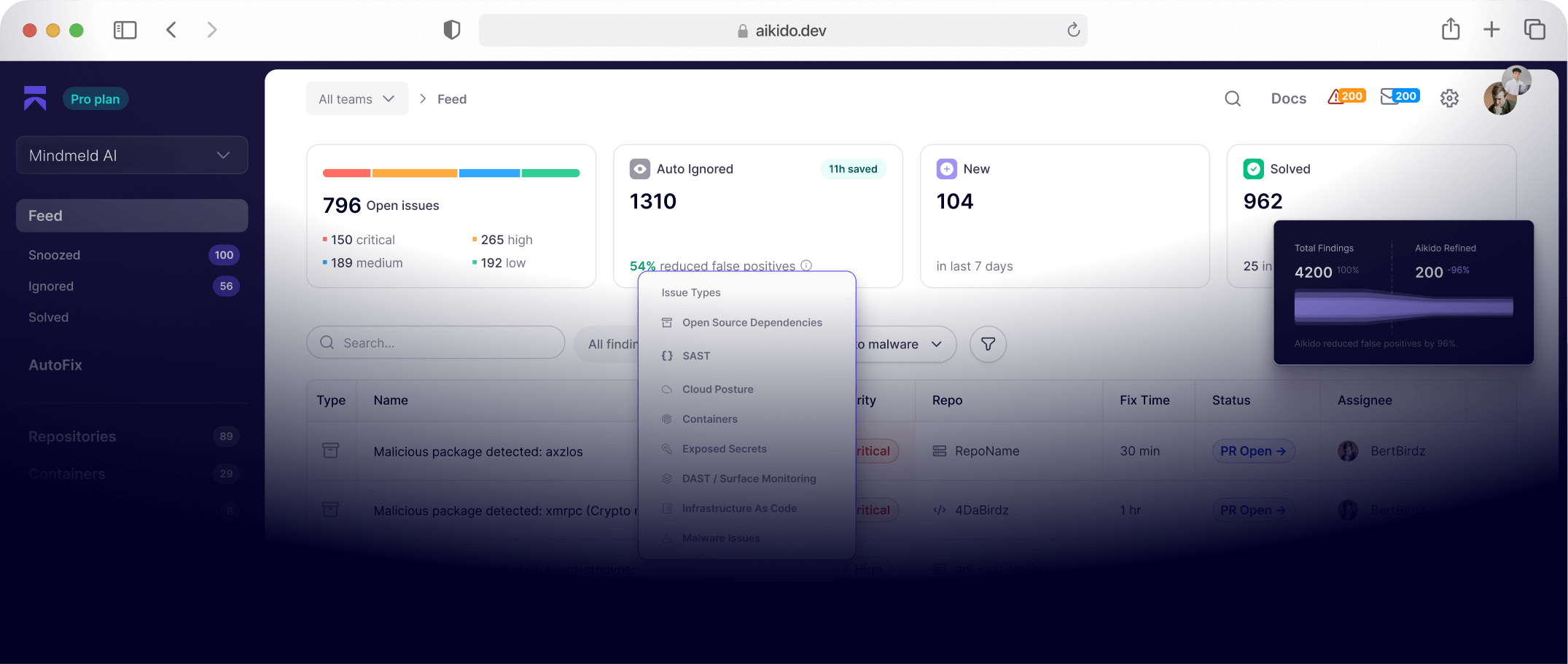
Overview: Aikido Security is a developer-first platform that provides an all-in-one solution for application security, covering everything from code to cloud. It combines multiple scanners and tools under a single dashboard – including static code analysis, open-source dependency scanning, container and Infrastructure as Code (IaC) checks, API testing, cloud configuration scanning, and more. Aikido’s standout capability is its emphasis on accuracy and automation: it uses AI to reduce false positives and even offers one-click fixes for certain issues via its AI AutoFix feature.
Key Features:
Why Choose It: If your team is frustrated with GitLab Ultimate’s noise or complexity, Aikido is a strong choice. It’s ideal for teams that want comprehensive AppSec coverage but with a simpler, developer-first experience. You’ll benefit from far fewer false positives, faster triage, and more automation from code to cloud. It also offers a transparent pricing model and a free tier, making it easier to try without commitment.

Overview: ArmorCode is an Application Security Posture Management (ASPM) platform focused on aggregating and orchestrating your security tools. It connects to your scanners (SAST, DAST, cloud, etc.) and centralizes all findings into one system for prioritization and governance. Unlike point scanners, it doesn’t scan code directly — it helps teams manage AppSec at scale.
Key Features:
Why Choose It: ArmorCode is great for companies that already use multiple security tools and need a “single pane of glass” to manage them. It’s not a scanner — it’s an orchestrator. Choose it if you want better governance, visibility, and process automation on top of your existing AppSec stack, especially at enterprise scale.

Overview: Snyk is a developer-centric security tool focused on finding vulnerabilities in open-source dependencies, container images, and IaC configs. Originally built for SCA, it has since expanded into container and IaC security, and offers SAST capabilities via Snyk Code. Its core strength lies in seamless dev workflow integrations and a huge open-source vulnerability database.
Key Features:
Why Choose It: Snyk shines if your top concern is supply chain risk. Its dev-friendly design, CI/CD integration, and automated patch suggestions make it ideal for teams securing open-source dependencies and containers. Just note it’s more focused than a full-stack platform like Aikido.

Overview: SpectralOps is a fast, lightweight scanner built to catch sensitive data and misconfigurations before they hit production. Its key strength lies in secret detection and scanning infrastructure files for insecure defaults. It’s popular with DevOps and security engineers who want speed and simplicity without sacrificing coverage on high-risk issues.
Key Features:
Why Choose It: Spectral is best for teams who want focused protection against the most damaging mistakes (like key leaks) and don’t need a full-blown AppSec platform. It complements GitLab or other scanners well, and works especially well in fast-moving DevOps pipelines.
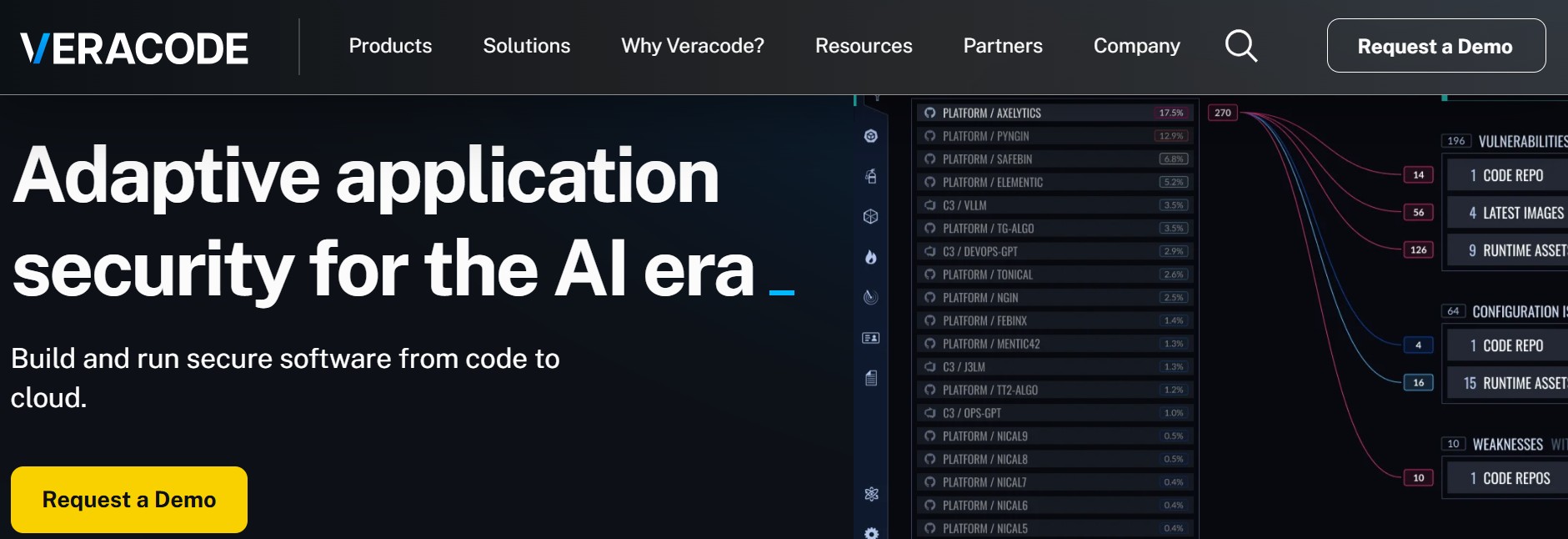
Overview: Veracode is an enterprise-grade Application Security Testing (AST) suite known for its depth and compliance readiness. It offers SAST, DAST, and SCA, delivered mostly as a cloud service. It’s widely used by large organizations with complex security and governance needs.
Key Features:
Why Choose It: Veracode is ideal if you need auditability, compliance, and scale across a large engineering org. It’s less flexible for individual developers than tools like Aikido, but excels when paired with a security team managing a centralized program.
GitLab Ultimate offers a lot—but it’s not always what fast-moving dev teams need. Whether it’s the noise, the cost, or the clunky experience, more teams are moving to alternatives that are faster, leaner, and more developer-first.
If you want a simpler, more accurate way to secure your code, cloud, and CI/CD without the bloat, try Aikido Security — or book a demo to see it in action.
If you’re looking for a free option, Snyk is often cited as a top choice. Snyk offers a generous free tier for open source projects and small teams, allowing you to scan your code dependencies and containers at no cost (with certain usage limits). It’s very developer-friendly and easy to integrate.
Another option is Aikido Security’s free plan, which provides an all-in-one security platform with limited usage for free – this is great if you want broad coverage (SAST, SCA, etc.) without budget.
For purely open-source solutions, you could also assemble your own toolchain (for example, OWASP Zap for DAST, open-source SAST tools, etc.), but that requires more effort. Snyk (for dependency scanning) combined with GitLab’s built-in free scanners could cover a lot of ground for zero cost, with Snyk being the more polished tool for developers.
Switching to Aikido Security can significantly improve the developer experience and reduce noise. GitLab Ultimate’s security suite is powerful but often overwhelming – in contrast, Aikido takes a developer-first approach with a cleaner UI and far fewer false positives (thanks to its AI engine).
Teams report that Aikido’s results are more relevant, and its real-time feedback (in IDEs and merge requests) helps developers fix issues faster. Additionally, Aikido covers everything Ultimate does (code, open-source, containers, IaC, etc.) in one platform, but with more automation (like one-click fixes) and simpler, transparent pricing.
If you’re paying a lot for Ultimate and not loving the UX or the signal-to-noise ratio, Aikido can be a refreshing change that boosts productivity and security outcomes at the same time.
Absolutely. In practice many organizations use a combination of AppSec tools to cover different needs. For example, you might use Snyk for dependency scanning and container security, plus a SAST tool like Veracode or Aikido for code analysis.
You can also run GitLab’s own scanners in tandem with external tools – they won’t usually conflict (apart from consuming more CI minutes). Using multiple tools can improve coverage, but be mindful that it also adds overhead: you’ll need to manage various integrations and deal with possibly overlapping findings.
This is where an aggregation platform like ArmorCode can help, by pulling all findings into one view. The key is to clearly define which tool is responsible for which type of testing to avoid confusion. Many teams, for instance, use one tool for SAST and a different one for DAST, since no single solution is best-in-class at everything. As long as you integrate their outputs into your workflow (for example, all creating tickets in the same Jira), using multiple tools can provide a layered defense.
GitLab Ultimate is a solid offering for AppSec in the sense that it provides a lot of security functionality out-of-the-box. It’s especially convenient if you’re already using GitLab for CI/CD – the scanners can run automatically on your pipelines, giving you a baseline of SAST, DAST, dependency scanning, and more without purchasing separate products.
For basic application security needs and compliance checkboxes, Ultimate does the job. However, “good” is relative to your experience using it. Many teams find that while the features are there, the developer experience is not ideal (lots of false positives, clunky interface, difficulty customizing scans).
So GitLab Ultimate covers the bases of AppSec, but it might not be the most efficient or developer-friendly way to do it. If you have a dedicated security team to manage it and tune it, Ultimate can yield good results. If not, you might get better value from a specialized tool that the developers find easier to work with.
For a developer-centric experience, Aikido Security and Snyk are top contenders. Aikido Security is built to be dev-first: it integrates into coding workflows, provides very actionable results with minimal noise, and even fixes issues automatically – all of which developers appreciate because it saves time.
Snyk is also highly developer-friendly, focused on the areas (like open-source libs and containers) that developers deal with, with a slick UI and helpful guided fixes.
If your team values a clean UX and integration with tools like VS Code, Slack, and GitHub/GitLab, these two are excellent choices. SpectralOps is another developer-friendly tool, albeit more specialized (great for devs to catch secrets and config issues early).
On the other hand, an enterprise tool like Veracode, while very powerful, can feel less approachable for individual developers (it’s often managed more by the security team). So, if we’re talking “which is best for developers to engage with directly,” Aikido and Snyk would be at the top of the list.
You Might Also Like:
Last updated on:
May 15, 2026
Tired of false positives?
Try Aikido like 100k others.
Start Now
Get a personalized walkthrough
Trusted by 100k+ teams
Book Now
Scan your app for IDORs and real attack paths
Trusted by 100k+ teams
Start Scanning
See how AI pentests your app
Trusted by 100k+ teams
Start Testing
•
DevSec Tools & Comparisons
Tenable Nessus is a powerful scanner, but powerful tools that nobody uses don't make software more secure. Compare five alternatives built for how engineering teams actually work.

•
DevSec Tools & Comparisons
Compare the Top GitGuardian Alternatives for secrets scanning in 2026. See where Aikido Security, GitHub Secret Protection, TruffleHog, Gitleaks, Semgrep, Snyk, Cycode, Checkmarx, and GitLab fit best.
•
DevSec Tools & Comparisons
Looking for a Gitleaks alternative? We compare Betterleaks, TruffleHog, Aikido, GitHub Advanced Security, and Spectral so you can find the best secrets scanner for your team.
Secure your code, cloud, and runtime in one central system.
Find and fix vulnerabilities fast automatically.
No credit card required | Scan results in 32secs.

此内容由惯性聚合(RSS阅读器)自动聚合整理,仅供阅读参考。 原文来自 — 版权归原作者所有。