
惯性聚合 高效追踪和阅读你感兴趣的博客、新闻、科技资讯
阅读原文 在惯性聚合中打开

推荐订阅源

H
Heimdal Security Blog
P
Privacy International News Feed
S
Schneier on Security
P
Proofpoint News Feed
L
Lohrmann on Cybersecurity
Spread Privacy
Spread Privacy
P
Privacy & Cybersecurity Law Blog
D
Darknet – Hacking Tools, Hacker News & Cyber Security
Scott Helme
Scott Helme
K
Kaspersky official blog
大猫的无限游戏
大猫的无限游戏
freeCodeCamp Programming Tutorials: Python, JavaScript, Git & More
aimingoo的专栏
aimingoo的专栏
Simon Willison's Weblog
S
Securelist
Help Net Security
Help Net Security
B
Blog
H
Hackread – Cybersecurity News, Data Breaches, AI and More
Security Archives - TechRepublic
云风的 BLOG
云风的 BLOG
The GitHub Blog
The GitHub Blog
N
News and Events Feed by Topic
Hacker News: Ask HN
Hacker News: Ask HN
cs.CV updates on arXiv.org
CTFtime.org: upcoming CTF events
M
MIT News - Artificial intelligence
雷峰网
雷峰网
博客园 - 司徒正美
V
V2EX
AWS News Blog
AWS News Blog
Know Your Adversary
Know Your Adversary
N
News | PayPal Newsroom
T
Tor Project blog
Cisco Talos Blog
Cisco Talos Blog
OSCHINA 社区最新新闻
OSCHINA 社区最新新闻
PCI Perspectives
PCI Perspectives
Google DeepMind News
Threat Intelligence Blog | Flashpoint
U
Unit 42
C
Cybersecurity and Infrastructure Security Agency CISA
P
Palo Alto Networks Blog
G
Google Developers Blog
T
Threat Research - Cisco Blogs
博客园 - Franky
I
InfoQ
D
DataBreaches.Net
爱范儿
爱范儿
Y
Y Combinator Blog
博客园 - 叶小钗
奇客Solidot–传递最新科技情报
奇客Solidot–传递最新科技情报

Step Security Blog

Securing Vibe Coding and AI Coding Agents: An End-to-End Approach with StepSecurity - StepSecurity Introducing StepSecurity Dev Machine Guard: Protecting Developer Machines from Supply Chain Attacks - StepSecurity Top 2024 Predictions for CI/CD Security - StepSecurity Dev Machine Guard Is Now Open Source: See What's Really Running on Your Developer Machine - StepSecurity Datadog's DevSecOps 2026 Report Validates What We've Been Building - StepSecurity hackerbot-claw: An AI-Powered Bot Actively Exploiting GitHub Actions - Microsoft, DataDog, and CNCF Projects Hit So Far - StepSecurity Cline Supply Chain Attack Detected: cline@2.3.0 Silently Installs OpenClaw - StepSecurity StepSecurity’s Unified Protection Across the SDLC Infrastructure Threat Framework (SITF) - StepSecurity @velora-dex/sdk Compromised on npm: Malicious Version Drops macOS Backdoor via launchctl Persistence - StepSecurity axios Compromised on npm - Malicious Versions Drop Remote Access Trojan - StepSecurity Behind the Scenes: How StepSecurity Detected and Helped Remediate the Largest npm Supply Chain Attack - StepSecurity 10 Layers Deep: How StepSecurity Stops TeamPCP's Trivy Supply Chain Attack on GitHub Actions - StepSecurity Malicious IoliteLabs VSCode Extensions Target Solidity Developers on Windows, macOS, and Linux with Backdoor - StepSecurity TeamPCP Plants WAV Steganography Credential Stealer in telnyx PyPI Package - StepSecurity litellm: Credential Stealer Hidden in PyPI Wheel - StepSecurity Checkmarx KICS GitHub Action Compromised: Malware Injected in All Git Tags - StepSecurity CanisterWorm: How a Self-Propagating npm Worm Is Spreading Backdoors Across the Ecosystem - StepSecurity Trivy Compromised a Second Time - Malicious v0.69.4 Release, aquasecurity/setup-trivy, aquasecurity/trivy-action GitHub Actions Compromised - StepSecurity bittensor-wallet 4.0.2 Compromised on PyPI - Backdoor Exfiltrates Private Keys - StepSecurity Malicious npm Releases Found in Popular React Native Packages - 130K+ Monthly Downloads Compromised - StepSecurity Malicious Polymarket Bot Hides in Hijacked dev-protocol GitHub Org and Steals Wallet Keys - StepSecurity ForceMemo: Hundreds of GitHub Python Repos Compromised via Account Takeover and Force-Push - StepSecurity xygeni-action Compromised: C2 Reverse Shell Backdoor Injected via Tag Poisoning - StepSecurity kubernetes-el Compromised: How a Pwn Request Exploited a Popular Emacs Package - StepSecurity How StepSecurity Caught a Release Storm in Microsoft’s @types Packages - StepSecurity Harden Runner Now Supports Windows and macOS GitHub Actions Runners - StepSecurity 10,000 Open-Source Projects Now Secured by Harden-Runner Community-Tier: A Milestone Three Years in the Making - StepSecurity 20+ Popular NPM Packages Compromised (Chalk, Debug, Strip-ANSI, Color-Convert, Wrap-ANSI...) - StepSecurity 2024 in Review: The Evolution of CI/CD Security & What's Next - StepSecurity How to Use Docker in Actions Runner Controller (ARC) Runners Securely - StepSecurity Celebrating 1000 Repositories Secured with Harden Runner: A Journey of Growth and Collaboration - StepSecurity StepSecurity Detects Early Supply Chain Risk Signals in kilocode npm - StepSecurity Another npm Supply Chain Attack: The 'is' Package Compromise - StepSecurity anthropics/claude-code-action Security: How to Secure Claude Code in GitHub Actions with Harden-Runner - StepSecurity Harden-Runner detection: tj-actions/changed-files action is compromised - StepSecurity StepSecurity's Catalog of Fixes - StepSecurity Orchestrating Security: StepSecurity's Impact on 400+ Repositories and Future Plans - StepSecurity Announcing Anomalous Outbound Call Detection Using Machine Learning - StepSecurity Announcing GitHub Actions Advisor and StepSecurity Maintained Actions - StepSecurity Analysis of Backdoored XZ Utils Build Process with Harden-Runner - StepSecurity Announcing General Availability of Harden Runner - StepSecurity Milestone Achieved: 2500+ Public Repositories Secured with Harden-Runner - StepSecurity Build secretless CI/CD pipelines using wait-for-secrets - StepSecurity Introducing Apps & PATs: Centralized Visibility for GitHub Apps and Personal Access Tokens - StepSecurity CVE-2026-22709: Critical Sandbox Escape Vulnerability in vm2 - StepSecurity StepSecurity Now Supports Dark Mode - StepSecurity 2025 in Review: The Evolution of Supply Chain Security & What's Next - StepSecurity Bake Harden-Runner Into GitHub's Custom Runner Images for Organization-Wide CI/CD Security - StepSecurity StepSecurity Is Now Available on Azure Marketplace - StepSecurity Critical Remote Code Execution Vulnerabilities Discovered in React Server Components and Next.js - StepSecurity How Harden Runner Detected the Sha1-Hulud Supply Chain Attack in CNCF's Backstage Repository - StepSecurity Sha1-Hulud: The Second Coming - Zapier, ENS Domains, and Other Prominent NPM Packages Compromised - StepSecurity Supply Chain Security Alert: eslint-config-prettier Package Shows Signs of Compromise - StepSecurity 9,000 Open-Source Projects Now Secured by Harden-Runner - StepSecurity Shai-Hulud: Self-Replicating Worm Compromises 500+ NPM Packages - StepSecurity Introducing npm Package Search: Find Where Any Package Was Introduced Across Your GitHub Organizations - StepSecurity StepSecurity Is Sponsoring GitHub Universe 2025 - StepSecurity s1ngularity: Popular Nx Build System Package Compromised with Data-Stealing Malware - StepSecurity Introducing StepSecurity Threat Intelligence: Real-Time Supply Chain Attack Alerts for Your SIEM - StepSecurity 8,000 Strong: Harden-Runner's Growing Impact on CI/CD Security - StepSecurity Securing Google Gemini in GitHub Actions with Harden-Runner - StepSecurity GhostAction Campaign: Over 3,000 Secrets Stolen Through Malicious GitHub Workflows - StepSecurity Introducing the NPM Package Cooldown Check - StepSecurity Securing GitHub Copilot in GitHub Actions with Harden-Runner - StepSecurity Calculate Your CI/CD Security ROI with StepSecurity's New ROI Calculator - StepSecurity How StepSecurity Harden Runner Detected Unexpected Microsoft Defender Installation on GitHub-hosted Ubuntu Runners - StepSecurity StepSecurity Harden Runner: Detect source code tampering during the build process - StepSecurity Suspicious Tag Movement in AWS’s GitHub Action: What Happened and Why It Matters - StepSecurity When 'Changed Files' Changed Everything: Our Black Hat 2025 Presentation on the tj-actions Supply Chain Breach - StepSecurity Lessons from AWS CodeBuild’s Memory-Dump Incident (CVE-2025-8217) - StepSecurity Supply Chain Security Alert: num2words PyPI Package Shows Signs of Compromise - StepSecurity When AI Meets CI/CD: Coding Agents in GitHub Actions Pose Hidden Security Risks - StepSecurity The GitHub Warning Everyone Ignores: 'This Commit Does Not Belong to Any Branch' - StepSecurity 8 GitHub Actions Secrets Management Best Practices to Follow - StepSecurity reviewdog GitHub Actions are compromised - StepSecurity 7,000 Open-Source Projects Now Secured by Harden-Runner - StepSecurity Replace Third-Party Actions with StepSecurity Maintained Actions via Automated Pull Requests - StepSecurity StepSecurity Is Now Available on AWS Marketplace - StepSecurity Introducing StepSecurity Artifact Monitor: Detect Unauthorized Software Releases in minutes, not months - StepSecurity Introducing Workflow Run Policies: Guardrails for Blocking Non-Compliant GitHub Actions Runs - StepSecurity Harden-Runner Detects New Traffic to release-assets.githubusercontent.com Across Multiple Customers - StepSecurity Grafana GitHub Actions Security Incident - StepSecurity Export Harden-Runner Security Insights and Detections to Amazon S3 - StepSecurity Evolving Harden-Runner’s disable-sudo Policy for Improved Runner Security - StepSecurity Announcing Policy-Driven Automated Pull Requests for CI/CD Misconfiguration Remediation - StepSecurity Announcing StepSecurity’s Integration with RunsOn: Secure and Optimized CI/CD Pipelines - StepSecurity Secure Repo Just Got Better: New Features for GitHub Actions Security Best Practices - StepSecurity Why Compliance Auditors Are Looking at Your CI/CD Runners - And How to Prepare - StepSecurity Harden-Runner Flags Anomalous Outbound Call, Leading to Docker Documentation Update - StepSecurity StepSecurity Harden-Runner Now Secures GitHub Actions Workflows for Over 5,000 Open Source Projects - StepSecurity GitHub Actions Pwn Request Vulnerability - StepSecurity Prevent Ultralytics Style CI/CD Security Attacks with Network Security Controls - StepSecurity PyTorch Supply Chain Compromise - StepSecurity Unified Network Egress View: Centralize GitHub Actions Network Destinations for Your Enterprise - StepSecurity Uniting Developers and Security: Celebrating the Success of 500+ Open Source Projects Using StepSecurity's Orchestration Platform - StepSecurity 5 Effective Third-Party GitHub Actions Governance Best Practices - StepSecurity StepSecurity Recognized Among CRN’s "10 Hottest DevOps Startups Of 2024" - StepSecurity Streamline Your GitHub Actions Workflows with StepSecurity’s Latest Feature - StepSecurity StepSecurity Steps Up the Security Game with SOC 2 Type 2 Compliance - StepSecurity StepSecurity's Alignment with CISA's CI/CD Security Guidance - StepSecurity
Announcing Dependabot Configuration Enhancements: Cooldown and Group Support - StepSecurity
2026-04-15 · via Step Security Blog

StepSecurity now supports cooldown and group attributes for Dependabot configuration management. These additions give organizations precise control over how dependency updates are batched and how frequently they arrive, across npm, pip, Docker, GitHub Actions, and other Dependabot supported ecosystems.

If you are already familiar with StepSecurity's npm Package Cooldown check, which blocks PRs that introduce recently published packages, think of this as the other half of the cooldown story. The npm Package Cooldown check controls when a new package version is safe to adopt. Dependabot cooldown controls how often update PRs are proposed in the first place. Together, they give organizations a complete framework for managing the pace and safety of dependency updates.

What Is New

Group: Batch Related Updates Into a Single PR

The group attribute lets you define rules for combining related dependency updates into one PR instead of many. You can group by update type (minor and patch together), by package name patterns, or by dependency scope.

A typical setup might batch all non-major production dependency updates into a single weekly PR, while keeping major version bumps as individual PRs for closer review. This works across all ecosystems Dependabot supports.
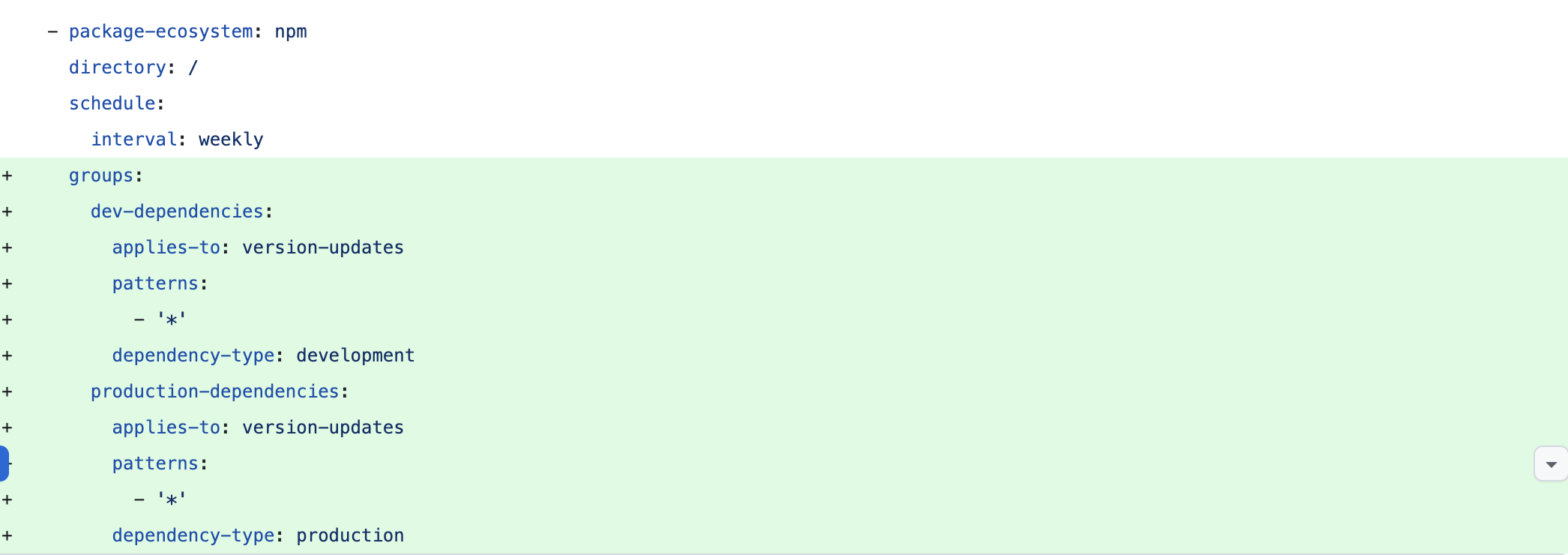
PR diff introducing group attributes

Cooldown: Control How Often Update PRs Arrive

The cooldown attribute controls the minimum interval between new Dependabot PRs. Instead of receiving every update the moment it is available, you set a cadence that matches your team's capacity to review.

This prevents the common scenario where a burst of transitive dependency updates floods your PR queue and causes your team to stop reviewing dependency PRs altogether.

PR diff introducing cooldown attributes

Centralized Management

Both attributes are available through StepSecurity's centralized Dependabot configuration. You can define grouping and cooldown policies once and apply them consistently across every repository in your organization. StepSecurity can also automatically generate or enhance dependabot.yml files for repositories that lack proper configuration.
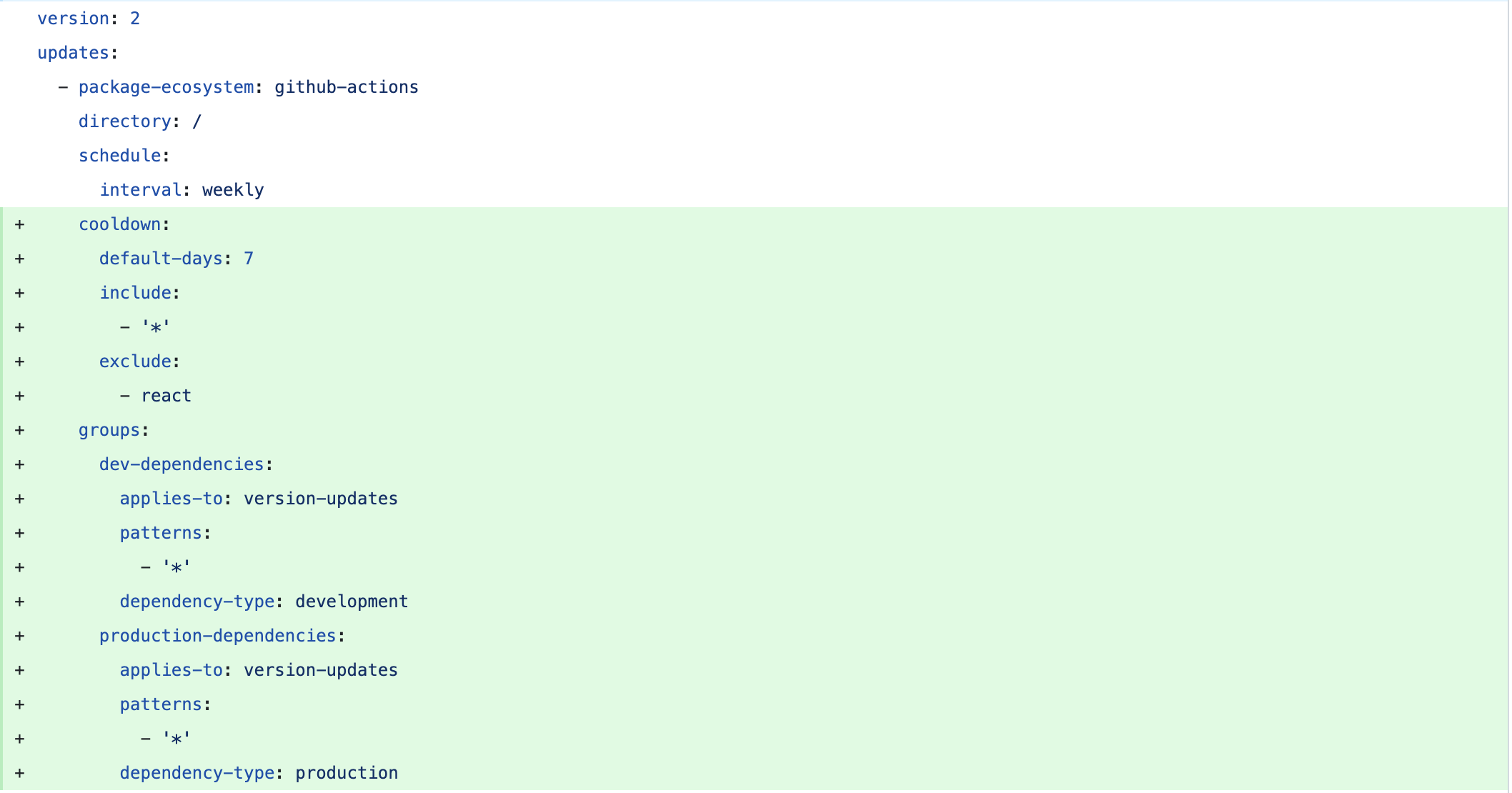
PR diff introducing group and cooldown attributes

How This Connects to npm Package Cooldown

StepSecurity already offers the npm Package Cooldown check as part of its GitHub Checks suite. That feature serves a different but complementary purpose.

The npm Package Cooldown check is a PR-level security gate. When a pull request introduces or updates a dependency to a version published within a configurable window (default: 2 days), the check fails and blocks the merge. The logic is straightforward: most supply chain attacks are discovered within the first 24 hours of a malicious package being published. A short waiting period before adoption dramatically reduces the risk of pulling in a compromised version before anyone has had time to flag it.

This proved its value during the Shai-Hulud attack in 2025. When compromised npm packages were published, the cooldown check automatically failed PRs that attempted to adopt the malicious versions, because they had been published only hours earlier. Customers with cooldown enabled were fully shielded from accidentally merging the malicious updates.

The new Dependabot cooldown serves a different layer of the same problem. Where the npm Package Cooldown check asks "is this specific package version old enough to be trusted?", Dependabot cooldown asks "is this team receiving updates at a pace they can actually process?" One is a security gate on individual packages. The other is a workflow control on the volume of proposed changes.

They work together. Dependabot cooldown ensures your team is not overwhelmed with update PRs, so they actually review the ones that arrive. The npm Package Cooldown check ensures that the versions in those PRs have been published long enough to have been vetted by the ecosystem. Between the two, you get sustainable update velocity with a built-in safety net against freshly compromised packages.

Why Now

March 2026 was one of the most active months for software supply chain attacks in recent memory. Our team detected and responded to a series of incidents that hit in rapid succession.

TeamPCP compromised 76 of 77 version tags of the Trivy GitHub Action, embedding credential stealers that harvested secrets from CI/CD runners. Days later, the Checkmarx KICS GitHub Action was hit with the same playbook. The stolen npm tokens from those compromised pipelines fueled CanisterWorm, a self-propagating npm worm that published backdoored patch versions across every namespace it could reach, including 16+ packages in the @opengov scope. The same threat actor planted credential stealers in the litellm and telnyx PyPI packages using WAV steganography.

Then came the axios compromise. A state-sponsored actor, later attributed to North Korean group UNC1069, hijacked the most popular HTTP client on npm. Over 100 million weekly downloads. Malicious versions published with a hidden dependency that dropped a cross-platform remote access trojan. When we created GitHub issues to warn the community, the attacker used the compromised maintainer's account to delete them roughly 20 times before GitHub suspended the account.

Every one of these attacks targeted dependency trust. And in every case, the organizations best positioned to respond were those with current dependency trees and functioning update workflows. They could immediately answer the question: what versions are we running, and are any of them compromised?

Organizations where Dependabot PRs had been piling up unreviewed for weeks could not answer that question.

The Problem These Features Solve

Dependabot is widely enabled. It is not widely effective.

Without grouping, a modest repository can generate dozens of individual PRs per week. A minor bump to a test utility gets the same treatment as a critical security patch. The signal-to-noise ratio collapses, and developers stop reviewing dependency updates entirely.

Without cooldown controls, updates arrive on Dependabot's default schedule regardless of whether anyone has capacity to review them. After a period of inactivity or a cascade of transitive updates, the queue becomes unmanageable. Teams mute the notifications, close the PRs in bulk, or disable Dependabot.

The result is the worst possible outcome: the tool is technically enabled, but no updates are getting merged. Patch velocity drops. Known vulnerabilities sit unaddressed. And when the next supply chain incident hits, the organization has no clear picture of its dependency state.

This is the gap that group and cooldown close. Grouping reduces volume so each PR gets actual attention. Cooldown makes the flow sustainable so teams keep reviewing instead of giving up.

When an attack like CanisterWorm targets patch versions specifically because they get auto-installed silently, you need your team to be reviewing patch updates, not ignoring them because there are forty identical-looking PRs in the queue. And when those grouped, paced PRs arrive, the npm Package Cooldown check is there as the final safety net, blocking any version that was published too recently to be trusted.

How to Get Started

If you are already using StepSecurity Policy Driven PRs in your configuration, you can update the Dependabot configuration to include the cooldown and group attributes

This interactive demo walks through configuring cooldown and group attributes for a repository using Policy Driven PRs

If you have repositories without a dependabot.yml file, StepSecurity can generate one with grouping and cooldown policies already configured.

If you have not yet enabled the npm Package Cooldown check, you can do so under GitHub Checks in your StepSecurity dashboard. The default cooldown window is 2 days, configurable between 1 and 30 days based on your organization's risk tolerance. We recommend enabling both the Dependabot cooldown for workflow pacing and the npm Package Cooldown check for package-level safety.

If you are not yet using StepSecurity, you can start free or request a demo to see how these capabilities fit into your supply chain security strategy.

The Bigger Picture

Detection matters. We proved that over the past month with axios, CanisterWorm, and the rest. But detection is reactive by definition. The upstream discipline of keeping dependencies current, reviewing updates consistently, and maintaining visibility into what versions are running across your organization is what determines how exposed you are before an incident and how fast you recover after one.

StepSecurity now covers the full dependency update lifecycle. Dependabot group and cooldown ensure updates arrive at a manageable pace and in a reviewable format. The npm Package Cooldown check ensures that the versions being proposed have been published long enough to be vetted. The npm Package Compromised Updates check blocks versions that are known to be malicious. And when an incident does happen, npm Package Search tells you exactly which repositories are affected.

Dependency management is not overhead. It is a security control. These enhancements are designed to make it one that actually works.