



惯性聚合 高效追踪和阅读你感兴趣的博客、新闻、科技资讯
阅读原文 在惯性聚合中打开

推荐订阅源

freeCodeCamp Programming Tutorials: Python, JavaScript, Git & More
Jina AI
Jina AI
钛媒体:引领未来商业与生活新知
钛媒体:引领未来商业与生活新知
T
Troy Hunt's Blog
T
The Exploit Database - CXSecurity.com
Microsoft Security Blog
V
Visual Studio Blog
F
Fortinet All Blogs
博客园_首页
P
Proofpoint News Feed
V
Vulnerabilities – Threatpost
The Cloudflare Blog
C
Cyber Attacks, Cyber Crime and Cyber Security
cs.CL updates on arXiv.org
H
Heimdal Security Blog
cs.AI updates on arXiv.org
A
About on SuperTechFans
Cyber Security Advisories - MS-ISAC
AI
AI
奇客Solidot–传递最新科技情报
奇客Solidot–传递最新科技情报
S
Security Affairs
The Register - Security
S
Security @ Cisco Blogs
Hugging Face - Blog
Hugging Face - Blog
OSCHINA 社区最新新闻
OSCHINA 社区最新新闻
博客园 - 聂微东
Schneier on Security
WordPress大学
WordPress大学
Google DeepMind News
GbyAI
GbyAI
T
Tailwind CSS Blog
Hacker News: Ask HN
Hacker News: Ask HN
W
WeLiveSecurity
D
Docker
L
LangChain Blog
B
Blog RSS Feed
The Last Watchdog
The Last Watchdog
Cloudbric
Cloudbric
TaoSecurity Blog
TaoSecurity Blog
N
Netflix TechBlog - Medium
酷 壳 – CoolShell
酷 壳 – CoolShell
I
InfoQ
The Hacker News
The Hacker News
AWS News Blog
AWS News Blog
Exploit-DB.com RSS Feed
宝玉的分享
宝玉的分享
I
Intezer
云风的 BLOG
云风的 BLOG
V2EX - 技术
V2EX - 技术
K
KPMG report finds enterprise disconnect between AI and its ROI | CIO

School of Computer Science News

Looking Ahead: AI Needs UI Liu Receives NSF CAREER Award Carnegie Foundry, Carnegie Mellon and American Drone Manufacturers Launch Initiative to Supercharge America Stepping Toward Better Mobility Natalie Hatcher Turns Closed Doors Into Open Futures for High School Students - The Piper - Carnegie Mellon University When One Drone Isn’t Enough: CMU Builds Swarms for High-Stakes Response Efforts Carnegie Mellon’s Richard King Mellon Hall of Sciences Enters New Phase of Construction Researchers Channel AI To Solve Open Mathematical Problems Fujitsu Joins CMU Robotics Innovation Center The Missing Infrastructure for AI-Powered Robots - Robotics Institute Carnegie Mellon University CMU Partners WithOptiTrack For Motion Capture Technology in Robotics Innovation Center CMU Team Rises to Amazon Nova AI Challenge - Language Technologies Institute - School of Computer Science - Carnegie Mellon University NoRILLA Wins Global Competition Don’t Let FOMO Be Your Organization’s AI Strategy CMU Researchers Train Robots With Internet Videos - Robotics Institute Carnegie Mellon University Carnegie Mellon and Meta Partner To Develop AI Tools for Emergency Response Singing a New Tune: Computational Music — The Link - The Magazine of CMU's School of Computer Science Pathak Receives 2026 PAMI Young Researcher Award Carnegie Mellon Team Helps Farmers Fight Crop Disease With Robots EcoAssist Shows Devs Greener Ways to Code Bacteria Can Learn and Form Memories Without a Brain Sandholm Receives SIGecom Test of Time Award SURF Grant Powers Research Into the Genetics of Bipolar Disorder Chen Receives NSF CAREER Award for Research in Machine Learning Systems Vatican Calls on Waibel to Help Shape AI Ethics — The Link - The Magazine of CMU's School of Computer Science Frank Pfenning Receives Herbrand Award How Do Boomers Really Feel About AI? Decoding Muscle Fatigue With Radar - Electrical and Computer Engineering - College of Engineering - Carnegie Mellon University Listening to Your Fingertips Test of Time Award - Electrical and Computer Engineering - College of Engineering - Carnegie Mellon University Let Me Entertain You: How SCS Trains the Minds Who Shape How We Play — The Link - The Magazine of CMU's School of Computer Science Delphi Group Uses Data To Forecast the Flu and Other Epidemics Carnegie Mellon extends historic run with its fifth straight MITRE eCTF title NVIDIA Founder, CEO Jensen Huang to Carnegie Mellon University Graduates: ‘Shape What Comes Next’ CMU Researchers Develop AI System to Help Prevent Airport Collisions Kaplow Named 2026 Searle Scholar New CMU Tool Reduces Manual Work To Accelerate Medical Analysis Rosenfeld Named University Professor Work Hard and Dream Harder Xing Named 2026 ISCB Fellow CMU Tool Prevents Anxiety Spirals When Searching for Medical Advice Online Design Tweaks That Keep Students Learning CyLab study finds “privacy-preserving” tracking alternatives may still expose users Bringing Computational Sciences to Health and Human Services — The Link - The Magazine of CMU's School of Computer Science How Transformational Play Is Shaping CMU’s Next Research Frontier - Center for Transformational Play - Carnegie Mellon University Playing on Common Ground: CMU Monster Game Helps Groups Work Across Differences Fujitsu, CMU Launch Joint Center for Physical AI Pennsylvania Universities and Commonwealth Leaders Launch Keystone AI + Quantum Factory CMU Teams Recognized in Moonshots AI Competition After you’re gone, who gets your passwords? Compeau Inducted Into 2026 AIMBE College of Fellows Chan Wins AHA Career Development Award CMU Tops U.S. News Graduate CS Rankings The AI Is in the Room Bridging the Communication Gap With AI Earbuds that Listen to the Heart - Electrical and Computer Engineering - College of Engineering - Carnegie Mellon University CMU Launches Keystone Astronomy & AI Visiting Fellows Program Obituary: David J. Farber Earned Nickname 'Grandfather of the Internet' CMU Research Challenges Long-Held Ecological Belief of How Rare Species Survive Teaching AI-Generated Scenes To Obey Physics Saxena, Saint Phalle Receive Stehlik Scholarship Application Opens for 2026 LearnLab Summer School AI4BIO Selects Inaugural Projects for Biomedical Discovery - Center for AI-Driven Biomedical Research - School of Computer Science - Carnegie Mellon University When an AI Bot Becomes Your Boss MSCF Program Adds Accelerated Option for CMU Undergraduates Akshat Prakash Serano Tannason
Job Interviews, But Make It a Game Night
2026-04-28 · via School of Computer Science News

A team of recent graduates from Carnegie Mellon University turned career prep into a card game.

Terrible Workers helps middle and high school students practice interpersonal skills like active listening, adaptability and conflict resolution. Players pitch themselves for a mix of both realistic and unconventional jobs in a low-stakes, high-engagement setting.

During gameplay, one player takes on the role of the boss, while others compete as candidates for a range of roles, from cat cafe manager to supervillain sidekick. Players build their pitches using prompt cards that highlight personality traits, strengths and unexpected quirks. These range from always motivating others to do their best or quickly making well-informed decisions to being extremely photogenic or even knowing Morse code.
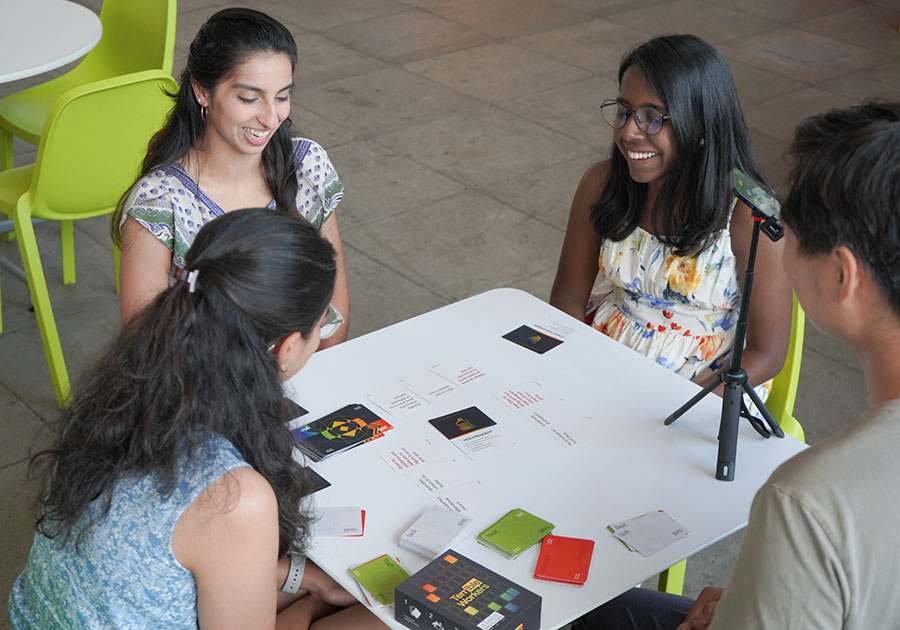
Four people sit around a table, playing a card game.
Terrible Workers, a card game designed by a team of recent SCS alums, helps middle and high school students practice interpersonal skills like active listening, adaptability and conflict resolution.

Players then present their case to the boss, who ultimately decides who gets the job. Along the way, players can complicate how candidates are perceived by assigning each other terrible personality traits, such as always being late or making up excuses anytime someone asks for help. The result is part improv, part storytelling and — most importantly — a way for students to explore how they communicate, collaborate and present themselves without the overwhelming pressure of a real interview.

By reframing traditionally high-stakes scenarios like job interviews into something playful, Terrible Workers creates space for more authentic self-expression. Instead of asking students directly what they want to be, which often leads to anxiety, the game invites them to experiment with who they could be. Through humor and creativity, players can discover real skills and preferences that might otherwise go unnoticed.

"If students weren't engaging with serious questions in a serious format, why not meet them where they are and make it fun?" said Archana Ramakrishnan, part of the team that created the game. "We immediately saw more critical engagement from students after working to understand them instead of forcing them into a box."

The project originated as a Master of Human-Computer Interaction (MHCI) Capstone by 2023 program graduates Ramakrishnan, Simran Chawla, Lawrence Zheng, Manvi Gupta and Jenny Liu in partnership with the South Fayette School District. Early research revealed that students often shut down when asked to talk about their futures, answering with jokes instead of serious thoughts.

The team observed students in the classroom, interviewed them and conducted hands-on playtest sessions as they developed the game. Many early prototypes were digital, from chatbots to mobile apps. But through repeated testing and direct comparisons of how students engaged across formats, they discovered that the most effective experiences were analog, emphasizing face-to-face conversation and collaboration.

The final result was a card game designed to foster interaction, reflection and meaningful social connections.

"The MHCI program is often associated with technology like apps, interfaces and robotics, but what it really teaches is a human-first mindset to solving problems," Zheng said. "Technology is just one way to bring those ideas to life. For this project, 'human-first' meant focusing on interpersonal skills that aren't always explicitly taught, but are essential for navigating school, work and life."

The team's approach comes through in how the game unfolds. Students work through fast-moving rounds of roleplay where they build and defend their pitches as the boss evaluates candidates and personality traits change how each one is perceived. The boss listens to each pitch, asks follow-up questions and weighs not just the listed traits but how convincingly each player responds under pressure and adapts to new information.

At the end of the round, the boss makes a hiring decision, selecting a candidate for the role based on a combination of creativity, communication and how well they navigated the social dynamics of the game. Rather than rewarding a single correct answer, the outcome reflects how effectively players advocate for themselves and respond in real time. The final choice then opens a discussion about perception, persuasion and interpersonal skills rather than a simple win or loss.

After the team presented their final prototype at the end of their project, momentum continued to build. Terrible Workers earned first place at the 2024 International Educational Game Awards in Denmark and third place at the 2024 International Serious Play Awards in Canada.

The recognition helped validate not just the game itself, but the broader framework behind it, something the team now shares as they expand the project's reach. In addition to the physical game, they offer "Play for People Skills," a set of heuristics — mental shortcuts that can help facilitate problem-solving — designed to help educators create engaging curricula focused on social and emotional learning. These components reflect the team's larger vision of a scalable approach that blends structured guidance with playful interaction.

Although the team members have since moved into full-time roles, they continue to meet regularly and explore opportunities to further develop and distribute the project.

To learn more about Terrible Workers, visit the game website.