
惯性聚合 高效追踪和阅读你感兴趣的博客、新闻、科技资讯
阅读原文 在惯性聚合中打开

推荐订阅源

B
Blog RSS Feed
C
CERT Recently Published Vulnerability Notes
P
Proofpoint News Feed
Y
Y Combinator Blog
T
The Blog of Author Tim Ferriss
云风的 BLOG
云风的 BLOG
H
Help Net Security
Recorded Future
Recorded Future
The Register - Security
F
Full Disclosure
N
Netflix TechBlog - Medium
Cyber Security Advisories - MS-ISAC
酷 壳 – CoolShell
酷 壳 – CoolShell
H
Hackread – Cybersecurity News, Data Breaches, AI and More
爱范儿
爱范儿
Security Archives - TechRepublic
Simon Willison's Weblog
Cisco Talos Blog
Cisco Talos Blog
I
InfoQ
T
Tenable Blog
T
Tor Project blog
人人都是产品经理
人人都是产品经理
D
DataBreaches.Net
NISL@THU
NISL@THU
Google DeepMind News
博客园 - 叶小钗
B
Blog
V
V2EX
Jina AI
Jina AI
L
LangChain Blog
月光博客
月光博客
W
WeLiveSecurity
U
Unit 42
AWS News Blog
AWS News Blog
C
Cyber Attacks, Cyber Crime and Cyber Security
博客园 - 聂微东
V
Visual Studio Blog
A
Arctic Wolf
T
Tailwind CSS Blog
The Cloudflare Blog
SecWiki News
SecWiki News
S
SegmentFault 最新的问题
Hacker News - Newest:
Hacker News - Newest: "LLM"
宝玉的分享
宝玉的分享
MyScale Blog
MyScale Blog
cs.CL updates on arXiv.org
S
Securelist
www.infosecurity-magazine.com
腾讯CDC
雷峰网
雷峰网

School of Computer Science News

Stepping Toward Better Mobility Natalie Hatcher Turns Closed Doors Into Open Futures for High School Students - The Piper - Carnegie Mellon University When One Drone Isn’t Enough: CMU Builds Swarms for High-Stakes Response Efforts Carnegie Mellon’s Richard King Mellon Hall of Sciences Enters New Phase of Construction Researchers Channel AI To Solve Open Mathematical Problems Fujitsu Joins CMU Robotics Innovation Center The Missing Infrastructure for AI-Powered Robots - Robotics Institute Carnegie Mellon University CMU Partners WithOptiTrack For Motion Capture Technology in Robotics Innovation Center CMU Team Rises to Amazon Nova AI Challenge - Language Technologies Institute - School of Computer Science - Carnegie Mellon University NoRILLA Wins Global Competition Don’t Let FOMO Be Your Organization’s AI Strategy CMU Researchers Train Robots With Internet Videos - Robotics Institute Carnegie Mellon University Carnegie Mellon and Meta Partner To Develop AI Tools for Emergency Response Singing a New Tune: Computational Music — The Link - The Magazine of CMU's School of Computer Science Pathak Receives 2026 PAMI Young Researcher Award Carnegie Mellon Team Helps Farmers Fight Crop Disease With Robots EcoAssist Shows Devs Greener Ways to Code Bacteria Can Learn and Form Memories Without a Brain Sandholm Receives SIGecom Test of Time Award SURF Grant Powers Research Into the Genetics of Bipolar Disorder Chen Receives NSF CAREER Award for Research in Machine Learning Systems Frank Pfenning Receives Herbrand Award How Do Boomers Really Feel About AI? Decoding Muscle Fatigue With Radar - Electrical and Computer Engineering - College of Engineering - Carnegie Mellon University Listening to Your Fingertips Test of Time Award - Electrical and Computer Engineering - College of Engineering - Carnegie Mellon University Let Me Entertain You: How SCS Trains the Minds Who Shape How We Play — The Link - The Magazine of CMU's School of Computer Science Delphi Group Uses Data To Forecast the Flu and Other Epidemics Carnegie Mellon extends historic run with its fifth straight MITRE eCTF title NVIDIA Founder, CEO Jensen Huang to Carnegie Mellon University Graduates: ‘Shape What Comes Next’ CMU Researchers Develop AI System to Help Prevent Airport Collisions Kaplow Named 2026 Searle Scholar New CMU Tool Reduces Manual Work To Accelerate Medical Analysis Rosenfeld Named University Professor Work Hard and Dream Harder Xing Named 2026 ISCB Fellow CMU Tool Prevents Anxiety Spirals When Searching for Medical Advice Online Design Tweaks That Keep Students Learning Job Interviews, But Make It a Game Night CyLab study finds “privacy-preserving” tracking alternatives may still expose users Bringing Computational Sciences to Health and Human Services — The Link - The Magazine of CMU's School of Computer Science How Transformational Play Is Shaping CMU’s Next Research Frontier - Center for Transformational Play - Carnegie Mellon University Playing on Common Ground: CMU Monster Game Helps Groups Work Across Differences Fujitsu, CMU Launch Joint Center for Physical AI Pennsylvania Universities and Commonwealth Leaders Launch Keystone AI + Quantum Factory CMU Teams Recognized in Moonshots AI Competition After you’re gone, who gets your passwords? Compeau Inducted Into 2026 AIMBE College of Fellows Chan Wins AHA Career Development Award CMU Tops U.S. News Graduate CS Rankings The AI Is in the Room Bridging the Communication Gap With AI Earbuds that Listen to the Heart - Electrical and Computer Engineering - College of Engineering - Carnegie Mellon University CMU Launches Keystone Astronomy & AI Visiting Fellows Program Obituary: David J. Farber Earned Nickname 'Grandfather of the Internet' CMU Research Challenges Long-Held Ecological Belief of How Rare Species Survive Teaching AI-Generated Scenes To Obey Physics Saxena, Saint Phalle Receive Stehlik Scholarship Application Opens for 2026 LearnLab Summer School AI4BIO Selects Inaugural Projects for Biomedical Discovery - Center for AI-Driven Biomedical Research - School of Computer Science - Carnegie Mellon University When an AI Bot Becomes Your Boss MSCF Program Adds Accelerated Option for CMU Undergraduates Akshat Prakash Serano Tannason
Vatican Calls on Waibel to Help Shape AI Ethics — The Link - The Magazine of CMU's School of Computer Science
2026-06-02 · via School of Computer Science News

Alex Waibel and the members of Pope Leo XIV’s working group on AI guidelines at the Vatican.

Pope Convenes Global AI Working Group that includes SCS Professor

As we apply artificial intelligence to more of the mechanisms of our world — from education and healthcare to transportation and finance — debates around AI’s role and power in society are sharpening.

In September, at the invitation of Pope Leo XIV, Alexander Waibel, a professor in SCS’s Language Technologies Institute, participated in the AI and Human Fraternity Working Group at the Vatican, to discuss and hammer out recommendations to ensure AI benefits humanity, and to suggest ways to mitigate AI’s potential risks. Pope Leo has called AI a critical matter and said that it poses “new challenges for the defense of human dignity, justice and labor.”
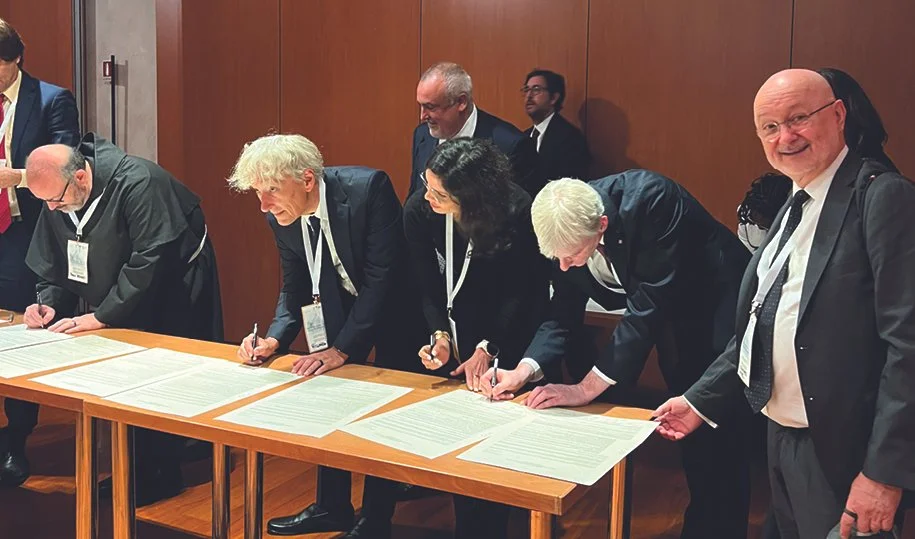
Alex Waibel (right), professor in LTI, pictured signing documents with other members of the Vatican Working Group on September 12, 2025.

Alex Waibel (right), professor in LTI, pictured signing documents with other members of the Vatican Working Group on September 12, 2025.

In 2023, more than 350 AI industry leaders and researchers signed on to a one-sentence statement declaring AI an extinction risk on the level of nuclear war and pandemics. The list included such AI luminaries as Nobel Prize winner and former SCS faculty member Geoffrey Hinton and Yoshua Bengio, a co-winner of the 2019 A.M. Turing Award. Hinton and Bengio were both part of the 12-person September working group convened by Pope Leo, along with Waibel, Grammy-winning artist will.i.am., and other AI thought leaders.

The working group developed a set of AI guidelines that recognized its threat, implored that AI always be used as a tool under ultimate human control, and called for responsible development. “Vast and rapidly growing sums are devoted to creating agentic technologies with the potential to surpass human intelligence — what many in the AI research community refer to as ‘superintelligence,’” the letter stated. “These challenges call for moral leadership and urgent concrete actions.”

The first postulate regarding the regulation of AI, according to Waibel, is that AI cannot be stopped. “We all share concerns about AI having a bad impact, but if you try to inhibit it or take a six-month moratorium, others will double down and do more,” he said. “There will always be geopolitical and commercial contests, and we will never get them to have the well-being of society as a primary interest. That sounds cynical, but I think it is realistic. So, it’s up to us to come up with mechanisms that guide the technology in the direction we want it to go.”

Waibel’s thoughts demonstrate the difficulty facing those who wish to reap the benefits of AI while reducing its potential harm. In the face of powerful nations and corporations with their own interests, a panel of experts and thinkers, even those of the highest caliber, will be waging a contest for hearts and minds to sway those with the power of the purse and policy, and those with technical expertise, to think broadly about potential threats.
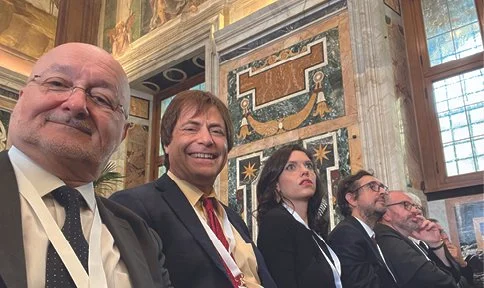
Alex Waibel (left), takes a selfie with some of the other members of Pope Leo XIV’s working group on AI guidelines at the Vatican.

Alex Waibel (left), takes a selfie with some of the other members of Pope Leo XIV’s working group on AI guidelines at the Vatican.

Waibel suggests efforts begin at home. “At CMU for instance, if we put our heads together, we could take a bunch of these problems and look at ways at which we can impose different objective functions in the learning of AI,” he said. “I really do believe this is technically feasible.”

Asked about his long-term forecast for AI, Waibel says that while he is wary of potential dangers, he is generally optimistic. “We have to pay attention. We must develop societal guardrails and regulation for the technology. I think we need to work hard on making sure we find good counterweights to all of this, rather than simply stopping it, which is neither desirable nor realistic.” ■

More from the Spring 2026 LINK Issue
From the Dean: Widening the Aperture

Shivaas Gulati (SCS 2010)

Game Changers: How CMU Computer Scientists Are Reshaping Professional Sports