


惯性聚合 高效追踪和阅读你感兴趣的博客、新闻、科技资讯
阅读原文 在惯性聚合中打开

推荐订阅源

B
Blog RSS Feed
Spread Privacy
Spread Privacy
T
Threatpost
C
Cisco Blogs
P
Palo Alto Networks Blog
AI
AI
Cyberwarzone
Cyberwarzone
NISL@THU
NISL@THU
P
Privacy & Cybersecurity Law Blog
G
GRAHAM CLULEY
Simon Willison's Weblog
T
Tor Project blog
Latest news
Latest news
AWS News Blog
AWS News Blog
D
Docker
S
SegmentFault 最新的问题
博客园 - 聂微东
WordPress大学
WordPress大学
Vercel News
Vercel News
S
Securelist
爱范儿
爱范儿
J
Java Code Geeks
Know Your Adversary
Know Your Adversary
S
Schneier on Security
Hugging Face - Blog
Hugging Face - Blog
F
Fortinet All Blogs
Last Week in AI
Last Week in AI
D
DataBreaches.Net
宝玉的分享
宝玉的分享
D
Darknet – Hacking Tools, Hacker News & Cyber Security
MongoDB | Blog
MongoDB | Blog
Engineering at Meta
Engineering at Meta
K
Kaspersky official blog
美团技术团队
博客园 - 叶小钗
阮一峰的网络日志
阮一峰的网络日志
量子位
博客园_首页
Attack and Defense Labs
S
Secure Thoughts
Google Online Security Blog
Application and Cybersecurity Blog
Threat Intelligence Blog | Flashpoint
腾讯CDC
T
Threat Research - Cisco Blogs
雷峰网
雷峰网
有赞技术团队
有赞技术团队
www.infosecurity-magazine.com
P
Privacy International News Feed
S
Security Affairs

Microsoft Security Blog

ACR Stealer: Two observed intrusion chains amid increased threat activity | Microsoft Security Blog Least privilege for AI agents: Identity, access, and tool binding | Microsoft Security Blog Unpacking the AsyncAPI npm supply chain compromise and import-time payload delivery | Microsoft Security Blog Turning threat intelligence into decisive action with Defender Experts | Microsoft Security Blog Defending SaaS-based applications against ShinyHunters OAuth abuse | Microsoft Security Blog Microsoft Entra ID security updates: Passkeys are the default authentication method in Entra ID | Microsoft Security Blog Securing our future: July 2026 progress report on Microsoft's Secure Future Initiative | Microsoft Security Blog GigaWiper: Anatomy of a destructive backdoor assembled from multiple malware | Microsoft Security Blog Protecting Microsoft at AI speed: How SFI proactively hardens our cloud   | Microsoft Security Blog 5 insights from Frost & Sullivan’s 2025 Frost Radar™ for Cloud Security Posture Management | Microsoft Security Blog Improving security posture across the Microsoft partner ecosystem | Microsoft Security Blog Microsoft named a leader in the Frost Radar for cloud and application runtime security | Microsoft Security Blog Accelerating the quantum-safe timeline | Microsoft Security Blog ​​What’s new in Microsoft Security: June 2026 | Microsoft Security Blog Securing AI agents: When AI tools move from reading to acting | Microsoft Security Blog Chromium extension uses AI‑related branding to redirect browser search | Microsoft Security Blog Photo ZIP campaign targeting hospitality industry delivers Node.js implant for persistent access | Microsoft Security Blog Microsoft a Leader in The Forrester Wave™ for Endpoint Management Platforms | Microsoft Security Blog CNAPP evolution: How Microsoft aligns with leading cloud risk management platforms | Microsoft Security Blog StealC and Amadey: Breaking down infostealers and the cybercrime services that deliver them | Microsoft Security Blog Guarding AI memory | Microsoft Security Blog One intrusion, two cyberattackers: Uncovering parallel threat activity | Microsoft Security Blog AutoJack: How a single page can RCE the host running your AI agent  | Microsoft Security Blog New Forrester study shows customers who unified with Microsoft Security benefited from 124% ROI | Microsoft Security Blog From package to postinstall payload: Inside the Mastra npm supply chain compromise | Microsoft Security Blog Crypto Clipper uses Tor and worm-like propagation for persistence and control | Microsoft Security Blog Beyond the benchmark: Advancing security at AI speed  | Microsoft Security Blog ​​Forrester names Microsoft a Leader in the 2026 Extended Detection and Response Platforms Wave™ report | Microsoft Security Blog AI is accelerating cyberattacks—here’s how to stay ahead Microsoft Defender email security benchmarking: Key insights from one year of data | Microsoft Security Blog Reconstructing AI activity in investigations AI brands as bait: How threat actors are using the AI hype in social engineering Securing CI/CD in an agentic world: Claude Code Github action case Updating the taxonomy of failure modes in agentic AI systems: What a year of red teaming taught us Preinstall to persistence: Inside the Red Hat npm Miasma credential-stealing campaign Turn specs into evals for any agent with ASSERT Microsoft Build 2026: Securing code, agents, and models across the development lifecycle Malicious npm packages abuse dependency confusion to profile developer environments Microsoft is named a Leader in the 2026 Gartner® Magic Quadrant™ for Endpoint Protection Typosquatted npm packages used to steal cloud and CI/CD secrets The Gentlemen ransomware: Dissecting a self-propagating Go encryptor From poisoned search results to GPU mining: A cryptojacking campaign abusing ScreenConnect and Microsoft .NET utilities Microsoft recognized as a Leader in The Forrester Wave™ for Workforce Identity Security Platforms From edge appliance to enterprise compromise: Multi-stage Linux intrusion via F5 and Confluence Microsoft Security success stories: How St. Luke’s and ManpowerGroup are securing AI foundations What’s new in Microsoft Security: May 2026 Mini Shai Hulud: Compromised @antv npm packages enable CI/CD credential theft Securing the gaming culture of cultures Introducing RAMPART and Clarity: Open source tools to bring safety into Agent development workflow Exposing Fox Tempest: A malware-signing service operation How Storm-2949 turned a compromised identity into a cloud-wide breach How to better protect your growing business in an AI-powered world Defense in depth for autonomous AI agents When configuration becomes a vulnerability: Exploitable misconfigurations in AI apps Accelerating detection engineering using AI-assisted synthetic attack logs generation Defending consumer web properties against modern DDoS attacks Undermining the trust boundary: Investigating a stealthy intrusion through third-party compromise Active attack: Dirty Frag Linux vulnerability expands post-compromise risk When prompts become shells: RCE vulnerabilities in AI agent frameworks World Passkey Day: Advancing passwordless authentication ​​Microsoft named an overall leader in KuppingerCole Analyst’s 2026 Emerging AI Security Operations Center (SOC) report ​​ ClickFix campaign uses fake macOS utilities lures to deliver infostealers Breaking the code: Multi-stage ‘code of conduct’ phishing campaign leads to AiTM token compromise Microsoft Agent 365, now generally available, expands capabilities and integrations What’s new, updated, or recently released in Microsoft Security Email threat landscape: Q1 2026 trends and insights 8 best practices for CISOs conducting risk reviews Simplifying AWS defense with Microsoft Sentinel UEBA AI-powered defense for an AI-accelerated threat landscape Detection strategies across cloud and identities against infiltrating IT workers Making opportunistic cyberattacks harder by design Cross‑tenant helpdesk impersonation to data exfiltration: A human-operated intrusion playbook Containing a domain compromise: How predictive shielding shut down lateral movement Building your cryptographic inventory: A customer strategy for cryptographic posture management Dissecting Sapphire Sleet’s macOS intrusion from lure to compromise Incident response for AI: Same fire, different fuel The agentic SOC—Rethinking SecOps for the next decade Investigating Storm-2755: “Payroll pirate” attacks targeting Canadian employees Intent redirection vulnerability in third-party SDK exposed millions of Android wallets to potential risk Inside an AI‑enabled device code phishing campaign Storm-1175 focuses gaze on vulnerable web-facing assets in high-tempo Medusa ransomware operations Threat actor abuse of AI accelerates from tool to cyberattack surface Cookie-controlled PHP webshells: A stealthy tradecraft in Linux hosting environments Mitigating the Axios npm supply chain compromise Critical Infrastructure at Risk | Security Insider
CVE-2026-31431: Copy Fail vulnerability enables Linux root privilege escalation across cloud environments
Microsoft De · 2026-05-02 · via Microsoft Security Blog

Microsoft Defender is investigating a high-severity local privilege escalation vulnerability (CVE-2026-31431) affecting multiple major Linux distributions including Red Hat, SUSE, Ubuntu, and AWS Linux. This vulnerability allows unauthorized escalation of privileges to root, impacting a significant portion of cloud Linux workloads and millions of Kubernetes clusters. Although active exploitation has been limited and primarily observed in proof-of-concept testing, the vulnerability’s broad applicability has caused widespread concern.

Given the availability of a fully working exploit proof-of-concept (PoC) and the race to patch systems, Microsoft Defender is seeing preliminary testing activity that might result most likely in increased threat actor exploitation over the next few days, as also confirmed by the recent addition of this vulnerability to the Cybersecurity and Infrastructure Security Agency (CISA) Known Exploited Vulnerability (KEV) catalog.

In this report, Microsoft Defender shares detailed analyses and detection insights for this vulnerability, as well as mitigation recommendations and hunting guidance for customers to act on. Further investigation towards providing stronger protection measures is in progress, and this report will be updated when more information becomes available.

Vulnerability details

Technical elementDetails
Vulnerability typeLocal privilege escalation
Attack vectorCode execution from unprivileged user
Prerequisites for exploitationLocal access to the machine as non-privileged user
Brief technical explanation A bug in the Linux kernel’s crypto-subsystem can be abused by an attacker to corrupt the cache of any readable file, including setuid binaries. This corruption could be carried out by unprivileged users and could result in code execution with root privilege, effectively escalating the unprivileged user to root in an unauthorized way.

The vulnerability affects virtually all Linux distributions running kernels released from 2017 until patched versions are applied, including but not limited to Ubuntu (for example, 24.04 LTS), Amazon Linux 2023, Red Hat Enterprise Linux (RHEL 10.1), and SUSE 16, as well as other distributions like Debian, Fedora, and Arch Linux. The CVSS score is 7.8 (High), reflecting its significant impact.

From an impact assessment standpoint, successful exploitation leads to full root privilege escalation (high impact to confidentiality, integrity, and availability) and could facilitate container breakout, multi-tenant compromise, and lateral movement within shared environments. Its reliability, stealth (in-memory-only modification), and cross-platform applicability make it particularly dangerous in cloud, CI/CD, and Kubernetes environments where untrusted code execution is common.

CVE-2026-31431 (also known as “Copy Fail”) is a high‑severity local privilege escalation (LPE) vulnerability affecting the Linux kernel’s cryptographic subsystem. The vulnerability type is a logic flaw within the algif_aead module of the AF_ALG (userspace crypto API), which results in improper handling of memory during in-place operations.

The attack vector is local (AV:L) and requires low privileges with no user interaction, meaning any unprivileged user on a vulnerable system can attempt exploitation. Critically, this vulnerability is not remotely exploitable in isolation, but becomes highly impactful when chained with an initial access vector such as Secure Shell (SSH) access, malicious CI job execution, or container footholds. The primary prerequisite for exploitation is the ability to execute code as a local non-privileged user on a system running a vulnerable Linux kernel with the affected crypto module enabled.

From a technical perspective, the flaw originates from an in-place optimization introduced in 2017, where the kernel reuses source memory as the destination during cryptographic operations. By abusing the interaction between the AF_ALG socket interface and the splice() system call, an attacker can perform a controlled 4-byte write into the kernel’s page cache of any readable file. This enables corruption of in-memory representations of privileged binaries (for example, /usr/bin/su) without modifying the on-disk file.

When executed, the modified binary yields root privileges, effectively breaking the system’s privilege boundary. Notably, the exploit is deterministic, does not rely on race conditions, and could be implemented in a very small (~732‑byte) script that works across distributions. Because the page cache is shared across containers and the host , the vulnerability also enables cross-container impacts and container escape scenarios.

The following is one possible exploitation attack chain.
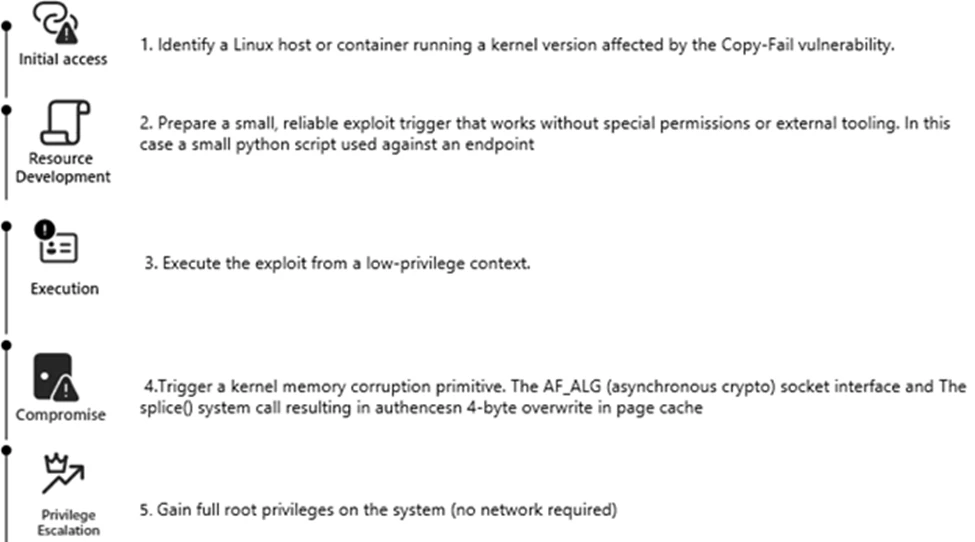
Phase 1: The attacker begins with reconnaissance. This may occur after gaining limited visibility into an environment (for example, a compromised CI runner, web container, or multi‑tenant host). Kernel version information is easily obtainable from within containers and user namespaces and does not require elevated privileges.

Because containers share the host kernel, a single vulnerable kernel version immediately expands the impact radius from one container to the entire node.

Phase 2: The attacker leverages a compact Python script that interacts only with standard kernel interfaces exposed to unprivileged users. The script does not rely on networking, compilation, or third‑party libraries, making it ideal for execution in restricted containers and hardened environments.

Phase 3: The attacker runs the script as either a regular Linux user on a host, or a compromised container process with no special capabilities. Crucially, the vulnerability does not require root inside the container, Kernel modules, or network access.  This makes it ideal for post‑exploitation scenarios where the attacker already has any foothold at all.

Phase 4: The exploit abuses an interaction between the AF_ALG (asynchronous crypto) socket interface, the splice() system call and improper error handling during a failed copy operation. This results in a controlled 4‑byte overwrite in the kernel page cache, allowing the attacker to corrupt sensitive kernel‑managed data even though they are unprivileged. This corruption occurs entirely within the kernel, bypassing traditional user‑space protections.

Phase 5: By corrupting kernel structures associated with credentials or execution context, the attacker escalates their process to UID 0. This completes the transition from unprivileged user to full root without touching the network. At this point, kernel trust boundaries are broken, SELinux/AppArmor protections are effectively neutralized, and local security controls are bypassed.

Mitigation and protection guidance

Immediate actions (0-24 hours):

  • Identify all instances of affected products/versions in your environment.
  • Apply mitigation based on patch availability:
    • If patches exist, apply immediately. Links to security bulletins and vendor patches are available at NVD – CVE-2026-31431.
    • If no patches exist, choose one of these interim mitigations:

○ Disable affected feature

○ Implement network isolation

○ Apply access controls

  • Review logs for signs of exploitation.

Because this vulnerability impacts a large swath of Linux devices, it is strongly recommended to do the following:

  • Patch or update your distribution’s kernel packages or to block AF_ALG socket creation.
  • Treat any container RCE as potential host compromise and enforce rapid node recycling after compromise indicators.

Microsoft Defender XDR detections

Microsoft Defender XDR customers can refer to the following list of applicable detections. Microsoft Defender XDR coordinates detection, prevention, investigation, and response across endpoints, identities, email, and apps to provide integrated protection against attacks like the threat discussed in this blog.

Customers with provisioned access can also use Microsoft Security Copilot in Microsoft Defender to investigate and respond to incidents, hunt for threats, and protect their organization with relevant threat intelligence.

TacticObserved activityMicrosoft Defender coverage
ExecutionExploitation of CVE-2026-31431Microsoft Defender Antivirus
– Exploit:Linux/CopyFailExpDl.A
– Exploit:Python/CopyFail.A
– Exploit:Linux/CVE-2026-31431.A
– Behavior:Linux/CVE-2026-31431

Microsoft Defender for Endpoint
Possible CVE-2026-31431 (“Copy Fail”) vulnerability exploitation

Microsoft Defender for Cloud
Potential exploitation of copy-fail vulnerability detected 

Microsoft Defender Vulnerability Management (MDVM) also surfaces devices in customer environments that might be vulnerable to CVE-2026-31431.

References

This research is provided by Microsoft Defender Security Research with contributions from Andrea Lelli, Dietrich Nembhard, Nir Avnery, Ori Glassman, and  members of Microsoft Threat Intelligence.

Learn more

For the latest security research from the Microsoft Threat Intelligence community, check out the Microsoft Threat Intelligence Blog.

To get notified about new publications and to join discussions on social media, follow us on LinkedInX (formerly Twitter), and Bluesky.

To hear stories and insights from the Microsoft Threat Intelligence community about the ever-evolving threat landscape, listen to the Microsoft Threat Intelligence podcast.

Review our documentation to learn more about our real-time protection capabilities and see how to enable them within your organization.