


惯性聚合 高效追踪和阅读你感兴趣的博客、新闻、科技资讯
阅读原文 在惯性聚合中打开

推荐订阅源

Cloudbric
Cloudbric
E
Exploit-DB.com RSS Feed
SecWiki News
SecWiki News
Forbes - Security
Forbes - Security
N
News | PayPal Newsroom
S
Security @ Cisco Blogs
Schneier on Security
V
V2EX - 技术
S
Secure Thoughts
W
WeLiveSecurity
Google DeepMind News
C
CERT Recently Published Vulnerability Notes
NISL@THU
NISL@THU
S
Securelist
S
Security Archives - TechRepublic
Know Your Adversary
Know Your Adversary
V
Vulnerabilities – Threatpost
Security Latest
Security Latest
Recent Commits to openclaw:main
G
GRAHAM CLULEY
H
Hacker News: Front Page
Microsoft Azure Blog
I
Intezer
Google Online Security Blog
美团技术团队
阮一峰的网络日志
阮一峰的网络日志
T
The Exploit Database - CXSecurity.com
钛媒体:引领未来商业与生活新知
钛媒体:引领未来商业与生活新知
Webroot Blog
Webroot Blog
Jina AI
Jina AI
Engineering at Meta
Engineering at Meta
P
Proofpoint News Feed
The Cloudflare Blog
I
InfoQ
L
LangChain Blog
U
Unit 42
P
Proofpoint News Feed
S
Schneier on Security
S
Security Affairs
Y
Y Combinator Blog
T
Tenable Blog
N
News and Events Feed by Topic
MyScale Blog
MyScale Blog
量子位
Google DeepMind News
Cyberwarzone
Cyberwarzone
博客园 - 聂微东
D
Darknet – Hacking Tools, Hacker News & Cyber Security
GbyAI
GbyAI
AWS News Blog
AWS News Blog

RapidFort Blog

RapidFort Test Blog Blog 4 Test Test Blog 3 Test 2 Mythos Vulnerability Assessment: Eliminate Real Risk, Not Just CVEs Securing Modern AI Workloads for National Security RBOM vs SBOM: The Critical Difference Between Software Inventory and Runtime Reality The Remediation Gap: When AI-Powered Discovery Outpaces Human Defense You Only Control 15% of Your Software. Here's How to Secure the Rest. Free ATO Readiness Cohort: Shorten Your Path to Federal Market US Cyber Strategy & Software Supply Chain Security EU CRA for Containers & Kubernetes: Scope, Deadlines & Steps PyPI, npm, and the New Frontline of Software Supply Chain Attacks GitHub Actions Security Audit: CI/CD Risk & Shell Injection What Is RBOM™? Runtime Bill of Materials vs SBOM Explained EU Cyber Resilience Act & Open Source Risk RapidFort Raises $42M Series A for Software Supply Chain Security Fintech Container Security 2026: SASM & RBOM™ RF Analyzer: Precision Container CVE Intelligence Kimia: Secure Kaniko Alternative for Kubernetes Builds AI-Powered Cyberattacks: How Defenders Must Adapt RapidFort Pioneered DoD Container Hardening | Industry Standard Turn Scanner Output into Verified CVE Elimination Why SBOMs Fail: RBOM™ & Near-Zero CVE Images Fix the Gap Defeat NPM Supply Chain Worms: Near-Zero CVE Defense Bitnami & Chainguard Alternatives: Free Near-Zero CVE Images Runtime Profiling: Eliminate up to 99.9% of Container CVEs Flow Defending: AI-Speed Container Hardening & Runtime Visibility AI in Software Supply Chain Security: Defense vs Attackers SBOM vs RBOM™: Why Runtime Bill of Materials Wins AI-Powered Container Stack: Built, Hardened & Defended AI-Generated Code Vulnerabilities: Runtime Defense for Containers Container Vulnerability Management Reimagined | RBOM™ 35,000+ Near-Zero CVE Images: FIPS, STIG & AI-Era Standard RBOM™ Runtime Intelligence: Cut CVE Noise & Improve Accuracy EU Vulnerability Database (EUVD): Impact on CVE Management Critical Infrastructure Cyber Resilience: Near-Zero CVE DoD Software Procurement: SWIFT, cATO & Container Security Stop Fixing CVEs One by One: Eliminate up to 99.9% Before Production Break the Patch-and-Pray Cycle: Proactive CVE Management Beyond FedRAMP Checklists: Continuous CVE Elimination Why RapidFort Outperforms the Competition: The Future of Secure Containers FedRAMP Fast-Track: Near-Zero CVE Images & Zero Patching Hidden Costs of Manual CVE Elimination | Automate with RapidFort PCI DSS, SOC 2, FedRAMP & HIPAA Compliance via CVE Elimination Emerging Cyber Threats 2024: Protect Containers with RapidFort Container Supply Chain Security: From Source to Deployment Build a Robust Security Stack with RapidFort's SASM Platform Securing Containerized Environments: Best Practices Identify & Eliminate Common App Vulnerabilities in 3 Steps Near-Zero CVE Blueprint: Securing Your Software Supply Chain Eliminate up to 99.9% of Container CVEs in 3 Steps | No Code Changes DoD Innovation: SpaceWERX, AFWERX & Defense Tech Firsthand Developer Security Training Do's & Don'ts Top 5 Software Security Myths Debunked AI-Generated Code Security Risks: CEO Insights Using AI in Software Development: Security Tips & Considerations RapidFort Wins Intellyx Digital Innovator Award | Runtime Security 3 Tips to Conquer CVE Alert Fatigue Mature DevSecOps Teams: Key Traits & Security Best Practices Top 3 Software Security Trends 2024: AI, Compliance & SASM Software Security Budgeting 2024: Eliminate CVEs by up to 99.9% & Measure ROI RapidFort 2023 Year in Review: Milestones & Container Security Wins OSS Vulnerability Scanning & Container Hardening RapidFort Joins Microsoft Pegasus Program | Container Security Runtime Container Protection: 90% Attack Surface Reduction Black Hat USA 2023: AI, CISO Trends & Cybersecurity Insights SOC 2 Type 2 Compliance for Container Security RapidFort Achieves SOC 2 Type 2 | Enterprise Security Validated Common Container Security Risks & How to Fix Them 6 Steps to Securing Your Software Supply Chain Harden Containers with Coverage Scripts & RBOM™ Profiling Container Vulnerability Management Best Practices Minimize Software Attack Surface | RBOM™-Powered SASM Docker Container Security Best Practices 2023 | Harden & Scan What Is Container Hardening? Reduce CVEs & Meet Compliance | Guide Securing Popular Docker Containers: Up to 80% Attack Surface Cut How RapidFort Secures Its Own Containers | Dogfooding DevSecOps Why Container Security Tools Fail: Scan vs Eliminate Hidden OSS Trade-Offs: Container Bloat, CVEs & Security Debt OSS Patch Management: Eliminate Container Bloat & CVEs OpenSSL Vulnerability: Scan, Harden & Reduce Risk in Containers Harden Hundreds of Containers Today for Free Customs Bridge Automates CVE Elimination with RapidFort SAST vs DAST vs IAST: Limitations for Container OSS Security Delete 78% of Your Redis Container - It Still Works 100% Free Tool: Copy AMIs to AWS GovCloud Fast | Open-Source Script Stop Chasing CVEs: Smarter Container Test Cycles Why CVSS Severity Alone Fails: Use Exploit Probability The Limits of Shift Left: How Software Optimization Fills the Gap Software Supply Chain Security with SCA Scanning What Is Software Supply Chain Risk? Causes & How to Mitigate It Reduce Container Bloat: Remove Unused Components & Cut CVEs What Is Software Optimization? RBOM™ vs SBOM Explained Log4j Response: Harden Containers Now Before the Next Patch
RapidFort's Giant Washing Machine: Cleaning Open Source at Scale
Kamran Shirazi · 2025-11-05 · via RapidFort Blog

Security chores pile up. Engineers just want to build.

In his Paramify Podcast conversation, RapidFort’s Chief Strategy & Revenue Officer George Manuelian laid out a clear, engineer-first philosophy: take the drudgery out of vulnerability work, prove what’s actually running, and turn compliance from a brake pedal into a by-product of sound engineering.

This article distills George’s discussion, in his words and framing, into the core ideas that guide RapidFort’s approach today.

“It’s not sexy. It’s laundry. It’s the stuff you know you need to do, but you don’t want to. You’d rather outsource it or have a tool do it for you.” - George Manuelian, CRO, RapidFort

Built by Engineers, for Engineers

RapidFort’s origin story begins with a familiar crunch - a major refactor completed in months, then blocked at the finish line by a security review. Patching by hand took quarters. The lesson wasn’t “do less security.” It was “engineer a better way.”

As George put it, the company’s DNA is about helping engineers fix the problem without forcing a false choice between speed and safety.

Key principles he emphasized:
  • Work with what teams already ship. RapidFort doesn’t need source code to make meaningful progress on risk.
  • Automate where time is leaking. Let pipelines handle the repetitive parts. Save human effort for architecture and features.
  • Prove reality, not intent. Map what actually executes and keep evidence current.

The Scale Problem: Vulnerability Debt Outpaces Human Bandwidth

George shared numbers that feel uncomfortably common:

  • Teams spending about 20% of developer time on tickets, patch hunts, and research.
  • An enterprise reporting 7,000,000 total vulnerabilities, with 2,000,000 labeled critical.
  • A security group closing 100,000 CVEs per month while 175,000 new ones arrive.

Then there’s AI. “AI doesn’t sleep,” George said. It can find vulnerabilities in 30 seconds that once took 30 days. Discovery is accelerating, and exploit research is faster than ever. If your process relies on manual triage and one-off fixes, you will fall behind.

The only sustainable posture, George argues, is to start clean and stay clean automatically at every build.

Containers Changed the Patch Playbook

CISOs often ask, “We had golden VM images. What’s different with containers?” George’s answer is blunt:

  • Volume and Ephemerality: Where you had hundreds of VMs, you now have thousands - even tens of thousands - of containers spinning up and down constantly.
  • Immutable Reality: You don’t SSH and patch a running container. To fix, you rebuild and redeploy.
  • Developer Loop: Real remediation happens in the build system. Non-developers can’t hot-patch containers the way they could a VM.

The net effect: remediation belongs in CI/CD, not as a weekend fire drill on live systems.

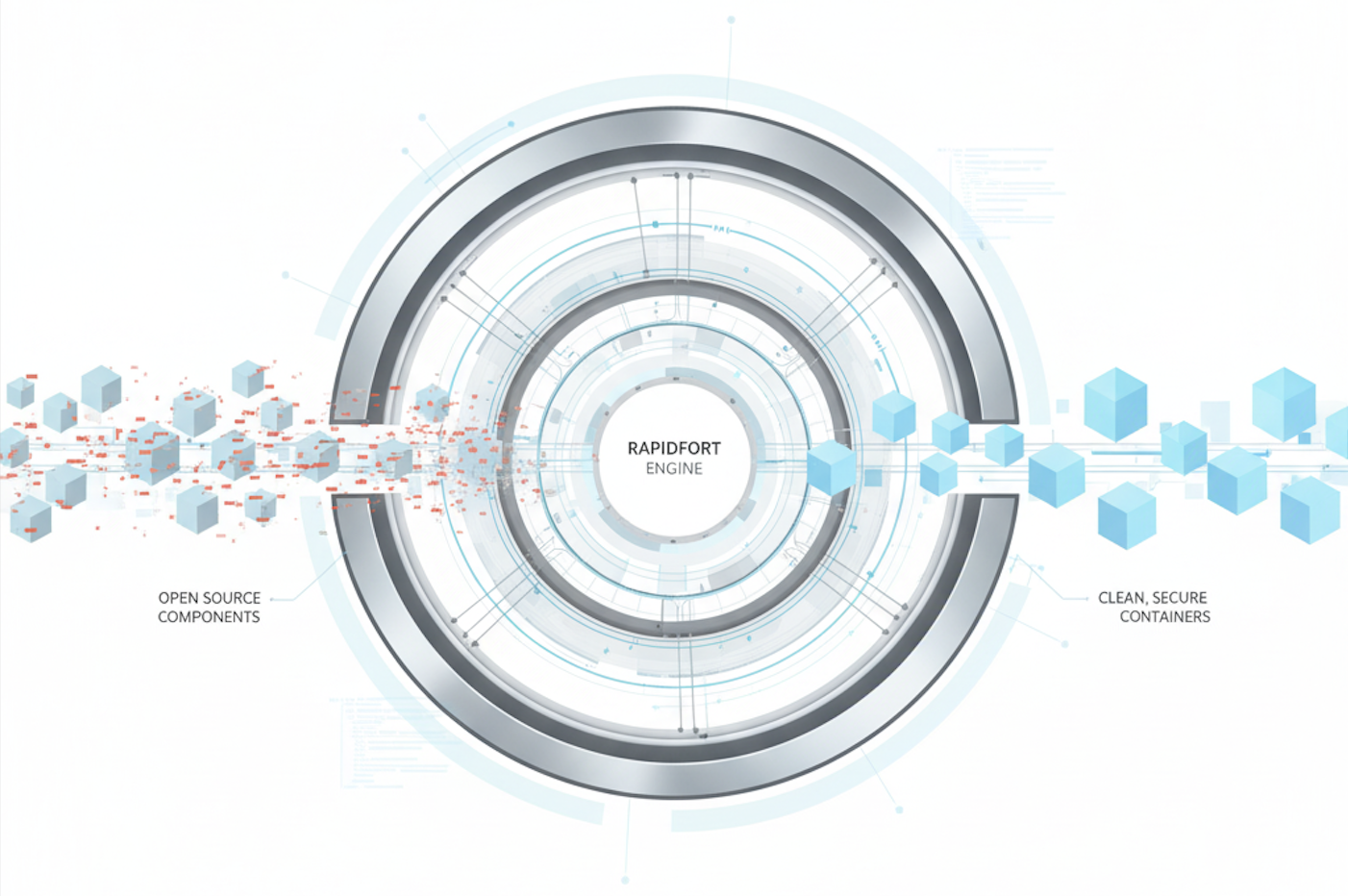
Open Source at the Core: “The Giant Washing Machine”

George describes RapidFort as a “giant washing machine” for open source:

  • Respect upstream. Leverage the strength of broad, public scrutiny across Debian, Ubuntu, Red Hat, Alpine, and more.
  • Patch once, distribute cleanly. Don’t make every team reinvent the same fixes.
  • Avoid lock-in. Keep bases compatible with upstream to preserve freedom of choice. This is critical for regulated and long-lived systems.

This is not about rewriting the ecosystem from scratch. It’s about cleaning and curating what millions already trust so teams can ship safer software without swapping their foundations.
“Start Clean, Stay Clean”: What That Looks Like in Practice

George’s framing is intentionally simple:

  • Begin with clean images. If your baseline is full of known CVEs, you’re already behind before the first line of your code compiles.
  • Continuously rebuild with fixes. Each build cycle should pull in upstream remediations and remove what you don’t need.
  • Prove what’s really running. Keep accurate inventories and execution-aware records that your auditors and incident responders can use.

The “stay clean” part matters as much as the “start clean.” Vulnerabilities don’t arrive on a schedule. Your process must keep pace by default, not as an emergency ritual.

Hardening Is About Reality, Not Reachability

George cautions against the “reachability” trap - assuming a firewall or network segmentation makes a vulnerability irrelevant.
Attackers jump fences. If they land in a container and find curl, package managers, shells, and unused tools, they have everything they need to move laterally or escalate.

The safer stance is to remove what isn’t mission-critical. Like your phone with 150 apps you don’t use, extra components are just extra risk.

Cadence: Patch at the Speed You Build

“How often should we deploy?” is the wrong question. George flips it to “How often do you build?” Patch on that cadence. Whether you build multiple times per day or monthly, each build should incorporate updates and hardening. That’s how you keep pace without stalls or surprise regressions.

Real-World Results (Framed the Way George Shared Them)

  • A customer facing roughly 3,582 CVEs estimated six engineers and three months to remediate.
  • With profiling, clean bases, and removal of unused components, they dropped to fewer than 500 CVEs in about two hours, then to 3 CVEs within a week. Those few weren’t patchable at the time, and there were no source code changes.
  • Image size shrank from about 1.8 GB to about 262 MB, improving performance and build times.

These outcomes illustrate the compounding effect of starting clean and shipping only what’s needed.

Compliance: Turn Evidence Into a Continuous Output

George is clear - this isn’t about buzzwords or checkbox theater. It’s about evidence that stands up for programs like FedRAMP and CMMC, and for internal risk reviews.

  • Generate SBOMs and a Runtime Bill of Materials (RBOM™) that reflect what’s actually executing.
  • Keep proof current at every build so compliance readiness accelerates instead of pausing delivery.
  • Produce artifacts that map directly to controls and Plans of Action and Milestones (POAMs) or self-attestations - the formats your governance teams need.

Compliance, in George’s view, should ride along with engineering, not work against it.

Why Upstream Alignment Matters (Especially in Regulated Spaces)

Enterprises - particularly public-sector and defense programs - need confidence they can maintain software lifecycles over years without being boxed in.

George underscored that staying true to upstream open source gives teams longevity, flexibility, and a broad community of scrutiny. It also reduces the blast radius if a vendor relationship changes. You’re not forced to rip out foundations to keep operating.

The Road Ahead: Closing the Loop

George’s forward look is about closing the loop between build-time and runtime:

  • Let runtime observations sharpen build-time decisions.
  • Push as much remediation as possible into automation so human time goes to design and verification.
  • Keep the proof flowing for security teams, auditors, and incident response.

As he put it, the aim is simple - give engineers their time back while raising the security floor for everything you ship.

Want to Hear It In George’s Words?

This article captures the conversation’s essence, but the full nuance, stories, numbers, and philosophy are in the Paramify Podcast episode featuring George Manuelian, Chief Strategy & Revenue Officer at RapidFort.

Listen to the full episode here: Paramify Podcast — “Giant Washing Machine of Open Source: Container Security with George Manuelian”

If your team is wrestling with vulnerability debt, patch cadence, or audit evidence, this conversation is a must-listen on building secure software the engineer-first way.