




When I was on the Product team at One Medical, our clinical and Ops teams were critical partners in how we shipped work. It was common to visit the offices to observe (going to gemba). During my four years at the health tech company, I learned about the various roles on clinical teams: primary care providers, registered nurses, care navigators, specialists, phlebotomists, and many more. In my research work, I spent the majority of the time with primary care providers (generalists).
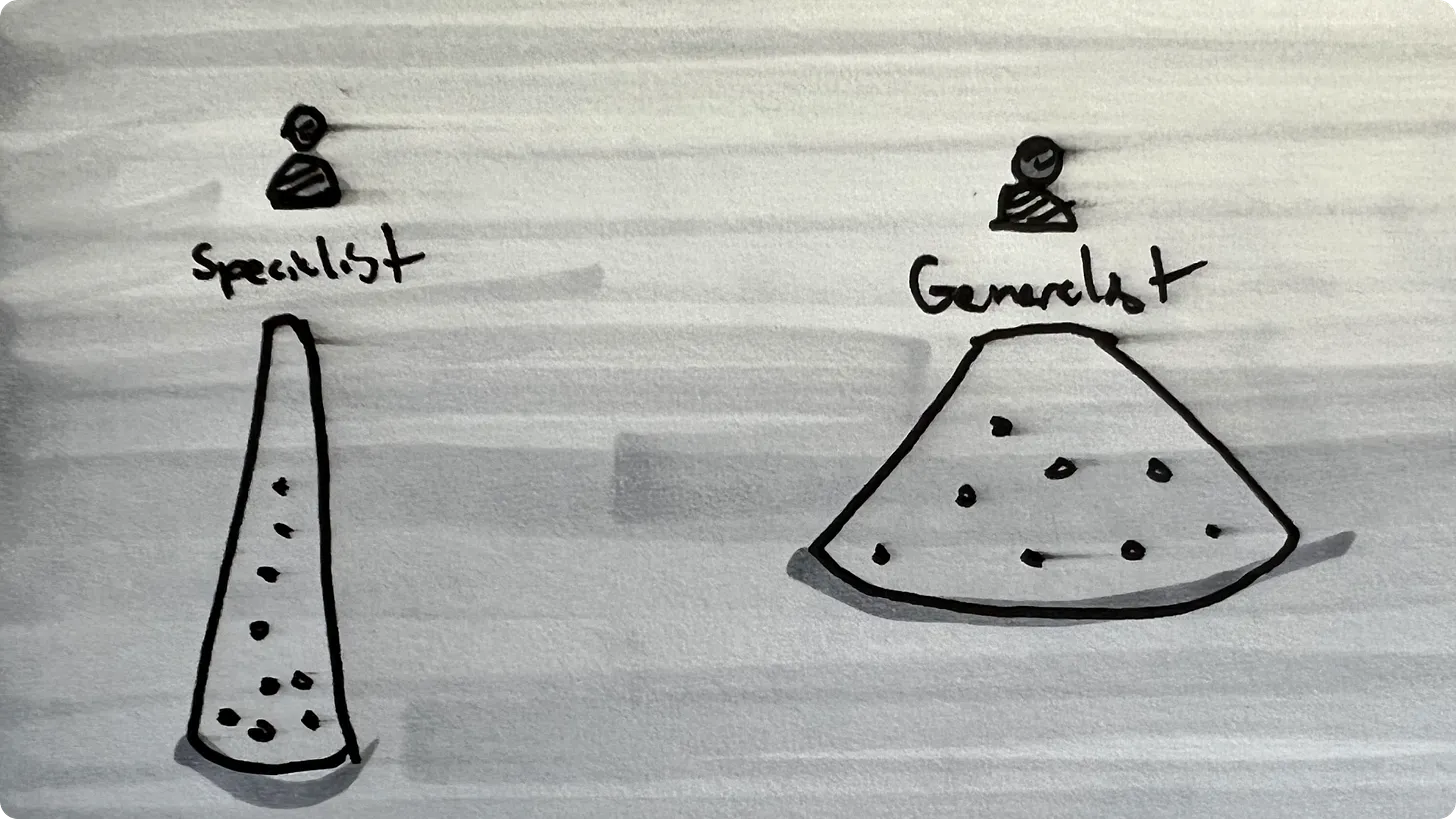
“Why did you decide to be a generalist instead of a specialist?”, I’d ask each provider. What compelled them to general care vs. being a specialist? Primary care physicians experience more burnout and specialists make more money. The truth is you make more money as a specialist, so what would compel someone to general care? The answer was consistent: to have a broader range to care for their patients’ health.
The path for specialists is more clear than generalists. If one chooses the generalist path, what does mastery look like? The notion of mastery as a generalist sounds oxymoronic. Let’s challenge that and identify how to grow in your craft in a generalist role. In order to master being a generalist, let’s reflect on how to know if you are a generalist, the impact they make, and leveling up as generalist practitioners.
If you grew up in the 90s and experiencing lower back pain, you may remember comedian Jeff Foxworthy’s “You might be a redneck” routine: “If you’ve been on the television more than five times describing what the tornado sounds like, you might be a redneck.” We can remix that and play it back with being a generalist:
If you can’t decide if you want to be a product manager, designer, or engineer, you might be a generalist
If you find yourself always wanting to learn new things outside of what you do, you might be a generalist
If you highly enjoy collaborating with every department, you might be a generalist
If you get excited about trying out emerging technology and tools, you might be a generalist
If you get bored by doing one thing, you might be a generalist
If you’re comfortable hiring people better than you at everything, you might be a generalist
Generalists are people who love variety, connecting the dots, and curious. In contrast, specialists usually focus and go deeper on a certain practice. I use the clinical metaphor above a lot when describing generalists and specialists. A brain surgeon could conduct a physical if needed the same way a primary care provider could do certain operations in the case of an emergency. However, based on the level of skill and precision, a specialist is more effective. Every designer can contribute to a design system and having a specialist in design systems will merit in more effective outcomes.
“Jack of all trades, master of none” can sound negative—almost implying one isn’t good at anything. Do you ever feel like you don’t fit into a specialty? Being a generalist allows flexibility and has broader range in what you can do. This is a great skill for early stage startups when wearing multiple hats is common. As the company grows, it’ll specialize at scale, and it makes sense. You don’t want your generalist co-founder to continue being responsible for people experience or finance and bring in the specialists. What happens to people who when they relinquish the said hats? You’re able to freelance and move around more. There might be a new initiative that needs to get spun up. If you’re interested in management, many people managers are generalists.
In the article “Generalists CEOs Not Specialists Spur Innovation,” there is a great excerpt on how generalist spark innovation:
“Under generalist CEOs, companies tend to engage in more ‘exploitative’ innovation, which involves improving or refining something that already exists, and also more ‘exploratory’ innovation — that is, engaging in a risky search for radical and transformative innovation. However, the difference between specialist CEOs and generalists is especially pronounced in exploratory innovation.”
You don’t see many specialist CEOs unless the business does something specific to it. A generalist can start an important initiative and collaborate with specialists to drastically improve it.
“Mastery as a generalist” is an oxymoron, but let’s embrace the duality. How does one become a better generalist? Great teams need a blend of generalists and specialists.
If there’s one specialty a generalist has, it’s learning to learn. Build familiarity in a discipline enough to understand the mechanics, develop experience, and when it scales, find a specialist. If you’ve ever had a manager who understands what you do because they’ve done it before, they can build more advocacy for the effort of your work. A designer understanding how the software development cycle works can anticipate questions that come up.
I’ve worked in so many aspects of design: UI Designer, Information Architect, Marketing Designer, Motion Designer, Researcher, or Product Designer, I’ve worked in dozens of roles. Understanding everyone’s roles and responsibilities helps you influence at a higher scale since you have a sense of what everyone is doing. It allows you to give better input and direction.
Understand how every org works and connecting the dots across them. One of the services I was most passionate at while at One Medical was pediatrics and family practice. Whenever I had a coffee break or free time, I’d make time to connect with people who were passionate about that program and ways to support it. Learn how to synthesize, story tell, and connect to the big picture.
Mastering the generalist path means everyone will be better than you at something, but you’re better than everyone at every little thing.
Originally posted on Proof of Concept
Being a generalist does not mean the work is shallow. It’s right sizing the amount of up skill needed to get the job done. If the path of a generalist resonates with you, continue diversifying your skill portfolio and extend your range.
此内容由惯性聚合(RSS阅读器)自动聚合整理,仅供阅读参考。 原文来自 — 版权归原作者所有。