







Earlier this year, I moved to the Bay Area and found myself in a global role, managing team members that spanned across San Francisco, Tokyo, and Singapore. This means that around half of my work consisted of cross-border and cross time zone collaboration.
Let’s face it; collaborating across time zones sucks. By default, it often turns into late-night or early-morning calls, loss of sleep, missed meals, burnout, nonexistent social life, communication breakdown, FOMO…
But if managed properly, it can also have enormous potential and benefits. Think of it like a relay race. When done well, it could make an organization much more productive, because around the clock, someone is always working. It also potentially gives you more uninterrupted focus time to get work done (when other regions are sleeping and no one is bothering you).
How do we maximize the benefits and minimize the downsides?
First of all, we need to acknowledge that collaborating across time zones is extremely challenging, and recognize that it’s necessary to deliberately change how we work. If we don’t make a conscious effort to do that, it will descend into chaos and burnout.
To do that, here are 7 helpful habits that I have distilled from my own experience.
First of all, we need to change our mindset.
The hardest thing about cross time zone collaboration is not even about effective communication or collaboration. It’s about mental health.
Not being in the same time zone as your colleagues naturally creates stress and FOMO (fear of missing out).
What if an important decision was made while I was asleep?
What if I was left out on a meeting I should have attended?
In my opinion, in order to have successful cross-border collaboration, we must turn FOMO into JOMO (the joy of missing out).
Instead of focusing on what you’re missing out, focus on what you’re getting back.
By missing that 1-hour boring status update meeting (and just spending 10 minutes to catch up on meeting notes afterwards), you just gained back 50 minutes of your precious time to do something more productive or creative.
By not being interrupted hundreds of times per day, you can gain back focus time to do deep work, and maybe finally write that strategy document that you’ve always wanted to write.
By having to say no to meetings all the time, you’re sharpening your judgment on what is really worth your time and what’s not.
By setting aside “me time” each day and refraining from checking or replying to work messages during that time, you’re taking a stand for your well-being and reminding yourself that “nothing is more important than my health”.
The harder something is, the more rewarding it usually is. Every day is an exercise in mental fortitude and self-discipline. Over time, you will have peace of mind, a sharper focus, and a clearer understanding of what really matters. (Some people need to spend thousands of dollars on a 10-day meditation retreat to achieve that!)
In cross-border collaboration, synchronous communication time is rare and precious. We only have a couple hours of overlapping time window per day between Asia and the US West Coast. If we only count “working hours” (let’s say between 9am and 7pm), then we actually only have 1 hour per day! (9am-10am in Singapore is 6pm-7pm on the West Coast) Of course, people usually work until later or get up earlier for cross-border work. But it’s crazy that you have such a narrow window for meetings.
This means we should treasure that precious time window, and make meetings ridiculously efficient.
Here are a few tips:
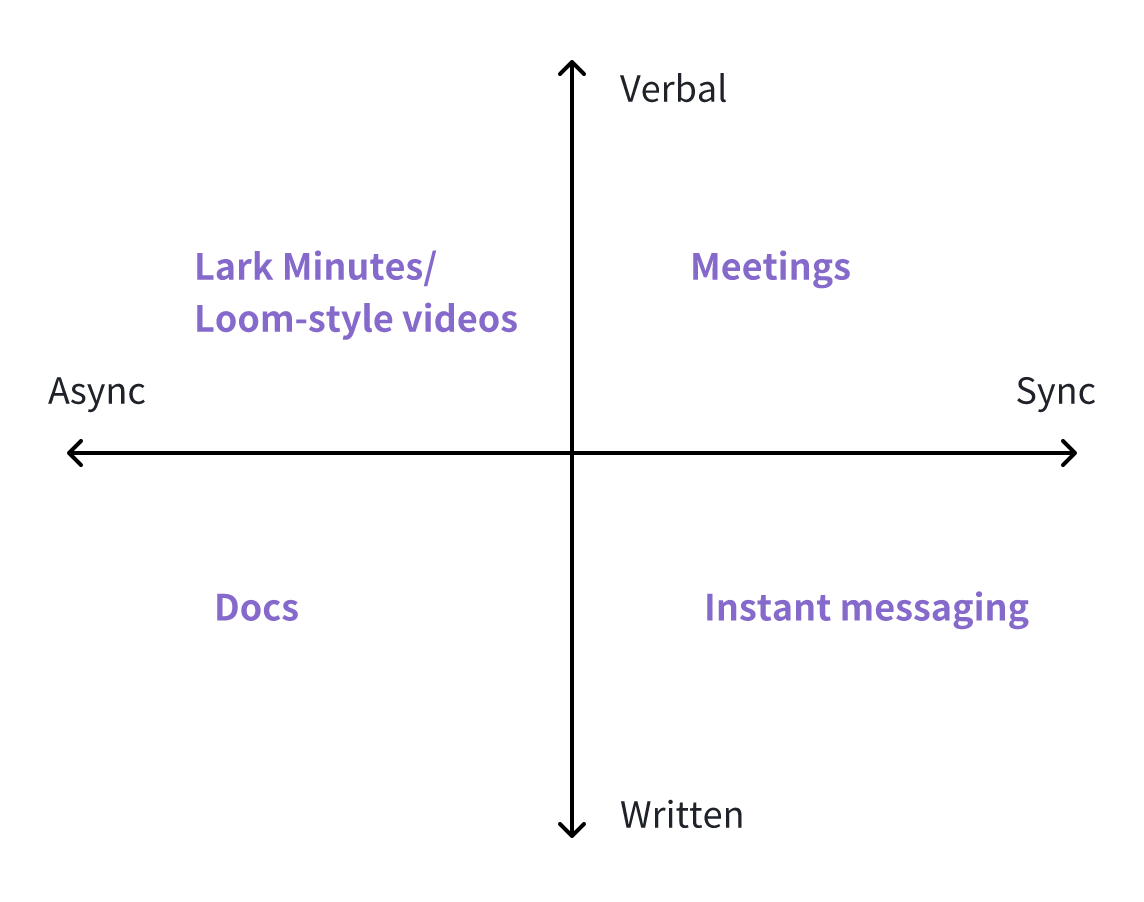
Successful cross time zone collaboration is about striking a good balance between sync and async communication and maximizing the effectiveness of each.
Given that the time window for synchronous communication is so narrow, asynchronous communication should be the default. Everyone needs to get accustomed to asynchronous communication, and get better at it.
Meetings should only be held for one of these purposes: brainstorms, interactive discussions/debates, problem solving, building relationship/trust. They should not be used for just status updates or one way communication. That would be an egregious waste of precious time.
Take a look at your last meeting. Were people actively exchanging ideas and debating and bouncing ideas off each other? Was everyone talking and participating, or just one or two people? Did it involve conveying emotion or building trust? If the answers to all three questions are “no”, then it probably shouldn’t have been a meeting.
It could have been:
We have mentioned that effective cross-border collaboration is like a relay race. What do relay race runners do? They pass the baton.
In our daily work, we also need to consciously “pass the baton”.
This might mean sending a proposal to the other side before you end your workday, so that your colleague can check it first thing when they wake up and provide feedback during their day.
For example, you’re in Singapore and you wanted to get feedback on something from a colleague in San Francisco. You could either send it at 7pm on Monday, or take a bit more time to brush it up the next morning and send it at 10am on Tuesday.
If you send it at 7pm on Monday, it would be 4am in San Francisco, so the colleague will see it first thing after they wake up on Monday morning.
If you decide to take another hour to work on the doc the next day, and send it at 10am on Tuesday, it would be 7pm in San Francisco. The colleague will likely have already left work and won’t reply until their Tuesday morning.
Even if you only took an extra 1-2 hours to brush up the document, it meant your colleague could only see it a whole 24 hours later. Your project would be delayed by a full day. It is worth it? Probably not. The smarter thing to do here would be to try your best to finish it by the end of Monday, or sending a 80% complete version and brush it up while waiting for feedback.
In cross time zone collaboration, each side needs to consciously assign “homework” to the other before they go to sleep. Whether that means asking for feedback on a document, asking questions in chat, or leaving feedback/comment for the other side to check and revise.
When a team is spread across multiple geographies and time zones, everyone needs to be very communicative and default to over-communication.
Because if you don’t do that, the default is that nobody knows what you’re working on or what you’re thinking, resulting in misunderstandings and misalignments.
We can’t just walk to someone, pat on their shoulder, and start chatting spontaneously.
One of the biggest rewards of cross-border collaboration is that everyone can benefit from learning the insights derived in other markets. For example, if something is working well in Japan, maybe Singapore can benefit from that as well. As a local team member, you have unparalleled access to your local customers, cross-functional collaborators, and market insights. Whether it’s lessons learned on a project, or feedback you heard from a customer—share these liberally. Write a daily little newsletter in the team chat.
Don’t just share status updates. Share insights.
Even though it’s called “instant messaging”, in reality it’s almost never instant. Most likely, when you send out the message, the recipient is asleep.
Everyone should operate on the common understanding that “we don’t expect the recipient to reply immediately”.
That means your message needs to include much more context. It should preempt the back-and-forth communication that you don’t have the luxury for. Stand in the recipients shoes; ask yourself “What would they need to know to answer this effectively? What other context or information would be helpful here?” And put all of those in your message.
| Do | Don’t |
| This conversation took 12 hours: | This conversation took 48 hours: |
| This conversation took 12 hours: | This conversation took 24 hours: |
Make it concise because people tend to lose their attention when reading long messages.
Also keep in mind that messages don’t include verbal or visual cues (such as facial expression, gesture, tone of voice), so the other party might overthink or misinterpret your message. If you’re saying something that requires a certain tone of voice, try sending a voice message. If you’re saying something that’s best communicated visually, try recording a Lark Minutes (or a Loom video).
This is the reality of working across time zones:
Every morning, you wake up to 100 unread messages and your heart sinks. You then rush to your desk to get on 4 back-to-back morning calls without even having time to shower (So thankful for the brush-up features in video calls).
Every night before you go to sleep, you have meetings until so late that your brain is still actively working when you’re lying in bed. You also ruminate about something a colleague said during a meeting or in a message. All of these make it impossible to fall asleep.
Your friends invite you to dinners or events in the evening, but you have to turn them down because you need to work in the evening.
If we don’t fiercely protect our health (and basic activities like eating and sleeping), we will almost certainly be burned out.
Try to not check your phone right before you go to sleep or right before you wake up (I know; it’s so hard). Set aside some time for personal wellness, whether it’s stretching or reading a book or spending time with family.
And don’t let work eat into your sleep time (unless in very extreme or urgent situations). Your health matters more. We can only work well if we sleep well.
At Lark, we’re building the best collaboration tool tailored to the needs of global/cross-border teams. If you’re also running a global team and would like to chat more about best practices/tips/tools, shoot me an email at zara@larksuite.com.

Zara Zhang works at ByteDance in its Beijing office. Previously, she was an investment analyst at GGV Capital (first in the Menlo Park office, then in the Beijing office), a venture capital firm that invests in companies in the US, China, and other emerging markets. She has interned as a reporter covering China’s tech industry for The Information. Her writings have been published on The Harvard Crimson, Harvard Magazine, Foreign Policy, Huffington Post, and China Personified. She has also worked as a marketing intern at ZhenFund. Zara graduated from Harvard University Phi Beta Kappa with a degree in psychology. At Harvard, she wrote and edited for The Harvard Crimson, led the organization of Harvard China Forum (a 1,000-people conference featuring leaders from China and the US), and ran a weekly newsletter about food around the university. Zara grew up in Changchun, a city in northeast China, and received her secondary education in Singapore. A language enthusiast, she is trained in Chinese-English interpretation and translation, speaks French and Japanese, and can sing in Cantonese. Zara co-hosted “996”, a podcast where she and GGV managing partner Hans Tung interviewed leaders in US-China cross-border tech and entrepreneurship. Listen on iTunes, Overcast, Spotify, SoundCloud, or search “996” in any podcast app. View all posts by Zara Zhang
此内容由惯性聚合(RSS阅读器)自动聚合整理,仅供阅读参考。 原文来自 — 版权归原作者所有。