


POSTS
Yesterday I met about twenty others at the London Scholarly Tech Meetup. It was good. It was my first time. A varied group mostly, it seemed to me, working for publishers of scholarly books and journals. And in related areas, such as the online LaTeX platform Overleaf. It seemed, although I'm not in a position to judge, that much of the group were interested in workflow and data-flow innovation and improvement.
There were three talks, each about 15 minutes, with time for questions. There was pizza after the first talk.
Researcher and social bookmarking
First on was Jonathan Cremers, talking about Researcher. This provides a web and app front end, that provides a feed of new journal articles in the areas that interest you. The back end is a database of journal articles, updated regularly, together with search tools.
It also provides community features, such as sharing of links with other users. In some ways, Researcher reminded me of bookmark sharing site Delicious. I used Delicious, and liked the social aspect. I could see who had bookmarked the same URLs as myself, and see their other bookmarks. It seems that Researcher understand better its business model than Delicious did. Delicious was acquired and discontinued by the social bookmarking site Pinboard.
I'm pleased to hear that Researcher now provides LaTeX support for the papers it feeds to its users. Looking at page source, I see that they're using SVG rather than MathJax to provide fonts and layout. This interests me, and I might post about this later.
From Marketing to Product Management
Next up, after pizza, was Roberta Cucuzza, from Overleaf. This described her personal journey. She started with a triangle, whose vertices are Users, Developers and the Business. In the centre of the triangle is the Product. Her journey was from Business to Product. My journey started at the Developer vertex of the triangle. So it was interesting that she found hard the things I found easy, and vice versa.
I particularly welcomed the sensible suggestions she made, for looking after oneself, and one's long term goals, during such a journey. We all face change in our life, if we are to grow. Someone once suggest that I should try to make the best of what there is. I found that advice helpful. Particularly understanding what there is.
During her transition, Roberta had to work two roles at the same time. I enjoyed this gif (below) she showed us, to demonstrate the problems this caused.
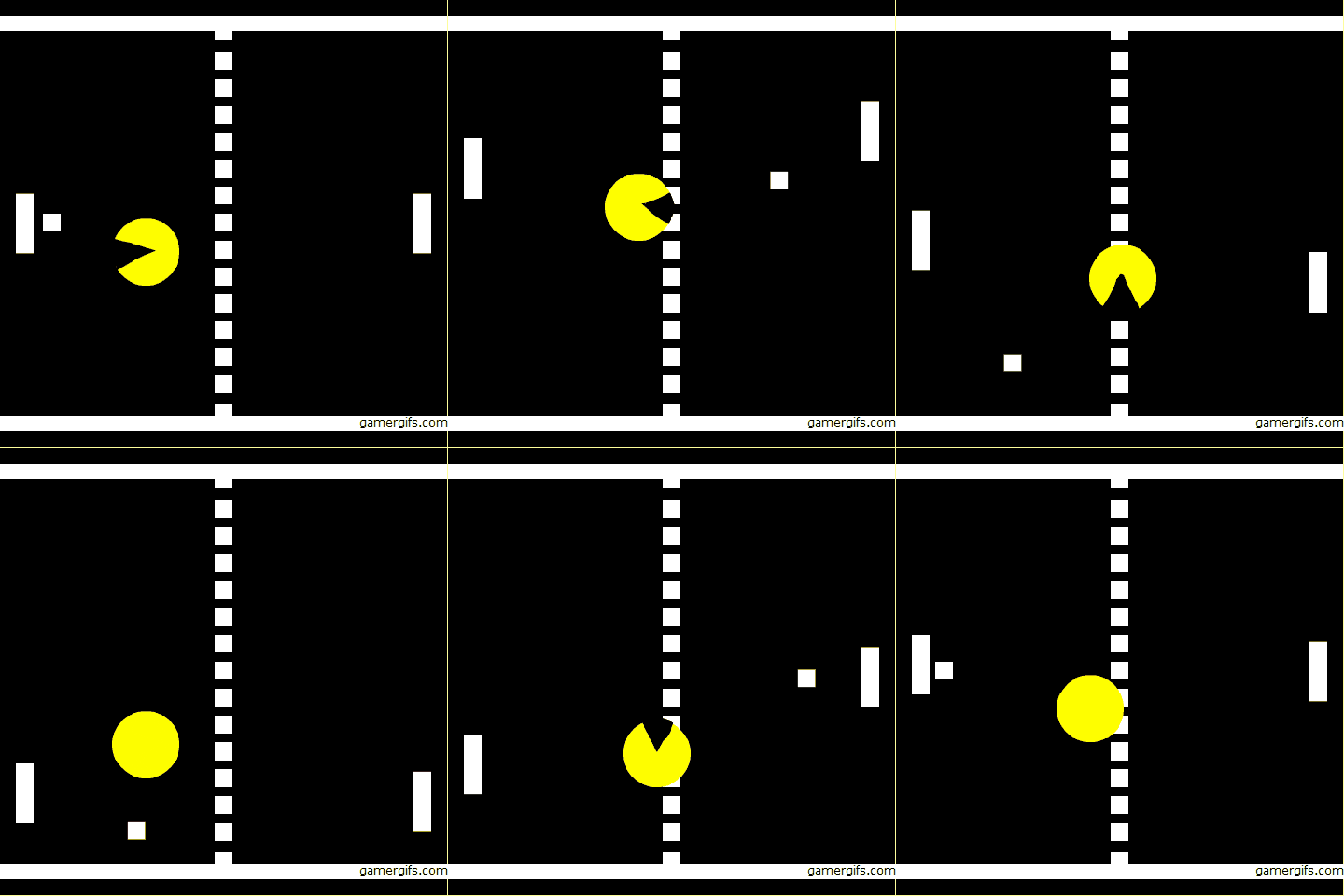
One game with two sets of rules
Note: Apologies. I've not found an easy way to allow the user to stop or start the animation of this GIF. I regret this perhaps as much as you do. I know it's an accessibility problem. I wish the framework and theme I use came with a ready-to-use solution.
Improving web accessibility
Finally, Ali Smith, also from Overleaf, described his personal experience of improving web accessibility. This was a case study, based on his experience as a front-end web developer. I learnt a lot from this talk.
My main lesson for me, I think, was that small things done at the right time can make a big difference. And that the basics of accessibility are a helpful force, for bringing about good design for everyone.
I used to work at the Open University. This is a very large institution. It has over 1,000 academic and research staff, and 170,000 students. An organisation of this size needs internal standards and procedures, to work efficiently. And this affects the approach to accessibility.
So it was interesting to see accessibility done in a smaller setting. Most Overleaf pages are simple, concerned with communication of information, and things like account management. There, accessibility should be straightforward.
The big exception is the online LaTeX editor (which is the core of the business). That's necessarily complicated, and perhaps lies outside Ali's range of experience.
Overleaf allows its users to create LaTeX documents, and compile them into PDF output. Arising from Ali's talk was an interesting conversation about how the back-end might be improved, to produce more accessible output.
Because Overleaf relies on TeX/LaTeX to produce the outputs, this is probably not a problem they can solve by themselves. Again, I might post about this later.
Conclusion
The meetup was a pleasant experience. I look forward to the next one.