








Your browser does not support the audio element.
Listen to article
This content is generated by Google AI. Generative AI is experimental
[[duration]] minutes
A central pillar of effective public health is the combination of health-related data with geospatial insights and predictive modeling to anticipate and mitigate health risks. The introduction of Google Earth AI and its ability to provide planetary intelligence presents new opportunities for the field.
Earth AI is already in use by researchers to forecast diseases such as dengue fever and cholera, predict clinic utilization in Malawi and identify chronic disease needs in Australia, with its potential to improve health outcomes worldwide quickly coming into focus.
Leveraging decades of research that models the physical world, Earth AI provides a deeper understanding of environmental factors — such as weather, air quality and flooding — and the complex ways populations interact with them through our Population Dynamics Foundation Model (PDFM) and Mobility AI. By combining unique insights with region or context-specific health information, we can support public health officials, researchers and organizations in moving beyond reacting to crises. Instead, this creates the potential for forecasting and anticipating them — turning decades of research into effective, proactive care for communities everywhere.
Our partners are already beginning to validate the real-world impact of this approach. The following initiatives illustrate some examples of how these integrated insights are already being utilized.
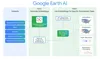
In Malawi, Google.org grantee Cooper/Smith combined Earth AI’s PDFM and AlphaEarth satellite embeddings with local data to predict health service utilization at local clinics. This can help decision-makers spot early warning signs of disease outbreaks and allocate limited resources more efficiently.
To combat the rise of measles, researchers at Mount Sinai and Boston Children’s Hospital/Harvard, used Earth AI’s PDFM to fill gaps and produce "superresolution" estimates of vaccination coverage. Based on privacy-preserving, aggregated data, researchers can map vaccination rates down to the ZIP-code level without revealing sensitive personal information, and identify localized clusters of undervaccination that align with recent outbreaks.
Weather influences the pace of many diseases, and specific weather patterns can signal health crises. For example, summer rains can cause dengue fever to spike, while flooding can significantly increase cholera outbreaks. Combining population dynamics with predictive weather models helps improve forecasting of health emergencies weeks or months in advance.
In collaboration with the WHO Regional Office for Africa, we evaluated a sub-national forecasting model for cholera cases utilizing the WHO centralized Integrated Disease Surveillance Data. We found that by combining Google's TimesFM time-series model with PDFM and weather data, we were able to improve the forecasting accuracy of cholera cases by over 35% compared to standard models. Better forecasting could enable public health officials to plan proactively, rather than react after a crisis — for example by moving life-saving rehydration supplies to where they will be needed.
Furthermore, researchers at the University of Oxford have successfully used Earth AI models and datasets to improve forecasting of dengue fever in Brazil. Including PDFM embeddings significantly raised the predictive accuracy of six-month forecasts, giving local authorities more time to implement preventative measures.
Earth AI is also unlocking critical insights into non-communicable diseases. In a recent initiative in Australia, we partnered with the Victor Chang Cardiac Research Institute, Wesfarmers Health and Latrobe Health Services to deploy Population Health AI (PHAI). Currently available as a proof-of-concept to select partners, PHAI uses Earth AI’s PDFM embeddings alongside other key datasets like air quality, pollen and places insights to uncover the health needs of communities in rural Australia, aiming to support their chronic disease needs and prevention efforts.
Technology is most powerful when it leads to real-world action. By fusing Google Earth AI’s planetary intelligence along with the deep health expertise of our partners, we are moving toward a future goal where health systems everywhere possess the data-driven insights needed to protect and improve public health.
此内容由惯性聚合(RSS阅读器)自动聚合整理,仅供阅读参考。 原文来自 — 版权归原作者所有。